Projects & Supplies

From the Franklin Mill store

On Saturday, my friend Dana and I went to the Franklin Mill Store in, yes, Franklin, MA. Their 20% off everything sale ends this coming Saturday, when Dana is working and I am taking the Young Mr to an admissions open house at a local school. So off we went, and here’s what I came back with.

From the left:

  • Green English broadcloth for Mr S’s frock coat.
  • Dark blue Italian linen-cotton blend heavy weight plain weave for Mr S’s summer frock coat, to be modeled in part on one at work that a historic costume specialist calls “Joe Providence.”
  • Interfacing for waistcoats and frock coats, already successfully applied to the Young Mr’s new waistcoat collar.
  • Green ribbon for a black taffeta bonnet to be made from the black taffeta seen here, and enough taffeta for a petticoat.
  • Brown wool for buttons. Expect tangling.
Magasin des Modes, June 1787, thanks to Dames a la Mode

The taffeta for the petticoat seems out of character for my linen and wool life, but I have a plan. At the Artee Fabrics store in Pawtucket, I picked up a remnant of green silk taffeta, but not enough for a full dress or gown. There is enough for an open robe, though, and I got an idea watching The Duchess.  One costume is dark redingcote over a rose petticoat: not my colors. But then I found this fashion plate, with green over black, and there you are. Pure costume fantasy, but  fun to make. Or at least fun to think about making–there’s always swearing.

To keep track of these insane plans, I started a projects page to list the schemes and deadlines. We’ll see how it goes.
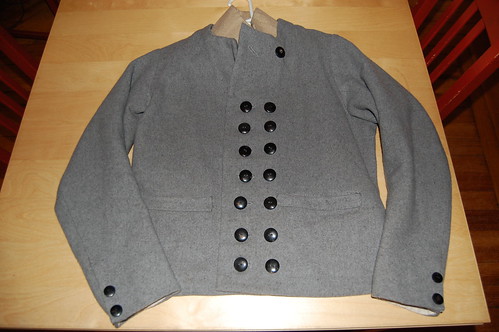
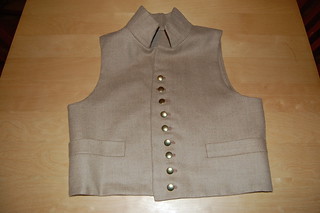
HSF #0: Waistcoat, Bloody Waistcoat

Challenge garment peers from jacket. Calm thyselves, fellow authenticity hounds. New buttons for jacket are on order.

(Actually, the jacket was bloody where I jabbed myself with the needle inserting the sleeve, but that’s fun for another day. And how you know your historical sewing project is complete. I bled for this, man.)

The Challenge: #0, Starting Simple

Fabric: Body: ¾ yard remnant from Wm Booth Draper WWB816 Broadcloth, light brown. Lining: Left over heavy-weight linen. Might also have come from Booth, I forget.

Pattern: Kannik’s Korner Man’s Waistcoats, 1790-1815

Year: Call it 1799. That’s the year where it will be worn.

Notions: 9 brass buttons from Wm Booth Draper

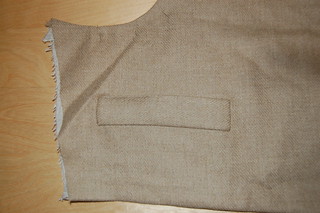
What monkey did those buttonholes?

How historically accurate is it? Well…the pattern has good documentation and the fabric is within reason for the period. The waistcoat is entirely hand-sewn, but the button holes were apparently accomplished by drunken crack-headed monkeys, which is what you get for trying to finish a garment on New Year’s Eve. I was neither drunk, nor on crack, and have no helper monkeys, but all the same…thank god for jackets to hide the sins of my buttonholes.

Best welt I ever made–aside from butting heads with a colleague once.

Hours to complete: Don’t ask. It’s a soul-robbing number. The buttons and buttonholes alone took 1 full and two half Abbot & Costello movies, and two “Monarchy” episodes. Probably 25 hours total (I started in November, but stopped sewing after December 2). Total time may include naps taken when I fell asleep while sewing.

First worn: To be worn by the new owner (Mr S) January 19, at the Winter Frolic.

Total cost: Blood, sweat, tears… sorry, wrong war. Buttonholes bring that out in me.

  • Fabric:  $13.50
  • Lining: Leftover, hence not factored in.
  • Buttons: Used 9, but bought 10 because I’m not as simple as I look, so $12.50
  • Pattern: Also from Wm Booth, $16.

That puts the cash outlay at $26 for materials, and $16 for pattern, which I will use again starting yesterday. Yes, sports fans, another bloody waistcoat to sew. Lucky for me, it’s red, so the blood won’t show. Checking the HSF schedule, I can see that the only 1813 garment I can make is another waistcoat (1790-1815, remember?) for the Young Mr, who needs a full set of clothes made by January 19. Waistcoat underway, pattern pieces assembled and two more pieces of broadcloth remnant order for a jacket, leaving trousers to wrestle with. At least I have fabric. 

Portrait of a Waistcoat

RIHS-Robert Jenkins

Meet Mr. Jenkins. There are references to a Robert Jenkins, Vestryman of Christ Church, Boston and merchant of Salem, MA and Newport, RI. A Robert Jenkins married Elizabeth Champlin of Newport, and we have a pendant portrait of Betsey Jenkins, suggesting stronger ties to Newport. The records are confusing, but one thing is clear: that’s his waistcoat and he’s happy to have you see it.

This 1748 portrait by John Greenwood shows a man associated with a port city, perhaps connected with shipping and mercantile trade (see the ships in the background), and who has made enough money to a) commission a portrait and b) either own that sweet silk velvet waistcoat or to have one painted. It is entirely possible that he owned it.

Met-Waistcoat

And it probably looked a lot like this 1750-1755 one from the Met, but without the sleeves. There is fragment (two fronts) of one very like this in the collection at work. It’s not Robert Jenkins’, but it is Rhode Island, so we know these kind of garments were available and worn. The last piece to track down would be an account book, to get some idea of what this might have cost.

What I like in particular about the Met’s waistcoat is the cuff detail. The sleeve, which would be heavy if fully made of velvet, is not. Only the cuff is the velvet, while the sleeve itself is lighter weight silk.

Smibert Smitten

John Smibert made me laugh. He’s been dead since 1751, so it wasn’t easy.

The day I went to the MFA and walked into the gallery with Mrs Tyng on wall, I laughed, and said, “I know her!” while my son died a small interior death. Then I pulled up the record and image for Mrs Browne, and showed him how I knew Mrs Tyng.

Follow Smibert’s pictorial advice if you’re reenacting an American woman of means between 1729 and 1732, and you’re wearing blue silk. You may have a red silk wrapper/shawl. Your shift will show at the center front and sleeves to show off your fine linen. You look like you might be a little cold, but perhaps that explains the “I store oranges in my bodice” look.

See for yourself:

MMA, Mrs Brinley & her son
MFA, Mrs MacSparran
RIHS, Mrs Browne
MFA, Mrs Tyng
MFA, Mrs Dudley
Smith College- Mrs Erving


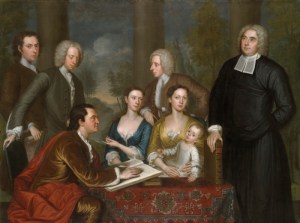
Yale- The Bermuda Group

After a while, you start to wonder if there was only one woman in the colonies in 1730… And then you wonder how she got into every painting

I know, style and conventions helped create these portraits as much as Smibert’s skill. And the portraits only get weird when you do the thing that was never supposed to happen. We were never meant to see all of these portraits all together, all at once, anywhere.

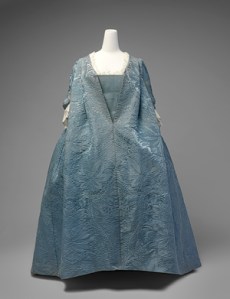
h2_2010.148-1 So, what’s she wearing? Probably this dress. No, not this exact dress, though if it was same woman in all those paintings, maybe the Met does have her actual dress. (Sometimes I have these weird museum-y ideas, and that’s generally when I need a vacation or come up with a new program idea.)

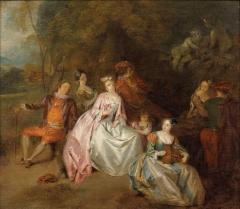
The robe volante shows up in paintings of women dressing, and in informal scenes, as below. She’s clearly wearing stays, which is helpful to know, because while I knew the women in the Smibert paintings ought to be wearing stays, and they had conical torsos, the orange-smuggling look was confusing.

Galerie Dreyfus- Scène galante dans un parc, ca 1725

In fact, it confuses me still.

Seriously, the 18th century was a pretty sexy place, if you like oranges and silk.

Yale- Mrs Tyng
Yale- Mrs Tyng

Look, there’s Mrs Tyng again! She’s left the MFA and taken a chair at Yale.