[An amazonian dress]. London : Pubd. May 26, 1797, by G.M. Woodward, Berners Street. Lewis Walpole Library Image Number lwlpr08972, Call Number 797.05.26.02
I was wondering about contrast revers on women’s clothes, and if I could really get away with such a detail on a Spencer, when I happened upon this image on Pinterest. Well found indeed from 1797, and very nice hat as well. Bonus: Giant Muff.
The dog has a coat, too, and now that it’s cold in New England, the local whippets are turning out in their winter coats. Mr S and I had a slightly crazy notion to dress a dog we know in a canine-scaled replica of a certain very special coat, but would need access to the hound (for measurements) and a particular scrap pile. With those circumstances not in the offing, let’s just be delighted that dogs in 1797 wore coats, and had bows in their topknots, which means that the end of civilization has been coming for a lot longer than previously thought.
Of course it may be that the dog has to dress as a human to keep from being eaten by the ENORMOUS and possibly carnivorous MUFF of DOOM. I think you could make one from the sheepskins at Ikea, if you could settle for white.
Like a zombie, I’ve returned to the Historical Sew Fortnightly with an undead shirt. I was working on it in August 2012, and at long last, it is really complete. So I offer it up as the Re-Do for HSF #11: Squares, Rectangles and Triangles, as it has no curves at all. (Well, aside from any wonky cutting I may have done.) It would also work for HSF #15, White, as it is actually white. Things happened in the basket along the way to getting done, and the half-made body had to washed.
The thing about shirts is that they don’t look like much unless they’re well photographed, preferably on a human or a mannequin with arms. I lack the latter, and the former specimens were not worth asking, since they’d been made to work all weekend.
Pattern: This would have been cut from the Kannik’s Korner shirt pattern, though more by using the pieces to mark and measure and make sure I had all the small squares and bits the pattern takes.
Year: 1770-1790, depending. At their class level, the guys can keep wearing this kind of shirt for a long time. (It will be the Young Mr’s.)
Notions: Two thread buttons, one bone button; all three from my strategic reserve as the new selection of thread buttons has vanished (I blame the cat).
How historically accurate is it? Well, let’s give it 75%. It’s all linen, but the selvedges aren’t right, the stitching is variable and the insides are not all finished correctly. Patience, Iago, patience…there will be time for the last felling over whipstitching. I suppose for the common shirt it is, the coarser linen and variable stitching might boost the accuracy a bit. 82% for intentions, points still taken off for knowing what’s wrong with it.
Hours to complete: Freaking endless. I lost count, but in the end, probably five hours to finish button holes, felling, hems, and side gussets. The problem is that it’s repetitive and boring: back stitch, prick stitch, slip stitch, hem, all in straight lines. And this was shirt number three (four is right behind for Mr S) so the thrill’s gone out a bit.
First worn: Rejected in nearly-finished but unhemmed state by the Young Mr at Fort Lee, thoughit would have stayed in his trousers better than his too-small-clothes, he’ll wear this shirt in February at a celebration of Washington’s birthday.
Total cost: $17.74 for the fabric, I forget for the buttons and there’s always thread in the house. Call it $20 all told.
Coat, 1790s American CB: 38 in. Gift of The New York Historical Society, 1979.346.42. MMA
Textile Sample Book, 1771. British Rogers Fund, 156.4 T31, MMA
Some gentlemen I know should consider what they might want to do to avoid (or alternately, encourage) having this coat made for them. It’s really a lovely thing, found as the best things are, while looking for something else.
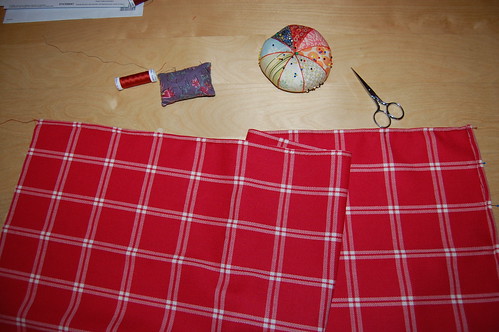
Wm Booth has a new linen coming in the winter, and as the men in my house have outgrown or outworn their shirts, I am thinking of making new check shirts. I did finish a white shirt at Fort Lee, which will go to the Young Mr (his small clothes being now his too-small clothes). I will have to make Mr S a white shirt for best wear, but they could each use a second working shirt. At least with checks you get “cut here” and “sew here” lines.
Last week, I found a weavers’ book in the Arkwright Company Records (Box 1, Folder 1, 1815). It’s a slim, blue paper-covered volume with small samplers glued in to the pages, and full of checks and stripes. Blue and white, red and blue, checks and stripes were prevalent in the late 18th and early 19th centuries. The more I look at extant garments, sample books, and ads, the more I think the streets must have been a vibrant, if grimy, visual riot.
It’s always cold, though, and I could use a day sewing various projects or vacuuming. But it’s also the last event of the season. Of course, in the slack time, I always stand on the NJ shore wondering how feasible it would be to run over to Manhattan for trim, fabric, or a trip to a museum. In kit. Because…. why not?
But Mr S wants me to come, so I’ve stirred myself to cutting and pressing and starting to hem a wool kerchief. This is made from some crossed-barred wool found in Somerville on the shopping expedition with Sew 18th Century.
She kindly sent me the image above, which is a good thing because I get distracted and think, “you know, that image with the duck and the girl and the bonnet,” which will give you 71,000,000 results in Google, but fortunately includes this one.
Three hems: I should be done by now.
It’s an easy project, but sometimes those are the hardest because you’re not learning anything. That, of course, is what Netflix is for: ghastly murders or sophisticated dramas keep you going on repetitive hems. (I do my best backstitching to BBC crime dramas– go figure.)
So, a November Saturday up on the Palisades means wool, in fact, requires wool, and for the first time I think I have enough wool to stay reasonably comfortable. That’s a cloak, kerchief, gown and two wool petticoats, plus wool stockings and, if they fit, sheepskin insoles for my shoes. We have a wool shift at work, but at about 50 years later than the Fall of Fort Lee, it provides no justification for a wool flannel shift. Still, a wool shift is a tempting thought, and suddenly that kerchief hem gets more interesting, as I start to think about where to look for documentation of wool or flannel shifts.

![[An amazonian dress]. London : Pubd. May 26, 1797, by G.M. Woodward, Berners Street. Lewis Walpole Library Image Number lwlpr08972, Call Number 797.05.26.02](https://kirstenhammerstrom.com/wp-content/uploads/2023/03/0a76a-reverse_lapel.jpg?w=370&h=485)


 Kirsten Hammerstrom
You must be logged in to post a comment.