Come sew with me! Well, you’ll be sewing with Henry Cooke, but I’ll be there, too.
Check the Newport Historical Society’s website for more information about workshops and conversations this winter designed to for anyone with an interest in early American history who wants to expand their understanding of material culture interpretation.
In the past decade, museums, particularly historic house museums, have been challenged to refresh and reinvent their interpretations and presentations. The most notable challenge has come from the Anarchist Guide to Historic House Museums (AGHHM), and the Historic House Trust of New York’s executive director, Franklin Vagnone.
I re-read a number of Vagnone and Deborah Ryan’s papers recently (including this one), thinking not just about What Cheer Day in a historic house, but about reenacting, living history, and costumed interpretation.
To make a historic house museum (HHM) seem more inhabited and real takes a lot of stuff: clothes, dishes, shoes, stockings, toys— all the stuff that surrounds us now, but correct for the time of the HHM, and arranged in a plausible manner, not like a sitcom set, where chairs before a fireplace face the visitor and not the hearth.
Stuff makes a house
To a degree, this is set-dressing, but set-dressing for a still-life, or real life, if the habitation will be by costumed interpreters. It has to be accurate to be authentic, whether it’s a HHM or a living history event that is striving to create a moment, or series of moments, in time– immersive moments.
We cannot step into the past unless we believe the representation we’re seeing, and that’s true no matter where we are: that’s why fabric matters, sewing techniques matter, tent pins and kettles and canteens matter. The world is made up of tiny details that we do actually notice without even knowing it: we see more than we realize, faster than we think. We’ll trip on the different, and stop.
A variety of coats can tell a variety of stories
But what we want to do, as interpreters, is to have the visitor catch the right difference: not the one about which canteen and why, but the larger interpretive point. In one hypothetical example, wooden canteens are a way to talk about defense contracting and supplying the American army, just as over-dyed captured coats are a way to talk about the American Revolution as an international, and not just a civil, war.
An encampment is, in a way, a neighborhood of HHMs turned inside out, with each regiment a separate family within the larger neighborhood. Each regiment tells a story about itself and its history, and is a lens through which visitors see the larger story.
That’s why accuracy matters: you don’t want to debunk Ye Olde Colonial craft in camp, or cotton-poly polonaises (poly-naises?) worn by purported women on the ration: you want to focus on the larger interpretive point. When not everyone plays by the same rules, it is better to focus on your own accuracy and authenticity and to ignore Ye Olde Annoyances.
Tell the larger story, the story of your own regiment’s people: that’s your interpretive goal.
Yes, finished! And just in time, too! The braid arrived in the mail three days before the Spencer was wanted, and fortunately I had finished the garment by then, and the baking could take care of itself after a while, and I managed not to get eggs beaten with sugar on any lovely wool or mohair.
I think it looks well enough with the gown and bonnet, though I am fairly certain the darts are too far to the sides in this iteration. How that happens when you use the same pattern twice I do not know.
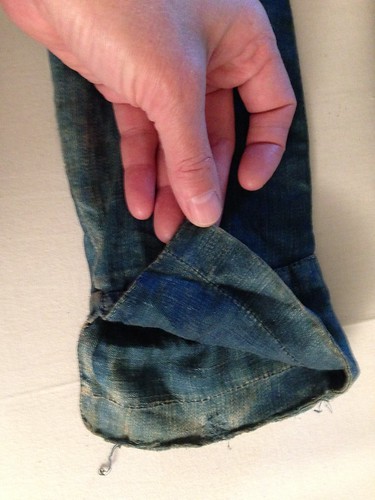
As mentioned previously, the cuffs are pieced, but this is a perfectly accurate way to deal with a shortage of material and/or cuffs.
I’m fairly pleased with how it turned out, and very pleased with how warm it is. Over the cotton gown, the Spencer was plenty warm– and I certainly wished I had it after we left the house and went down to the river!
On the whole, I suppose I’m pleased…as pleased as I ever am …which means you can expect pattern revisions in the future!
Mr Herreshoff and Miss Brown hope soon to be married
Mrs Brown will be in, and receiving guests, and we hear that Mr Herreshoff will come to call as well. While he may decry the state of the roads, we expect him to have news of business conditions in New York, and his prospects for the future.
Miss Alice– Mrs Mason, now– will be at home with her sister, Miss Brown, and Mr Mason is living here now as well. I do not know how I shall keep their room in order, since he is hardly outside of it!
There are other visitors I expect as well; there is a man (I cannot call him a gentleman) who has been doing jobs for us, though he does not live here at the house. He seems extraordinarily interested in the house, and will not stay away. Whatever can be his interest? There may also be a tailor and his apprentice– though the apprentice tends to daydreaming, and looks above his station, studying Latin at all hours. I think he will not be long in his apprenticeship if he will not pay attention.






 Kirsten Hammerstrom
You must be logged in to post a comment.