Itching for Style

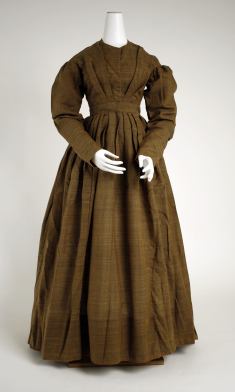
Dress Date: 1830s Culture: American Medium: wool Dimensions: Length at CB: 53 1/2 in. (135.9 cm) Credit Line: Gift of John Eastman and Gerard L. Eastman, 1976 Accession Number: 1976.209.2
Dress, 1830s. American, wool.
Gift of John Eastman and Gerard L. Eastman, 1976.209.2 Metropolitan Museum of Art

Wool. It’s a thing. This dress from the Met has many of the markers of everyday fashion– a vernacular form, if you will, of what Deliverance Mapes Waldo is wearing in this portrait

Deliverance Mapes Waldo and Her Son about 1830 Samuel Lovett Waldo (American, 1783–1861 American) DIMENSIONS 77.15 x 64.45 cm (30 3/8 x 25 3/8 in.) ACCESSION NUMBER 45.891 MFA Boston
Deliverance Mapes Waldo and Her Son, about 1830
Samuel Lovett Waldo. 45.891 MFA Boston

Of course, dating these things is never a science when they don’t come with a clearly labeled tag you can affirm with research. The extant garment first. The sleeves say 1820s, the waistline says 1830s. Could it be 1840s? Perhaps. Without provenance, it’s really hard to know.

Mrs Waldo’s sleeves are clearly 1830s sleeves: full on gigot, sloped shoulder. It’s the contrast between her sleeves and the Met’s dress that makes me question their date (along with the fashion plates we saw yesterday).

Here’s a wool gown from England, land of the fabulous wools.

Dress, England, Great Britain.  1836-1838. Printed wool, trimmed with printed wool, lined with cotton, hand-sewn Given by Mrs H. M. Shepherd, T.11-1935. Victoria & Albert Museum.
Dress, England, Great Britain. 1836-1838.
Printed wool, trimmed with printed wool, lined with cotton, hand-sewn
Given by Mrs H. M. Shepherd, T.11-1935. Victoria & Albert Museum.

Here the sleeves are starting to be narrowed at the shoulder, taming the gigot. That places this 1836 or later, which is helpful. The bodice style is still not the pleated or smocked front of the 1840s, so that’s another marker for mid-to-late 1830s.

What will I do? I don’t know. I’ve ordered two patterns (and one for a new chemise, sigh). The Past Patterns Lowell Mill Girl dress appears to make up quite nicely, but I also ordered the Wisconsin Historical Society pattern for comparison. (Hey, when you can’t examine originals, you have to use the patterns.) Fabric is always a question, but if I’m feeling plain wool, there’s always Burnley & Trowbridge’s “Virginia Cloth.” I’ve worked with it before, so I know how it handles, and while the color looks itchy, it’s actually pretty soft.

Gigot or Gigantic?

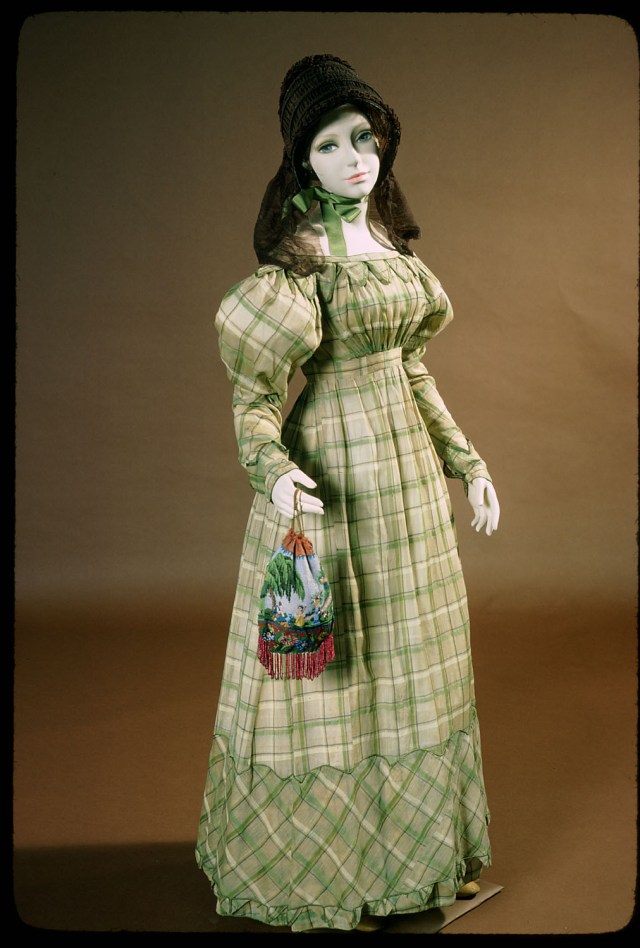
Carriage and Morning Dress, 1832. LAPL Fashion Plate Collection

So, about that 1833 thing…

No, it’s not that I’m reconsidering. It is merely that as I consider the options, the fashion plates are a bit overwhelming. On the other hand, I am getting really good at recognizing the look of the 1830s in undated portraits. There’s an upside to everything.

Extant garments are fairly plentiful in the Usual Suspects’ Collections; there’s even a Tumblr. There’s a Tumblr for everything.

Woman's Green, Tan, Yellow and Blue Striped/Plaid Gown. OSV, 26.33.63
Woman’s Green, Tan, Yellow and Blue Striped/Plaid Gown. OSV, 26.33.63

Fortunately, there are some tamer garments out there, with sleeves less likely to result in flight in a high wind. Bonus: not floral, and not silk. Printed wool seems to have been fairly common, but the weight is just impossible to find. I did some looking in New York, but nothing convinced me with print or price.

This is a milita muster, so there will be time outside. I’m toying with a habit or Amazone (hard to resist a garment with that name) though the most I know about horses is that they have four legs. It’s tailoring that attracts me, not use. Also, wool. Mid-September might warrant wool, even if that’s hard to imagine today. (The downside, of course, is that there’s menswear to be made, too, so a simple dress is surely the best option.)

Room, Officers’, for the use of.

Sometimes I feel like a third wheel at Rev War events. There is not always a lot for women to do besides chores, and the public often ignore us. Still, there is one maxim I know to be true: if you’re bored, work.

Thus, when I found myself drifting off Saturday, I started dinner. The best part was where I got to make dinner: in a chamber off the main room of the Temple at the New Windsor Cantonment. These two rooms were occupied by the 10th Mass this year. Last year, the unfinished room had been the scene of Dirt Stew.

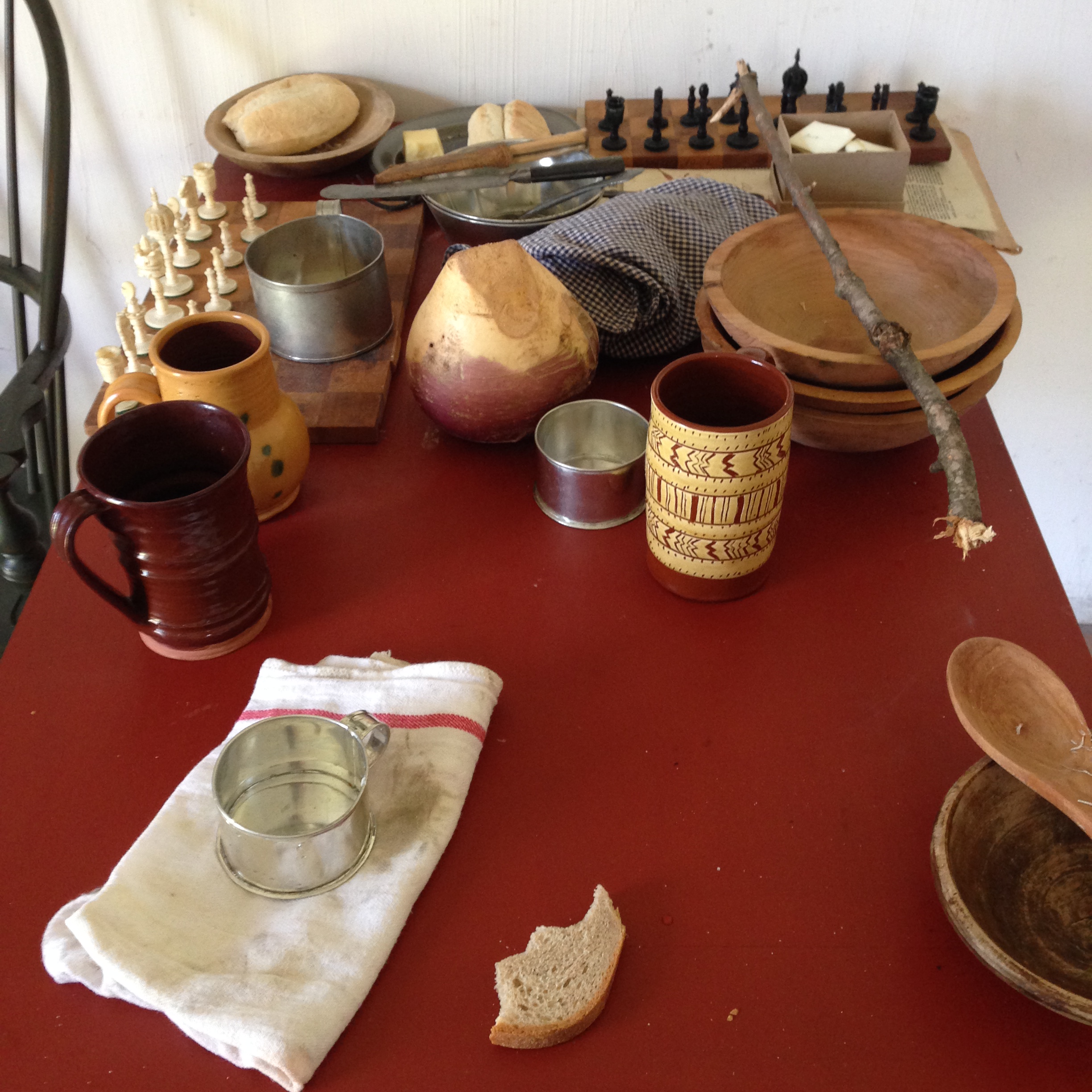
Cutting vegetables on a table was a major upgrade; last year, I think I used the kettle lid, the floor being too gritty even for me.

IMG_3470

It’s End of Stored Root Vegetable season here, so largish carrots and parsnips went into the pot, along with potatoes, onions, and a cooked chicken disjointed by hand (a task I have experience in).

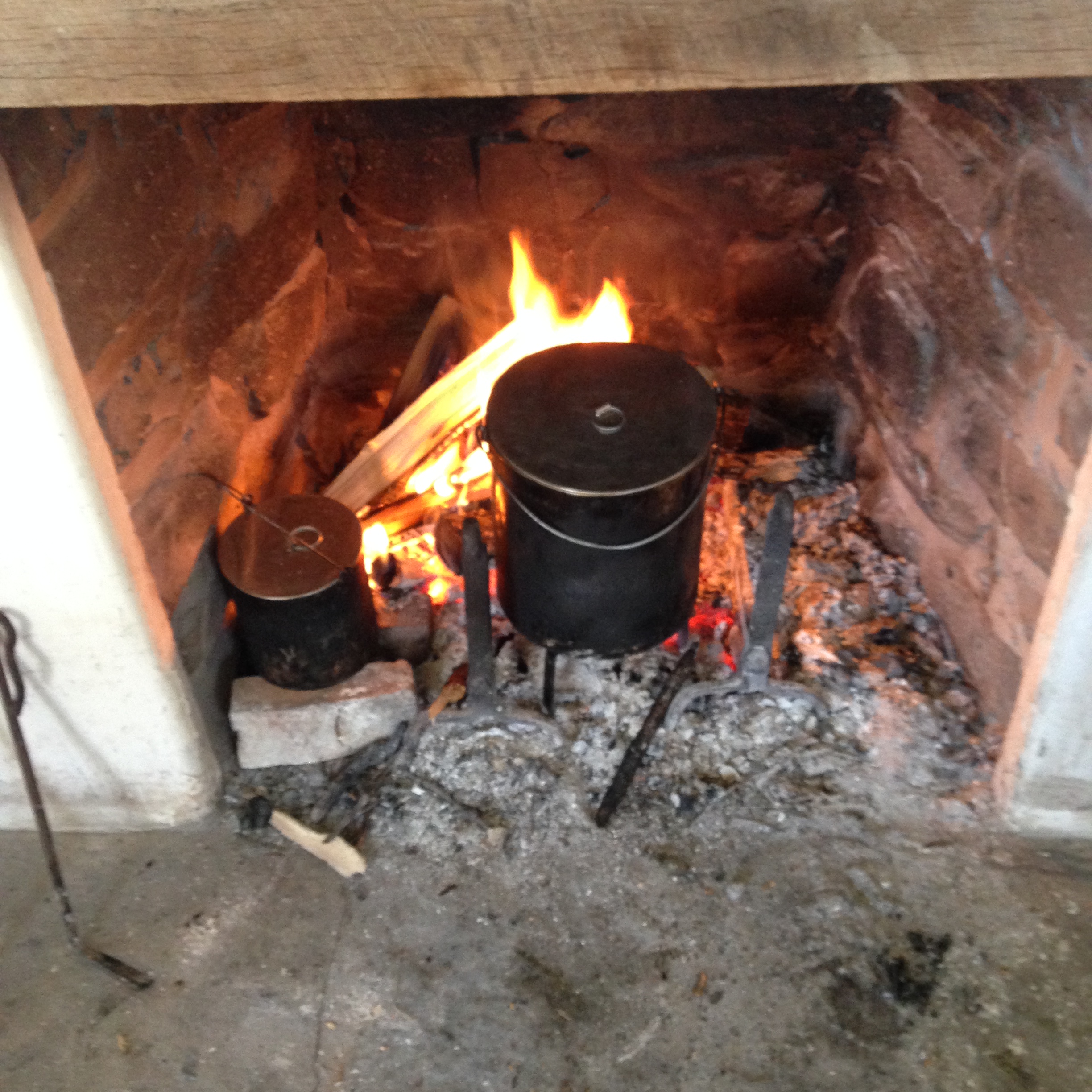
This year, we brought the only iron we own, a small trivet-like stand to put the big kettle on; the little one went on bricks from the Temple’s other fireplace. Was that slim piece of iron wrong? Probably, but in a place where we can’t dig a kitchen or make a fire outdoors, we compromised in the name of keeping supper unspilled.

IMG_3471

Why no fires outdoors? Red flag warnings, due to high winds and low RH. That all hobbies will be affected by climate change was clear on Saturday, as we discussed invasive species, transporting wood across state lines, and various site rules on using brush to build shelters. It’s not just about digging fire pits or kitchens and archaeology anymore.

Surreal School

On the King's Highway, behind Knox's HQ
On the King’s Highway, behind Knox’s HQ

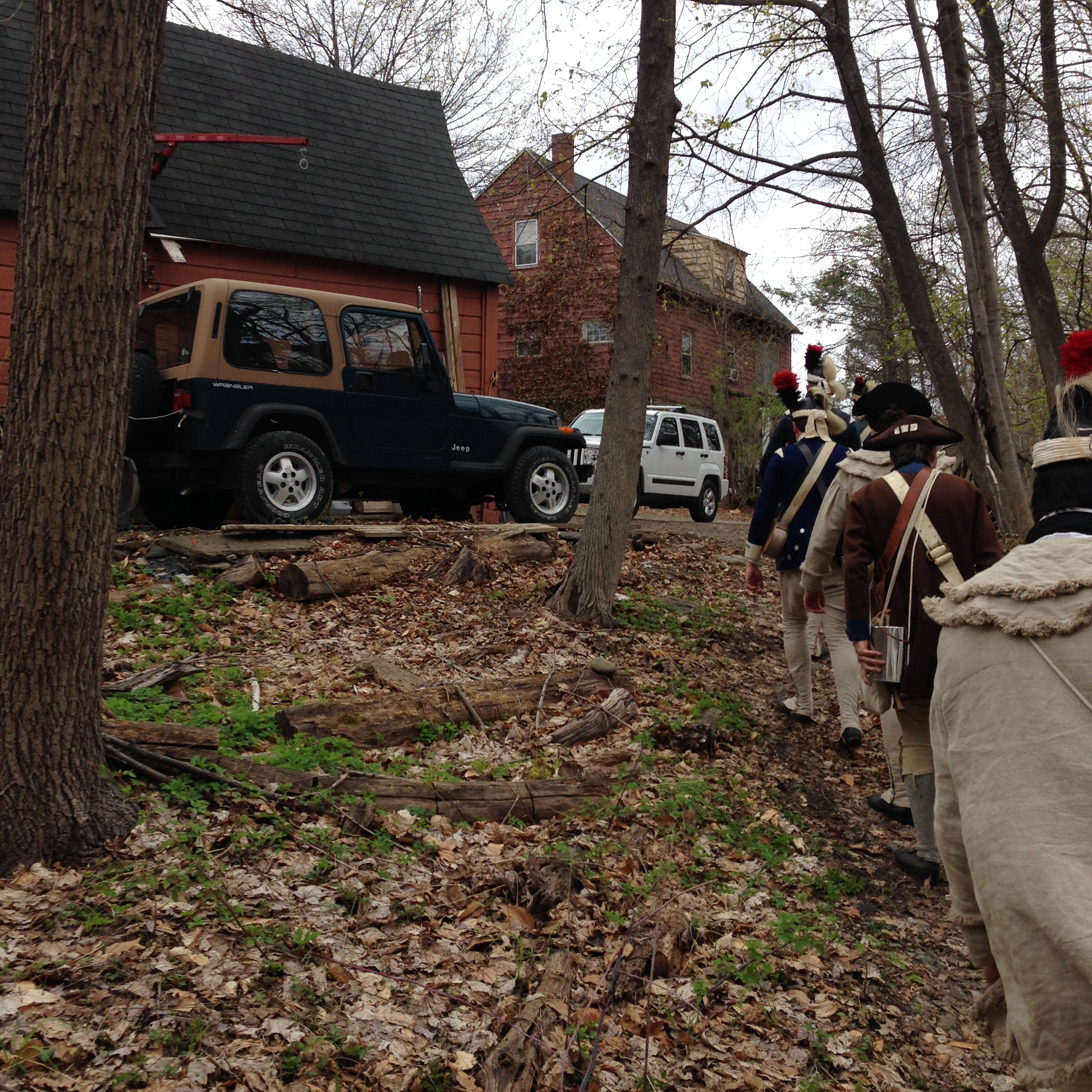
The School of Instruction is always interesting, and this year was no exception. One of my favorite activities is walking with the troops (well, behind). The experience is usually surreal, and the walk we took behind Knox’s Headquarters met expectations.

Clash of the Time Periods

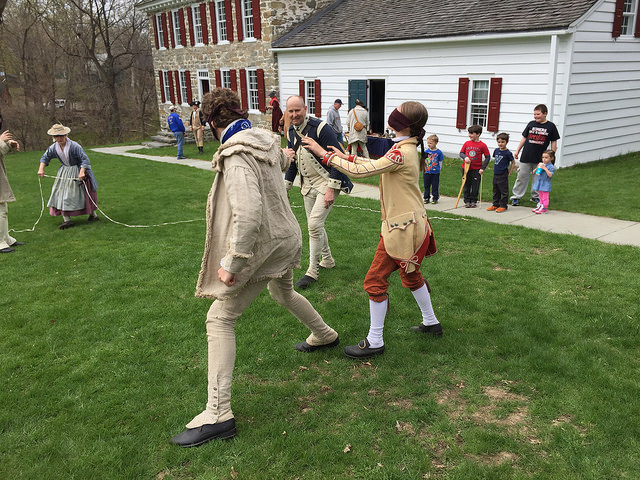
Knox’s Headquarters was a new location for us, with new activities: we played a Jingling Match, which resulted in as much giggling as jingling, and felt like the Walking Dead met the 18th Century.

Jingling without Giggling is the hard part

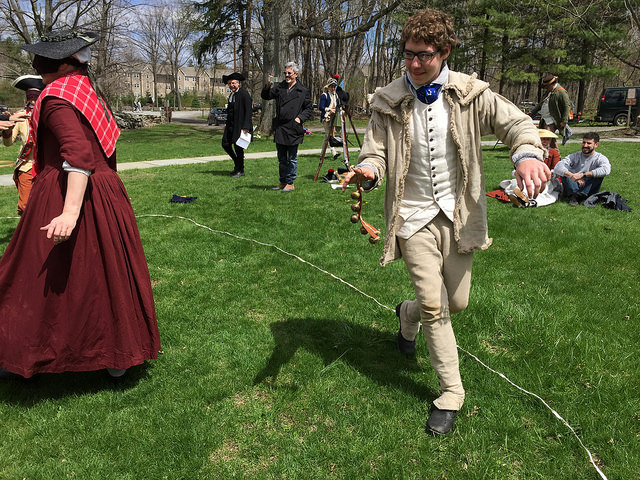
The game is pretty simple: mark out an area, blindfold as many as are willing to play, and set one without blindfold loose. The object is to touch the person ringing the bell, and it is a hilarious and merry game indeed, though I do agree with Mr McC that playing with a number of men full in their cups, or at certain sites (Stony Point comes to mind) would be too dangerous.
WildJingling

Still, it’s simple and fun, if a little Kubrickian when you first tie on the blindfold. The person who catches the jingler is the next one to taunt the blindfolded.

tomBrianwill

Next stop? Bell research, of course. I definitely want to play this in Newport later this summer.