So Hip

I don’t always feel the need to enhance my anatomy; in fact, I rarely do, but then I started on the sacque. Ah, the sacque. I nearly abandoned the whole business but then I thought I’d look pretty silly dressed as the maid, or for George Washington’s funeral instead of his birthday party.[1]

I also don’t want to have a house littered with UFOs, because that is what my knitting stash is for. In order for the sacque to look right, I need hips. HIPS.

And while I planned to make panniers AKA pocket hoops, a simpler and easier solution occurred to me. Hip pads: I’d seen them on Sharon’s site and thought I could at least try a pair. They’d help my poor fake quilted petticoat (FQP, long story[2]), which will come in handy for a party in February. So I spent my New Year’s Day making hips and playing a bit with the sacque silk.

To make the hips, I started out by laying a piece of muslin against Cassandra, and tracing a waist arc. I worked between the muslin and paper to create a paper pattern, and then made up a muslin, which I filled with polyester stuffing and then tested under the FQP. Better, no?

Then I added the seam allowance to the paper pattern (which you can download here and print at 100% if you have a waist in the 30 inch range and want enormous hips yourself) and cut four more of linen.

After three episodes of Death Comes to Pemberly[3], I had hips. They weren’t quite the same size, but my right hip is larger or higher or something, so I put the smaller one on the right and the larger on the left to balance my own deficiencies.

The alteration to the silhouette is pretty amazing, though Mr S did laugh. Perhaps this figure is an acquired taste.


[1] All I have right now to wear with the Celebration Spencer is a black petticoat, so I’d be rocking the 1799 George-is-Dead look.

[2] The story is that I have a real one basted onto a frame but I cannot fit both the frame and a sofa in the apartment. We chose sofa. I am sad but comfy.

[3] I’m ambivalent. Though I do love Trevor Eve, I wondered why there was not more changing of dress for various times of day

The View from Ft Lee

To the South.

Silver and shimmering, there’s Manhattan Island: you can hear the train whistles from the New Jersey shore, this century always intruding on the past. To be honest, this event makes me as nuts as it makes me happy (the 32 pound gun did, finally, go off after four tries). There’s something slap-dash about it, this last event of the season (or the first of next, as the BAR commander would have it). The range and quality of impressions is astonishing but it’s a small, manageable event that’s good for trying things out, and for first-time-users.

Which could bring me to the highlight of the day for someone close to me, but suffice it to say that what happens in the blockhouse stays in the blockhouse and I haven’t seen a particular teenage boy that excited, like, ever. He stayed excited, too, until he finally fell asleep somewhere on I-95 northbound.

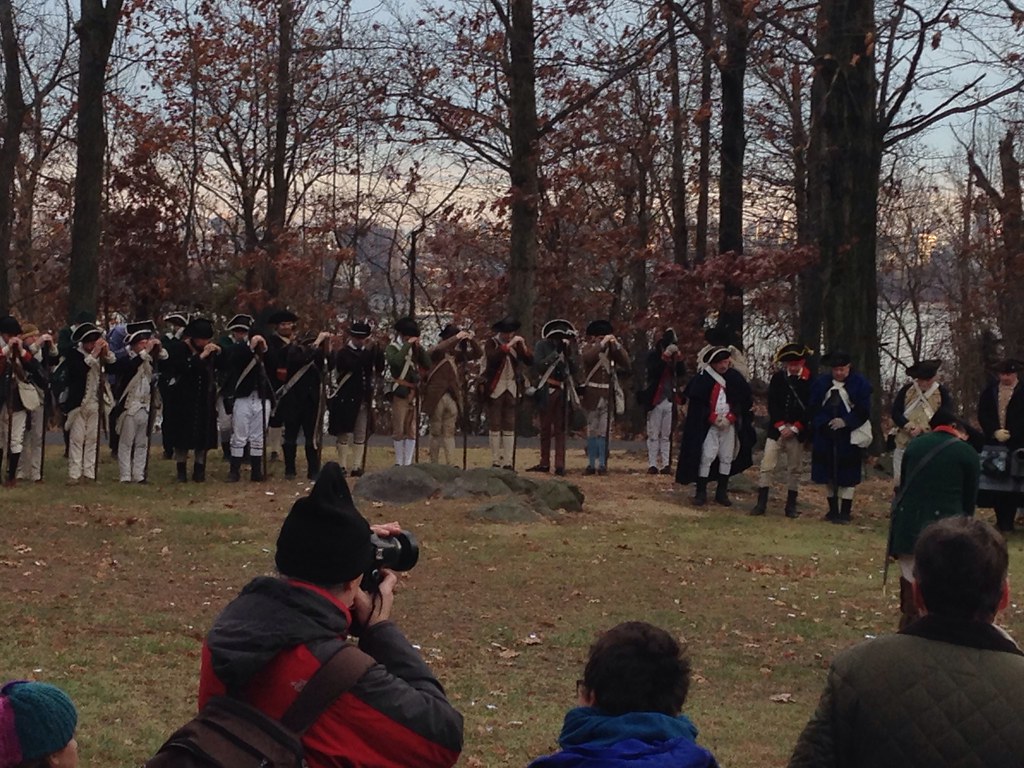
Mourn Arms at the end of the Day.

I like the predictable ritual of Fort Lee: it’s always cold, the sun fades around noon and the light is always pale by the afternoon, the guns are always fired, and the blockhouse is always lost. There’s a ceremony up in the town and the square always smells delicious, the kettles are always full of mysterious stew with some charcoal bits mixed in and the kid always has three bowls full.

There are always a lot of photographers stalking the ‘wily and elusive reenactor’ at this event; there’s a Fort Lee photo club and they come every year. Unlike Tower Park, there’s no touching, just long-lens stalking. It’s a little weird and I try not to laugh but the lengths they go to do are funny, somehow, though it’s just someone else’s hobby and obsession.

The comments in the public are always revealing. This year’s prize goes the gentleman who told his son muskets are slow to fire and hard to use because they’re breech loading. I think few people have much experience with the physical world, and we would be well-rewarded for spending some time thinking about larger themes in our interpretations, as I’m not convinced people come with much context for what they’re told or what they see.

The Four in Brown, portraying Colonel Moses Little’s 12th Continental Regiment.

Mr S could not remember the name of the regiment they were portraying when I asked him to remind me: the best he could do was “Colonel Sanders’ Regiment,” which was thankfully taken in good spirits when confessed, but you have to know that a man who has managed to get potato on his hat is, well, let’s call it befuddled with hunger. We were probably all a little punchy with cold when the conversation turned to the overheard remark that there would be parakeet [parapet] firing. I asked how many parakeets it took for a four pound gun: four. And then we were off on a flight of fancy noting that loading the guns with the birds would clean the barrels on the way down, and that a parrot, beak forward and in flight, had a fine and aerodynamic profile, but it is damned hard to load the birds tail-first. [Insert squawking noises and some broadcloth-sleeved arm flapping.] After this, we had a demonstration of a simple rapid-fire musket exchange principle which I believe may have been employed to some good effect in the blockhouse.

On the way down, we had spotted a woman driving with a small parrot on her shoulder, loose in her small car, with a cage in the back, so the day really began on a parrot and parakeet theme, though the Free Men of the Sea were parading in Plymouth. All in all, a very typical, slightly surreal Fort Lee.

Headed for the Hudson

Fort Lee: It’s a mixed bag.

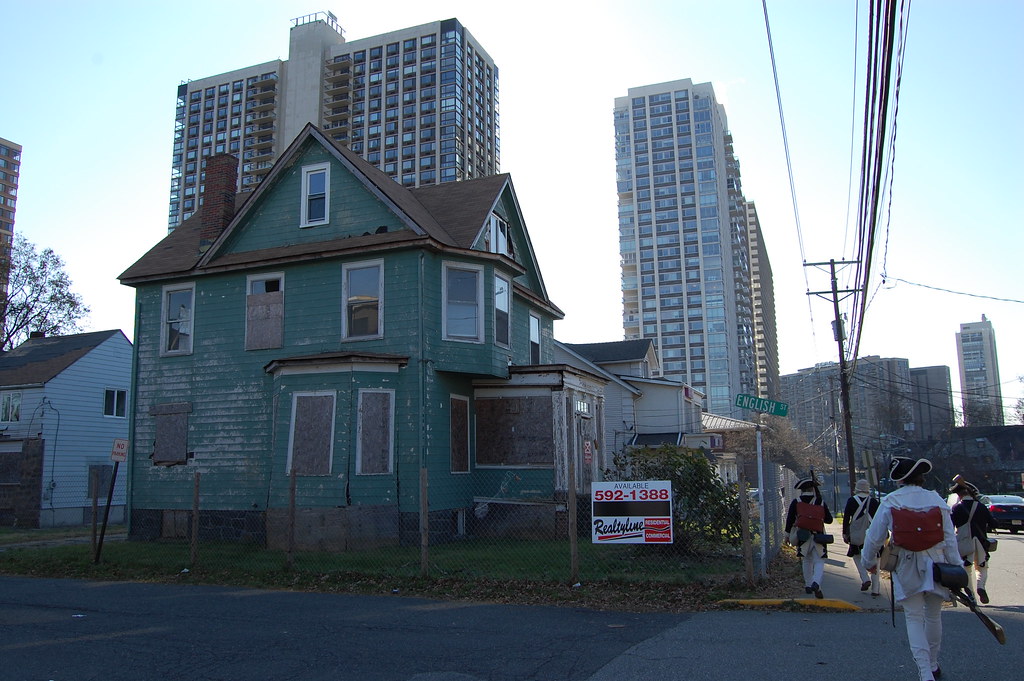
Fort Lee is a mixed bag: the site is very urban, authenticity levels vary, the activities sometimes get off schedule, and I don’t think anyone knows for certain what goes into the stew pot. Still, it’s an easy there-and-back dash, and all of us are going now that Sunday’s swim meet is cancelled.

After all, the Young Mr has an agenda. After being told at the Fort that “they didn’t have grapeshot then,” we found a reference in the Jeremiah Greenman diary to grapeshot being fired on the Continental troops at Fort Mifflin in 1777. He’s fastened on this and looks forward to moving that conversation forward…

And I’m just happy to have a day outside to look forward to. It’s a little dull without a fire and tent, but the event has its quirky charms, and I can always bring a book or work on shirts.

To (Ft) Lee or Not to (Ft) Lee?

A Market Girl with a Mallard Duck, pastel by John Russell, 1787. (Sold by Christie's)
A Market Girl with a Mallard Duck, pastel by John Russell, 1787. (Sold by Christie’s)

I like Fort Lee: after all, I like big guns, and Fort Lee has a 32 pound gun.

It’s always cold, though, and I could use a day sewing various projects or vacuuming. But it’s also the last event of the season. Of course, in the slack time, I always stand on the NJ shore wondering how feasible it would be to run over to Manhattan for trim, fabric, or a trip to a museum. In kit. Because…. why not?

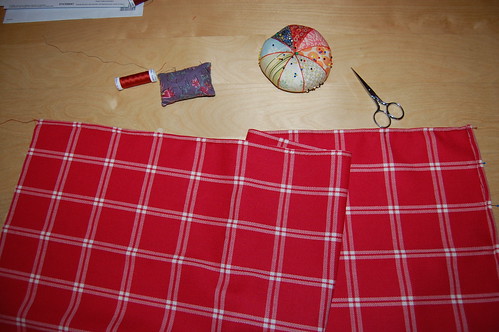
But Mr S wants me to come, so I’ve stirred myself to cutting and pressing and starting to hem a wool kerchief. This is made from some crossed-barred wool found in Somerville on the shopping expedition with Sew 18th Century.

She kindly sent me the image above, which is a good thing because I get distracted and think, “you know, that image with the duck and the girl and the bonnet,” which will give you 71,000,000 results in Google, but fortunately includes this one.

Three hems: I should be done by now.

It’s an easy project, but sometimes those are the hardest because you’re not learning anything. That, of course, is what Netflix is for: ghastly murders or sophisticated dramas keep you going on repetitive hems.  (I do my best backstitching to BBC crime dramas– go figure.)

So, a November Saturday up on the Palisades means wool, in fact, requires wool, and for the first time I think I have enough wool to stay reasonably comfortable. That’s a cloak, kerchief, gown and two wool petticoats, plus wool stockings and, if they fit, sheepskin insoles for my shoes. We have a wool shift at work, but at about 50 years later than the Fall of Fort Lee, it provides no justification for a wool flannel shift. Still, a wool shift is a tempting thought, and suddenly that kerchief hem gets more interesting, as I start to think about where to look for documentation of wool or flannel shifts.