The Birth-Night Ball (a preview)

Fully done up.

Photos by a real photographer won’t be available for another two weeks (patience, Iago, patience) but  Mr S and I had a lovely time, high-heeled shoes excepted. The gowns were dramatic, the gentlemen dandy, and the dancing elegant, if bumpy at the start. There are some videos here, both of the assembled company dancing, and of the lovely minuet demonstration.

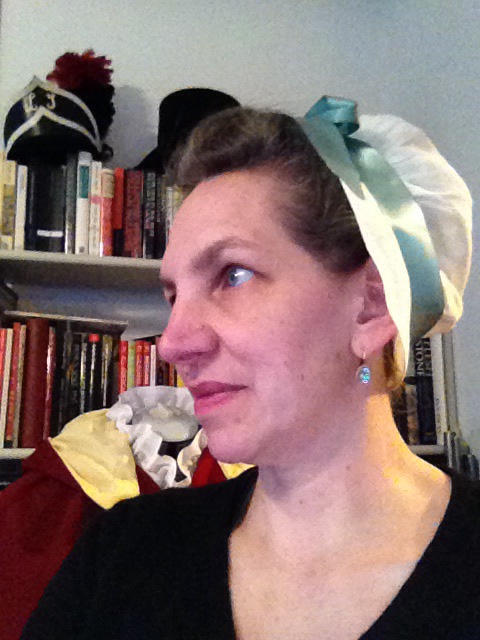
Selfie, and ready for bed!

I managed a phone photo just before I crashed into bed, and am generally satisfied with how the dressed-up laundress appeared. Clearly my laundry business is doing very, very well, or I have liberated some earrings from a client. One of the most challenging things about this event (aside from my over-thinking freak outs) was not having a persona to hold onto. We started reenacting as lower-class 18th century types, and spent some time as tenant farmers and maids. Mr S and I do not have clothes for the gentry, but can inch into the middling sorts when we want to.

That’s fine, and it’s comfortable– we’ve not yet really reached all the way down the lower sorts, either–but it does mean that when we’re presented with the opportunity to dress above our station, the need to really understand the new station kicks in, and delays the process.

I’ll finish that silk sacque someday, and sooner rather than later, but I’m glad I held off so I can really get the gown right, as well as the shoes, hair style, and other accessories.

Hair-raising

An old gown, with new sleeve ruffles and petticoat.

We are going to a ball tonight, and while I am looking forward to seeing Sew 18th Century and the lovely Mr and Mrs B among other friends, this is a different kind of experience for Mr S and me. We are, after all, more accustomed to crashing parties than attending them. (There are photos of the Riot Act Night here.)

The biggest difference is in presentation. I ended up making a changeable blue silk petticoat to dress up a cotton print gown, to which I’ve added sleeve ruffles made by the incomparable Cassidy. While I once had plans–dreams–of finishing and wearing the silk sacque in time for this, I was overtaken by events  and have settled for an ensemble more suited to my persona, and Mr S’s planned outfit, the Saratoga coat and breeches. I feel just OK with center front closing cotton print for late 1777, and have seen enough cotton print gown and silk petticoats at Williamsburg to brazen it out.

This is a marked upgrade from linen petticoats that smell like woodsmoke (sigh!) and print neckerchiefs that you shouldn’t smell.

Perhaps the biggest change, though, is to my hair. (Yes, the pun is finally paying off, like a loaded gun in the first act.)

All cleaned up with someplace to go.

I started this day with wet hair, curlers, setting lotion and bobby pins, swearing like a sailor and convinced/hoping the world might end right in our bathroom. Last night I watched Jenny La Fleur‘s 18th century pouf tutorial, and thought I had the basics down.

Wrong. Or half-wrong. I should have gone looking for a don’t-lose-your-mind video, plus one on how to make pin curls in exacting detail. True to my ability to over-think anything, I began to wonder which way I should spin the pin curls– clock wise? Counter-clock wise? Is it opposite if you’re in Australia and New Zealand? My brain is a cluttered place.

In under an hour I had achieved a lop-sided mound of curlers and curls, which I thoughtfully covered with a kerchief to spare my family from death by Medusa. They refused to take me to Walmart, though I finally had the hair for it. Eventually, I pulled out half the bobby pins in the known universe, and had a head full of snakes. Silver snakes. Apparently there’s more grey in my hair than I realized.

Another half-hour of pins and hairspray later, I had a slightly more upscale version of my usual hair style, accented with a shiny green ribbon. Underneath that demure cap, my hair is doing terrible, feral things. Of all the things I learned today, I know with certainty that despite my small head, the next time I’m gonna need bigger rollers, and when I get home from the ball, I must wash my hair.

Camp Followers or Women of the Army?

Soldiers and Camp Followers Resting from a March. Jean-Baptiste Pater, 1730. private collection. used from Wikimedia Commons.

I prefer woman belonging to the army, or “regimental woman,” which sounds like Mick Jagger or Roy Orbison could sing it, but one could have a pretty lively discussion of which term to use. Camp followers has a connotation–prostitute–that doesn’t reflect the full reality of army life for women in either the British or the Continental armies.

Were there prostitutes who took advantage of the proximity of a large customer base? Yes, undoubtedly. In the John Robinson Waterman Papers there is an unusual letter from Col. William Battey dated October 28, 1812 with a sketch of the army camp near Albany and a description of camp life. This description includes the treatment of a woman accused of prostitution and summarily banished from camp. I think she was beaten and half-drowned, so the army took the no-prostitutes-whatsoever dictum very seriously.

As far as cooking goes, a commenter elsewhere explained that women would have been cooking, at least for themselves. Typically, they did not cook for the soldiers’ mess, unless they were being paid to. This must have been a difficult situation for the Continental Army: when women were present, it made excellent sense to assign them all possible non-combatant tasks to ensure the maximum fighting force. But could discipline be maintained? Not always, given Bridget’s temper.

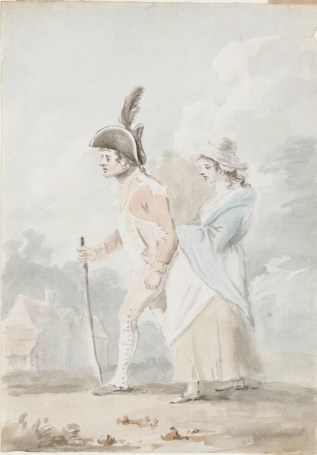
A soldier and his girl. Henry Bunbury, ca. 1794. Lewis Walpole Library, Drawings B87 no. 8

Rolling back a bit and trying to consider the army’s structure and camp layout, what are the mechanics of handling rations for women with the army? How are they fed? And did it vary, unit by unit? There is probably far more variation than we credit, that will only be illuminated by careful attention to the documentary record. That means finding as many victualing rolls and returns as possible, looking for women. It means reading all the orderly books that can be found, looking for women.

The best secondary source I know for the Continental Army’s women is with Holly Mayer’s book, Belonging to the Army. (And I’ll admit I haven’t read it in two years, so it’s time to re-read it.) If you’re British, I’m not in a position to help you as much, but there is Don Hagist’s work on Women of the British Army. For a more granular understanding of women in all armies, you have to turn to primary sources, and what’s available varies from unit to unit, state to state. There is a handy index of orderly books,  and while these vary in their utility, they are a good place to start. In fact, the whole RevWar 75 site is useful (though it is not loading at the time of this writing).

Soldiers’ diaries and accounts are also useful. Jeremiah Greenman of the 2nd Rhode Island Regiment recorded his experiences throughout the entire war, starting in 1775, when he joined Arnold’s expedition to Quebec. There were two women on that expedition, attached to two different companies. While there is not a plethora of detail about the women, it is clear that they were strong and able, and in one case, more able than her husband.

Camp Life

The Jolly Landlady in Hyde Park. Paul Sandby, 1780. British Museum 1904,0819.622
The Fair Stationer in Hyde Park, 1780. Outline engraving by Paul Sandby. British Museum 1880,1113.1915

Still wondering what to do in camp that’s not cooking or sewing? Technically, you shouldn’t be cooking if you’re a woman: that was a soldier’s job, though I recall seeing a reference to women cooking when all the men were pulled into the line during an engagement. A card file would help me, but for now, all I have is my scattered memory.

But if you’re tired of mending and making shirts (one of the most boring tasks, I find– all straight seams and very predictable), there’s more to do than laundry.

If the event represents a longer encampment, you could run a traveling coffee house or tavern. There’s the Widow Black in the Mid West, but I haven’t encountered this yet in New England. You could be a Jolly Landlady, or as the British Museum has it,  “a voluptuous lady stands in foreground to left, holding up a glass to a soldier on horseback.”

The Fair Stationer in Hyde Park 1780. Outline etching with watercolor, Paul Sandby. British Museum 1904,0819.576

The Fair Stationer shows us Lloyd’s Coffee House and what looks like a carriage body on blocks, converted to a news stand. You could sell newspapers and writing paper, pamphlets and poem and songs. It’s an impression that would take a lot of thinking and research for the American colonies, but could be very interesting. the transmission of news and information and the transport of mail and packages presented challenges. How were they overcome?

I’m also struck by the number of dogs in Sandby’s images. If it’s not the same dog, over and over, I would guess that in the 18th century as in the 20th, soldiers had pets that traveled with them, both common soldiers with common curs and officers with hunting dogs. The camps must have been disastrously messy, with fatigue details to clean them.  We can’t have dogs at reenactments, but we could have more outraged sergeants. It’s hard, though, because to do these things well, you have to know and trust the people you’re doing them with (and that includes yourself).