Experiencing Eastfield Village

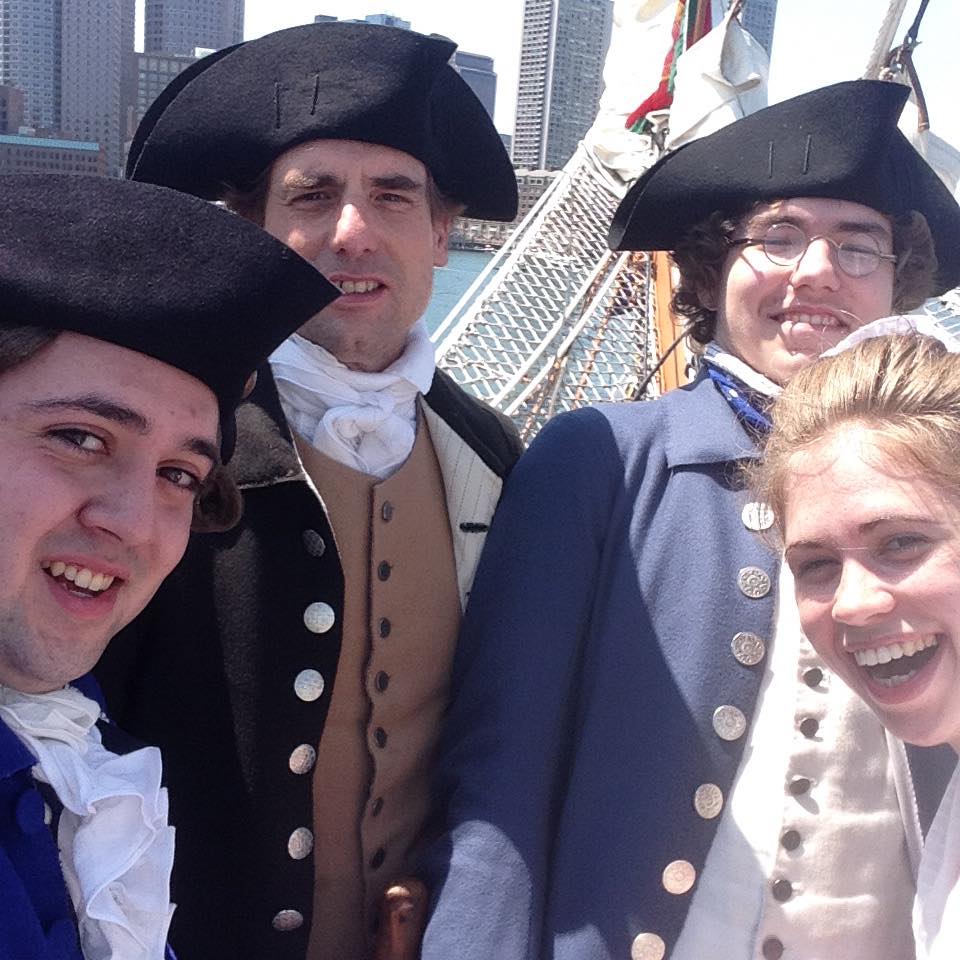
The Young Mr on site.

Mr Hiwell, the Young Mr and I ventured out to Nassau, New York this weekend to be part of Founders Day Celebration at Eastfield Village. The gents were part of the 1833 militia muster, while I traveled out intending to interpret tailoring with Mr JS, and to provide meals for the militia.

It’s an interesting assemblage of buildings, and we were pretty curious about what the site and the experience would be like. While OSV and Genesee are also assembled villages, they’re museums, with different missions and guidelines; they’re also larger, with electricity and flush toilets for visitors and volunteers alike. That means they’re lovely, but not nearly as immersive as the pitch-dark privy experience.

The back of the Benjamin Culver house, or, our dining room for dinner.
Wear all the patterns possible, please.

There was a lot to consider at Eastfield, but I’m tired from driving back and will stick to the simple things for now.

I was incredibly fortunate to have a bed—indeed, the entire 1787 Benjamin Culver house—to myself for sleeping. Friday night, after changing into period clothes, we went up to the Yellow Tavern to eat our supper (pasties brought from home, with hard cider for Mr JS and myself). The candle lit taproom was cozy, and I understand from Mr JS that the sleeping quarters upstairs were even cozier.

We cooked our meals in the Yellow Tavern kitchen, and ate sometimes in the taproom, and sometimes standing in the kitchen, except for dinner, which was served picnic style on the grass behind the Culver House. (Saturday supper was provided by Eastfield Village and prepared by Neil DiMarino with able help; that deserves a post all its own.)

Cozy is as cozy does.

Much of time was spent on women’s work, interpreting daily tasks to a stream of visitors travelling through the house from front door to back, and sometimes upstream. The scullery—for want of a better word—had a soapstone sink which drained through the wall, which made dish washing pretty plush, and provided entertainment for all who cared to witness it. No chickens were present, but from washing dishes at Coggeshall Farm, chickens would have enjoyed the ground beneath that window drain.
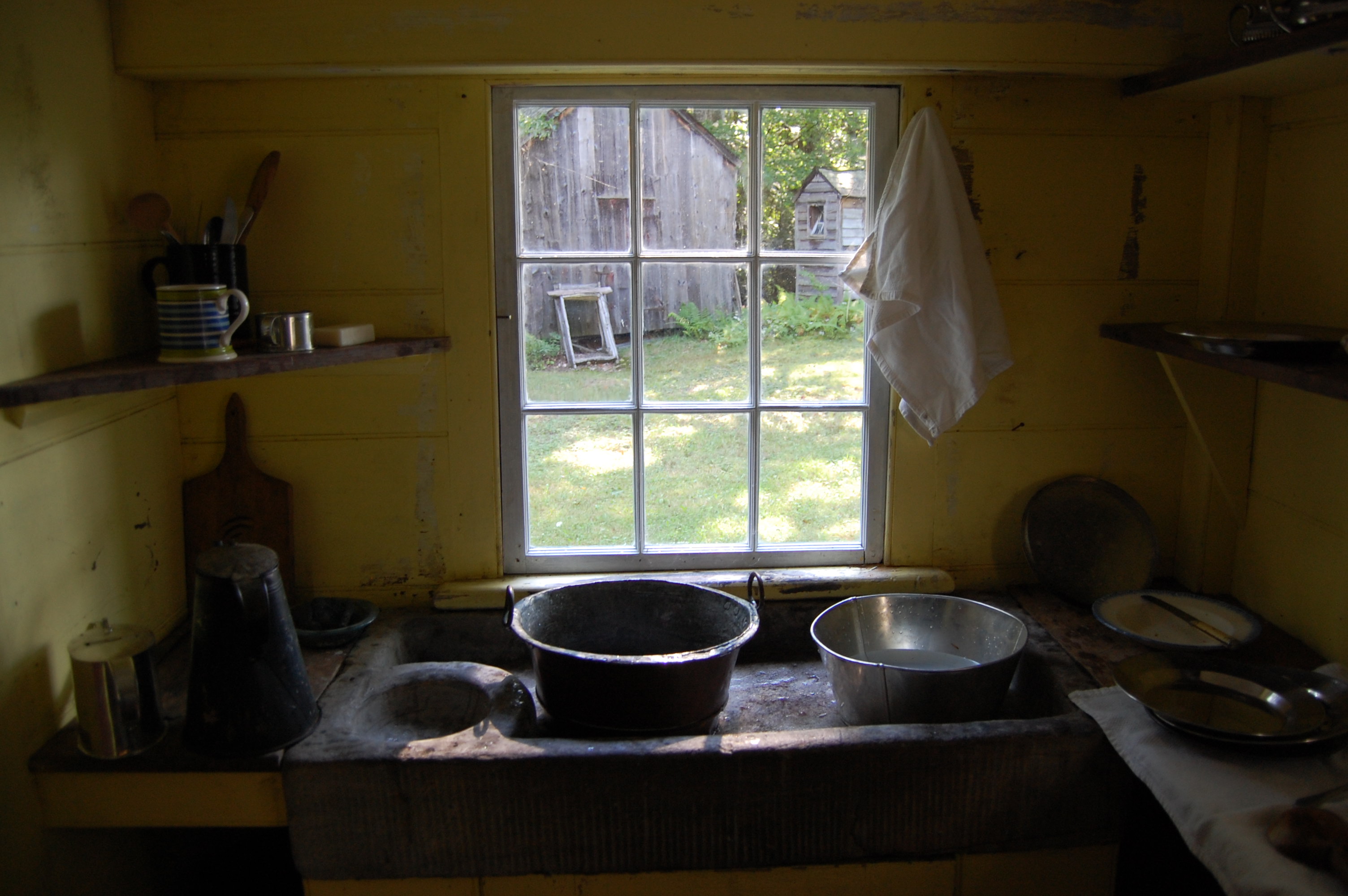
The view from the scullery: not bad, really.

There are always curious questions, from “Is this a house?” in a tone of wonderment, to “Where did you get the water?”

Gentle reader: these stumped me, briefly, until I was able to gather my wits enough to reply, “Yes, it’s a house, built in 1787,” and to assure the visitor that people had, in fact, managed to live in it. The water question was somewhat more perplexing.

I started with, “Well, I got this from the hose, but they would have had a well,” when the visitor stopped me. “No, I mean, how did you get it hot?”

The kettle had been over the fire in what would be the kitchen room where Mr JS and I were set up to sew, and the fire was still producing heat, albeit from coals. Then I realized she had not been among the clump of people watching me remove the kettle from the crane so that I could pour hot water into my basins. I pointed to the kettle, and said, “Over the fire.”

Fire hot.
Fire hot.

It’s hard: there’s so much we take from granted in our own daily 21st-century lives, let alone what we become accustomed to when we inhabit the past. Interpreting between the two worlds, things can be lost in translation.

I’m always curious about what I’ll learn when I travel to a different century, and I think what I learned, again, was that I find it hard to find a way to interpret women’s lives and work in the past that does not reinforce stereotypes of “life was hard” and “roles were constrained.” Enough! I tried explaining the greater freedom some women enjoyed in the early Federal era, in contrast to the pre-Revolution and post- Great Awakening eras, but that wasn’t entirely successful, and would you believe that story from a woman washing dishes?

What I may really have learned is that I’ve done enough time in the kitchen and the scullery; I’d rather be the tavern keeper than the cook or scullery maid. Women were in business, and while never on the scale of partnerships like Brown & Francis, women as merchants, tavern keepers, landlords, and, yes, tailoresses, are underrepresented. It’s easier to talk down the scale than it is to talk up the scale from the washbasin to the shop or tavern, so it’s time to leave the wash basins aside for a bit.

Done with dishes for now, thank you.

On & Off the Grid

It’s been a very busy time chez Calash, with many changes underway and to come. It’s hard to keep up with all the writing I’m doing everywhere, but eventually I’ll be back on topics of authenticity, standards, and whimsical Wednesdays.

This week, though, is all about checks. (Most weeks are, in some way, aren’t they?) Not paychecks, silly: linen checks.

We are headed out to Eastfield Village Friday afternoon where Mr Hiwell and the Young Mr will join in the 1833 militia muster, and Mr JS and I will occupy a house as a shop/tailoring business/punch-making and cooking establishment of one kind or another.

Mr Hiwell has been warned to expect a diet unlike his norm, and since his roundabout is white, we will quickly know if he is smuggling Oreos and barbeque sauce.
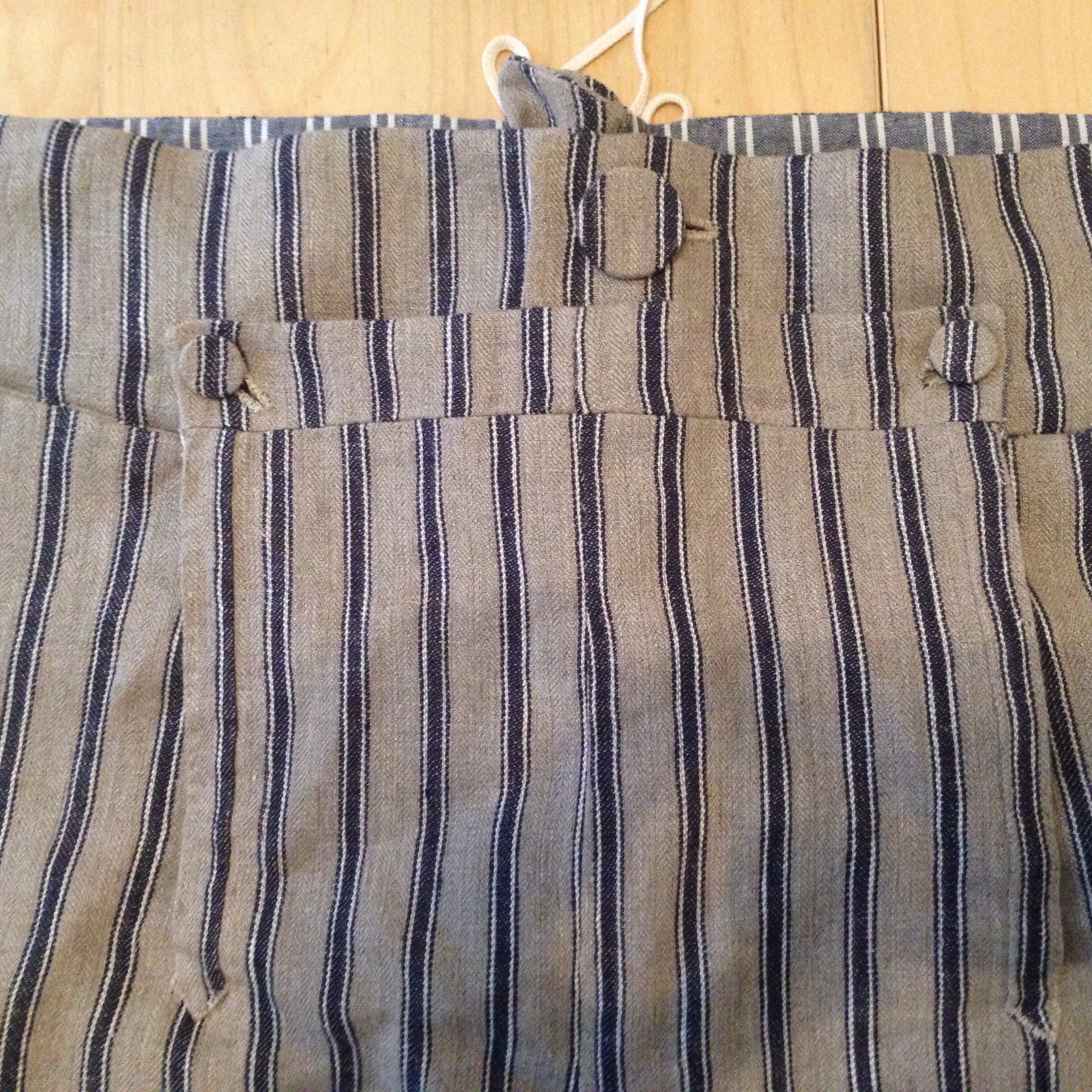
 For the Young Mr, I have been making trousers. Yes, I do like things to line up. I wasn’t even paying that much attention when I cut these, but apparently that was  was enough.

Yes, even the buttons.


Sigh. It’s a thing.

He’s also got a roundabout in the works, which I must focus on more closely to finish. This is patterned from an original in Henry Cooke’s collection, but… Mr. Cooke and I, on a very sticky Tuesday afternoon, did not have the Young Mr at hand to measure again. The original was too small: that we knew. What we did not know was that the boy had taken on a man’s shape– or, as a friend says, “he’s dude-shaped now!”–and the additions we made were not enough, except (barely) to the sleeves.


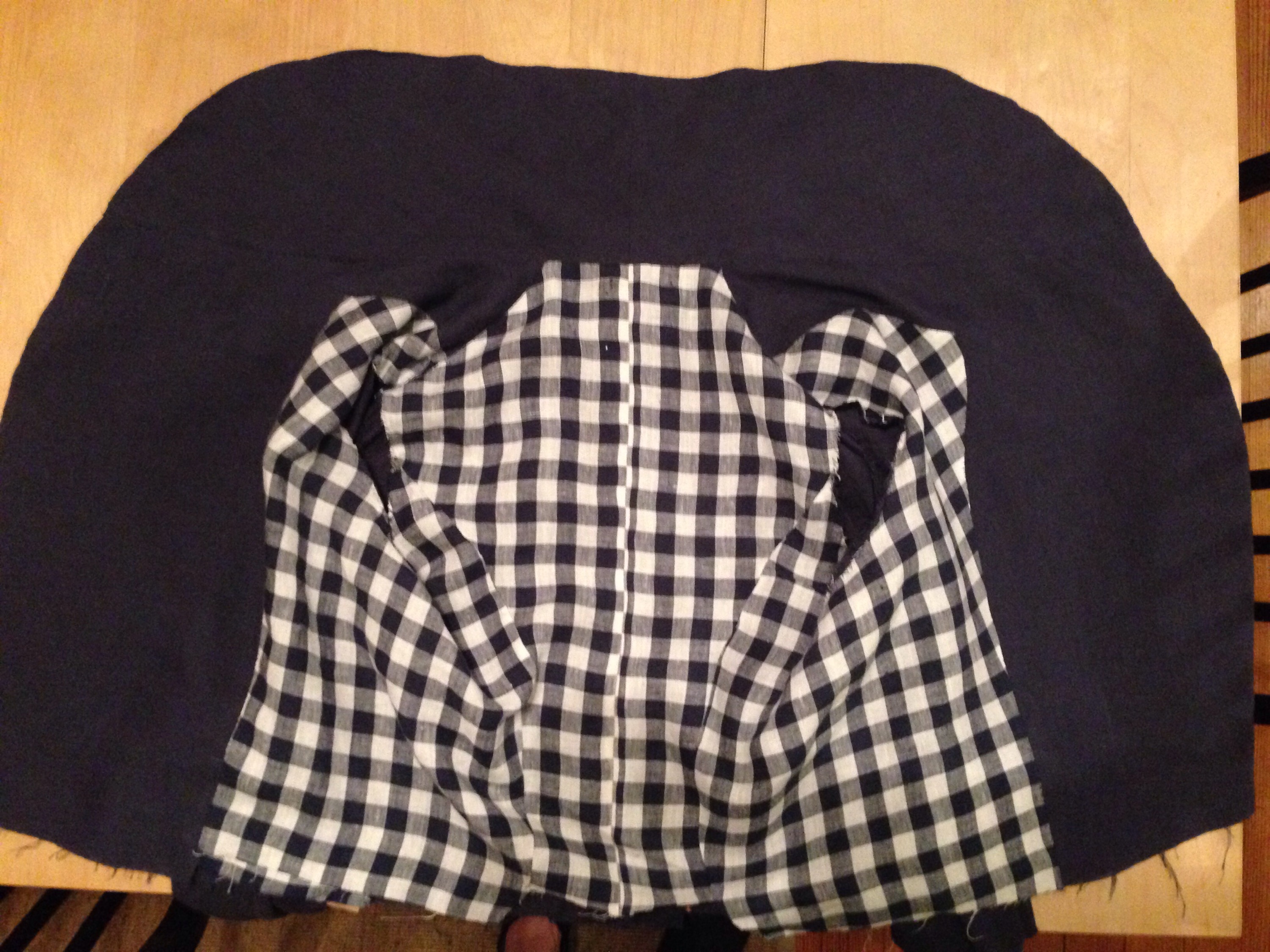
Oh, well. There was just enough to make it all work, and after some trials I realized it needed a lining. What kind of lining? A checked lining, of course!

It seems okay, but these collars are strange to  me.


Well, at least he will be clad.

Let you think  I’m sewing only for the lad, I am in fact working on a gown for myself. There’s a hopeful yard or so of another check’d  linen from the stickiest fabric store on 39th Street lurking, but I do not think that apron will happen this week. Perhaps John Brown’s housekeeper will finish it someday.

At least there are already gowns and aprons ready-made that can travel with me. Someday soon I’d like to finish my new stays… winter will come soon enough, and more sewing then.

Afternoon in Cambridge

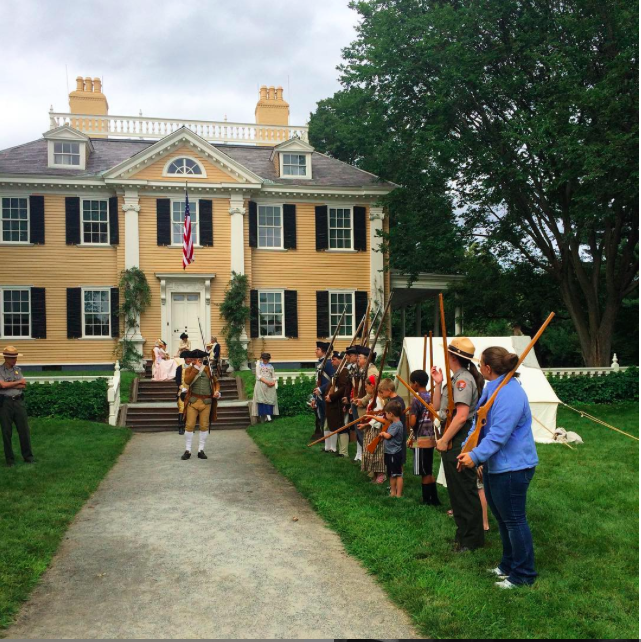
Cambridge. We’ve been there before to cause some mild lawn-based havoc and this year was much the same. We were on our own on the lower level, with just the six-plus-me of some abbreviated form of Soper’s company. Longfellow House is a very lovely site, and the lawn is large enough for a wall tent, drilling, eating, and general mischief.

Longfellow House, Cambridge. Photo from @longnps on Instagram

I packed our lunch in a series of linen bags in the wallet, and stuffed a gown skirt and sewing box in the other end, with a bowl and a mug. I brought the small pitcher and a glass, with the intent of selling ‘gin’ to the militia, but had only one taker. They got into enough trouble themselves with filthy faces, pilfering, and stealing the captain’s books.

unknown artist, 18th century, The Encampment in the Museum Garden, 1783, Aquatint, hand-colored, Yale Center for British Art, Paul Mellon Collection

It’s no immersion event, what with traffic on the street and tourists dressing in Mr Townsend’s best* but there are moments at any gathering when you become so engrossed in what you are doing that you forget where you are. This time was no different: I don’t recall how it started, but we took off down Brattle Street with Sergeant Cooke crossing the yard in hot pursuit– only to be stopped by the wall. He turned the stone barricade into a large and angry goose, neaatly solving solving the problem of not being able to scale the wall.

James Sowerby, 1756–1822, A Goose, undated, Watercolor and graphite on moderately thick, slightly textured, cream wove paper, Yale Center for British Art, Paul Mellon Collection

I don’t think I’ve ever bolted that fast in stays before, and it wasn’t the best idea I’ve ever had, but who cares? It can be done, running in stays, at least for short bursts.

There was much discussion of the filth of the troops, and their need to bathe; despite our best efforts, we could not quite get a satisfactory rise out of the officers, though some soldiers had clearly rolled in dirt. (It’s of a much better quality in Cambridge, you know, where you can wear the Harvard Yard.) There was an attempt at bathing at the Great Bridge, but in the end, one private’s face was washed with an apron corner dipped in ‘gin.’

Benjamin West, 1738–1820, American, active in Britain (from 1763), The Bathing Place at Ramsgate, ca. 1788, Oil on canvas, Yale Center for British Art, Paul Mellon Collection

Satisfying all around, really, from the recitation of Mr Pickering’s manual with its endless repetition of ‘butt,’ meaning musket, entertaining the simpler, uncivil soldiers, to the meal of bread, cheese and cherries, to the chasing. The audience was small, but well entertained if they were paying any attention.

*Oh, NPS, what were you thinking?

The Boarding Party, or, Trip to the Wrong Ship

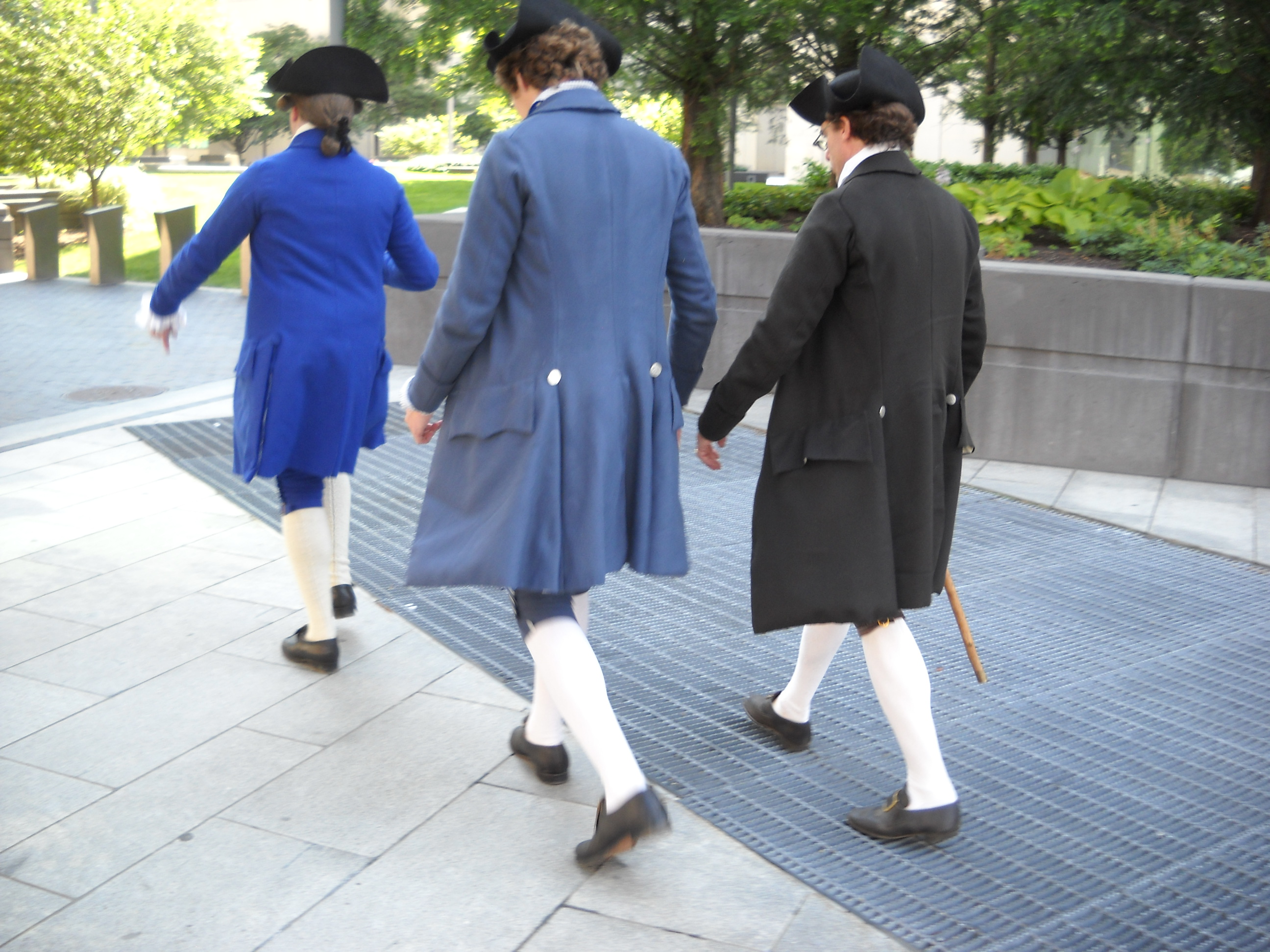
Three gentlemen at the Providence Station

L’Hermione, remember her? That French ship? We were asked back in January if we wanted to be part of a group of Citizens of Boston in 1780 who came out to greet L’Hermione when she arrived in port. Yesterday (July 11) was the day she finally came to town, and most of the Rhode Island contingent of our Massachusetts group went up on the MBTA to see her. The train was totally the way to go, though Mr Hiwell did consume three Diet Cokes before we even got to the ship. Turns out the Henry Cooke frock coat pattern pockets can each hold three cans– a full six pack per coat, should you care for such a thing.

Walk fast, it's the city!
Walk fast, it’s the city!

We got to Rowe’s Wharf in time for the national anthem– or, as we like to call it, The Anacreontic Song. There was much speechifying, and though we were not talking too much, water was required. Those pockets came in handy again, as did my own capacious pockets. Good thing, too: the line was long and the sun was hot. One woman offered to let us go ahead of her in line, but that seemed wrong: if you have to wait in line, you have to wait, and the rule we have absorbed is that the public comes before reenactors. But, since we’d been asked to come, we decided to check the situation, and went to inquire. The “bouncer” at the head of the line told us to come back later, so we decided it was time for some lunch.

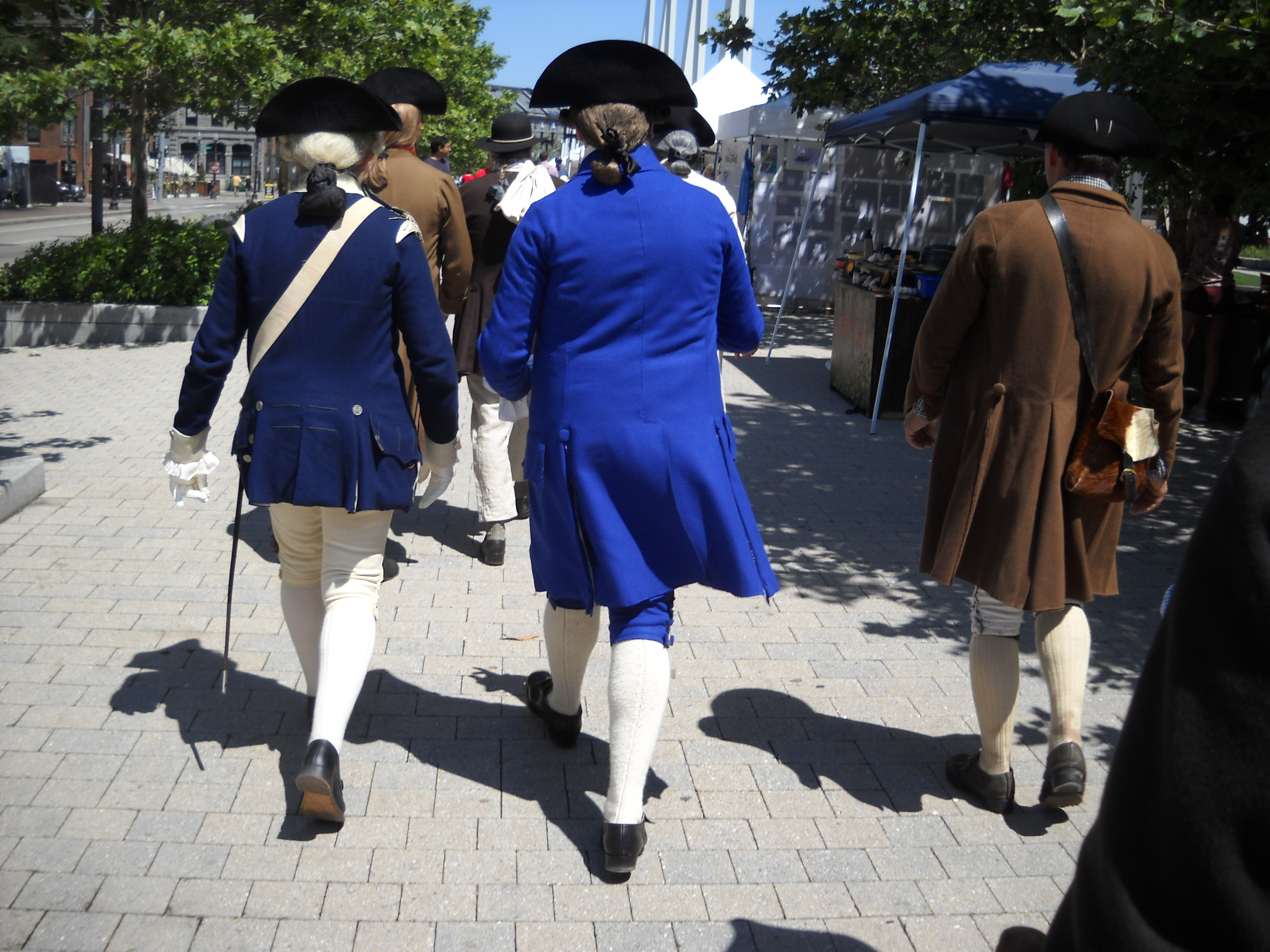
Lead, follow, get out of the way, or take another photo of backs.

By lunch, things were a little surreal as we sat at a table with people I never imagined sitting down with. No worries: it was all good, just a little weird that you have to leave Rhode Island to meet Rhode Islanders. The Young Mr inhaled his lunch, and probably made a lasting, if Hooverish, impression on our new acquaintances. The fact that the entire new contingent of the 10th Massachusetts sat on one side of the table, and that 80% of us were from RI, also made an impression. We are why you can’t have nice things.

Refreshed, we journeyed back to the ship, meeting more friends along the way. To be fair, Mr S and I had agreed beforehand that going up to Boston was as much about seeing our very dear and far-away friends as it was about the ship, and we were delighted to see every one of them. But at last, we thought, we can get on board.

Totally justified.
Totally justified.

No soap, as they say. The line was closing at 1:00 and we were too late to make it into the last crowd that would get on– it was the longest line I’d ever seen– and, even worse, many members of the public waited in the hot sun and failed to board. For us, five and a half months of anticipation were dashed in a moment.

But wait! Well found again, Mr and Mrs B and Baby B. Mr S was delighted to meet Georgiana (he has a thing for babies, and an uncanny ability to guess their ages, and to tease and delight them), whom he had very much wanted to see. L’Hermione was not the only tall ship in the sea: we considered the dry-docked USS Constitution, but chose the Sagres instead, as she is only in port for a few days. Off we went on another trek, waylaid often for photos. The Young Mr in particular kept getting stopped.

Gulliveresque, relly.

At least there was some shade here, and a bench. We took it in turns to go on the Sagres. Mr and Mrs B and I watched from the shore, and could see this happening. I don’t know how they trapped Mr S in this, but they did.

SagresSelfie

After an excursion to the ICA (which we are, as temporal performance art) for water, bathrooms, and some AC, the second shift got to visit the boat. We must have been cursed, because there was another line! At least this one moved, and however slowly and carefully in leather-soled shoes, we managed to go aboard.

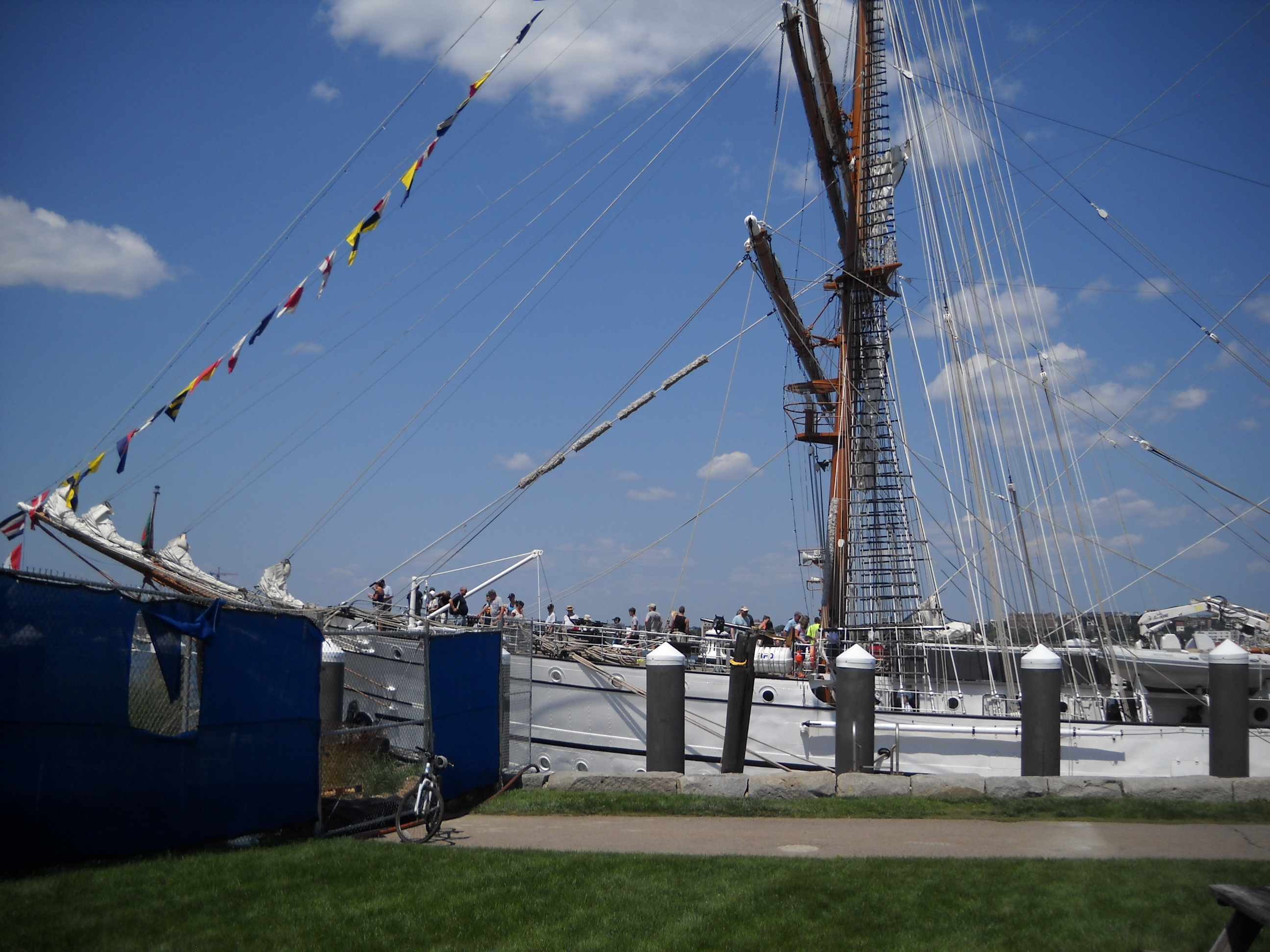
Hey, it's got masts.
Hey, it’s got masts.

Mr B was right: oversized yacht. Still very happy to have gone on a ship and to have seen many interesting things, including a very specific kind of display.

Portugal. The Best Fish in the World.

Mmmm, fish. All the packages were, in fact, empty. At this point we decided it was time for ice cream, and headed back. The Rhode Island Party ended up back at South Station for frozen yogurt and a bit of a rest. I don’t normally wear heels– ever– so a day in 18th century women’s shoes was a pedal workout. (We considered renting bikes, because if you have to be anachronistic, you might as well go all the way.)

Mr Hiwell and I considered the day: it wasn’t bad. We didn’t even get close to achieving what we thought was our goal. But we made our own fun with wonderful friends, had an adventure, and went at least three places we did not expect to go and had not been  to before. All in all, success, even in failure to board.

If they sleep on the way home, it wasn't a bad day.
If they sleep on the way home, it wasn’t a bad day.