Hand-woven Linens by Subscription

In the few short years I have been doing costumed interpretation and living history, I have made three shifts and four shirts and am making up a fifth shirt, with a possible sixth needing to be made, as well as four aprons. I’m not crazy, I just sew that way…for three people (one still growing) who dress for the decades between 1763 and 1812.

linen sample
Hand-woven linen: the top edge is the selvedge

There are several annoying factors when sewing historic clothing with modern materials– mostly that the modern materials aren’t quite right, and can be quite wrong. As Sharon Burnston explains on her website, much of this has to do with selvedges— which are not hard, and rarely tucked, now. The other trouble is width: many fabrics now come 54 to 60 inches wide, which means that you have to cut them down when making shift.

There is a solution: hand-woven, period-correct linen, available now by subscription from Justin Squizzero [email to order: justin(dot)levi(at)ymail(dot) com].

Mr Squizzero will weave both plain and check to the width you want: 3/4 (27″), 7/8 (31.5″) and yard (36″) widths, perfectly correct for period clothing.
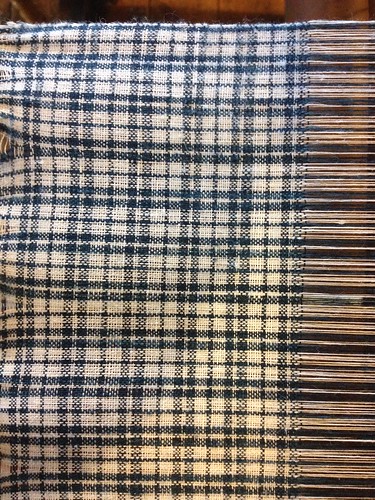
Hand-woven checked linen

The prices are $130/yard for plain bleached, $160/yard for checks– and what checks! Indigo dyed blue and white check in a pattern documented to New England at the turn of the 19th century? Oh, yes, please: I must save my allowance and sew only from my stash.

Although we debated fabric weights this past weekend, here’s what I think, and have found through wearing: shirts for soldiers and artisans– but not the elite–can certainly be made of the white and the check; I would made a shift from the white, but I prefer how my heavier shift body feels and behaves under stays. The check would be ideal, too, for an apron, which would require only one yard.

If you’re wearing a coat made from $120/yard wool dyed with documented colors, shouldn’t you wear the most correct shirt possible underneath? Entirely hand-woven (and hand-dyed in the case of the checks), you’re buying art– but isn’t that what you’re making and creating when you hand-sew your clothes and step into the past?
Disappearing Act

Being_A_Sandby

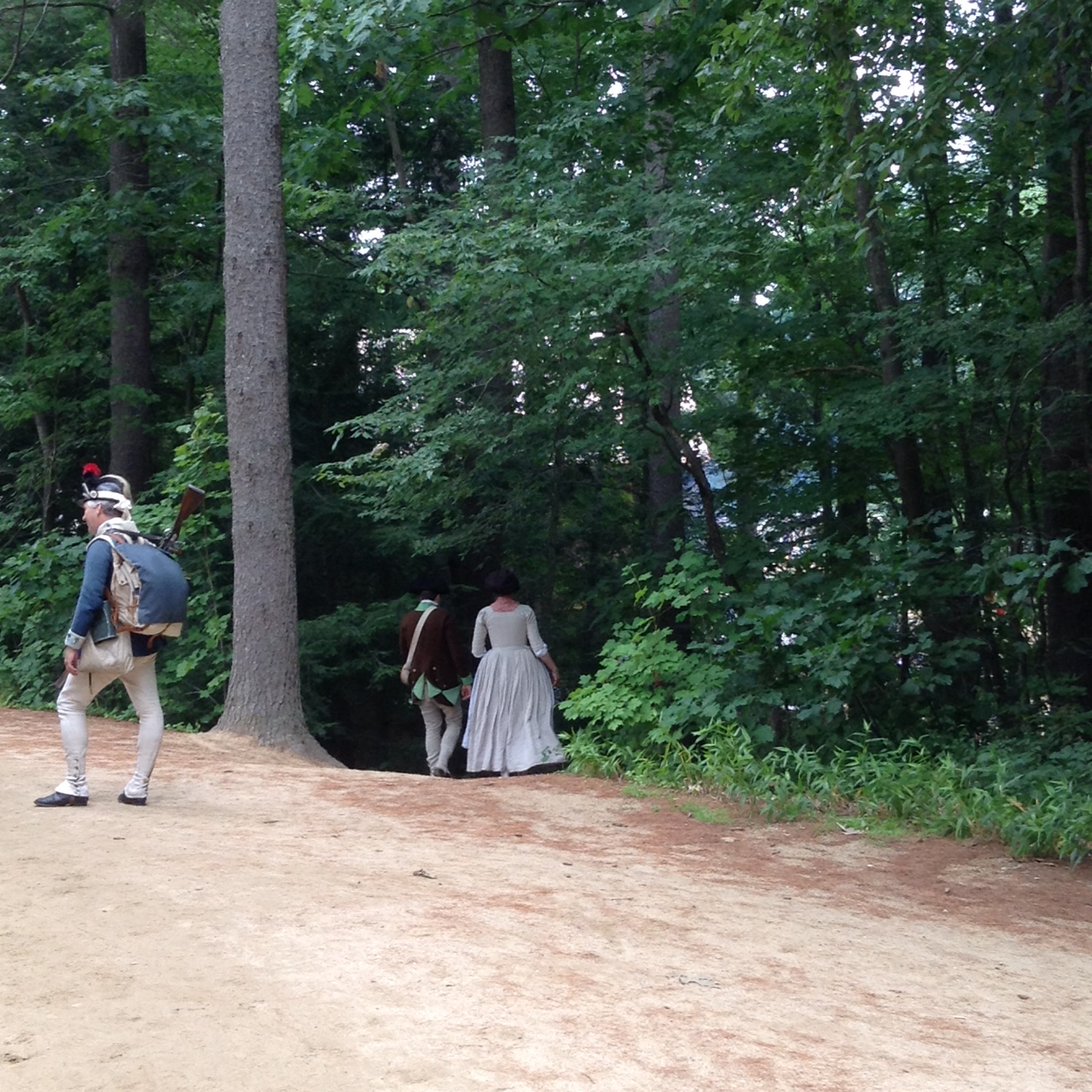
As you can see in this Sandby-like image, we went, briefly, to Sturbridge for Redcoats & Rebels, so that Mr S could wear the Andes Candies Coat and the Ugly Dog Coat in the Military Fashion Show and so that I could see Sew 18th Century again. (Thanks to her for the photo!). We didn’t realize how tired we were until we sat down.

It was then that I began to process the exclamation about Fort Plain and “We’ll make a bunch of the Ugly Dog coats,” which spun quickly to the research that needed to be done on the shape and type of lace and the regiment the coats were initially meant for.

Mr S says Mr HC rolled this out in the safest place possible: The Great Meeting House, in front of the public, where no harm could come to the one who suggested all that detailed sewing for Mr S and the Young Mr.

Afterwards, as we walked through the camps, I was glad we had not camped or spent more time: tired, I have even less patience for candelabra and spinning wheels in camp.

Instead, we enjoyed walking in the village. Just before the photo above was taken, Mr FC (at left) had been stopped by a family, who had many questions for him. My favorite moment was the little girl, perhaps 4 or 5, who held out her hand to him and said, “We found a cricket skin!” There are few men better suited to rolling with that that Mr FC, who took it all in stride.

After our stroll, yes, we exited through the gift shop. But I had a goal, a half-pint tin measure. Half of that is a gill, and multiplying up takes me to pints and even quarts, which means I get a little more sophisticated in camp cooking. Porridge, boiled flour puddings, dried pea soup will all be easier to get less wrong in a kettle with a basic measuring device. Yes, gills are the measure for rum, but I don’t recommend mixing it with hose water.

The Milliners’ Shop

One of the Milliners Stands in the Doorway

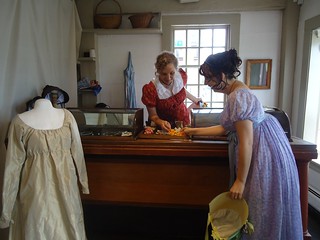
On Saturday last, Sew 18th Century and I set up a milliners’ shop for the Salem Maritime Festival. This was a fun event made even better by the opportunity to set up shop in an actual shop!

We started working on this project in the Spring, and kept working on it almost until it was time to pack for the trip.

Some of our goods, with the delightful Miss A

Milliners carried a wide range of goods designed to entice customers into the shop where they might purchase a new trim, ribbon or sash while admiring newer bonnet styles or fresh yard goods. Even in the 18th and 19th century, retailers new the value of repeat customers and impulse purchasing.

DSC_0238

Customers of all kinds came to our shop, some for retail trade, and some for wholesale. Mr JS is a weaver, and has offered plain and check linens by subscription– and I think our shop can do well referring custom to him. He was far more genteel than the sailors who came in– three times they visited, offering us money, but not for our bonnets!

Fresh from a privateer, Mr G and his crew mate stomped up the steps and made several untoward propositions, even daring to shake a bag of coin! Later they tried to entice a studious apprentice to join them, but fortunately he is a dutiful and serious lad with a thought for his future, and he declined their offer. At last Mr S was forced to confront these sailors on the waterfront– I think we shall soon require a committee of safety to patrol our streets and regulate the ruffians.

Mrs B examines some of our trims

Other customers shopped for trims and accessories. Mrs B is always fashionable, and one of our best customers. She sets a standard for refinement and style in our town that few can match.

cropped_Matt

Her husband is an officer in the Navy, and I fear sometimes he is startled by the bills– though he always pays, I think he may be surprised to see how fashionable we have become in Salem.

The bandbox maker, Ms M, set up in our shop as well. I do highly recommend her boxes as the finest made and best decorated that can be had. Bonnets and hats do not come cheap, and you do well to protect them.

In the late morning, I paid a call to Mrs B, and took tea. The coffee jelly was exquisite, molded in the shape of fish– very clever indeed– with marzipan fish and a rice pudding. It was a delight to all the senses, though sadly I had to hurry back to the shop. It is a great responsibility to keep a shop.

Shop window at the West India Goods Store

Thank you so much for visiting and for trading with us! Do come back soon, as we are certain to have new goods of interest to delight you.

Stony Point Part the Second

DSC_5121

No, it’s not my photo of the Young Mr: I didn’t even take a real camera on this trip. These top two photos are thanks to Gary V’s Flickr stream.

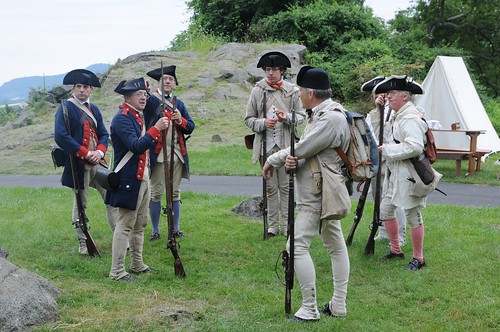
Here the kid is eating. I think he spent most of the weekend eating. There are some fine calves in the 10th Mass, aren’t there? Look what a well-fitted pair of overalls can do for you.

10th MA and 2nd RI: Mr S, Mr HC, Mr P, YM, Mr FC, Mr B, Mr  H

We all benefited from hanging around Niel DeMarino’s historic bakery. Broken cookies are just as delicious as whole, if not better, and the ginger cakes were the best I’d ever had. It’s a pity that one can’t really bake in camp…

Mr S thinks I should tell the story of my 90-minute stint in solitary at Stony Point, but I’m not quite prepared for that.

Instead, I shall recount the Hose Water Coffee.

As fans of the 18th century know, orange water and rose water are not uncommon flavors in the receipts found in Hannah Glasse or Amelia Simmons‘ cookbooks.

Hose water is something else again. It is not improved with age.

At Stony Point, there was water at a stone ‘bubbler’ (props to those who used this Rhode Island term for the street furniture known elsewhere as a drinking fountain), which was hard to see in the gathering dusk the night we arrived. There was also a hose, proximate to a saw horse with a sign for Pedestrian Only traffic, and just down the path from our tents.

Colonial breakfast on a rock
Our kitchen, dining table, and parlour

Following Heather’s excellent advice, I planned to make cold coffee overnight so that we could be caffeinated in the morning. Lazily and unwisely, I used the hose to fill the pitcher of doom that first evening.

What is the essence of tire? L’eau latex? That’s what we had: strong coffee with a strong base note and unmistakable top note and bountiful middle notes of hose. Did we drink it? Of course we did: we were up at 5, and coffee was not provided until 8:30, when we all had second breakfast.

Saturday night, I skulked back to the bubbler and filled the pitcher again for Sunday’s coffee. This time, the clear, strong liquid was redolent only of coffee, and was judged better than the hot coffee (which had, in fairness, not been made with hose water, either). I’ll definitely repeat the coffee experiment, though I think I can use a little less coffee to water– not that I measured.