Last Saturday, we stepped back in time to 1765 in Newport. I know: Newport always seems to be in a different time than gritty Providence, but this trip was truly different.
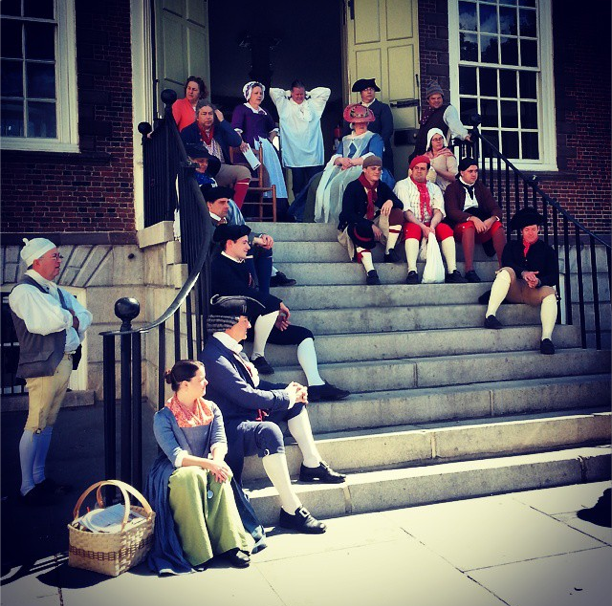
On the Colony House steps
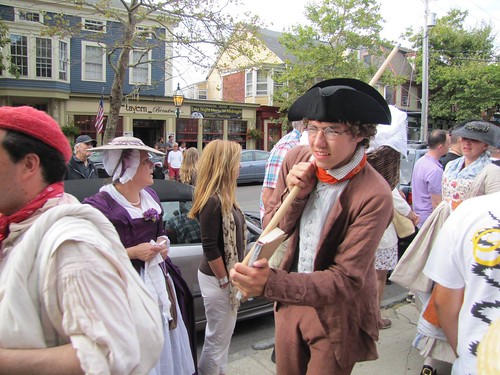
We were headed across the Bay for a Stamp Act Protest (no rioting, per police request). In this effort, we joined a large group of recruits from New England and even beyond, to fill Washington Square and other sites in the city.
Preparing the ‘sails’ for stitching. I never really noticed the cars till I saw the photos!
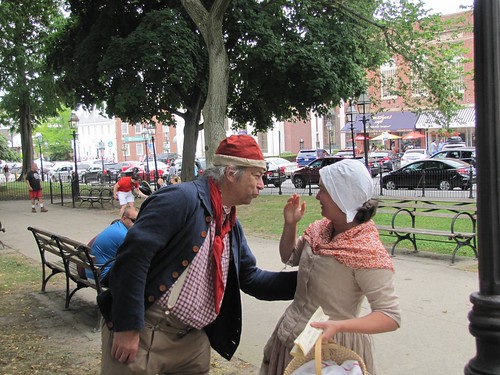
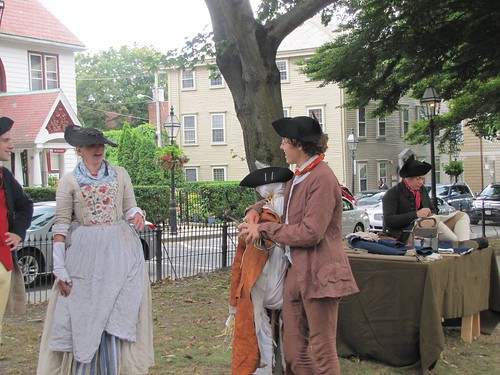
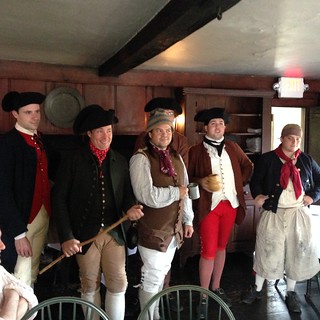
Stationed around the square were sailors mending or making a sail*, an apprentice-less printer, a sleepy apprentice boy, a tailor and his journeyman, a milliner, and leading citizens, one of whom was kind enough to read the newspaper to the apple seller, who wonders what has become of her son.
You must be very careful indeed around the sailors!
Up the street, some very fine ladies were having tea. Their refinement was evident in their appearance and dress, as well as in the elegant setting of their tables. They wanted none of my apples, as they had imported citrus fruits, far better than the apples the island’s trees produce. (Wasted on tea, truly: what one wants to do with a lemon is to find some rum and make a punch.)
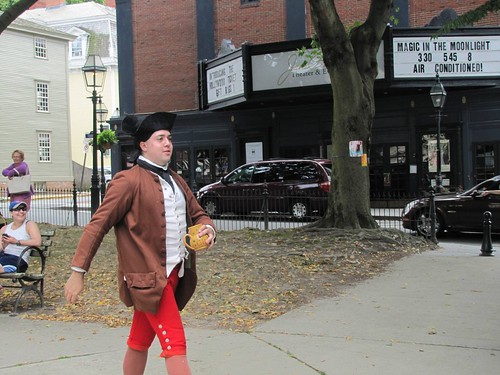
The Ladies’ TeaSeated for teaMr Robinson marches forth
The news was very bad, and tempers flared in the square. Mistress Ellery told me that dinner parties had become impossible to hold: parties nearly come to blows over discussions of taxes, customs, stamps, and the oppressive policies of Mr Robinson, who insists on enforcing the very letter and penny of the law. (He was quite insulting on the quality of my apples, indeed, spitting one upon me even as he continued to eat it!)
The apprentice boy had charge of the effigy; the tailor sewed on.
As the afternoon wore on, the debate grew more intense and the crowd more heated. And effigy of Mr Howard was made, paraded, and hung, and then the crowd of protesters dispersed to the White Horse Tavern.
Fortified!
Tensions seemed to dissipate, though when the runner came, the protesters– now fortified with ale, porter and cider–ran down the street to “plunder” Mr Howard’s house, played here by the Wanton-Lyman-Hazard House.
Ignoring the mistress of the house, protesters dashed to the back.
Although the mistress of the house tried to reason with them, the crowd would not be dissuaded, convinced of their mission (and perhaps more fortified than you would expect after just one glass). They carried their loot to the front of the Colony House, and heaped it up, glorying in their success.
The goods!More goods!
In the end, the house was not looted, tensions were dissipated, and the protesters dispersed into the afternoon. We were well-rewarded with cheese and ale at the Colony House, and enjoyed discussing the events of 1765 and 2014 with the public and Newport Historical Society staff members.
*Yes, Virginia, they do look like tents. That’s because they are tents. Someday, Light Infantry soldiers will sleep beneath that canvas. But for now, keep stitching!
When I don’t manage to write up the weekend quickly, I risk forgetting what happened, which is sad when you think how intense the time can be. This past weekend was a little different from others as there were more of us in camp than usual. I locked the camera in the car along with my car keys, and never remembered to ask Mr S for his key when he was present…so the images are all from other sources.
Last week I was party to the Great Oatmeal Debate by Text Message as I tried to determine whether or not oatmeal was correct in period, and if so, what kind. Let’s call it Hannah Glasse’s “oatmeal flummery” and move on.
To make Oatmeal-Flummery. GET fome oatmeal, put it into a broad deep pan, then co ver it with water, stir it together, and let itftand twelve hours, then pour off that water clear, and put on a good deal of fresh water, shift it again in twelve hours, and fo orrin twelve more ; then pour off the water clear, and ftrain the oatmeal through a coarfe hair-fieve, and pour it into a fauce-pan, keeping it stir ring all the time with a stick till it boils and is very thick ; then pour it into difhes ; when cold turn it into plates, and eat it with what you pleafe, either wine and fugar, or beer and sugar, or milk. It eats very pretty with cyder and fugar.
We were very lucky to have hard wood for fires, and I was very lucky indeed to have Mr McC on hand to tend to the fire, especially on Sunday morning, when I did not get up and start dressing until 6:00 AM. He joined us early Saturday morning with a kettle of hot coffee in hand, proving long experience with the un-caffeinated reenactor in the wild.
The Georgian Kitchen and Sugar Loafe Baking Co at Walloomsac
The Young Mr eventually bought his own loaf of bread, stuffed it in his haversack, and ate from it fairly continually on Sunday. If there had been a ginger cookie as large as a loaf of bread, I expect he would have bought that instead, but bread was a reasonable choice (though I think it proven tricky to hold a musket and a loaf of bread simultaneously….)
Militia in Small ClothesMr S (left handed, as you can see) following MrMcC
The 10th Massachusetts, fielding as militia, are in the second and third rows above; I was shocked–shocked!– to see them fielding in their small clothes, but it is documented, and as they said when they lay down and even left ranks before fielding, “We’re militia. We’re not listening.” (Left to right, that’s Mr FC, Mr S, Mr McC and, in the rear, Mr L.)
For me, the best part of the weekend was, as it always is, being outside of time. (I even had a nap on Saturday, when the gents were up at the battle: more delicious than stew or cookies or even quince cake.)
At Sunday’s divine service, I was reminded again of why I enjoy this, and why we keep doing this, even when it all seems ridiculous in the face of the larger world.
The old service from the Book of Common Prayer is not that different from what we used in church. The formal rhythm and familiar words always remind me of how different the 18th century was from our own time, and how small people could feel in the face of a world without electricity, internal combustion engines, and modern weapons of war. As we lined a psalm and recited the liturgy that hoped for peace, I thought of Ferguson again, and of the ways that people bind together in beliefs without regard to class or color, and had some hope (even as I recited om mani padme hum internally). A moment of grace is often more easily found stepping outside yourself, and stepping out of time and out of doors can help.
Speaking of stepping out…
Almost steppin’ out of the 18th century…
We had to pack up and flee back to the 21st century on Sunday afternoon, and I was caught getting partially undressed outside our tent (between my height and Natural Gace, I find outdoor dressing easier). No matter what you do, or when you do it, a healthy sense of humor about oneself is always useful.
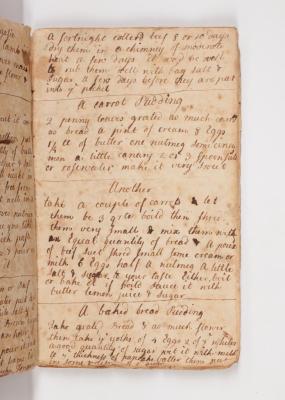
Thanks to the American Antiquarian Society and a grant from the Pine Tree Foundation, you can now access digitized versions of the AAS’s manuscript recipe/receipt/cookery books. Pretty cool, right? Because I know you want to experiment with every variation possible of carrot pudding. (Mr S got a stomachache just now and doesn’t know why…)
I first read about this in a twitter link to the MassLive article, and I’d like to point out up front that you go to the AAS GIGI portal and search in the box for Pine Tree Foundation. That’s the quickest way to access the books. I also searched for cookery or recipe and ended up in some interesting places with carrot pudding recipes.
One of the AAS staff members has been trying out the various recipes, and blogging about them here. There appear to be manuscript books as early as the late 17th or early 18th century, which is very cool (and still about puddings!).












 Kirsten Hammerstrom
You must be logged in to post a comment.