Itching for Style

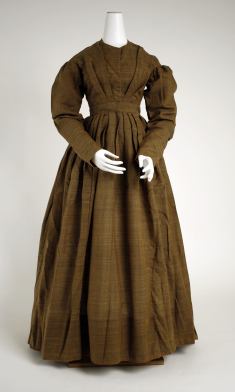
Dress Date: 1830s Culture: American Medium: wool Dimensions: Length at CB: 53 1/2 in. (135.9 cm) Credit Line: Gift of John Eastman and Gerard L. Eastman, 1976 Accession Number: 1976.209.2
Dress, 1830s. American, wool.
Gift of John Eastman and Gerard L. Eastman, 1976.209.2 Metropolitan Museum of Art

Wool. It’s a thing. This dress from the Met has many of the markers of everyday fashion– a vernacular form, if you will, of what Deliverance Mapes Waldo is wearing in this portrait

Deliverance Mapes Waldo and Her Son about 1830 Samuel Lovett Waldo (American, 1783–1861 American) DIMENSIONS 77.15 x 64.45 cm (30 3/8 x 25 3/8 in.) ACCESSION NUMBER 45.891 MFA Boston
Deliverance Mapes Waldo and Her Son, about 1830
Samuel Lovett Waldo. 45.891 MFA Boston

Of course, dating these things is never a science when they don’t come with a clearly labeled tag you can affirm with research. The extant garment first. The sleeves say 1820s, the waistline says 1830s. Could it be 1840s? Perhaps. Without provenance, it’s really hard to know.

Mrs Waldo’s sleeves are clearly 1830s sleeves: full on gigot, sloped shoulder. It’s the contrast between her sleeves and the Met’s dress that makes me question their date (along with the fashion plates we saw yesterday).

Here’s a wool gown from England, land of the fabulous wools.

Dress, England, Great Britain.  1836-1838. Printed wool, trimmed with printed wool, lined with cotton, hand-sewn Given by Mrs H. M. Shepherd, T.11-1935. Victoria & Albert Museum.
Dress, England, Great Britain. 1836-1838.
Printed wool, trimmed with printed wool, lined with cotton, hand-sewn
Given by Mrs H. M. Shepherd, T.11-1935. Victoria & Albert Museum.

Here the sleeves are starting to be narrowed at the shoulder, taming the gigot. That places this 1836 or later, which is helpful. The bodice style is still not the pleated or smocked front of the 1840s, so that’s another marker for mid-to-late 1830s.

What will I do? I don’t know. I’ve ordered two patterns (and one for a new chemise, sigh). The Past Patterns Lowell Mill Girl dress appears to make up quite nicely, but I also ordered the Wisconsin Historical Society pattern for comparison. (Hey, when you can’t examine originals, you have to use the patterns.) Fabric is always a question, but if I’m feeling plain wool, there’s always Burnley & Trowbridge’s “Virginia Cloth.” I’ve worked with it before, so I know how it handles, and while the color looks itchy, it’s actually pretty soft.

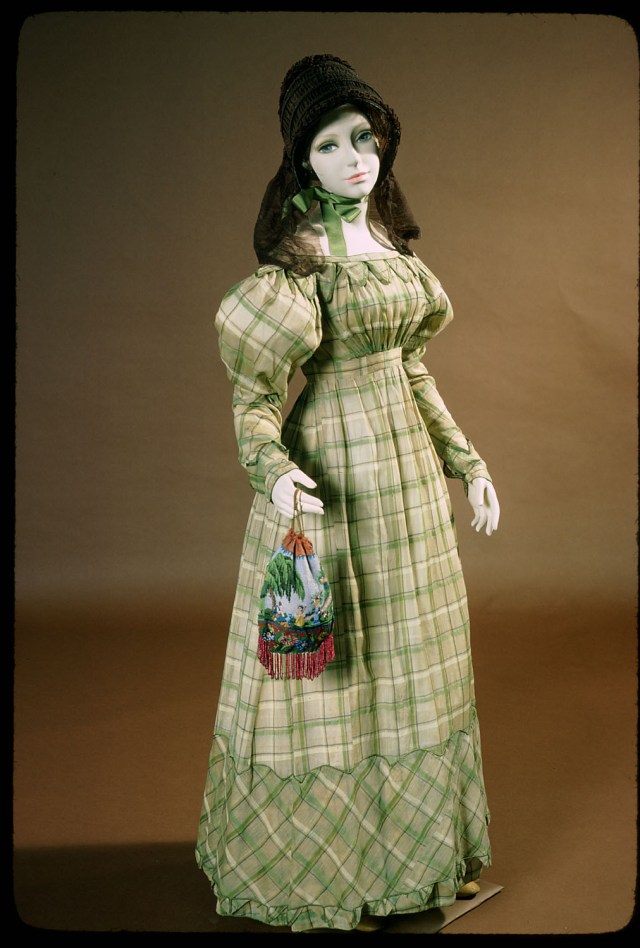
Gigot or Gigantic?

Carriage and Morning Dress, 1832. LAPL Fashion Plate Collection

So, about that 1833 thing…

No, it’s not that I’m reconsidering. It is merely that as I consider the options, the fashion plates are a bit overwhelming. On the other hand, I am getting really good at recognizing the look of the 1830s in undated portraits. There’s an upside to everything.

Extant garments are fairly plentiful in the Usual Suspects’ Collections; there’s even a Tumblr. There’s a Tumblr for everything.

Woman's Green, Tan, Yellow and Blue Striped/Plaid Gown. OSV, 26.33.63
Woman’s Green, Tan, Yellow and Blue Striped/Plaid Gown. OSV, 26.33.63

Fortunately, there are some tamer garments out there, with sleeves less likely to result in flight in a high wind. Bonus: not floral, and not silk. Printed wool seems to have been fairly common, but the weight is just impossible to find. I did some looking in New York, but nothing convinced me with print or price.

This is a milita muster, so there will be time outside. I’m toying with a habit or Amazone (hard to resist a garment with that name) though the most I know about horses is that they have four legs. It’s tailoring that attracts me, not use. Also, wool. Mid-September might warrant wool, even if that’s hard to imagine today. (The downside, of course, is that there’s menswear to be made, too, so a simple dress is surely the best option.)

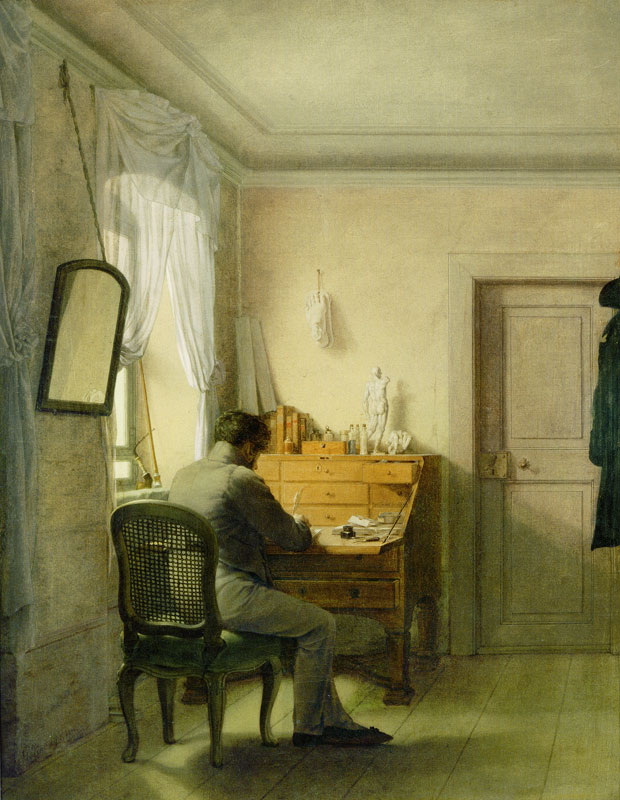
Man at His Desk

Georg Friedrich Kersting, A Man (artist) at His Desk.  1811. Klassik Stiftung Weimar, Goethe Nationalmuseum
Georg Friedrich Kersting, A Man (artist) at His Desk. 1811. Klassik Stiftung Weimar, Goethe Nationalmuseum

1811 caught my eye and stopped my Twitter scrolling. Kersting never fails to please, luminous watercolors and delicate details. Summer is here, along with events in so many years I feel quite distracted.

1780 this weekend (L’Hermione in Boston). 1775 a few weeks later. 1814 in August. 1833 in September. You could get whiplash looking at waistlines and sleeve silhouettes.

What I need is to take the time to sit, like Kersting’s man, to reflect and to write and to make a plan. I’ve fallen behind on the garment-a-week program, and need to catch up quickly. The faster I sew, the less like the Young Mr can outgrow the garment before it’s finished.

Proper Sewing for Proper Garments

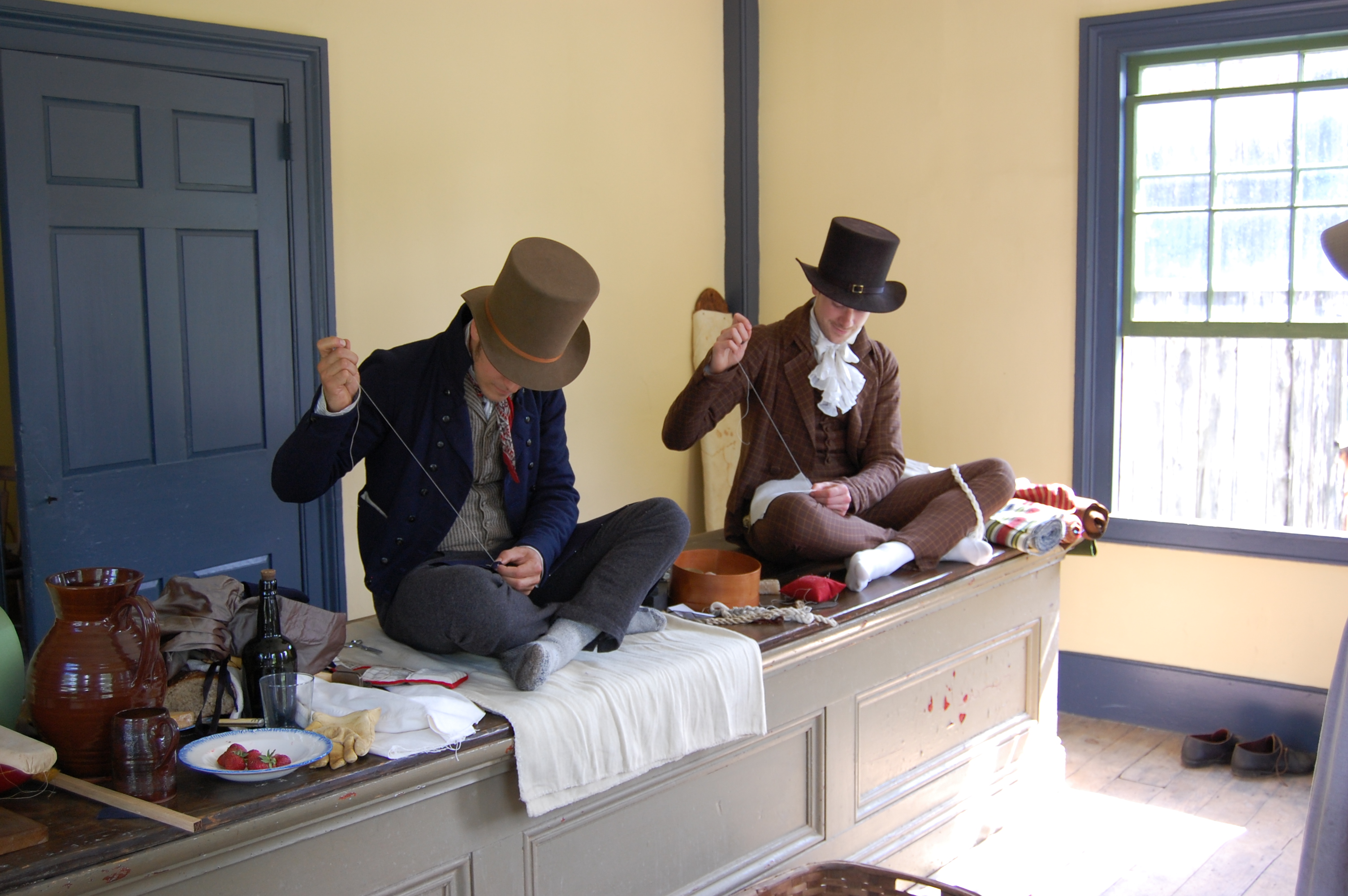
Synchronized sewing
Synchronized sewing

Tailoring: It’s the thing, right? A well-cut, well-fitted, and well-crafted garment fits like no other. Why do you think I prefer my historical clothes? They’re fitted to me, so they feel right.

There are lots of resources, if you’re willing to dig a bit. Last year, thanks to Mr Cooke, I brought you The Taylors’ Instructor. Good stuff, right?

But wait: there’s more. So much more. Not just the V&A Tailoring Reading List. Actual media. You can watch tailors using thimbles properly, and pad stitching with grace and ease. Prepare yourself for the bona fide English accent as Rory (winner of the 2009 Golden Shears Award) Duffy teaches you a thing or two in these videos.

Just want to know about thimbles? Here’s Savile Road Training to teach you technique.