Mopping Up

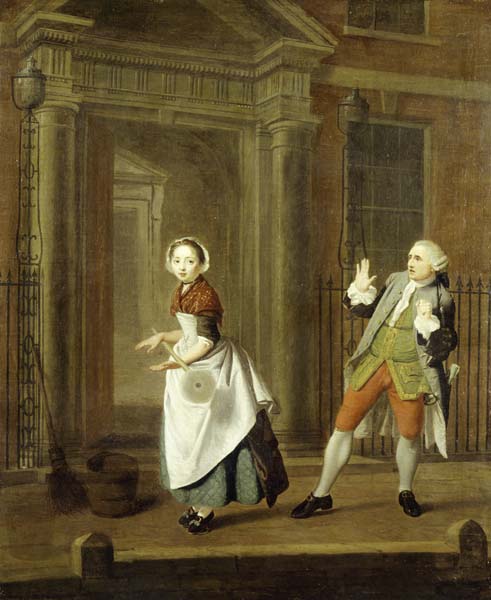
A City Shower. Oil on canvas by Edward Penny, 1764. Museum of London

Springtime sadness is best remedied by scouring[1], so in the best Scandinavian fashion, I have been looking into 18th century cleaning. Dem barracks, right?

First of all, were you wondering about what exactly they “smoked and cleansed” smallpox victims’ rooms with? Brimstone and frankincense.[2] Now you know what Edward Langford would wake up smelling when the house next door was free of smallpox.

But what about those floors? They need to be cleaned. Swept, yes, and scrubbed with sand. But also mopped, and the doorstep mopped.

Tit for Tat. stipple etching, London, Printed for R. Sayer Map, Chart & Printseller N° 53 Fleet Street, as the Act directs Novr 24. 1786. British Museum 1861,0518.958

I have a broom and a whisk broom, and can substitute a kettle for my sad bucket[3] but I lack a suitable mop. Lack never deterred me, whether of skills, knowledge, or supplies, so off to the interwebs and library I went.

I started with Foul Bodies, the 2009 monograph by Kathleen M. Brown. Nothing on floors, sadly.

I remembered the 10th Massachusetts Orderly book from 1782, that was more helpful.

Some part of the Camp and about the long Barracks in particular is relaxing into nastiness. Regimental QuarterMasters have been ordered to have them Clean and keep them so. An Officer of each Company has been ordered to visit the Barracks every day and to Confine & Report those who throw bones of meat Pot Liquor or filth of any kind near the Barracks. Yet all this has been done and no report has been made. it is hatefull to General Howe to Reitterate orders as it ought to be shamefull those who make it necessary.
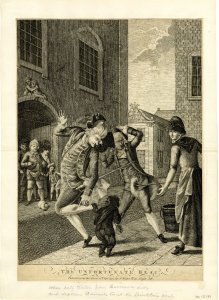
The Unfortunate Beau, etching, Publish'd as the Act directs 12th Sept 1772, by S.Hooper, No.25 Ludgate Hill. British Museum 1991,1214.20
The Unfortunate Beau, etching, Publish’d as the Act directs 12th Sept 1772, by S.Hooper, No.25 Ludgate Hill. British Museum 1991,1214.20

Nastiness. Those barracks sound noisome, don’t they? We can’t have that.

So let’s cast out the bones, sweep the floors of the branches and dirt and grit the men have brought in, and mop them, too, now that it’s spring.

Mop, you say?

What did mops look like the in 18th century?
And how on earth will we acquire one?

Tune in next time for another exciting installment of “historical cleaning instead of cleaning my own house.”


[1] Dude, I have scrubbed baseboards with a toothbrush. Not one of my finer moments, but a memorable one.

[2] Kathleen Brown, Foul Bodies: Cleanliness in Early America. (New Haven: 2009) p. 129

[3] Really really: I meant it when I said keep the bucket wet.
Frugal Friday: Make Do and Mend

In a world of fast fashion, mending is quite out of date (unless you’re a hipster, and I am one of the trilobites of hipsterism), so it is all the more appropriate that I have a gown in need of mending.

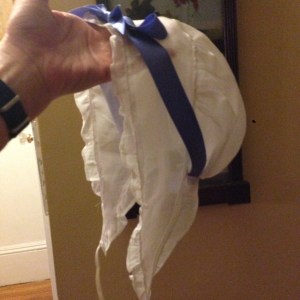
I am still making new things, like the “Bad Squishy” jellyfish cap. It didn’t look so tentacular until I held it up to show it off. As with any cap, the main goal is merely to keep it upon my head–always in doubt.

Tenactularly good. And now I can whip gather.

In just a week I’ll be headed up to Fort Ticonderoga to clean the officers’ quarters and generally represent the women who accompanied the 26th Regiment of Foot— and yes, I know I’m old enough to be the mother of any number of those folks, but there’s no need to point it out all the time. The main thing is the cleaning. And the weather, which looks like it could once again be unseasonably warm. That won’t stop me making another wool gown, which I am making up in a drab wool specifically for dirt and distracting my unsettled mind.

Washing, wearing, and airing

All the same, I pulled out the mother of all wrecked and wreckable gowns, the cotton gingham made for Bridget Connor. This has achieved a pretty nice patina, though I will confess to having washed it last fall after repeated wearings over the course of the summer. I know– not so necessary, but I did. Fear not: the stains remain.

But I wore it vigorously and made it up quickly– to the point of needing to take it off and mend it at Stony Point (was that really two years ago?). Mending is required once again, so that small seam ruptures do not become actual sleeve separations as I dust, sweep, and mop. Yes, of course I’ll be making experimental mops this weekend, why not? There just isn’t enough distraction in the world.

I worried about those eyelets I installed way back when, but was relieved to discover that I had seen a precedent, and that the date was within tolerances for someone of my age to retain in her clothes. The lacings also make dressing significantly easier for me; some days, putting on an open robe takes me back to the button-up and lace-up toys of pre-school, when tying shoelaces was a major accomplishment.

Zen and the Art of Living History

sandpitGate
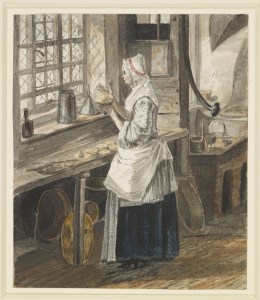
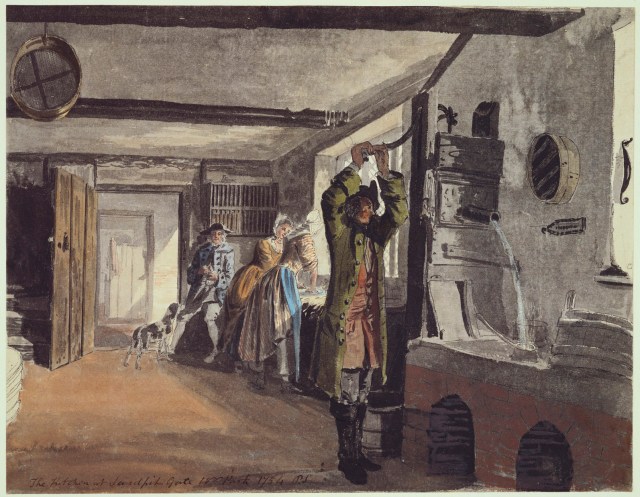
Paul Sandy. The Kitchen at Sandpit Gate, ca 1752 RCIN 914333

or, Embrace the Everyday

Chop Wood, Carry Water is taken from a Zen saying: Before enlightenment, chop wood, carry water. After enlightenment, chop wood, carry water.

Yes, I read the classic book decades ago when my life had fallen apart pretty completely, and when I dismantled it again recently, similar principles applied. After processing archival collections, sorting sewer bills and love letters– toiling in the salt mines of the mundane–I came to appreciate Chop Wood, Carry Water even more. The world isn’t really binary, but it can feel that way.

Paul Sandby. At Sandpit Gate circa 1752 Pencil, pen and ink and watercolor. RCIN 914329
Paul Sandby. At Sandpit Gate, ca 1752 RCIN 914329

We look up out of the trench of daily life and think we see giant, heroic figures doing great things, and we feel jealous. We want to feel special. Some of us want to feel pretty, or handsome, or important.

Some of us want to chop wood, carry water.

Paul Sandy. The Kitchen at Sandpit Gate, 1754. RCIN 914331

The way to make living history more interesting and more relevant is to go deep into the everyday. I don’t mean spinning– unless you tell me why you’re spinning, and I hope it’s part of Boston’s failed “We’ll make it all ourselves!” Little-Red-Hen experiment of the late 1760s–I mean living. Everyday things.

Dishes, laundry, three meals, sweeping, making up beds, mending, chucking the cat out the window, checking on dinner, chucking the cat out the window again. That’s the background against which all of the Great Men and Remembered Ladies stride and saunter. Us. You and me. Waking up with frowzy hair, blinking in the pale light of dawn. That’s the world the Great Men woke up in. That’s the world they occupied most of the time.

When we recreate Great Moments, we’re only replaying the highlight reel. Without context, those moments have less meaning. You’ve heard this sentiment before.

Chop wood, carry water. Embrace the everyday, bring everyone back into history.

Massacres and Mondays

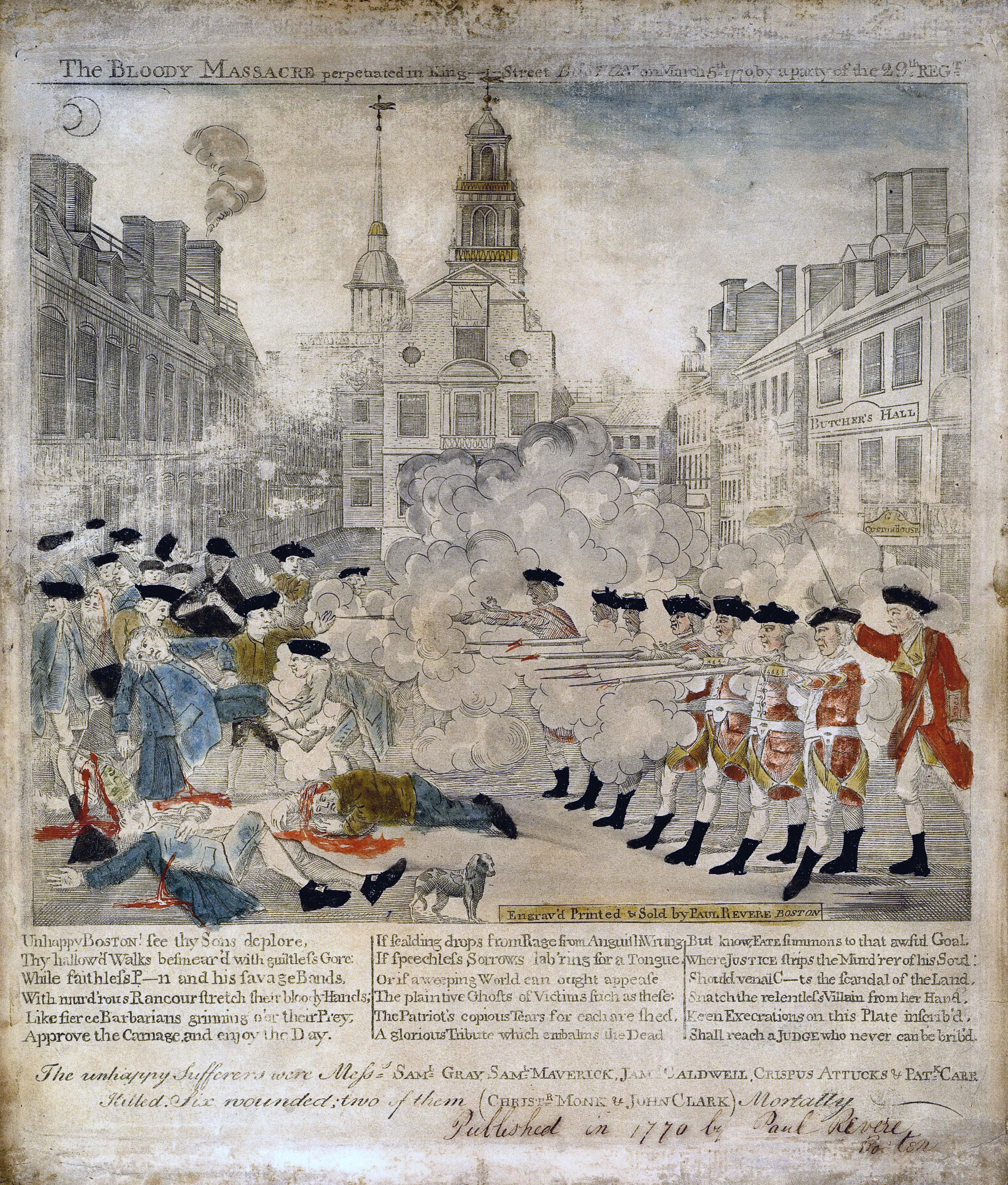
March 5, 1770: Sound familiar? The Boston Massacre.

Happened on a Monday, by the way: how ironic is that?

But here’s the thing: if the Monday is emphasized, the Massacre stands out. Focusing on the normal makes the unusual ever much more so. And in the case of Monday, March 5, 1770, the usual is actually unusual.

Paul Revere, “The Bloody Massacre in King-Street, March 5, 1770.” Boston, 1770

Over the course of the month leading up to Saturday’s event, Drunk Tailor and I spent a lot of time talking about the night watch, peddling, food supplies to Boston, population, and what I might call “the texture of everyday life” in a meeting at work. Any reading you do forces you to realize that the key to the Massacre is how very abnormal everyday life had become in Boston that winter.

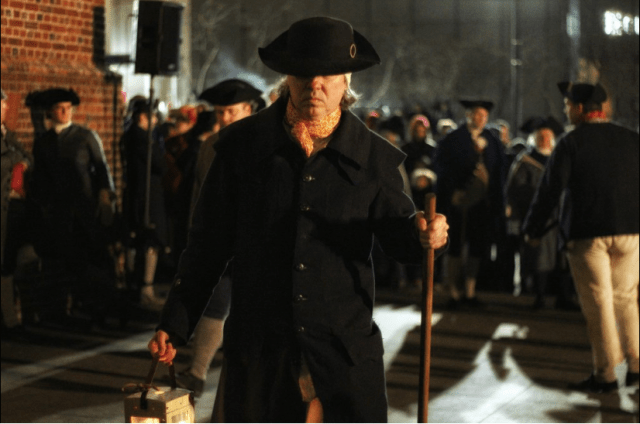
Edward Langford, disaffected nightwatchman. Boston Str
Edward Langford, disaffected nightwatchman. @BostonStrolls on Twitter

By 1770, Boston was an occupied city: Ferguson comes to mind, or Ramadi. Soldiers and watchmen patrol the streets, civil and martial structures clash, and the Sons of Liberty chafe under this control– or attempt at control. Scuffles, fights, brawls, break out. A boy is shot to death– accidentally– and tensions mount higher.  Sailors and soldiers alike commit acts of vandalism. Women are assaulted. Normal isn’t normal anymore, and Boston was always expensive to live in. Even in a city occupied by “friendly” forces, gathering supplies and going about one’s daily business became harder.

People are scared. This is a tense city. Lots of people are just trying to survive. Lots of those people are children. Roughly 16,000 people, and if the estimates are correct, 2,000 soldiers and 4,000 men (white, African, other, free, indented and enslaved), which means about 4,000 women and 8,000 children under 16. Let that one sink in: lots of children, lots of teenagers. I don’t know about you, but a city with a large population of teenagers is going to be tense under the best of circumstances, even in an era before the rise of youth culture. Hormones, man. The kid can’t help it.

So imagine this: instead of a mobile monument and a commemorative ritual that substitutes fists for muskets, the Massacre commemoration expands to include the day, and not just the night. Monday and a Massacre.

Townspeople hurry home as dark falls. Women lug laundry back to customers or to the washhouse, or trundle barrows home, empty, after a day of hawking cats’ meat, oysters, or fish. Tired cordwainers trudge the streets, hoping for meat at supper. A mother scavenges firewood to warm her rented rooms, keeping an eye out for the watch. Those are not Mr Hutchinson’s fence posts, truly.

Photo by Tommy Tringale (Claus' Rangers, 2nd NH, 3rdMA and HMS Somerset)
Photo by Tommy Tringale (Claus’ Rangers, 2nd NH, 3rdMA and HMS Somerset)

Women look over their shoulders, nervous at the sound of hobnailed shoes on the streets. Older men skirt closer to buildings, out of the way of soldiers in the street. Apprentices mock an officer, a sentry responds.

Insults, a scuffle, a boy knocked down. A mob, soldiers, a woman shoved, shots fired, men killed and wounded, blood on the snow.

Murder in the midst of the mundane. More horrifying (in truth, I have never heard Boston so silent as I did on Saturday night) within its context than set apart.

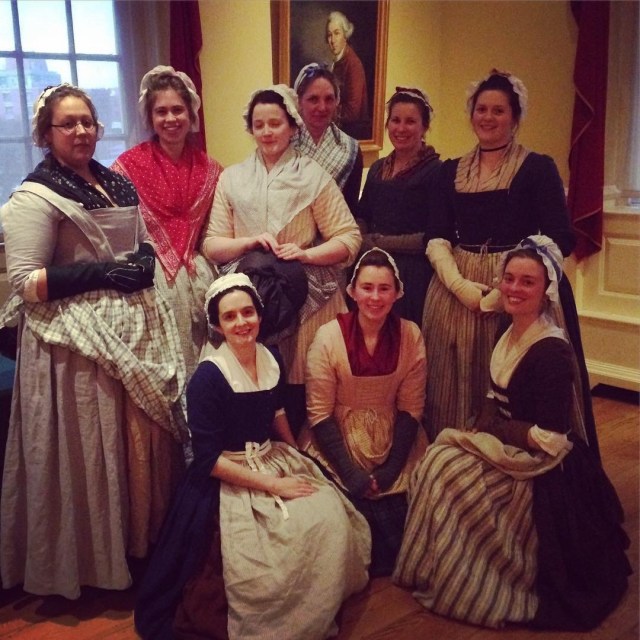
The Women of the 2017 Boston Massacre commemoration. Photo by Drunk Tailor at the behest of Our Girl History

The benefits?
A more complete picture of life in 1770 that puts the events of the evening of March 5, 1770 into deeper context and thus a sharper contrast.
A recognition that history isn’t just about men and conflict.
Understanding that what made living under occupation so hard was more the living– trying to be normal–than the occupation.
And, yes: more for women to do.