
It has been a long time since I read Bowling Alone, and longer still since I read A Pattern Language or Jane Jacobs, but all of those came to mind this past weekend.
I don’t mythologize or romanticize the villages of the past: we all know how The Crucible turns out, but I thought about privacy and proximity, and I thought about scale. Let’s take privacy first.
In this century, it’s difficult to experience the past as anything more than a series of simulacra which we piece together in a crazy quilt of understanding, but past notions of privacy are far different from our own.

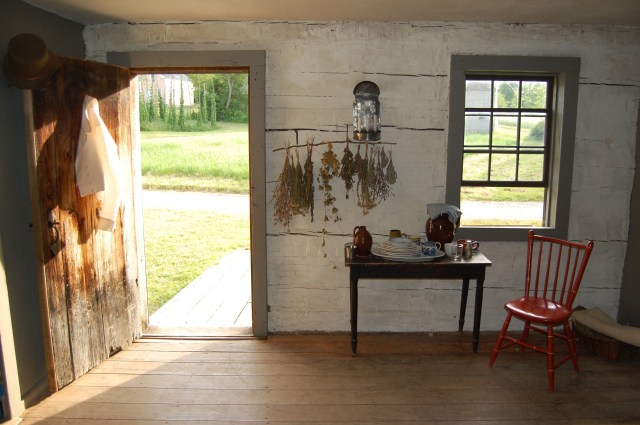
Early one morning, as I lay in a creaking rope bed, I considered how unfamiliar most of us are with the noises of other humans. The wall of our bedroom just barely fit against the exterior wall, and moonlight on whitewash showed the spaces between planking and the plaster, and we slept with the bedroom door open to take best advantage of the cool evening cross breeze.
As I lay awake, my companion happily asleep, I pondered the true extent of my laziness. How much clothing did I really need to wear to go up to the public facility? How loud would relieving myself in the chamber pot be? And what would the reaction be? (I have been on the side of someone else’s choice not to use a chamber pot, and said, “I wouldn’t care,” but one never knows.) And though I elected to put on more than my shift and walk to the public convenience, I began to wonder: what did the people in the past tolerate, ignore, or politely decline to mention?
What did living together feel like, when people shared smaller spaces? When the boundary between private and public, bedroom and parlor, was pierced with holes?
 When I climbed the stairs to Hosmer’s Tavern for Sunday dinner, the kind ladies at the front door told me, “Your family’s in the back room.” This directive gave me pause, for while I am one to argue that we each define our families for ourselves, I did not believe the young woman necessarily understood my theorizing on the dangers of calling people “families” when you don’t know their genealogy. Then I saw this image, taken at Jones House the evening before by the lovely Mrs LC, and realized that the young lady on the porch may have seen something I am too vain to admit.
 Mr S had the most meta experience of all of us, for as I photographed him, an artist was painting him drawing. We could not have had a better living history through literary theory weekend if we had tried. Mr B worked with the camera lucida, something that is beyond my abilities. (It is an unintentionally meta image of Mrs B photographing Mr B while I captured both of them: my junior year art history professor would be dismayed.)
 Representing leisure is something I haven’t done before. My idea of


 Kirsten Hammerstrom
You must be logged in to post a comment.