Sandby in Salem (New Jersey)

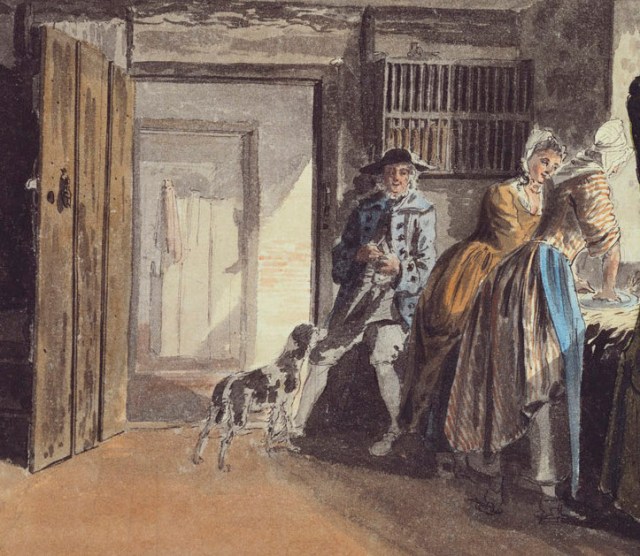
The Kitchen at Sandpit Gate (detail). Watercolor on paper by Paul Sandby 1754. Royal Collection Trust, RCIN 914331

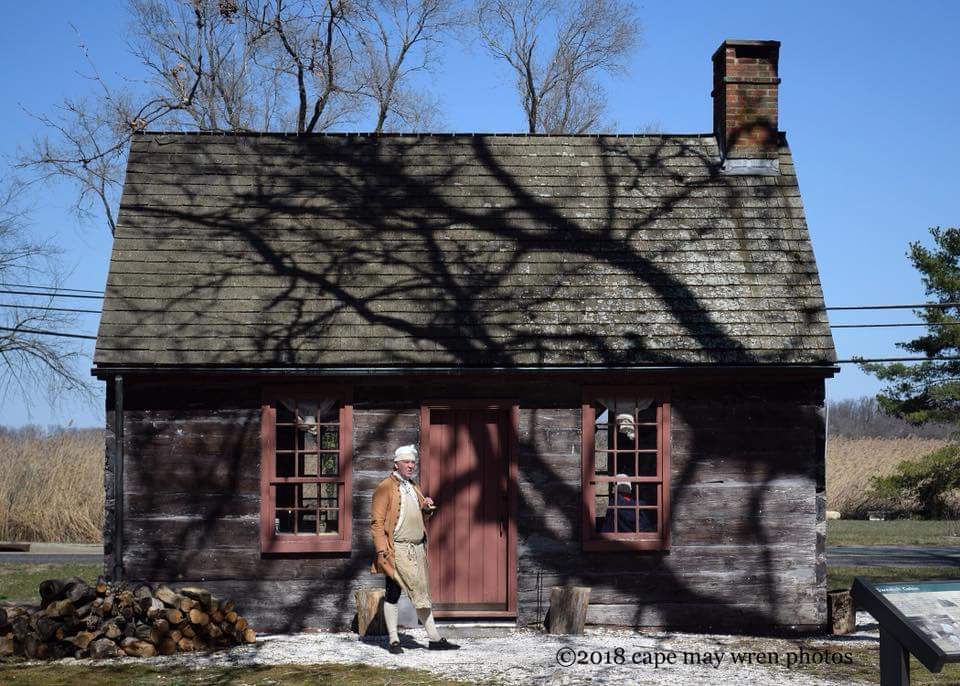
The best times are always those when we are the least self-conscious– not that we can necessarily choose those times. Often they simply happen to us, but if we are lucky enough, we will notice, or someone else will record those moments for us. Last weekend, without even meaning to, we came as close as I may ever hope to get to recreating Sandby images of the Sandpit Gate kitchen.

Mistress F commanded the kitchen: I served as her reasonably able scullion, and, with assistance from Drunk Tailor and the company of the B’s, we managed to produce enough food for several dozen people.


(I baked the pound cake at home, but the egg and onion pies were made on site. I lack historically correct baking apparatus aside from one pie plate.) Cooking in the cabin at Hancock House reminded me of good times long ago— and not so long ago–and how much I enjoyed throwing refuse out a window, and using a soapstone sink. The weekend also brought to mind “show, don’t tell” as it applies to interpretation, and made me think again about how to create more immersive educational experiences for visitors, without becoming ritualistic.

There’s not much time to think those esoteric, grad-school-seminar thoughts when you’re in the midst of cooking, and that can actually be a relief. Instead, better to think of the light, and the landscape, and the time remaining until a pie is cooked through.


The landscape and the light: redemptive, all that space, the blue sky and the grasses. I thought of The Witch of Blackbird Pond, which I haven’t read in decades, for in some ways, the coast of New Jersey resembles the coast of Connecticut. It’s one of the first historical novels I remember reading– it is probably one reason I have ended up doing the work I do, and spending as much time as I did in New England. (You can read it here.) It’s not brilliant literature, and it was nearly two decades old when I read it, but it was certainly memorable.

Photos courtesy of HM 17th Regiment, Al Pochek, and Cape May Wren Photography.

Didion, Despair, and Not Looking Back

Not everyone develops a relationship with a place that feels romantic, a relationship so intense, even when tortured, that when you leave, at last, as leave you must, you are torn apart by knowing the place abused you– and knowing you must go. Still: you love the place and cannot quite bear to not be there. It’s a complicated thing, and as with most tempestuous relationships, this tug of a place on one’s heart must be analyzed, objectified, studied, and understood. I thought I was making progress that way until I was given a chance to look back– don’t ever look back– and even though I did not look the basilisk full in the face, I was nauseated: waves of sadness and anger broke over me at reading a head line and image caption.

I stepped back to consider just what it was about the place and the situation that affected me so. Reading almost always helps. This time, I pursued literary criticism as a means to understanding. Van Wyck Brooks absent from the shelf at my local public library, I took hold of Joan Didion, and found myself rewarded.

The Seacoast of Despair” described my place perfectly.

‘Happiness’ is, after all, a consumption ethic, and Newport if the monument of a society in which production was seen as the moral point, the reward if not exactly the end, of the economic process. The place is devoid of the pleasure principle.

Devoid of the pleasure principle? In Freudian psychology, the pleasure principle is the instinctive seeking of pleasure and avoiding of pain in order to satisfy biological and psychological needs. Specifically, the pleasure principle is the driving force guiding the id. Didion states, “To have had the money to build “The Breakers” or “Marble House” or “Ochre Court” and to choose to build at Newport is in itself a denial of possibilities; the island is physically ugly, mean without the saving grace of extreme severity, a landscape less to be enjoyed than dominated.”

Indeed. Mean with the extreme severity, a landscape to be dominated. Those phrases define the principles that shaped my relationships with a few denizens of Newport, who, in truth worked and did not live there, but who seemed fully to embody, embrace, and imbue their personages with non-pleasure principled forces drove them to dominate others, and to consume, for their own use, much of what they encountered. Didion described my experiences and observations of Newport in language better than I could ever hope to conjure.

Three years ago this week, I came to a realization, first on a drive to Newport, and then on a train to Boston. I saved the tweets from that train trip.

I went to Boston that Saturday–it snowed; the train was an early one–to make a presentation at History Camp on work that related to Rhode Island and to Newport history. Earlier in the week, I’d had a vision in Newport that unsettled and delighted me, and informed those tweets.

“There was a for sale sign on one property (Sotheby’s Realty, of course), and for an instant, I imagined walking into the house and owning it, starting a life completely different from the one I live, with different people and places.”

Between that vision on Bellevue and Saturday’s train trip, I had enough exchanges with the object of my desire to form a fuller notion of what that vision meant. That understanding led to the tweets, which I posted as #fiction to protect the vision, and the desire, from the reality of my seemingly-unalterable situation.

The miracle here is that I had a vision, and have very nearly carried it out, despite not fully understanding how much of my standing life I would have to burn down to achieve that kind of freedom. It had not occurred to me that moving and changing  to achieve what I wanted–to no longer have a secret, to grasp those lapels nearly every night when I arrive home from work, and taste that accent on every kiss– it had not occurred to me how much I would have to destroy, or leave behind, and that in doing so, I would leave bones of my former soul to be picked over by opportunists ready to exploit an opening.

The consumption ethic: they have grabbed what they could not get while I was still there, and they run their paws over the work without fully understanding it. And that is where I can take my sole pleasure: the schadenfreude of watching them strive and fail, or perhaps the pleasure of watching them reach and grasp. Either way, I know I cannot look back. Something might be gaining on you, and it’s best to outrun those monsters.
Didion, Joan. “The Seacoast of Despair,” p. 157-158.  Reprinted in We Tell Ourselves Stories in Order to Live, New York: Everyman’s Library, 2006.

Making an Impression

Trade card for Dorothy Mercier, Printseller and Stationer; Etching with engraved lettering below. Print by Jean Baptiste Chatelain after Gravelot. 1745-1770. British Museum, D,2.3396

Dorothy Mercier: widow of an artist (and a painter herself), Mercier went into business after the death of her husband, Philip, first as a printseller and stationer, and later as a purveyor of artists’ supplies. Some of what she sold is listed below the vignette of a shop, and includes ‘all Sorts of Papers for Drawing, &c./ The best Black Lead Pencils, Black, Red & White Chalk./ Variety of Water-Colours, and Camels Hair Pencils./…English, Dutch, & French Drawing Paper, Abortive Vellum for Drawing,/ Writing Vellum, the Silk Paper for Drawing.’ She also sold “Continental prints” and “paintings of flowers in her own hand,” a pursuit considered suitable for ladies in the mid-18th century.

Evidence of widows taking over a husband’s print shop in the American colonies in the 18th century is harder to come by–there seems to be less specialization of retail sales in the colonies, certainly compared to London, which is one factor–though printers’ widows did assume their trade in Newport and Williamsburg, among other places. If we imagine a print shop in the colonies, what would we find for sale?

Nicholas Brooks’ ad from the Pennsylvania Packet of June 21, 1773 provides an answer:

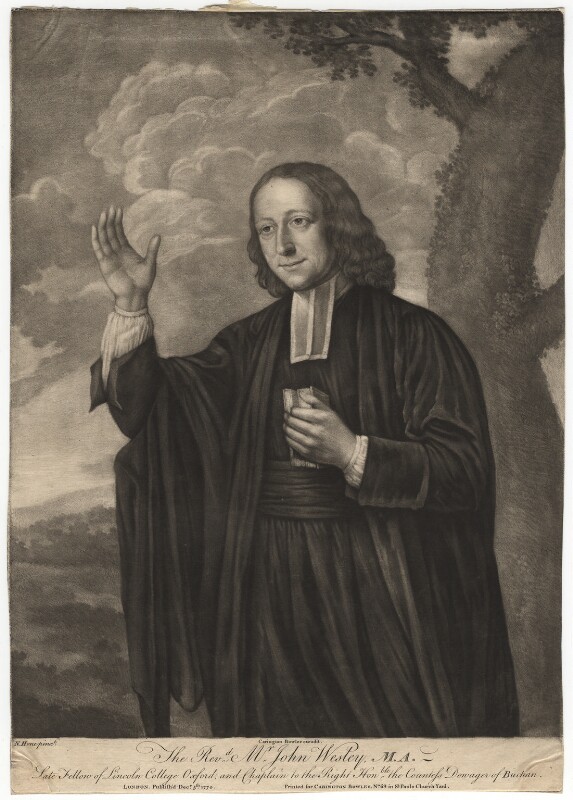
Mrs. Yates in the character of Electra; Venus blinding Cupid by Strange (that’s a print by Robert Strange after Titian, no matter what glorious oddity you may imagine), and portraits of George Whitefield, John Wesley, and other religious luminaries. Whitefield and Wesley were popular Methodist ministers: Whitefield, the peripatetic evangelist, was the primary force behind the Great Awakening, and Wesley, despite his loyalty to King and Church, was an inspiration to the Revolutionary movement in America.

John Wesley after Nathaniel Hone
mezzotint, published 1770
© National Portrait Gallery, London NPG D4740

This print of Wesley is one I have seen in person, in a period frame, with a period backboard inscribed “Capt. Wm Noyes 1st Conts” and to be fair, it is one I have spent some time researching, so the titles in that Nicholas Brooks ad– which I was reading for another purpose altogether– were exciting to find. When I think about visual or print culture in the Revolutionary era, I try to imagine the ways in which people encountered imagery, and how they understood it. Wesley– and print shops– are one way I begin to fill in a picture of the past.

The Work of Women

International Women’s Day: I may have missed it online but I have spent this day– this entire week, in fact– working with a woman I greatly admire and like. I’ve written about her before, my 96-year-old friend who was in the OSS and married a man who had fought for Chiang Kai-shek in World War II and against the Communists after the war.

It has been a week of learning about my friend, her mother, her aunts and great aunts and grandmothers; of learning about her daughters (and son), and her friends and the work she did.

Tuesday night, we had dinner with one of her friends who lives in a little red house not far from where I lived before I left Rhode Island. The Little Red House, as we always call it, was cozy and warm, built in 1793 when the East Side of Providene was rural, and the north end of it occupied by the Dexters, Morrises, Sessions and Coles on their farms.

The parlor was small, and the five of us filled it (along with a silver standard poodle who shook hands with us all). We ate in what had been the kitchen of the house, with a fire in the fireplace that had been used for cooking (and was still set up for cooking, though that was not where our meal was cooked). We ate from antique transferware, drank wine poured from antique decanters, and sat on antique chairs at an antique table in a room lit by candles. I would be lying if I tried to deny the warm magic of the setting, the scene, and the storytelling.

But the point is not that I had a wonderful time: the point is that I learned that night, and this week, about the ways that women look out for each other (when they’re not competing with each other), and the ways that women shepherd the history of families and places as they maintain collections of furniture, textiles, paintings, and prints.

As I held my friend’s hand and lit her way with my phone flashlight down a stone path to a waiting Subaru, I might as well have been holding a lantern and guiding her down a path to a waiting carriage, where wooden and tin footwarmers would replace a heater and blower motor. Some things are timeless and placeless: friendship, love, and caring. The need (the aspiration) to always care for the people around you, to be gentle and giving when you can, and to take and ask for help when you must: Those “feminine” values are what makes the world go ‘round, and keeps it steady.