Fort Lee Surrealism

Surreal: that was the word for the morning at Monument Park. The RI Reg’t walked over the park instead of parading with the troops, because one of our members has not been well, and did not think he could keep up with the parade. It was odd to follow the reenactors in 18th century clothing under power lines and past high rise apartment buildings shouldering out old frame homes, but the surrealism really kicked in at the park.
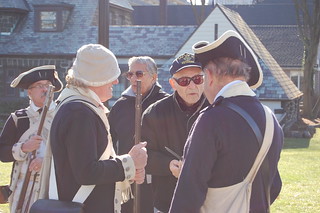
Describing sniper fire in WWII to salsa music

There it became multi-sensory when the ceremony’s organizers turned on the music. It wasn’t exactly merengue, and it wasn’t exactly salsa…then the soundtrack switched to updated Big Band hits and finally landed on a strange, over-the-top, quasi-operatic version of “Battle Hymn of the Republic.”

So when you look at the photos on flickr, play some salsa or an album you might have ordered at 2 AM from a TV ad, and think about standing in 40F/4C weather eavesdropping on politicians talking about inching closer to universal health, and the lessons of Hurricane Sandy for high-rise dwellers, while squeezing up next to you for a photo op.

Later, at Fort Lee Historic Park, the artillery demonstration was loud and satisfying, but we got behind schedule and to the oddness of the morning was added rushing. It was capped off at the end by the order to fix bayonets, which led to bayonets being caught in branches.

Bayonets fixed, Capt. Becker takes measure of the trees

Finally, for me, the day nearly foundered when I pulled my phone out of pocket at the end of the event to check the time, and saw my boss had been texting me all afternoon over a non-crisis. Part of why I love re-enacting and living history so much is that it takes me so far away from myself and from my daily existence. It’s related (slightly) to my work, but to be so far away in place and time and effort is a delight. I can’t just throw the phone away or not take it along: I am supposed to be on call, all the time…but it’s history, not a hospital, and if budgets change, so should expectations.
Warm in Bed

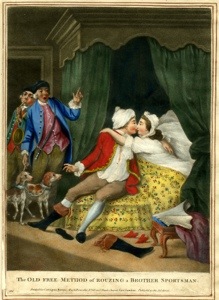
20121117-044602.jpg Last night, I leaned back on the pillows and felt the cold seep through my shirt. Our house, at 62 or 64 degrees, is warmer than the 58 degrees Moses Brown recorded in the early 19th century and warmer than the mid-50s temperatures some people I know still keep. But I have layers I can wear, wool or wicking space-age materials, and will wear anything to bed to keep warm. What did people wear in the 18th century? How did they stay warm in bed?

One solution was the bed warmer, the long-handled brass pan filled with hot coals and swiped over the linen sheets of a bed just before the sleeper hopped in. This method required strength, speed and a steady hand, and worked best if someone other than the sleeper could do the swiping. Heat would dissipate quickly while a warming pan was stowed safely.

Another option was heated stones or bricks wrapped in fabric and tucked into the foot of the bed. That sounds good to me now, cold as my sheets can be. Jane Nylander writes in “Our Own Snug Fireside” that some people perceived warming the bed as a sign of weakness, and it is hard to document such a mundane act.

Truly quotidian details are hard to find in written primary sources: people in the past took their daily lives as much for granted as we take ours. How often do our diarists today record whether they wore socks to bed?

In the collection at work, we do have one woolen flannel shift from the early part of the 19th century. I suspect I will want to copy that for January.

Evenings by the Fire

I am chasing two things at once these days: late 18th century high-style table settings, and late 18th century life after dark. They’re related topics, but in a way they’re not.

Setting aside the table, for I have diagrams and dishes and silver service identified and am down to questions of exact napkin folding and placement, how did people spend their time in the 18th century? We assume life was more tuned than ours to diurnal rhythms ( see Circles and Lines) but was it always?

There were differences between the days of servants, slaves and masters, and one good place for resources on those differences is Colonial Williamsburg. Like OSV, CW has placed some of their research papers online. For the house where I work, the Daily Schedule for a Young Gentry Woman is very helpful:

“From about 8:30 p. m. until 10 or 11 p.m. she, members of her family, and guests socialize at home or with neighbors. Their evening activities include conversation, toasting friends, singing or listening to music, reading aloud, playing cards or board games such as backgammon, dancing, and taking moonlight strolls. … “Kate read the Vicar of Wakefield to me this evening and highly entertained me” (Robert Hunter journal, 1786).  … “We play’d whist from 9 to 11. Capt. Clopper & myself, Mr. Harris & Munroe” (Ruth Henshaw Bascom diary, 1802).”

These observations of Virginia pastimes coincide with how we know Providence residents spent their evenings in the late 18th century. How late people stayed up was determined in part by need: was there work still to be done writing a sermon? was a family member ill? and in part by access: were there candles by which to work or read?

Fun to think and read about, but for now, I must put it aside. Fort Lee is tomorrow, and I have mending to do or we will all be cold. It will be an early bed for us all tonight, since we are driving down tomorrow morning. Photos on Sunday, as long as I remember the camera.

Light, or Lack of It

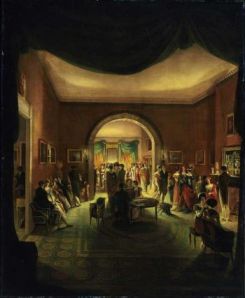
The Tea Party, 1824, MFA Boston

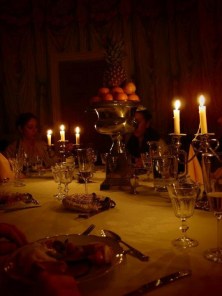
On Saturday evening, we drove up to Old Sturbridge Village for their “Evening of Illumination” tour. The village is by no means as fancy as the house depicted at left, but the gentle quality of the candlelight captured by Henry Sargent reminds me of the evening. I took no photos, because I just wanted to enjoy the experience…and learn from it.

Candles used in New England were usually home made, dipped, and of tallow. (See here for one reference.) The Browns of Providence had a spermaceti candle manufactory, and people in cities and towns often bought candles–by the pound, not by the stick. Spermaceti supposedly burns brighter than beeswax or tallow, but the only spermaceti candles I know of are accessioned museum objects and will never be lit.

In thinking about upcoming programs at two different sites, I’ve been thinking about what it was like to live in the dark, and to work mostly within the sun’s hours, and then judiciously by candle light. Sharon Burnston says, “Sew by daylight, knit by candlelight,” and if you think about process, you can imagine that  in low light, even the fine thread of sock knitting is far more manageable than fine sewing.

Large fireplaces provided both heat and light, and candles are surprisingly bright. I suspect that an evening by a fireplace, reading aloud by candlelight while a friend or sibling knit, was pleasant enough in a wool gown, or with a shawl over muslin. The trip to bed would have been another matter, and getting up something else indeed.

It is also well to remember that class difference would have created comfort differences: a servant would have been colder getting up than the master, for the servant would rise in a cold room and be expected to light a fire in the master’s bedroom. Rural workers would also have risen in a cold room, to cold or frozen water.

These are some of the things I’m thinking about as I read and look and get ready for programs, and for winter.