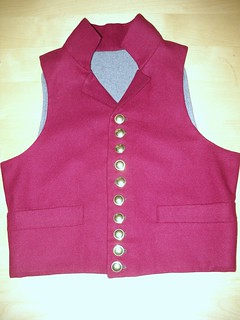
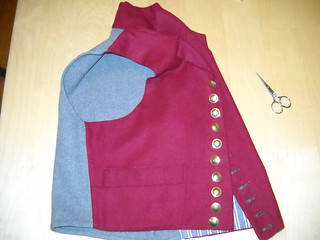
Fabric: Fronts, 100% wool leftover yardage from a petticoat. Back, wool broadcloth left over from remnant (is that a remnant remnant?) purchased for Mr S’s short jacket. Lining, heavy-weight linen.
How historically accurate is it? Well…the pattern has good documentation and the fabric is within reason for the period. The waistcoat is entirely hand-sewn, and the coarse linen pocket linings match extant garments in collections. So I know that’s good. And as it turns out, I completely and inadvertently made…this! So excited to find this! More excited than you’d expect! First quarter 19th century means 1813 is A-OK!!Also, that waistcoat is HOT! So I think I have achieved pretty accurate, even if it will be used in a time machine back to 1799.
Hours to complete: This was much faster than the first one. 12 hours for cutting and sewing, with about 3 hours just on button holes.
First worn: To be worn by the new owner (The Young Mr) January 19, at the Winter Frolic
Total cost: Since I used fabric left over from a petticoat and the jacket, I’d say the cost was really only in the buttons, so $14.50.
Cutting out makes me think of freeing mastodons from glaciers
If this is Saturday, I must be sewing trousers. I’ve managed overalls in a day from cutting out to made up, lacking only buttons and buttonholes, so I have hope for the trousers. It is true I am starting a new pattern, and so I am considering adapting the pattern I already use for breeches and overalls…. except that the style is 20 years out of date for where these are going. At least the first pair is for the kid, for whom oddly-fitted clothes are the norm now because of his size and personality, and would have been then, since he’s not the son of gentry.
He’s got shoes, though, and they fit! His feet stopped at size 12 in fall 2011, and the 12.5 Fugawee straight-lasted Ligonier shoes fit him over his winter socks. His feet are just too big not to put into better shoes–no one can help noticing them, and there are no gaiters to hide them under.
We’ll see how leather-soled shoes go. Expect slipping and falling.
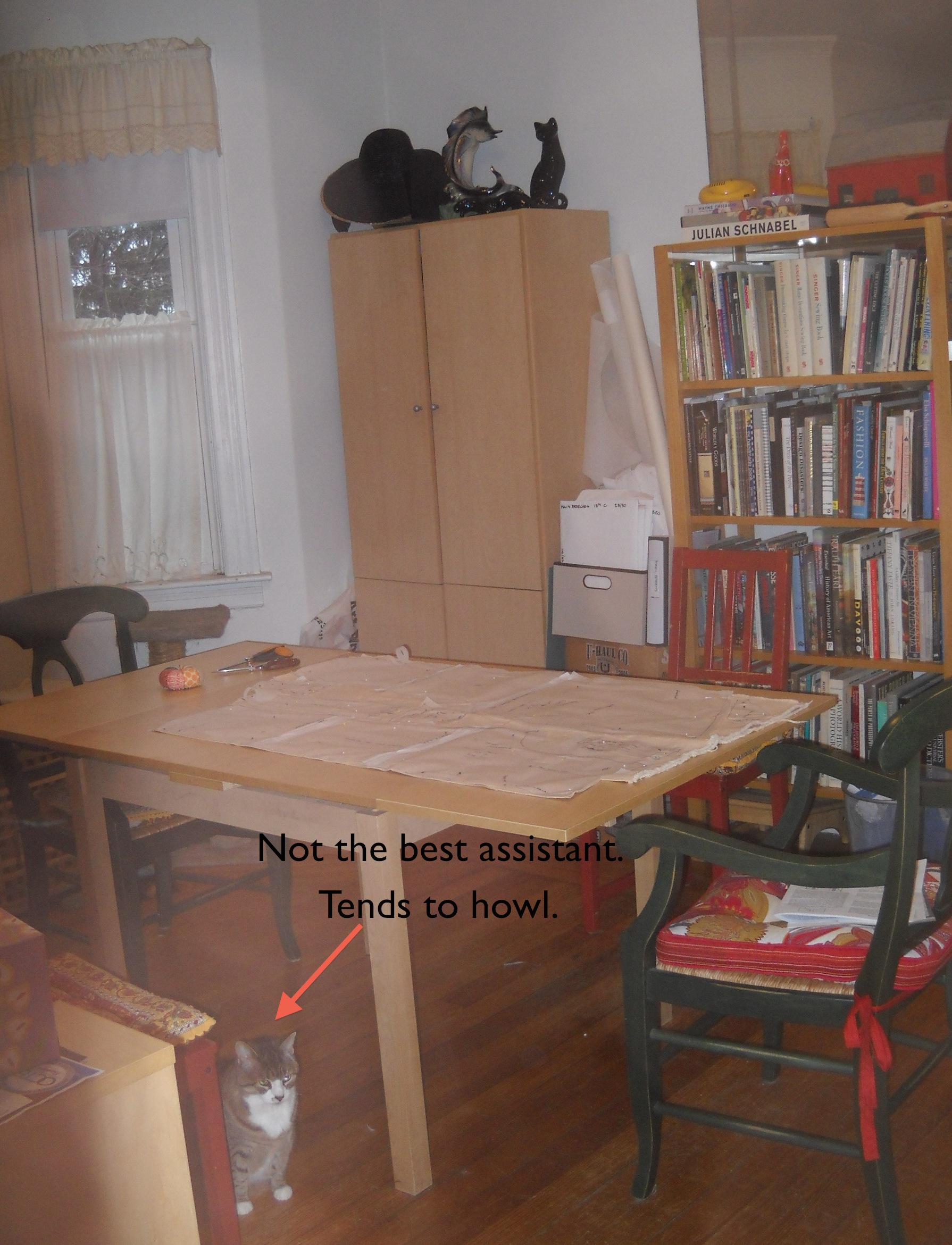
Dining/sewing/library room with “assistant”
My plan is to knock out the trousers today to the point of finishing work, and then finish the waistcoat tomorrow (it lacks only buttons and buttonholes). Having spent Tuesday on costume research scrutinizing seams, and blinking at buttonholes from 1788-1800, I feel better (and less self-conscious) about my sewing skills. They’re not as awful as I think they are, and the worst part of the tan waistcoat was the placement of the buttonholes, not their actual execution. Of course, the placement is the part I can’t fix…
On another note, on Tuesday I also looked at a number of ways to do pockets in breeches and jackets. Some were chamois lined, and then I wondered, how do we know what kind of leather the pockets are lined in? Aren’t they more likely to be deerskin than actual chamois? It doesn’t take long before you’re down the rabbit hole of historical wonderings.
Sara Hough’s date of ca. 1805 piqued my curiosity and Cassidy was suspicious, too. So I went looking into Paul Sandby a little bit more.
Many of us know him for the sketches and watercolors of working people in mid-18th century England. They’re oft-used references for people doing Rev War reenacting as they’re full of the kinds of details seen in the watercolor of Sara Hough. I hadn’t thought of Sandby for later 18th century references, which shows how little I was thinking.
Sandby: Figure with Lute & Tamourine, YCBA
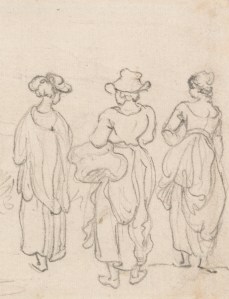
Thanks to the 18th Century Material Culture Resource Center, I found the Sandby “People and Places” presentation, which led me back to the Yale Center for British Art, and this image of musicians, horses and women. There’s no date in the record, though the presentation calls it ca. 1785. There seems to be a series or portfolio of Sandby sketches similar in size and type from about 1785, so it’s a reasonable assumption…with the usual caveat about assumptions, but no aspersions on the compiler of the presentation.
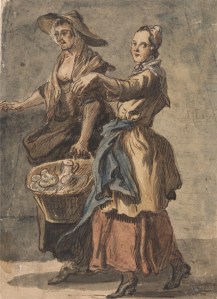
Sandby, detail, YCBASandby: Two Women and a Basket, ca. 1759 YCBA
Let’s look at a detail of the women in the drawing. Their waists are higher than we see in earlier Sandby drawings, and their profile slimmer, more classical, particularly the figure on the far right. Her bodice looks to me like a late 18th-century bodices.
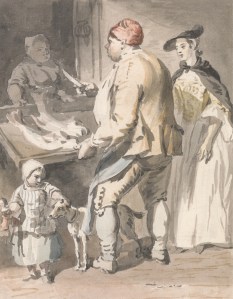
Sandby: A Fishmonger, ca. 1759 YCBA
Sandby had the skill to depict clothing with minimal gestures, as he does below in A Fishmonger, part of the London Cries series.
It’s that circa that gets you. I believe it for the ca. 1759, all the way. The figures fit into the visual continuum of Sandby’s mid-century work as I know it. (You’ll just have to trust me that I have a visual memory, and that, for once, the years of art school matter.)
And I kept wondering if he really had worked late into the 18th century, and then I found this:
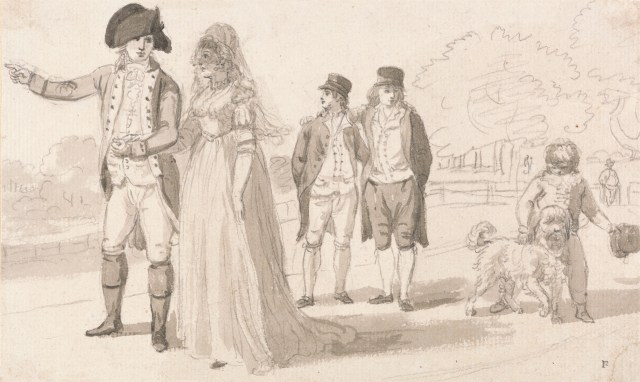
Sandby: Family in Hyde Park, YCBA
Again, no date, but there are distinctive markers to tell us this is post-1780, even inching to the early 1790s. The waistcoats on the adolescent boys are shorter and double-breasted. The shape of the boy’s hats has changed: these aren’t cocked hats, and they’re not soft round hats. But look even closer and you’ll see the ties at the knees of their breeches, very typical and fashionable for the 1790s. All this before we’ve even gotten to the woman! Look at what she’s wearing: that’s certainly a plausible ensemble for 1794, isn’t it? The waist has moved up, the skirts are lighter, likely mull or muslin, and the skirt of what I interpret as an open robe, much like Sara Hough‘s, is trained on the ground. If this is a Sandby drawing, which I don’t doubt, then I think we definitely see him working into the mid-1790s.
And just for one final kick, I checked the Met again, where they have a Paul Sandby drawing dated 1798-1799. I wonder…but the coat collar and waistcoat might have it.
Sandby, Group of 4 Children and a Dog, MMA
I’m still not sold on ca. 1805 for Sara Hough (why no ‘h’ on Sara when the drawing is inscribed by Sandby, “Sarah Hough…”?) but I’d endorse 1795. The tricky part, as always, is the circa: so much depends on how a museum interprets ‘circa.’ For some, it’s 5 years either side of the date; for others, it’s 10. When I see a circa date, I get skeptical, and start doing math.
Here is Sara Hough, Mrs. T. P. Sandby’s Nursery Maid drawn by Paul Sandby ca. 1805, from the Yale Center for British art. She’s rather lovely, and though I’d tend to put her date earlier than 1805 based on the clothing, I don’t know enough (anything) about the Sandbys, and it may be that the dates of Sara’s employment fixed the date of the drawing. But doesn’t that robe and train look distinctly 1790s?
What I like about it is that here is a maid wearing an open robe and train–how impractical, especially in a nursery–so the drawing makes a third kind of evidence in addition to fashion plates and extant examples.
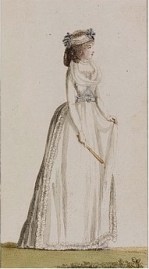
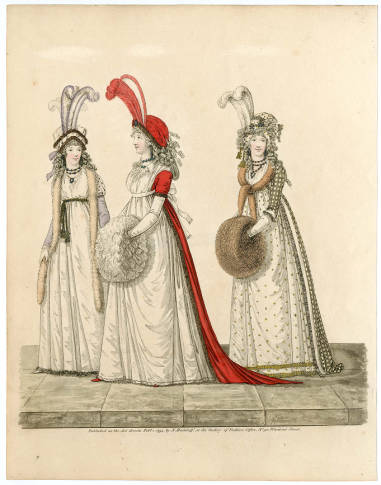
1794, V&A1795, MMA
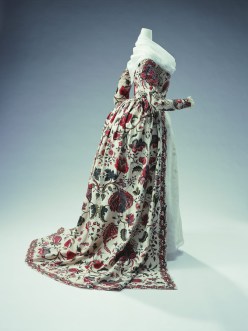
1794 and 1795 fashion plates from the V&A and the Met show similar robes, though the V&A is described as a walking dress, and the Met’s plate shows evening dress. Extant examples include the Kyoto chintz gown, and this chintz gown at the V&A.
1795-1800, V&A1780s, KCI
I like how art once again blows up my expectations and makes me think more about the time frame when styles can be worn, and why: maids lag mistresses in style? Comfort and personal taste? or is the assigned date just not right? It’s an evasive “circa,” which can wiggle 5 to 10 years either way, depending on the collection’s standards. The drawing could be 1795, and it’s not later than 1809, when Sandby died.
Aside from the questions and quibbles over the date, the image gives us great information about how to wear an open robe with an apron, how to carry scissors, what watering cans looked like around 1800, the profile of shoes and caps, and how hair might be styled.








 Kirsten Hammerstrom
You must be logged in to post a comment.