For once, the MFA’s search engine trumps the Met’s (hat tip to Sharon for pointing out painted versions).
Brace-back Windsor side chairs, Providence, 1780-1810. MFA Boston, 1976.776
Providence, thank you very much, green over black paint. Here’s another chair, clearly green. (This is very interesting, as the ones in my museum are not painted. Clearly, there’s wide range and variation in chair finishes. Now to think about temporal and geographic distribution of those finishes…)
High fan-back Windsor armchair, Boston area. MFA Boston, 64.86
My first concern was location. All I can tell you right now about the one I found is that is seems to be from New England: much more looking to do to narrow this down to a state. (Most of my furniture time is spent looking at shells, feet, and splats, but I like the Windsor style better, so this will be fun.)
Once I figure out where the chair came from–if I can–then I can decide whether or not to strip it. The easiest thing is to clean it and then repaint it in proper colors (like green over black, happily documented to Providence).
If the preponderance of examples I find like this are not painted then I will have to look at the condition of the wood (hmm…might not be so great) and see what I think. Somewhere I even think I’ve seen a furniture check cover for a Windsor chair in a painting…always more to hunt for.
The Mouse Diorama, thankfully a short-lived art form.
Because the Boston Peace Treaty event got moved (it will now happen on Saturday, September 28; more on this later), we were free this past weekend. We went east on Route 6, where in years past I have purchased a Christmas tree at a clam shack, southeastern New England’s answer to the gas station tree lots I’ve visited in suburban Philadelphia. It’s not the prettiest drive, but it has some coastal views eventually, sporadically, you can end up at strange antiques emporia in converted mills.
It’s not pretty out there: people do bad things with objects. The exact heyday of the Mouse Diorama is unknown, but I believe this form flourished in the late 1970s and early 1980s; by the late 1980s, artists were, uh, “commenting ironically” on the form (if I had a slide scanner, I’d show you). This example makes striking use of red, and the “Love By Cat” title of the book read by the mouse in bed intrigues me. “Love by Cat?” And the cat portrait on the chair: does the mouse upstairs have some sado-masochistic cat-related death-wish fantasies hidden from Mrs Mousie downstairs in her sanguine faux-colonial gown? I don’t know, but this is one of the more disturbing rodent dioramas I’ve seen.
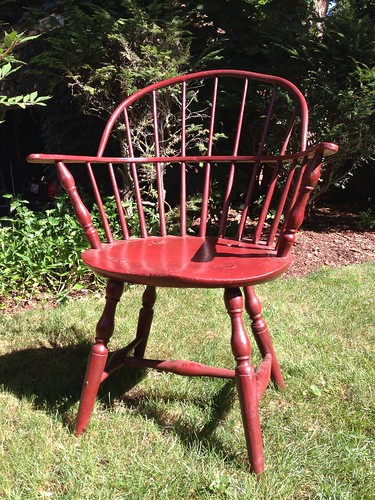
Poor painted chair.
In happier and less bizarre news, we found a decent chair. Bad things have been done to this chair, well, one bad thing called paint (oddly, also red; perhaps Mrs Mousie gets around). The bones of the chair are fine: basic country Windsor chair, but painted. We’ve seen a lot of painted “primitive” stuff out there in the antique shops lately. It’s pretty sad what people will to a perfectly usable wooden bowl, or saddest of all, an 18th century sea chest with hand-forged hinges. Paint! But, this chair was well-priced and half-off that price, so we bought it, and on the way home, bought stripper. It’s already wrecked so we might as well strip it and use it.
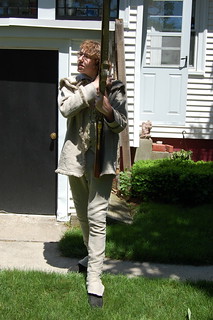
They’re not Mr S’s favorite thing, and I can understand why. Hunting frocks lack pizzazz, buttons, tape, lace, lapels, skirts and all the things that make him so fond of the Ugly Dog Coat worn by the 10th Massachusetts in 1782. (I think these are the coats captured from British supply ships and dyed at Newburgh and West Point in tanner’s vats.) But what he has right now is a hunting frock.
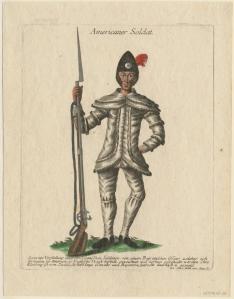
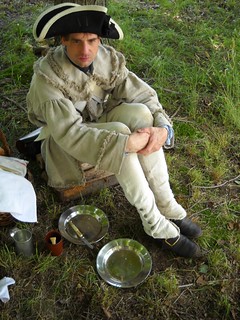
Here’s the kid in his new hunting frock, and a hand colored copper engraving by Johann Martin Will from 1776.
You gotta hold your tongue just right when you drill.Americaner Soldat, Johann Martin Will. Ann S. K. Brown Collection, Brown University.
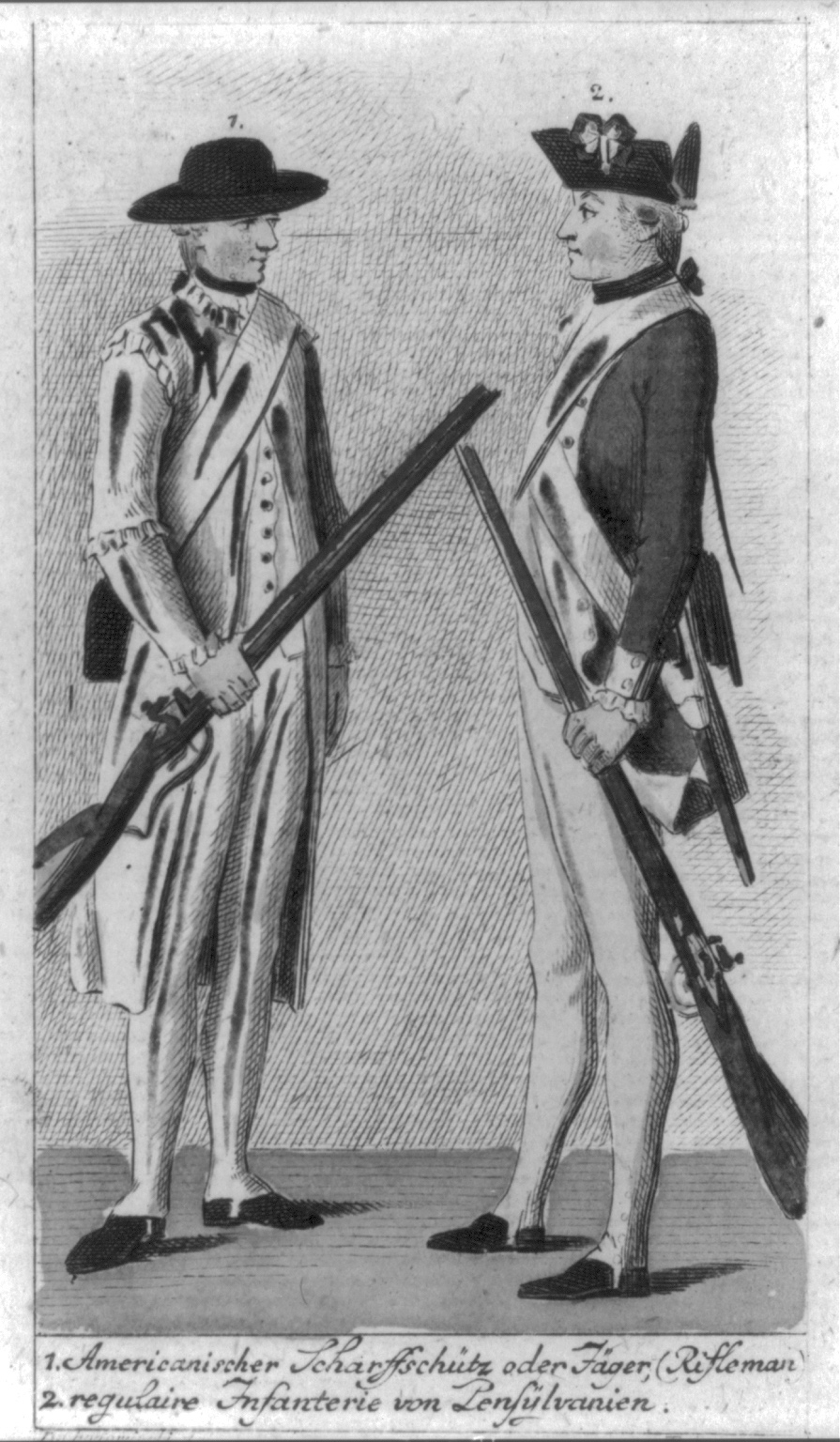
And then there are the colored and plain engravings, “1. Americanischer scharffschütz oder Jäger (rifleman) 2. regulaire infanterie von Pensylvanien,” engraved by Berger after Chodowiecki.
Library of CongressAnn S. K. Brown Collection
I started thinking about these again because not only am I reading Hurst’s thesis, but I’m fresh from helping the guys get dressed and arrange their capes and straps. I have been doing that as long as Mr S has been wearing historic clothing.
Early days of draping Drapey capes
The hunting frock drifts if it does not have some kind of fastening at the neck. The two halves migrate in opposite directions, and while belts help, the light infantry bayonet shoulder belt does not contain the hunting frock as well as one might like. So the thing to do, I think, is to attach a loop and button at the neck to hold the garment in place. From the period engravings, I think that’s acceptable. The garments all look as if they are closed at the neck. From the evidence in the field, and from the images, I plan to make loops and attach buttons, and hope that will limit some tendency to wander.
The image of the two soldiers together suggests another wrinkle in the hunting frock quandary, since the left hand soldier’s out garment looks like a long pocket-less coat with applied fringe and only a very small cape at the neck. Thank goodness that soldier is a rifleman, and thus outside the realm of immediate relevance. (And on a side note, I know a gentleman who very much resembles the Pennsylvania infantry man: identical calves, and even a similar face.)
Stripes. I love them, really, I do. Gowns, petticoats, cats. Why do I want to use them so much?
For the guys, because I can document what they’re wearing, at least based on their current state of residence and their current nominal “home” unit with the BAR.
Here’s why:
1777 Oct 22 An inventory of Searjeant George Babcock’s Wearing Apparil who was Killed at fort Mercer Octor 22d 1777 Belonging to Capt Thos Arnold’s Comp’y in Colo Green’s Regemt
Two Check Linen Shirts one Pair of Striped Linen overalls one Striped Cotton & linen Jacket without Sleeves one flannel Jacket without Sleeves one home spun Woolen Jacket without sleeves one Linen & Worsted cotee one Kersey outside Jacket Lined with flannel one beaver Hat & one Pair of shoes one Pair of blue worsted stockings one pair of thread ditto one pair of blue yarn Stockings one Linnen Handkerchief one knapsack
From RIHS MSS 72, Preserved Pearce papers, Tailor’s and Tavern account books, 1778-1781.
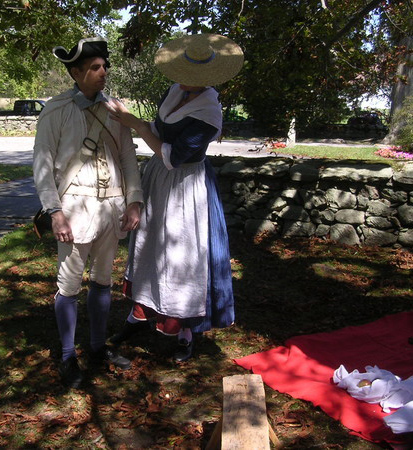
This inventory has formed the basis for many of the clothing choices I’ve made for Mr S and the Young Mr from their check linen shirts to their blue stockings. I was criticized for the size of the checks of their linen shirts (too small! I heard), but feel vindicated time and again by the extant garments I’ve found (aprons, mostly) in this period. The checks are small.
The best piece of evidence I found was serendipitous: whilst going through tailor’s books Thursday, looking for stays, I found a scrap of blue and white checked linen used as a binding. The biggest lesson from that scrap is that I need a deeper, more indigo-rich blue and white to begin with.
The “Striped Linen overalls” in the inventory are definitely on the list of things I’d love to make, along with the “Striped Cotton & linen Jacket without Sleeves.”
One of my favorite garments of all time. Boy’s frock, ca. 1760-1770. RIHS 1959.6.1
After a while, though, blue stockings and checked linen shirts seem…ordinary. Common. You might start to wonder if they’re just another re-enactorism, they’re so ubiquitous.
It’s worth checking again to see that these are, in fact, common garments, probably as prevalent then as they are now.





 Kirsten Hammerstrom
You must be logged in to post a comment.