Open to Interpretation

Interpretation: I’ve been thinking about it a lot lately, reducing it to basics. Beverly Serrel challenges exhibit designers to articulate the one Big Idea about their work; one sentence that describes what your exhibition is about. I’ve been thinking about the Big Ideas for some upcoming exhibitions and programs at work, and in my personal work.

Some seem easy: Slavery in Rhode Island: Everyone was involved, everyone is connected. Slavery is part of our shared past. We are all part of the web of complicity. (Pick one, they’re all related.)

For the house museum, and the living history day at the house museum, it’s a little more complicated. We tried an involved story line last year and it didn’t seem to matter to visitors who were mostly intrigued by watching pretty costumes in a pretty house.
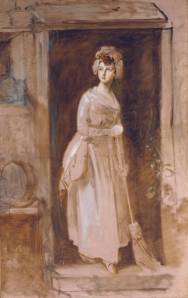
Thomas Gainsborough, The Housemaid. 1782-86. Tate Museum, Presented by Rosalind, Countess of Carlisle 1913, N02928

What I’ve settled on for now is a crude variation of “it takes a village,” in that a complex web of food and support networks was necessary to sustain an elegant 18th century mansion. (Our theme this year is Rhode Island Seascape and Landscapes, AKA Surf & Turf.) I begin to imagine diagrams that support that theory: small holding farmers and dairymen and fishermen who sold supplies to the wealthy, the merchants importing goods, the sailors and captains and shipbuilders needed to bring the barrels of china, boxes of sweets and tea and nankeens back to Rhode Island to support the scenes of elegant perched at the very top of the social pyramid.

Then I come to my personal interpretation and Bridget Connor. What is that story about? A Bridget with a troubled past and nothing left to lose? Poor women struggled to survive in an unstable war economy? Or simply that not everyone in the Revolution was a hero?
The Shurts off there Backs

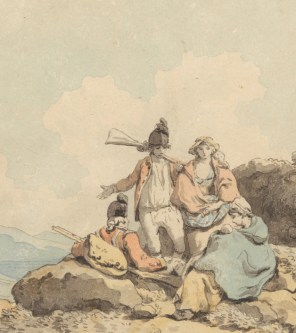
Francis Wheatley, 1747-1801, British, Soldiers and Country Women, undated, Pen and black ink with watercolor on medium, smooth, cream wove paper, Yale Center for British Art, Paul Mellon Collection

Among the things I wondered about Bridget Connor and her court martial was from whom she’d bought that “publick shurt.” Why would a soldier have an extra shirt, or be willing to sell an extra shirt?

There are some circumstances in which it is plausible.

ClothingRegs1776_77

While shirts could have been sent from home,  regulations established in 1777 called for soldiers be issued two shirts, or an equivalent bounty. A soldier who wanted cash for alcohol or other non-regulation and non-issued goods or services might sell his second shirt, or steal a shirt to sell.

With the context of what soldiers should have been issued, we can  begin to tease the story out of the orderly books.

Regimental Orders July 15th 1782

At a Court Martial whereof Capt Dean was pre
sident, was tried Paul Pendexter & Titus Tuttel
soldiers in the 6th Company 10th Massachusetts Regt
For Stealing a Shurt and Disposing of the Same
ware Both found Guilty and Sentancd to Sixty Lashes
on there Naked Backs—the Colo approves
the opinion of the Court and orders it to
take this Evening and the prisoners to Return
to Duty——-The Court Martial of
which Capt Dean is president is Desolvd

The quote above is a full seven days before Bridget appears at her own Regimental Court Martial “for purchasing a publick Shurt from a Soldier.”

Paul Pendexter and Titus Tuttel were just the guys to get caught, until Bridget was discovered. It does make me wonder if there was an extensive ring for black market shirts (and where did they go once Bridget had them? Did she try to sell them back into the public stores, i.e. the quartermaster)?

Criminal masterminds these people weren’t, but it does seem possible that the Shirt Ring was fairly busy before it was collared.

tite Dressed

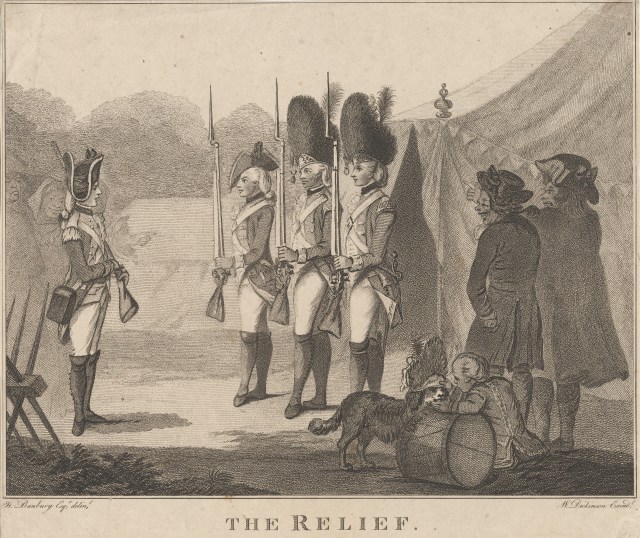
William Dickinson, 1746-1823, The Relief, 1781, Stipple engraving and etching on moderately thick, slightly textured, beige laid paper, Yale Center for British Art, Paul Mellon Collection

Reading the Abbott orderly books takes some patience, even though they have been transcribed. As with so many 18th century texts, punctuation is unreliable and open to interpretation. Here’s an entry from July, 1782, on the subject of uniforms, guard duty and fatigue duty.

July 22 1782
The Greatest Care and aten
tion is to Be pade to the preservation of the Mens
Clothing and to keep the Cloth Clean.. As
the Guards are always to Be fill Dressed in
uniform they are not while on that Duty to be
put on Ferteeg or any kind of Meaniel service
but to appear Clean, tite Dressed and In a
Soldierly manner when any parties for
Ferteeg are Necesery they are not to be applied for
and Sent in there undress or Ferteeg Clothes
this order to be Strictly observed

Which seems in more sentence-like form to be:

The greatest care and attention is to be paid to the preservation of the men’s clothing and to keep the clothes clean. As the guards are always to be full dressed in uniform, they are not, while on this duty, to be put on fatigue or an kind of menial service, but to appear clean, tight dressed, and in a soldierly manner. When any parties for fatigue are necessary, they are not to be applied for, and sent in their undress or fatigue clothes. This order to be strictly observed.

Here’s what I think it means:

Pay attention to the men’s clothing and keep it clean.
Men assigned to guard duty are always to appear in full uniform. When on guard duty, these men are not to be assigned to fatigues or menial duties. They should instead always appear clean, neatly dressed, and solider-like. When fatigue parties are called, the guards are not to be assigned to that duty, so that they do not appear on guard in their fatigue or undress uniforms. This order is to be strictly obeyed.

Once Upon A Time…

Betsy Ross and friends: A Child Guidance Educational Activity

This is the third set of these paper dolls (Educational Activity) I have owned. The very first set was given to me by my mother, Lo, at the Dawn of Time, in the Dark Ages known as the 1970s.

I wore them out.

A new set was purchased, probably once again at Marshall Field’s, possibly in the book department. They now reside in an attic outside Philadelphia (how appropriate).

From this Educational Activity flowed many more home-designed outfits and home-made paper dolls of historical and literary origins, which have led to this moment, when I make myself and my family into historical characters, make us outfits, and set us in motion with friends and colleagues in scenes of historical play-acting, by which I mean Educational Activity.

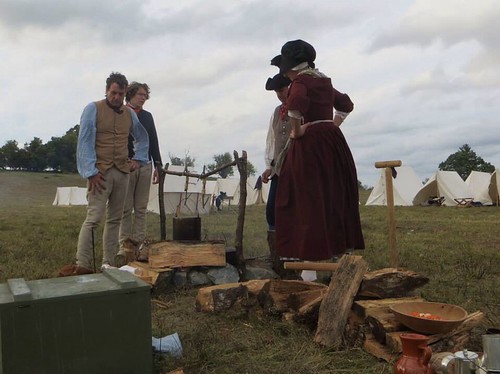
Cooking at Saratoga: very Educational. Photo courtesy D Molly Ross.

I like to think that the clothing we wear is more correct than the “Authentic Costumes” advertised on Betsy Ross’s box, but there is always more to learn. I am in no way denigrating Betsy Ross, or paper dolls, or suggesting that I see my family, friends and colleagues as paper dolls. But I do know that as long as I have been playing, I’ve been playing history and reading history, and drawing history, and using books and paintings and yes, even paper dolls, to figure out the world present and past.

If January Jones played Betsy Ross...
If January Jones played Betsy Ross…

Even though I always thought I wanted Betsy’s birthday cake gown, the one I really liked was the work gown. The “construction” of her garments confused me even as child: how the heck does that kerchief work? And the bodice front? Never mind, have a slice of dress, I mean cake. (Field’s had a cafeteria that served slices of pink-iced layer cake that I somehow conflated with the paper dolls, thanks to the shopping trips my mother and I made.)

Memory and fact, impression and citation: when we reenact the past as an Educational Activity, we should remember that some will walk away enlightened, and others will walk away thinking about birthday cake. Our job, beyond getting the facts right, is to engage our visitors, to interest them, and to excite their imaginations. What they do from there is up to them, but we will know that we have done our best to present them with a scene that can take them one step closer to being there.