A Day in Time

You know what’s wrong with most reenactments and living history events?

They’re not actual days. They’re fragments of many days jammed together like a fractured mosaic.

It’s tough and tiring to imagine and script and play out a whole day—all the simultaneous pieces—but if living history or reenacting events were run as A Day In Time, there would more likely be:

• Roles for More [kinds of] People
• Contextualization of Events
• Boring Bits like Paper Work
• No Time for Spinning
• Moar Drilling
• Rations & Messes, Actually
• Moar Drilling
• Courts Martial
• Small Acts of Drama Amid the Quotidian

Of course, y’all would have to work together…but imagine the power if an entire event ran the way a military camp should be, would have been, run. Orderly books provide plenty of ideas, entire days of stuff to do and get in trouble for.

Stop splitting, start lumping, and these events will, at last, become truly engaging on both sides of the rope line.

Men, Women, and Work

After a late afternoon meeting that left me raw from the way men speak over, interrupt, and dismiss women, I began to think again about a conversation I’d had with a friend at lunch about women’s roles at living history events, primarily military, but also militia, so let’s call them Gun Shows.

14999323655_5d9dcf2259_o

What do women do at the Gun Shows? They cook, for one thing, tied to camp fires. That’s at least a little better than the spinning that can happen, but it’s still not always right. I think a lot about how we’re not truly representing the ways that armies moved, slept, provisioned themselves, and how that affects the roles that women, children, and the (forgive me ) Invalid Corps might play. Yes, there are options: laundry, petty sutlering. There are women doing those things and doing them well, which is fantastic. When I think about how I might complement that, I end up thinking about women even naughtier than Bridget– and I think Bridget must have been very naughty indeed.

Even when you move away from military events, let us say to militia events, similar segregation occurs: women cook and wash dishes, men fire weapons. It just makes me tired, this notion of women forever being pendant to a gun, dependent on housework. It leaves me wondering what else I can do.

Perhaps more Gaskell than Austen, here

That’s easier in a civilian context. Women ran boarding houses, had small shops, ran needlework and boarding schools, worked as seamstresses, soap makers, tailoresses, milliners, mantua makers, painters and silhouette cutters. None of those things belong in a camp, and I begin to think that unless I can figure out a feminist interpretation of women’s lives of drudgery, I will have to give up the Gun Shows completely. And yes, for those of you who know me, that will be a natural transition, won’t it?

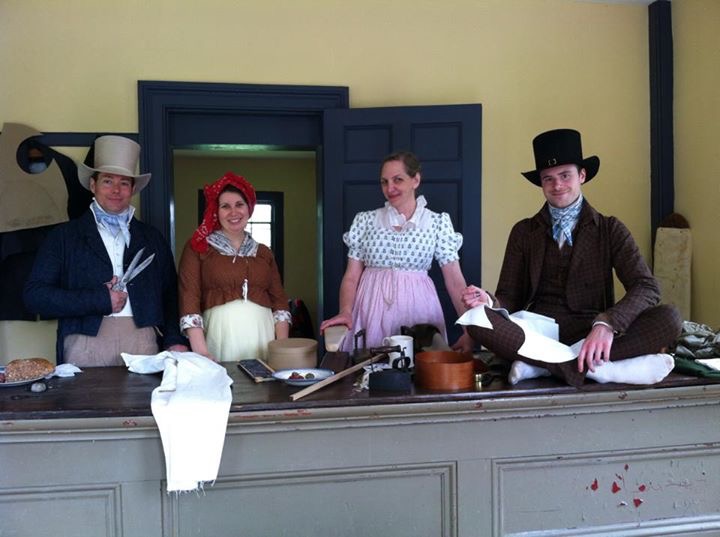
Three Tailors & a Tailoress

Sounds like the start of a bad joke, doesn’t it? It could also begin, “A weaver, a blacksmith, and a curator walk into a diner,” but it doesn’t. Genesee was fabulous, and there will be words soon, but after 8 hours on the road, there are only photos for now.

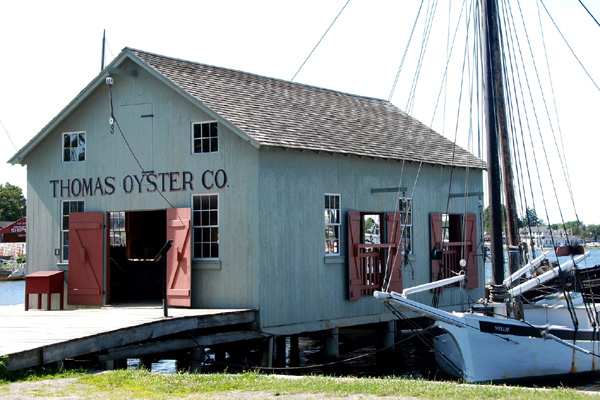
Bound for Mystic: Hold the Oysters

4259691669_ef8a11367a_o

Not literally, of course; it’s still too cold for a mittful of raw oysters, shucked or otherwise.

The Thomas Oyster Co. has long been my favorite building at Mystic for its name, and with more time, I can unearth the photo of two Thomases from years ago. Today I’m bound there for the ALHFAM Conference and two presentations, finally completed, but still nerve-wracking. Synopses soon, but now I’m bound away.