Frivolous Friday: Cap o’ Floof

img_8933I know you will remember Mrs Warren, whose cap I’ve called A Bowl of Whipped Cream and a Jellyfish. She appeared two Friday nights ago at the Arcade after the woman temporarily inhabiting her skin installed a window display. (Mr Hiwell appeared in the guise of Dr E. F. Throckmorton, Cryonogenics Specialist who, through the miracle of a lab accident, brought the Warrens back to Providence.)
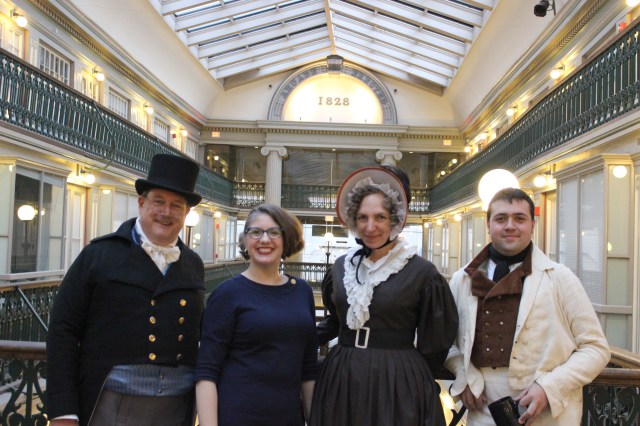
With my cohort.
With my cohort.

The cap proved more challenging than initially anticipated, in that I miscalculated the size of the floofy inserts and made them too small; another hitch is that my whip gathering skills on tiny things lag my desires. Monster cap with inserts will have to wait. So, instead, I made up a long (130 inches or so) ruffle. When attached to the cap brim, this did an excellent job of framing my face and filling in the bonnet frame.

For an event of just a few hours designed as a lark, this didn’t turn out too badly. Last year’s Meat Shoot Gown worked out well enough, and the bonnet has its charms. The lace collar/fichu business is antique, as is the crescent-shaped mourning brooch (Lydia Warren’s sister died in 1817; Lydia then married her late sister’s husband, Russell. Let us pretend that Lydia wore a brooch of Sarah’s hair.)

Lydia and Russell Warren.

It’s a time period that needs more refinement on my part, but until I’m spending more than a couple of hours in the late 1820s, I probably won’t address the details. Mrs Pabodie awaits, after all.
Friday’s Fright: A Dress in White

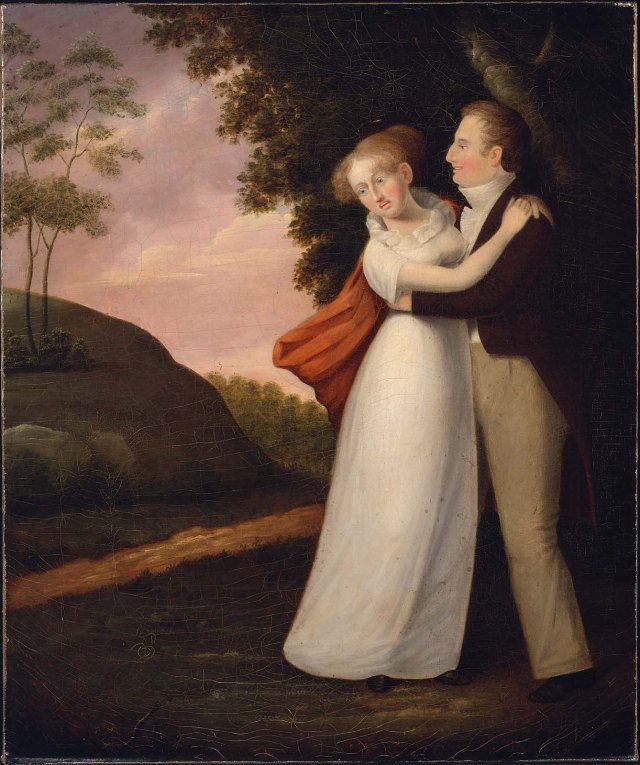
The Frightened Girl, oil on canvas by Cephas Thompson ca. 1810. MFA Boston, 1986.397

Two paths crossed for me this week, both in the early Federal era. Cephas Thompson, a self-taught New England painter, recently became very interesting to me. Although he grew up in Massachusetts, Thompson painted extensively in Virginia, but also in Providence, so of course the story resonated with me. But even more than the story, I loved the images. What a show the portraits would make– and he seems to have painted miniatures as well– so when I met with a local preservationist who turned out to be a fellow art school fugitive, wheels began to turn.

“What clothes!” my new friend said.
“I can get you a room full of people in those clothes,” I replied. And what fun would that be, a gallery opening where the people in the portraits appear to have come to life? Beats the pants off mere mannequins, but keep your Cossacks on: this one’s gonna take a while. In the meantime, what about those clothes?

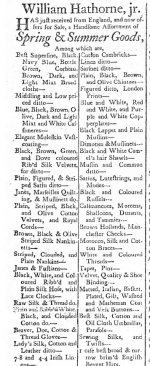
Salem Register, July 14, 1803.

Saturday marks the third time I’ve been part of the Salem Maritime Festival, and once again the West India Goods Store will be the base of operations for a mercantile enterprise. Millinery has its charms, but this year, the park historian shared fascinating notes on “She Merchants” of Salem, and the Hathorne sisters really intrigued me. Drunk Tailor dug into online newspapers (harder than ever to access remotely) and found an 1803 issue of the Salem Register

That’s an incredibly helpful list of goods to sell (and to pack from the Strategic Fabric Reserve), but a new year means a new dress, of course, and for reasons still not entirely clear to me, this seemed like exactly the right time to wear white. That’s sort of where Cephas Thompson comes back into play: white dresses.

Mrs. Cephas Thompson (Olivia Leonard). Oil on canvas by Cephas Thompson, 1810-1820. MMA, 1985.22

There’s a pile of white cotton and white linen on my table, ready to be packed up this evening: with the dress on for a fitting, I felt like a bowl of whipped cream, the red silk Spencer and scarf the cherry on top. Happily, white and red are documentable to New England, though I would be mortified to be as frighted of a garter snake as the girl in Thompson’s painting. Strawberries and coffee are entirely different, and I shall probably require a bib for Saturday, lest my whipped cream be spoilt.

Mopping Up

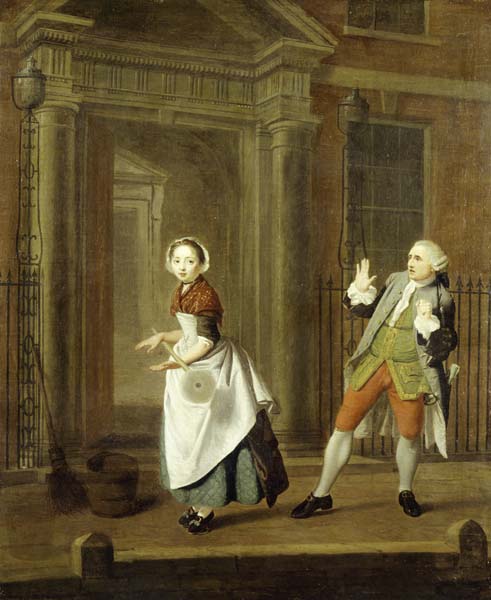
A City Shower. Oil on canvas by Edward Penny, 1764. Museum of London

Springtime sadness is best remedied by scouring[1], so in the best Scandinavian fashion, I have been looking into 18th century cleaning. Dem barracks, right?

First of all, were you wondering about what exactly they “smoked and cleansed” smallpox victims’ rooms with? Brimstone and frankincense.[2] Now you know what Edward Langford would wake up smelling when the house next door was free of smallpox.

But what about those floors? They need to be cleaned. Swept, yes, and scrubbed with sand. But also mopped, and the doorstep mopped.

Tit for Tat. stipple etching, London, Printed for R. Sayer Map, Chart & Printseller N° 53 Fleet Street, as the Act directs Novr 24. 1786. British Museum 1861,0518.958

I have a broom and a whisk broom, and can substitute a kettle for my sad bucket[3] but I lack a suitable mop. Lack never deterred me, whether of skills, knowledge, or supplies, so off to the interwebs and library I went.

I started with Foul Bodies, the 2009 monograph by Kathleen M. Brown. Nothing on floors, sadly.

I remembered the 10th Massachusetts Orderly book from 1782, that was more helpful.

Some part of the Camp and about the long Barracks in particular is relaxing into nastiness. Regimental QuarterMasters have been ordered to have them Clean and keep them so. An Officer of each Company has been ordered to visit the Barracks every day and to Confine & Report those who throw bones of meat Pot Liquor or filth of any kind near the Barracks. Yet all this has been done and no report has been made. it is hatefull to General Howe to Reitterate orders as it ought to be shamefull those who make it necessary.

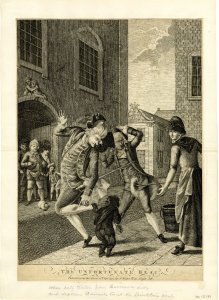
The Unfortunate Beau, etching, Publish'd as the Act directs 12th Sept 1772, by S.Hooper, No.25 Ludgate Hill. British Museum 1991,1214.20
The Unfortunate Beau, etching, Publish’d as the Act directs 12th Sept 1772, by S.Hooper, No.25 Ludgate Hill. British Museum 1991,1214.20

Nastiness. Those barracks sound noisome, don’t they? We can’t have that.

So let’s cast out the bones, sweep the floors of the branches and dirt and grit the men have brought in, and mop them, too, now that it’s spring.

Mop, you say?

What did mops look like the in 18th century?
And how on earth will we acquire one?

Tune in next time for another exciting installment of “historical cleaning instead of cleaning my own house.”


[1] Dude, I have scrubbed baseboards with a toothbrush. Not one of my finer moments, but a memorable one.

[2] Kathleen Brown, Foul Bodies: Cleanliness in Early America. (New Haven: 2009) p. 129

[3] Really really: I meant it when I said keep the bucket wet.

Small Obsessions

IMG_5625Some of you may recall that I am a recovering artist with a fairly constant need to keep my hands busy. To encourage industry and the domestic arts, and to keep me out of trouble generally, a thoughtful friend provided me with a start to furnishing an early nineteenth century-style paint box. They’re hard to come by, these paint boxes, and extant examples fetch far more than we can afford chez Calash, being in somewhat reduced circumstances of late.

Thomas Reeves & Son Artists watercolor paint box c. 1784 to 1794. Whimsie Virtual Museum of Watercolor Materials
Thomas Reeves & Son
Artists watercolor paint box c. 1784 to 1794. Whimsie Virtual Museum of Watercolor Materials

Researching paint boxes and miniature painting in the early Federal era has been a happy fall down a deep rabbit hole. It’s clear that Reeves watercolors were being sold in Providence in the early 19th century; Peter Grinnell & Sons include “Reeves watercolor boxes” among the extensive list of items for sale in an 1809 newspaper ad. Frames and cases were also to be had; John Jenckes, gold and silver-smith and jeweler, advertised gold miniature cases in 1800.

Distraction is always easy to come by, tunnels leading from main entrance to the warren. Painting manuals, scholarly articles, and extant examples, which prove most distracting of all. SO shiny.

George Catlin Artist: John Wood Dodge (1807–1893) Date: 1835 Medium: Watercolor on ivory Dimensions: 2 3/16 x 1 13/16 in. (5.6 x 4.6 cm) Classification: Paintings Credit Line: Rogers Fund, 1926 Accession Number: 26.47
George Catlin byJohn Wood Dodge, 1835, MMA 26.47

Searching the Met’s collection, I found a portrait of George Catlin, remarkably similar in pose to an image of a friend I considered copying, but had thought too modern. My assumption has been proved wrong, and I am delighted. And then I found the HIDEOUS checked neck wear, always distracting. Historic New England provided super-tiny-bowtie man, and then I really had to focus, since I’m only enabling, not making, neck wear.

My real focus, of course, is on female miniaturists, especially in Rhode Island (gallery of RI miniatures can be found here.) From the scant number of women I’ve found advertising in the local papers, (okay, two: Miss Mary R. Smith, in 1820, and Mrs Partridge in 1829) I’ll have to expand my search geographically. Nantucket Historical Association had an image attributed to Anna Swain, and ten attributed to Sally Gardner.

Eye

The Met, repository of so many wonders, has works by six women miniaturists, including Sarah “Wowza” Goodridge and Anna Claypoole Peale. For all we know, some of the works by unidentified makers might be the work of female painters. The extant miniatures in all collections, range in quality from excellent to amateur, giving hope to those of us unpracticed in portraiture, and regaining our hand.