Send in the History Clowns

Once upon a time, I called reenactors and costumed interpreters History Clowns. The pilgrims at Plimoth Plantation 25 years ago scared me, and I did not like to visit living history museums.
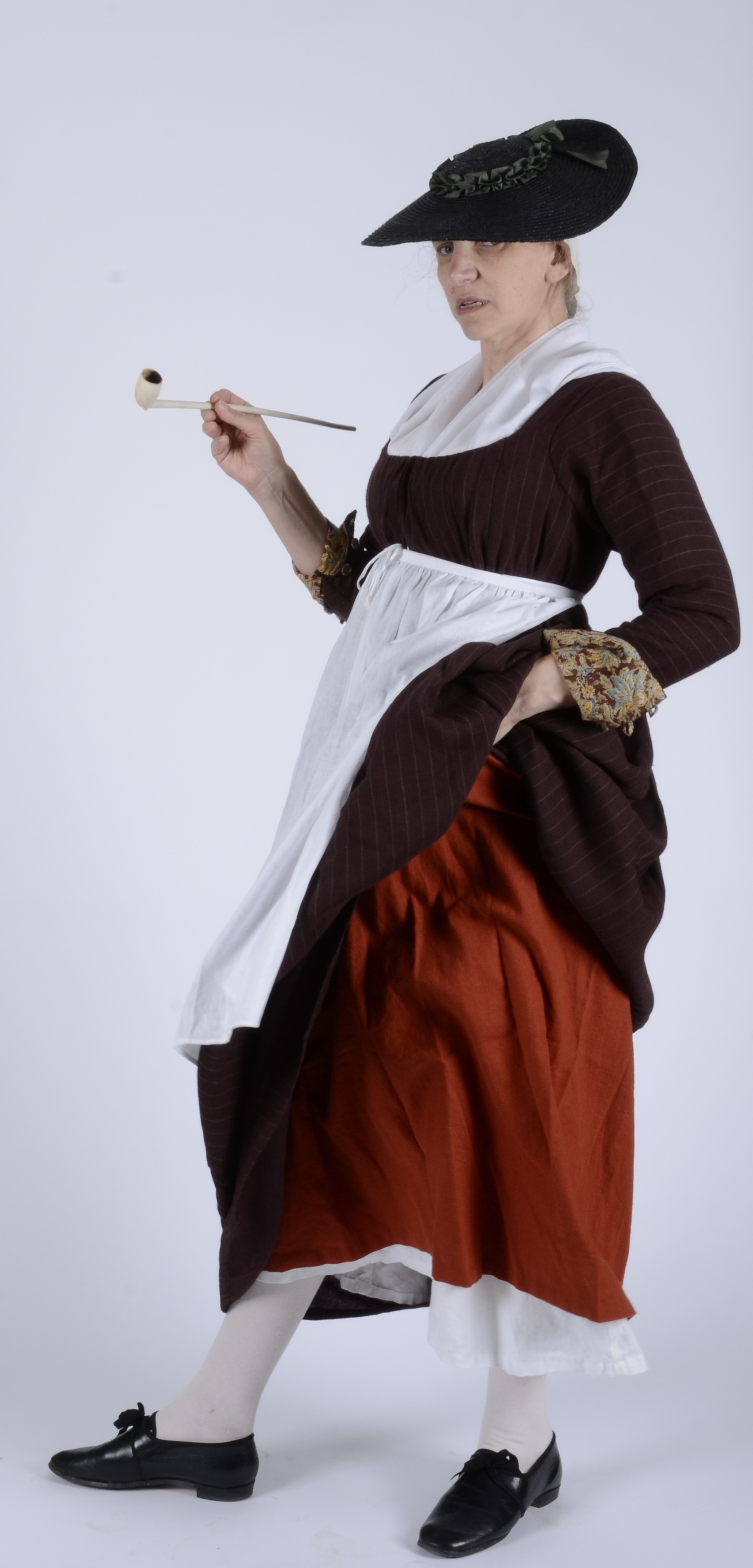
petticoat
History Clown

Now, I’m one those costumed clowns.

What changed? For one thing, I did. But more importantly, living history and reenacting changed. It got better. It became more accurate, more inclusive, more specific. (Even Plimoth admitted at a Dublin Seminar that their costuming had evolved.)

When I see the fights that erupt online (there was a skirmish on Facebook last night—Peale’s march will not die), I think about the History Clowns. I think about the evolution that has taken place, and I think about the skirmishes I get into in trying to plan living history events at my own institution.

Most of these fights are not about accuracy—that FB fracas wasn’t—but do we know what they are about? We try to push back with our insistence that accuracy matters, but that’s not the argument our opponents are trying to have with us. They don’t give two rats about the cut of your breeches or the cord on your canteen or what you think of their rubber-soled shoes.

They want to be recognized. They want to be appreciated. They want to matter.

It reminds me a lot of when I first came to the place I work; I was one of three new, younger people hired within a short span of time to work on exhibits and an expansion project that never happened. As we looked at the organization, we saw things that didn’t seem right to us. But often, we met a lot of resistance to new ideas: “We’ve done that already.” “We tried that and it didn’t work.” “This is fine the way it is.” “We’ve always done it that way.”

I think those translate thusly: If you do it, you might make my attempt look bad.

If you succeed where I failed, I will look bad.

I don’t want to change.

I’m afraid to try something new.

What about my efforts? Won’t they be rewarded anymore?

I think that’s what people are saying to us sometimes, even when the words they say are, “These haversacks are fine, they’re really durable. It doesn’t matter if the fabric isn’t really right,” or “Market wallets? No, that was just a Henry Cooke fad.”*

43919175The fight is probably not as much about accuracy and authenticity as it is about feelings. That said, I think it behooves people on both sides of this line (and it is often generational) to be equally mindful of each other’s feelings. While we can respect the work that people before us have done, they should respect the work we are doing now, as new resources come to light, and new thinking is applied to history and interpretation.

Just as we cannot live in the past of historic house museums, we cannot live in the past in reenacting/living history. And while I respect the tenure of some unchanging regiments and the work they’ve done before, it comes down to this:

Accuracy matters. Adapt or die.


*I think my eyeballs fell out when I heard that one, from a guy who prides himself on his extremely accurate topographic battlefield models.


Mansplained in the Museum+

+ Edited to correct typos and to add this link to Sheldon Cohen on Divorce in Providence County, 1749-1809.

I’ve been at a conference the latter half of this week, peering inside the workings of Cambridge and Boston cultural institutions, and most enjoyably, hearing about authenticity and disruption at the Bostonian Society: let’s get this party started!

Except: there I was in the elegantly and intelligently* done “Seat of Power” exhibition in the Council Chamber, pulling the label out from the chair seat to read about a Boston woman shopkeeper in the 18th century when a man had to explain it to me, with a special “feminist” bent that was supposed to, somehow, make this disruption of my visit okay.

I had been telling a young woman next to me, also part of the conference, that I wasn’t sure if this woman was the Boston woman who had been widowed three times and accumulated a great deal of wealth despite the interference of her husbands, and despite the property laws of the time.

The man, not part of the conference, needed to tell me that of course the woman had owned nothing herself, that being the regrettable law of the time, but in balance it was okay, because men were required to care for, and pay for the keep of, their wives and children.

Reader, this is where I made my mistake: I engaged.

“Not always,” I said. “There are certainly examples of divorce and bigamy, and women unable to get their bigamist husbands to pay heir children’s keep.”

“Oh, those were the exceptions. Men were even imprisoned and beaten for not neglecting their families.”

“Except when they advertised that they would not be a responsible for their wife’s debts, and forswore them; we see that in newspapers of the time. So it’s not universal.”

Do you hear the warning klaxon here? Because I surely missed it.

“I’m a history teacher, and I know. You cannot use the extreme exceptions of 1% of the population to justify your absolutist argument. You can’t make statements like that.”

Well, obviously I can: any of us can be as wrong as we care to be, whenever and wherever we like, if our skins are thick enough.

I replied that I thought I was trying to qualify his statement, and nothing more: that he had taken the absolutist position and I was interested in sticking up for the “predominately” and “mostly by not always” corners of history.

It devolved from there until I finally thanked him, told him he’d surely shown me the error of my ways, and I appreciated his comments.

He reemphasized his point that our forefathers had been wrong; I said they’d been right by their lights and in their time, and that it was important to remember that.

His rejoinder was that it was wrong, of course, and women should have rights, etc. etc.

Gentlemen: let me tell you now that this approach will not endear you to the ladies. These are bad pick up lines.

So there it was, mansplained in the museum, by a feminist history teacher.

It’s enough to make me stop talking to people. And best of all: I think he was a reenactor I’ve met before, unable to recognize me because I am a woman, and not a soldier. Also, no bonnet.

May your day be amused by this anecdote, even as I puzzle over it. References to divorce articles later– I am in a cafe before another session.

*thanks to T. S. Eliot for binding these words together in my mind for ever

Ceci n’est pas une cruche

This is not a pitcher

Sometimes a pitcher is not a pitcher. In the same way that Matthiessen‘s Snow Leopard is not about a snow leopard, this was not about me: this was about the woman who approached me as I walked with Cat to the water bubbler with this white ceramic pitcher from Home Goods.

She stopped me to say, “You shouldn’t have a pitcher in camp. You should have a bucket.”

This is true, as far as it goes: but really, I should have a tin kettle (and I do). But the reasoning I was given had to do not so much with the fragility of the pitcher (which I pack in a basket or wrap in our towels and stuff into something in the supply wagon) as it did with the myth of Molly Pitcher. For an explication of the Molly Pitcher myth, I refer you to the Journal of the American Revolution, because, as I said to the woman who approached me, “It’s not my fight.”

So what’s the point? Maybe there are several:

One might be, Everyone has a hobby horse. Some of us are made mad by The Bodice. Some of us cannot abide makeup on “camp followers” who look like stragglers from a high school production of Sweeny Todd. Some of us are material culture and camp equipment fanatics– begone, ironware! Still others twitch at the baggy, off-the-rack cut and fit of some uniforms.

For another, This wasn’t about me– or my pitcher. The woman who approached me had a thing about Molly Pitcher and the myth of the woman on the battlefield with a pitcher, bringing water to the men. My pitcher and I were merely a trigger.

colonial woman with pitcher and kettle
Everybody’s got something to hide ‘cept for me and my…pitcher? or kettle?

And for a third, We all make choices and compromises. I chose not to bring the antique family copper coffee pot into the field, and also chose not to let the coffee and water sit overnight in the tin kettle. I chose, too, to use the white pitcher and a redware one for water that we drank all day long. When it’s hot, I slice lemons or limes into the water to make it easier to drink as much water as we need to in a day spent sweating outdoors, and it prevents scurvy to boot.

Fourth? We can all, always, make better choices. Few among us achieves true 18th century purity– I can assure you that even had I dashed my pitcher to the ground Saturday and dropped to my knees in repentance, I was not 18th century to the skin. There are monthly occurrences that I won’t go old school on, and on this point I shall not be moved.

But back at my ‘rock maple’ table, I could do better. We could/should have but one wooden bowl (mine), and the boys could/should have tin bowls, and we could/should swap out the redware canns with the handles broken off, but they make a nice refugee statement and until they break completely…

And there is a fabulous copper cistern by Goose Bay Workshops that I covet for its copper glory, but since it is not tinned inside, no lemons or limes would be allowed, and it would be hard to argue it for a Light Company. That puts me at another tin kettle, designated for water, and dipping our cups in. I can probably live with that choice.

But then, if I encounter someone who wants to talk about Molly Kettle, I’ll know I’m in real trouble.

Visual Illiteracy

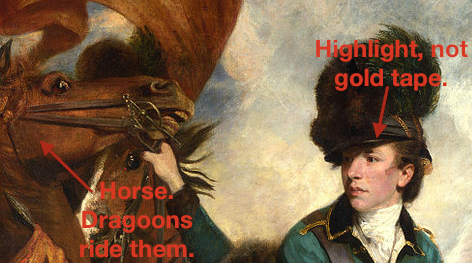
Banastre Tarlteon by Joshua Reynolds
Portrait of Sir Banastre Tarleton (1754-1833) by Joshua Reynolds, 1782. National Gallery (UK)

See update below!

By 9:00 on Sunday, I was asleep and missed “Turn,” which Mr S wasn’t even watching because, as he declared, “It’s just a bad show.” On Monday evening, I made it through the opening of the show and gave up for good. But those minutes made me think of the Banastre Tarleton portrait by Sir Joshua Reynolds, and the suggestion on Twitter that “Turn” had no historical consultant.

It occurred to me, as I stared at the rather curious headgear worn by Captain Tallmadge (I think it’s stretch lycra over a “Roman” gladiator costume helmet glued to a baseball cap visor and edge-taped with gold foil) that perhaps the people doing the costumes simply lacked visual literacy. This could explain the refugees from Fort Lee who looked like they stepped out of an Emma Lazarus poem, and it could explain the very unfortunate helmet.

Tarleton_notes

Let us look at Banastre Tarleton, hunky bad boy of the British dragoons: he came to mind on Monday night, and what visual relief he is.

Note the light edge of the visor: this is a highlight. The leading edge of a polished surface will shine, and helmets, even of leather, will be reflective. Over time, the edges will polished by wear if not on purpose. I cannot speak to the helmet habits of the horse-mounted, but I know from paintings, and that edge is a highlight.

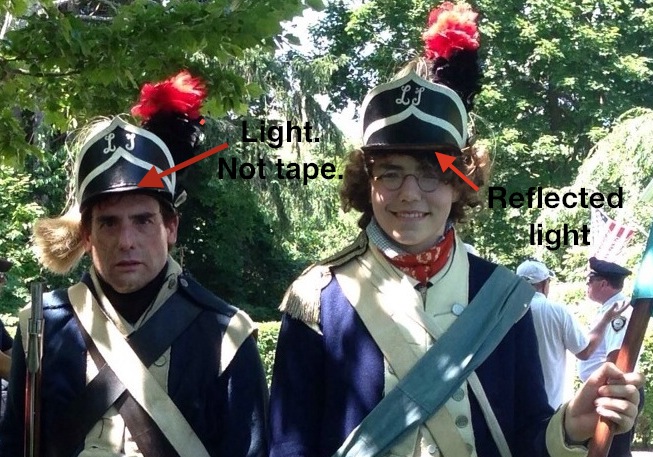
The Boys last July. Look, shiny, not-taped visor edges.

Reynolds painted what he saw, and just as the Young Mr’s cheekbones are reflecting light off the underside of his visor and Mr S’s helmet edge is shining in the direct light, so too is Colonel Tarleton’s helmet edge shining.

(Yes, there are both mounted and unmounted dragoons within a unit; but I just can’t help feeling that an officer would be mounted more often than he has appeared to be thus far.)

ETA: Heather has graciously pointed out a very nice blog on Turn, which is doing a far more even-handed and informed job of watching and commenting on the show. Thank you, Heather!