I troll the interwebs in the fishing and not the under-the-bridge sense: there’s a lot to read out there. Still, I’ve kept one eye on the feather-and-flower kerfluffle that erupted in certain circles this week, but have been much more interested in documentation of one kind and another.
Miss Vernon is really my favorite image of feathers on hats, and I wish I could say that a) I have replicated this fabulous creation or b) that I have seen such a thing, but alas! I have not.
Still, scouring sundry repositories for tayloring manuals (more on that another time), I found this delightful broadside. We can’t use 1782 to document 1780, and no means of using any of these items is mentioned or implied. Still, there they are, those inflammatory terms: Feathers, Flowers.
1782 Broadside. Early American Imprints, Series 1, no. 45771 (filmed)
Mr. Turner, out now on iTunes and elsewhere, won’t be for everyone: M’damsel isn’t treated very well– artists are, you know, often narcissistic, driven users– but the landscapes thrill.
We talk sometimes about going to the antique store in historical clothing and asking why our chattel is for sale. I toy with similar naughty thoughts about visiting historic house and other museums, but Mr Turner inspires a dream of a simpler pleasure: dressing in period clothes to visit a period gallery.
Classic Mr Turner in the salon
Possibly my companion would grunt as Turner does, but we might also unnerve guards by pointing walking sticks at salon-hung still lifes or reacting with disgust at the sight of an Impressionist work. (Might as well take it all the way.)
Everybody’s a critic
No takers yet for this diversion, which is just as well. I expect it would be a quick way to meet security and police staff if you didn’t coordinate with the museum/gallery in advance. Still: what a stunt. Someday I’ll pull it off.
There’s nothing like a little frivolity to lighten your day when you’ve been pondering some really serious and stomach-churning topics. Hail, then, the arrival of the Sotheby’s catalog and the momentary dropping of all material culture pretenses.
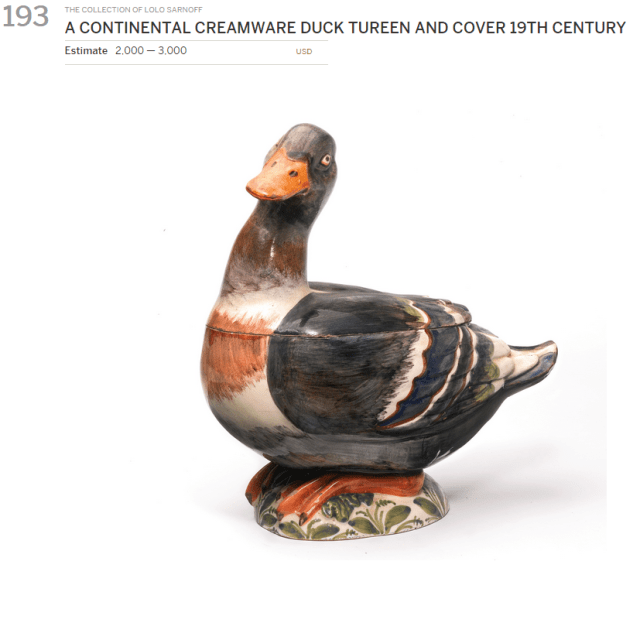
This time, it’s Private Collections. You say Private Collections, I say Disturbing and Hyper-Overpriced Gift Shop. But what does Snarky Duck say?
A Continental creamware duck tureen and cover. Duck says, No soup for you.
Poor Strangled Parrot: I don’t think he can say much.
A Holitsch parrot-form jug and cover ca. 1760.
And these guys, described as playful dogs, look more like dyspeptic pugs to me.
A pair of Hochst fayence figures of seated pugs ca 1770.
It is amazing what people will make and buy (which delights me), and I’m certain that things I own would astonish and appall someone with different taste. But animal effigies always intrigue me, and (aside from Snarky Duck, our 19th century friend) figures like these could have graced the mantels and tables of the finest homes of the 19th century. It would have been a crowded and raucous world.
Here’s the whole catalog, should you care for some ormolu chairs or Aubusson drapes (which I did not know existed until today).
Sylvia Lewis [Tyler], Diary (1801-1831), MSS 2899 in the Americana Collection of the NSDAR provides the basis for O’Brien’s article and my joy. It begins routinely enough with my favorite stuff– spinning!– and carries on to knitting: stockings, mittens, gloves, a hat or two, and even “comforters,” or scarves. Shag, or thrummed, knitting is mentioned, so at least those of us interpreting the world of 1801 and later can be war.
The real excitement comes on the third page: in the winter of 1803-1804, Sylvia Lewis cuts and sews a greatcoat. Then, in 1806, she makes a green Spencer, and in 1808, a black one.
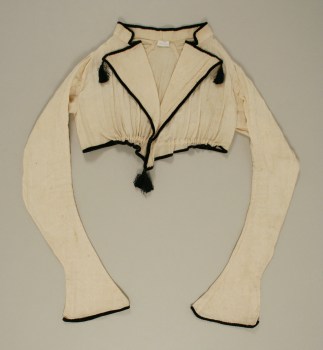
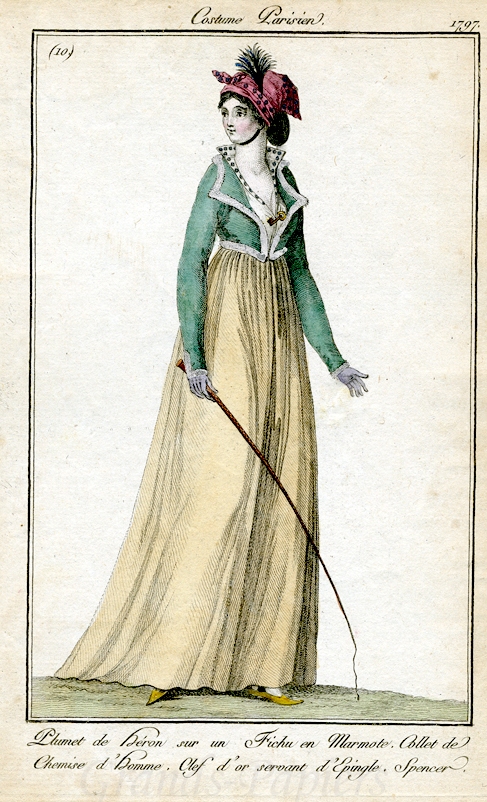
1806 is still later than I wore my Spencer. They’re shown in fashion plates of the 1790s, and here’s a pattern, too: so they’re clearly worn in Europe earlier than 1806. The similarity between the French silk spencer at the Met and fashion plates gives me confidence that they are being made and worn in the 1790s and early years of the 19th century; Spencers are also mentioned in tailoring manuals of this period.
1797, with a similar shape to the Met’s French silk spencer.
But there’s really good stuff in Sylvia Lewis’s diary for anyone who wants to know more about clothing production, use, and costs in early Federal New England. Even if your Library doesn’t have it, your Librarian can get a copy of the article for you through ILL or you can buy the entire proceedings here.







 Kirsten Hammerstrom
You must be logged in to post a comment.