The Enraged Musician. Chaos has a long history, and often I am for it. But not always.
For Organizers
Do not advertise. Having no audience makes an event super-lame.
Have no attendance limits on a closed site. Intense crowds and no security makes an event scary. Add alcohol for intensity.
Do not publish participant standards or a schedule. Confusion and laxity breed chaos.
Publish standards, but do not enforce them uniformly. Creating the appearance that standards are only enforced for people you don’t know erodes trust and credibility and discourages participation, reinforcing adolescent clique behavior.
Do not highlight (or provide) participant amenities like water, toilets, or dry firewood.
John Greenwood, Sea Captains Carousing in Suriname. Authentically bad behaviour.
For Participants
Don’t bring your own lunch, water, or powder.
Don’t follow the rules at a new event. Standards are for chumps. Text your friends while minding a rope line and acting as an interpreter.
Get drunk. Who doesn’t love an inebriate around gunpowder? Safety, schmafety. Besides, drunkenness is authentic.
Smoke cigarettes on the field. You can always hide your hand behind your back, next to your cartridge box…what can go wrong? The captain will never notice.
Make critical comments about the public and other reenactors just within their hearing. Don’t smile.
For the Public
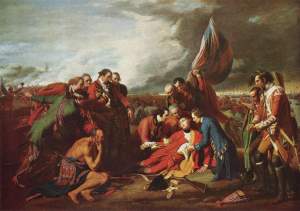
What, no dogs? The Death of General Wolfe, Benjamin West. NGC
Bring a dog. Dogs love guns, drums, and cannons. “Cry Havoc! And let slip the dogs of war,” right?
Ride your bicycle through the crowd. Make disparaging comments about the crowd interrupting your ride.
Touch things and people. Touch reenactors’ tools, weapons, clothes, children, food. Heck, use their tools. It’s not real, it’s history, so it has to be safe–right?
Interrupt people answering your questions, or better yet, someone else’s questions, and answer yourself.
Get drunk, especially on a hot, humid summer day or night.
Stop.
Breathe.
Think.
Then speak or act. Think about what you’re doing. Is it sensible? Is it kind? Is it how you would like to be treated? Does you behaviour foster a pleasant and welcoming environment?
Henrietta Diana, Dowager Countess of Stafford, Allan Ramsay, 1759(c) Glasgow Museums. Fur: cozy, but not for me. Also too early.
Winter is bearing down upon us, and while I was not in Connecticut last weekend, nor will I be in New Jersey two weekends hence, I do have winter history plans, barring the proverbial 50 feet of snow, which even a Subaru cannot handle. The Noble Train: I could not resist, for, as regular readers know, I prefer my history to hurt.
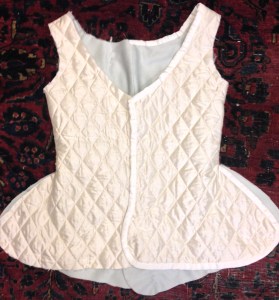
Still, I try to avoid cold-related illness and extreme discomfort, so I’m making sensible preparations. Of course, I have not finished my quilted petticoat, and lack the time to make a proper hand-quilted silk under-waistcoat. Reader, I have done a terrible thing: I have compromised.
The saddest part of all of this is that the waistcoat I’m making is the most feminine and luxurious item, and the only item even close to lingerie (aside from shifts) that I have ever made myself, or even own, no matter its inaccuracies. There is a kind of irony built into this project, hence a post while the irony is hot.
Waistcoat. Silk quilted and bound with silk grosgrain ribbon. ca. 1745. V&A Museum, T.87-1978
The waistcoat: an item of occasional debate, these are not the most common beast in museum collections. Fortunately, Sharon Burnston has a handy article and pattern posted on her website. To be clear, I am not recreating the Atwater-Kent waistcoat. I am cobbling together my own inappropriate but satisfying item. I am also using the absolutely inexcusable excuse that no one will see this garment, as well as previous bouts of pleurisy after long, cold events in stays when I had the merest hint of a cold. (My boss kindly offered to cup me for a cure when I had to take time off work, but I declined. The look on her face suggested a lack of appreciation for my historic ailment.)
But here we are, “confessions of a known bonnet-wearer” and all that, so onward to the project. I started with Sharon Burnston’s scaled diagram of the Atwater-Kent woman’s waistcoat. The shapes are very similar to a basic woman’s jacket of the period, bonus: loose fitting, no sleeves. It was easy enough to pattern up in an afternoon, with limited fitting (I did test it over stays, just in case.)
The compromises I made are in the materials: pre-quilted silk (with a cotton backing), lined with wool-cashmere, and bound in silk grosgrain ribbon. The size of the diamonds and the machine quilting, plus the wool lining, make this an inauthentic, inaccurate garment. The shape, construction, and binding are at least correct, as far as they go. But the lusciousness of that remnant table cashmere and the soft colors please me immensely, and I do expect to be warm.
This has been a quick project, with the majority of time spent on the binding. As in the Atwater-Kent waistcoat, I’m top stitching with a running stitch on the inside, folding the ribbon over, and hem stitching on the outside.
Will this feel like a hair shirt of shame under my gown, compromise as it is? Maybe, but at least it’s cashmere.
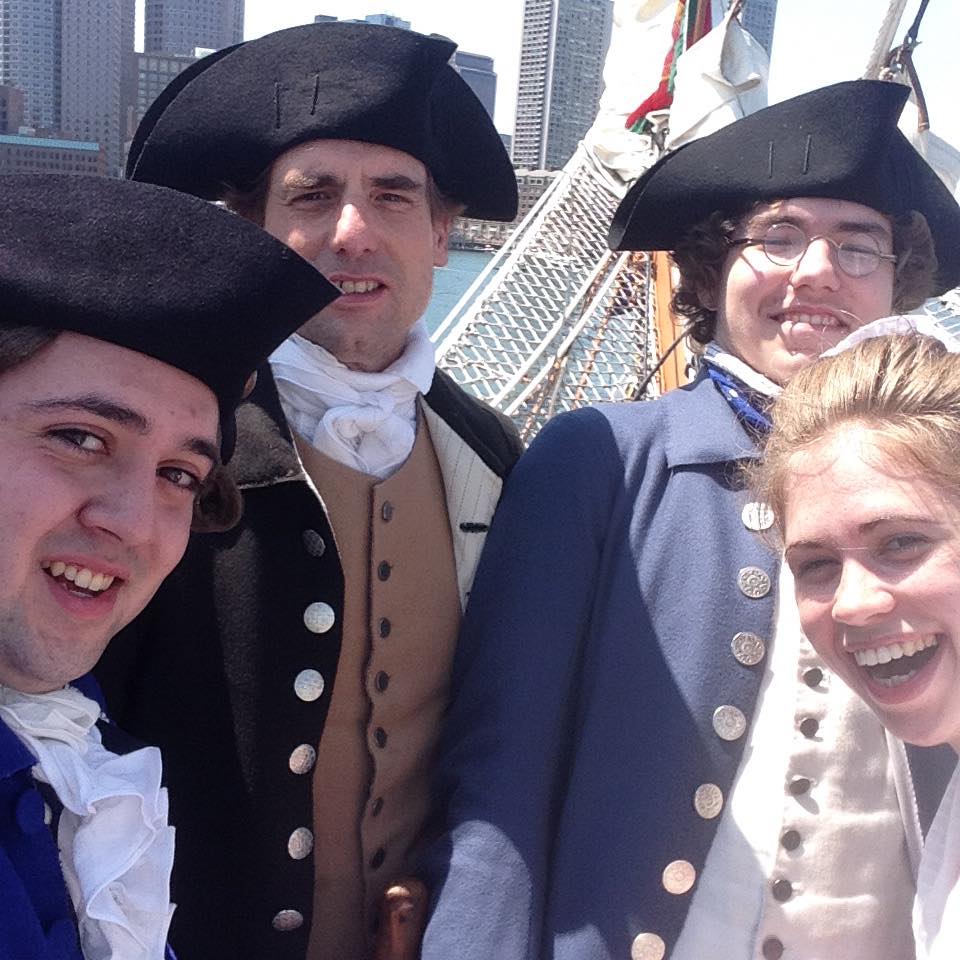
L’Hermione, remember her? That French ship? We were asked back in January if we wanted to be part of a group of Citizens of Boston in 1780 who came out to greet L’Hermione when she arrived in port. Yesterday (July 11) was the day she finally came to town, and most of the Rhode Island contingent of our Massachusetts group went up on the MBTA to see her. The train was totally the way to go, though Mr Hiwell did consume three Diet Cokes before we even got to the ship. Turns out the Henry Cooke frock coat pattern pockets can each hold three cans– a full six pack per coat, should you care for such a thing.
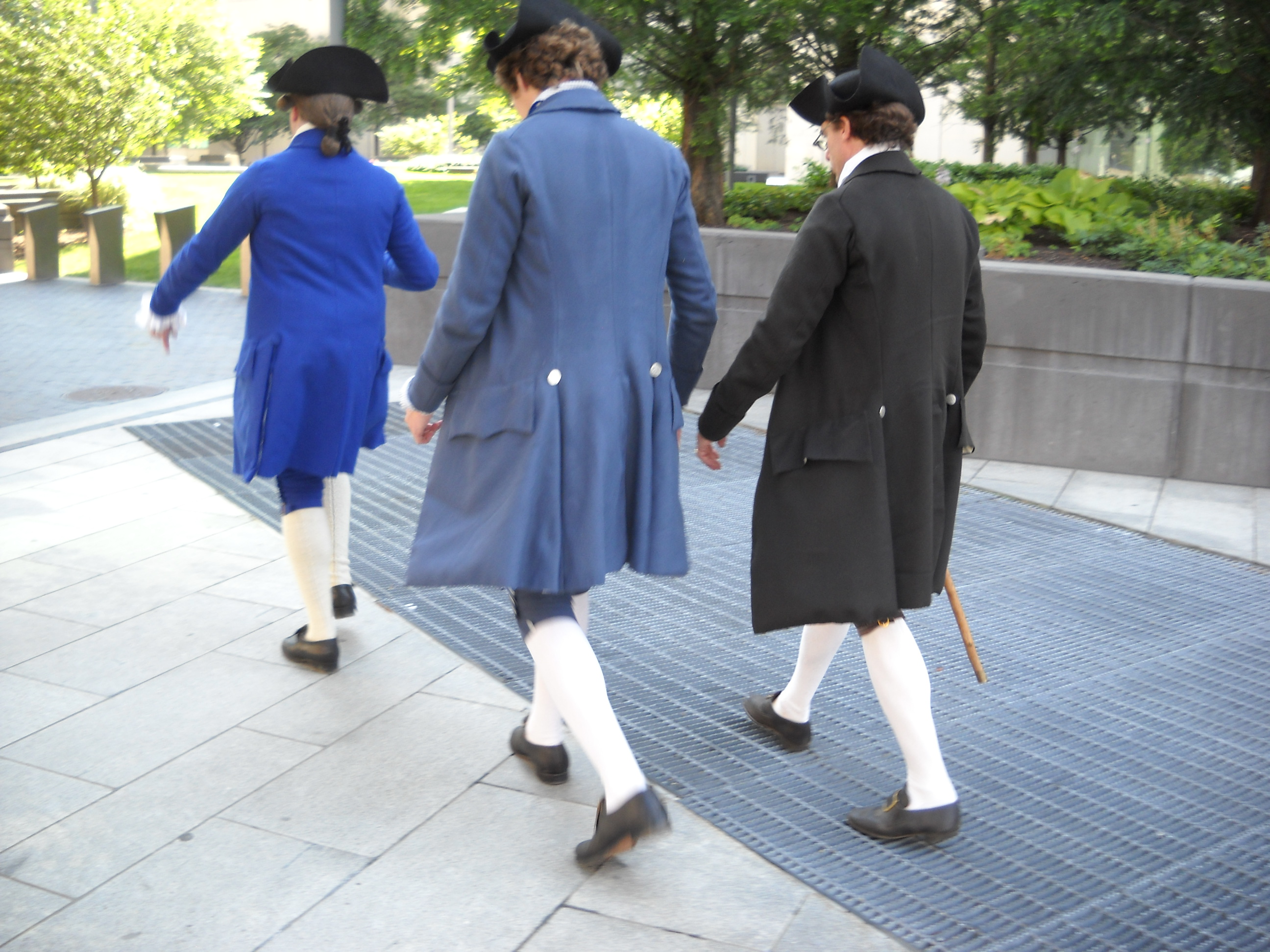
Walk fast, it’s the city!
We got to Rowe’s Wharf in time for the national anthem– or, as we like to call it, The Anacreontic Song. There was much speechifying, and though we were not talking too much, water was required. Those pockets came in handy again, as did my own capacious pockets. Good thing, too: the line was long and the sun was hot. One woman offered to let us go ahead of her in line, but that seemed wrong: if you have to wait in line, you have to wait, and the rule we have absorbed is that the public comes before reenactors. But, since we’d been asked to come, we decided to check the situation, and went to inquire. The “bouncer” at the head of the line told us to come back later, so we decided it was time for some lunch.
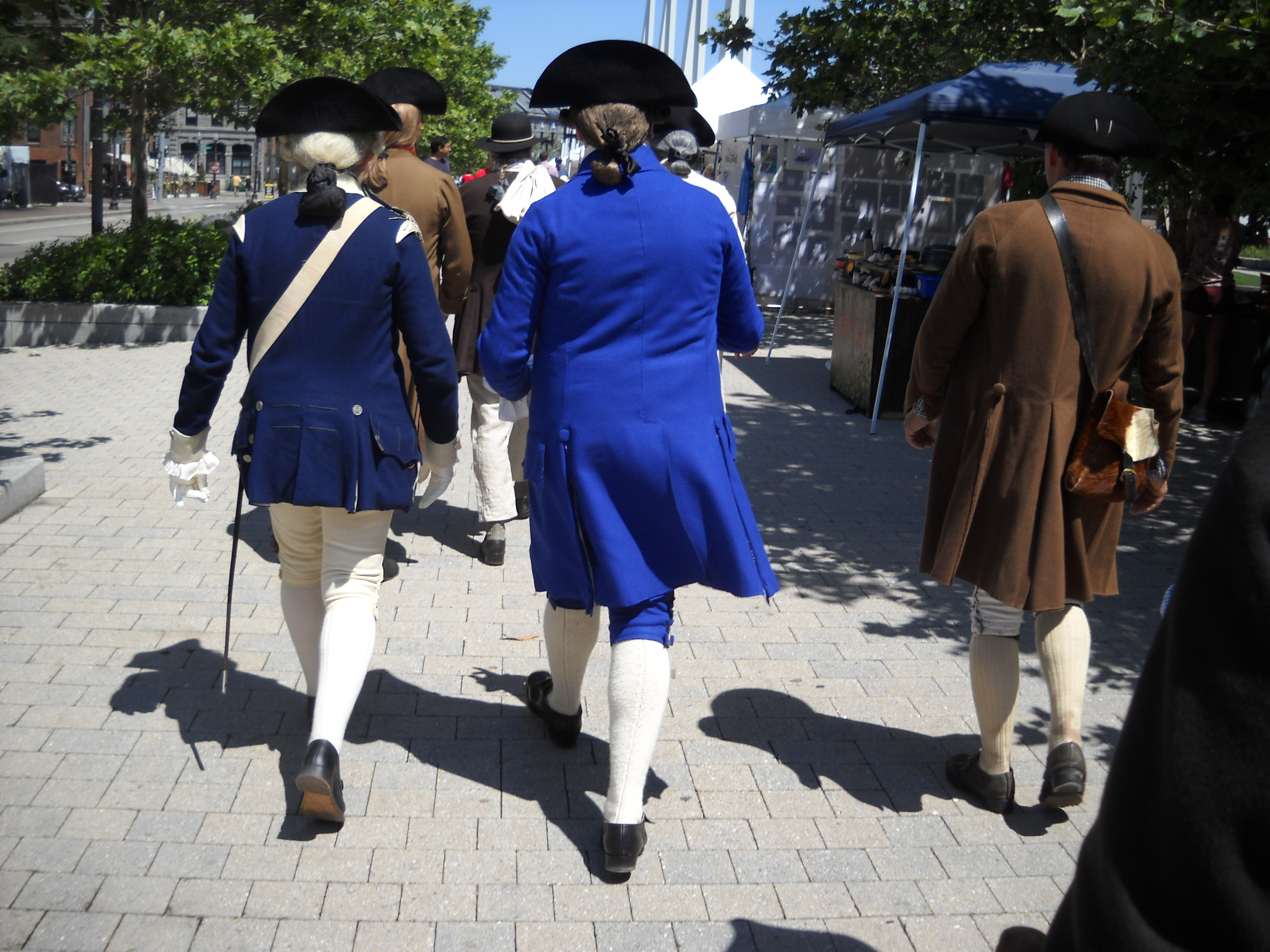
Lead, follow, get out of the way, or take another photo of backs.
By lunch, things were a little surreal as we sat at a table with people I never imagined sitting down with. No worries: it was all good, just a little weird that you have to leave Rhode Island to meet Rhode Islanders. The Young Mr inhaled his lunch, and probably made a lasting, if Hooverish, impression on our new acquaintances. The fact that the entire new contingent of the 10th Massachusetts sat on one side of the table, and that 80% of us were from RI, also made an impression. We are why you can’t have nice things.
Refreshed, we journeyed back to the ship, meeting more friends along the way. To be fair, Mr S and I had agreed beforehand that going up to Boston was as much about seeing our very dear and far-away friends as it was about the ship, and we were delighted to see every one of them. But at last, we thought, we can get on board.
Totally justified.
No soap, as they say. The line was closing at 1:00 and we were too late to make it into the last crowd that would get on– it was the longest line I’d ever seen– and, even worse, many members of the public waited in the hot sun and failed to board. For us, five and a half months of anticipation were dashed in a moment.
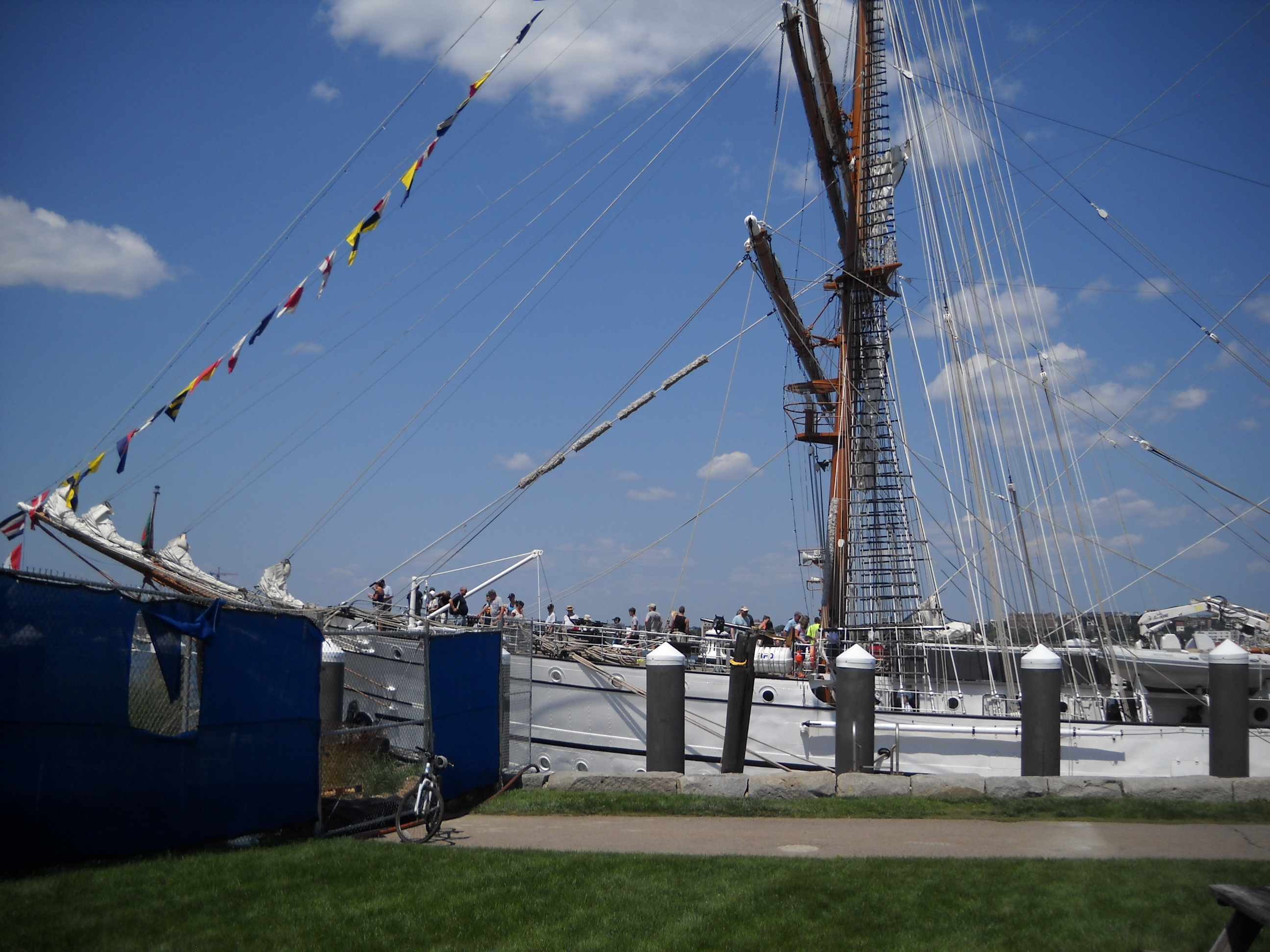
But wait! Well found again, Mr and Mrs B and Baby B. Mr S was delighted to meet Georgiana (he has a thing for babies, and an uncanny ability to guess their ages, and to tease and delight them), whom he had very much wanted to see. L’Hermione was not the only tall ship in the sea: we considered the dry-docked USS Constitution, but chose the Sagres instead, as she is only in port for a few days. Off we went on another trek, waylaid often for photos. The Young Mr in particular kept getting stopped.
Gulliveresque, relly.
At least there was some shade here, and a bench. We took it in turns to go on the Sagres. Mr and Mrs B and I watched from the shore, and could see this happening. I don’t know how they trapped Mr S in this, but they did.
After an excursion to the ICA (which we are, as temporal performance art) for water, bathrooms, and some AC, the second shift got to visit the boat. We must have been cursed, because there was another line! At least this one moved, and however slowly and carefully in leather-soled shoes, we managed to go aboard.
Hey, it’s got masts.
Mr B was right: oversized yacht. Still very happy to have gone on a ship and to have seen many interesting things, including a very specific kind of display.
Portugal. The Best Fish in the World.
Mmmm, fish. All the packages were, in fact, empty. At this point we decided it was time for ice cream, and headed back. The Rhode Island Party ended up back at South Station for frozen yogurt and a bit of a rest. I don’t normally wear heels– ever– so a day in 18th century women’s shoes was a pedal workout. (We considered renting bikes, because if you have to be anachronistic, you might as well go all the way.)
Mr Hiwell and I considered the day: it wasn’t bad. We didn’t even get close to achieving what we thought was our goal. But we made our own fun with wonderful friends, had an adventure, and went at least three places we did not expect to go and had not been to before. All in all, success, even in failure to board.
If they sleep on the way home, it wasn’t a bad day.
La famille Anglaise à Paris.Plate 11 to ‘London und Paris’, x, 1802 [1803]. Explanatory text, pp. 90-5. Copy of No. 11 in ‘Le Suprême Bon Ton’ series, see BMSat 9957. An English John Bull stands stolidly full face with clasped hands, a grown daughter on his right arm, his wife on his left arm. With them are two tiny little girls and a grown-up son, also stolid. A Frenchman and a lady attitudinize elegantly on the left. 1802 Hand-coloured etching. British Museum 1856,0712.605
Mr JS and I have amused ourselves of late not just with thimble chatter, but with this satirical print of the English family in Paris.
I’m not nearly as funny as Mr JS, who pointed out that the bonneted girl on the far right is “I literally can’t even right now.” I think of her as Lisa Simpson, 1803. That’s the voice I hear reading the line texted to me: “I just want to pull this chemise dress over my head and die. Could someone with yellow fever cough on me?”
The father is Homeresque in his proportions, and nearly as befuddled. The artist is clearly mocking this poor family, contrasted with the graceful Parisians at left, but only the two youngest are aware, hiding in their cones of shame.
That deep coal-scuttle-like bonnet is mocked in other engravings; it is probably closer to the actual form of Julia Bowen’s cold scoop of 1799 than my approximation this fall. Julia would surely have known the shaming purposes of those grandiose and over-sized calashes: “Go sit in your calash and think about what you’ve done!” Mr JS quipped.
Appropriately enough, the silk I ordered to make my own calash of shame has arrived at the post office. Dark green taffeta envy lined with the bright magenta of embarrassment: clothes are so emotional.











![La famille Anglaise à Paris.Plate 11 to 'London und Paris', x, 1802 [1803]. Explanatory text, pp. 90-5. Copy of No. 11 in 'Le Suprême Bon Ton' series, see BMSat 9957. An English John Bull stands stolidly full face with clasped hands, a grown daughter on his right arm, his wife on his left arm. With them are two tiny little girls and a grown-up son, also stolid. A Frenchman and a lady attitudinize elegantly on the left. 1802 Hand-coloured etching. British Museum 1856,0712.605](https://kirstenhammerstrom.com/wp-content/uploads/2023/03/a38fc-bontonno11.jpg?w=640)
 Kirsten Hammerstrom
You must be logged in to post a comment.