Draping and Dreaming

Why have just one dream project when you can have more than you can possibly achieve? Here, in no particular order, are things I’d like to make or achieve but probably never will:
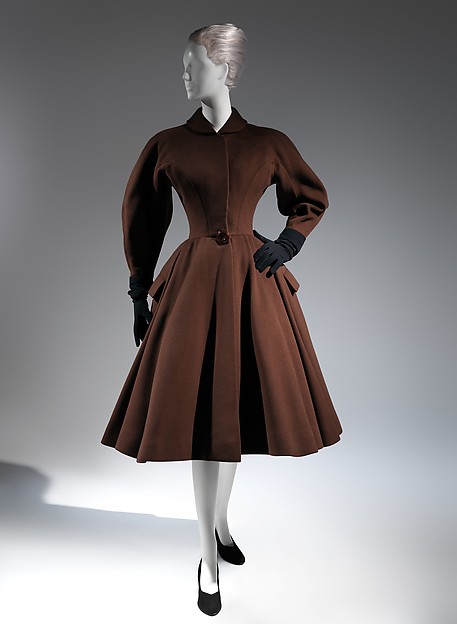
Charles James (American, born Great Britain, 1906–1978)
“Cossack”, 1952
American,
wool; Length at CB: 46 in. (116.8 cm)
The Metropolitan Museum of Art, New York, Brooklyn Museum Costume Collection at The Metropolitan Museum of Art, Gift of the Brooklyn Museum, 2009; Gift of Muriel Bultman Francis, 1966 (2009.300.402)

Charles James: American master of draping fabric. I have nowhere and no reason to make or wear this coat, but the lines and fabric appeal to me. This skill level is currently beyond me, but I recognize that I have enough historical clothing that I could get out of the 18th and 19th centuries to concentrate on learning the couture techniques of the 20th century. Many muslins went into making this, and a deep understanding of fabric. One of the best things about the Met’s Charles James collection is the large number of muslins. Costume and clothing designers’ sketches, muslins give us a good sense of how a designer thought, and what steps went into a garment.

Balenciaga is another favorite. Evening gowns, suits, and coats, all deliciously draped.
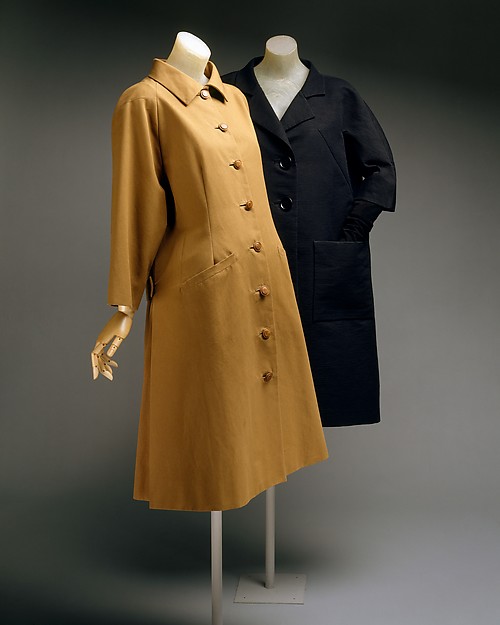
House of Balenciaga (French, founded 1937)
Rain ensemble, fall/winter 1965–66
French,
cotton ; Length (a): 42 1/2 in. (108 cm) Length (b): 24 in. (61 cm)
The Metropolitan Museum of Art, New York, Gift of Rachel L. Mellon, 1987 (1987.134.23a, b)

Lest you think I only like coats, the “Tulip” dress is equally interesting.

House of Balenciaga (French, founded 1937)
Evening Dress, 1964
French,
silk ;
The Metropolitan Museum of Art, New York, Gift of Baroness Philippe de Rothschild, 1973 (1973.21.8)

Thanks to the V&A, there are digital animations of the construction of the tulip dress, which has deceptively simple pattern pieces. The video was created in support of teh V&A’s Balenciaga exhibition, which I am sorry not to be able to see.

Equally out of reach is this: a remodeled silk lampas gown. The idea is to make the first gown– that is, the gown suitable for the fabric’s earliest date (which is probably not 1790, but closer to 1740-1750) and then alter that gown to the late 18th century style.

Unknown maker. Gown, 1790. French, silk, The Metropolitan Museum of Art, New York, Purchase, Irene Lewisohn Bequest, 1964, (C.I.64.32.2)

This last “dream” project is more achievable, though somewhat academic. Silk lampas fabric can be found, and there’s a simpler alteration project in lampas at the V&A
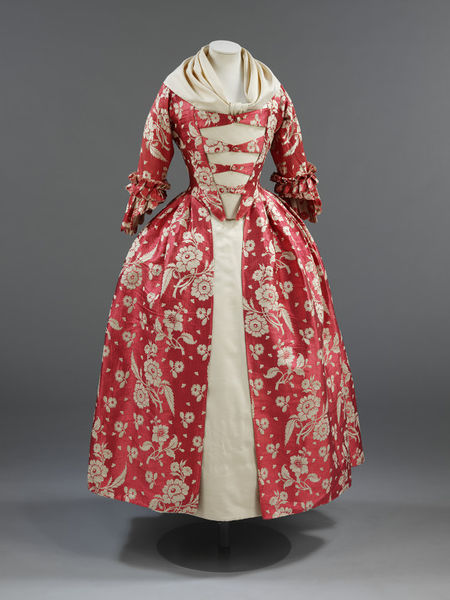
Gown, Spitalfields silk, ,
1740 – 1749 (weaving) 1740 – 1749 (sewing)
1760 – 1769 (altered) 1950 – 1959 (altered)
Given by Mrs H. H. Fraser Victoria and Albert Museum, T.433-1967

.
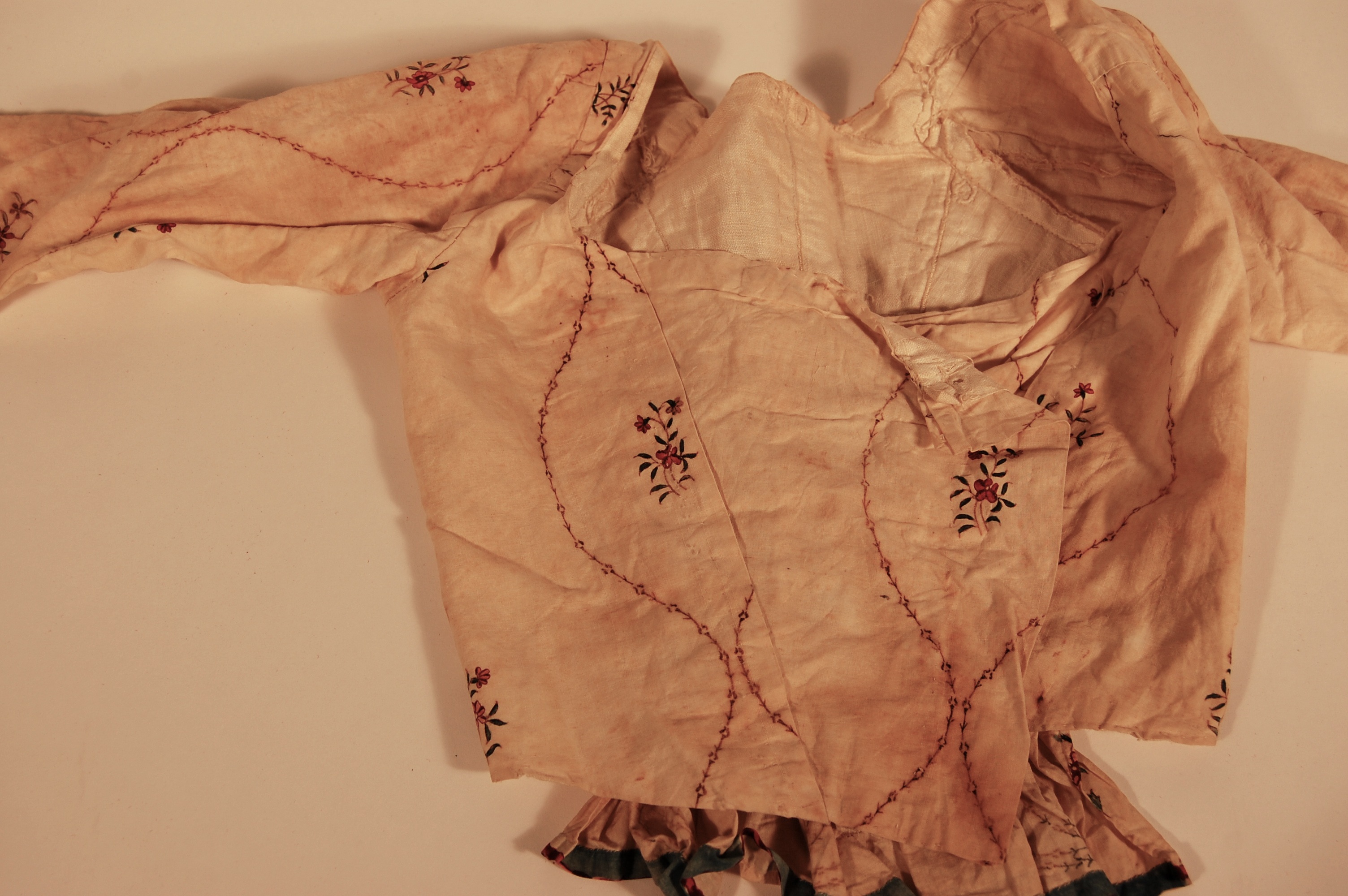
I Fall to Pieces: Extant Garment Fragments

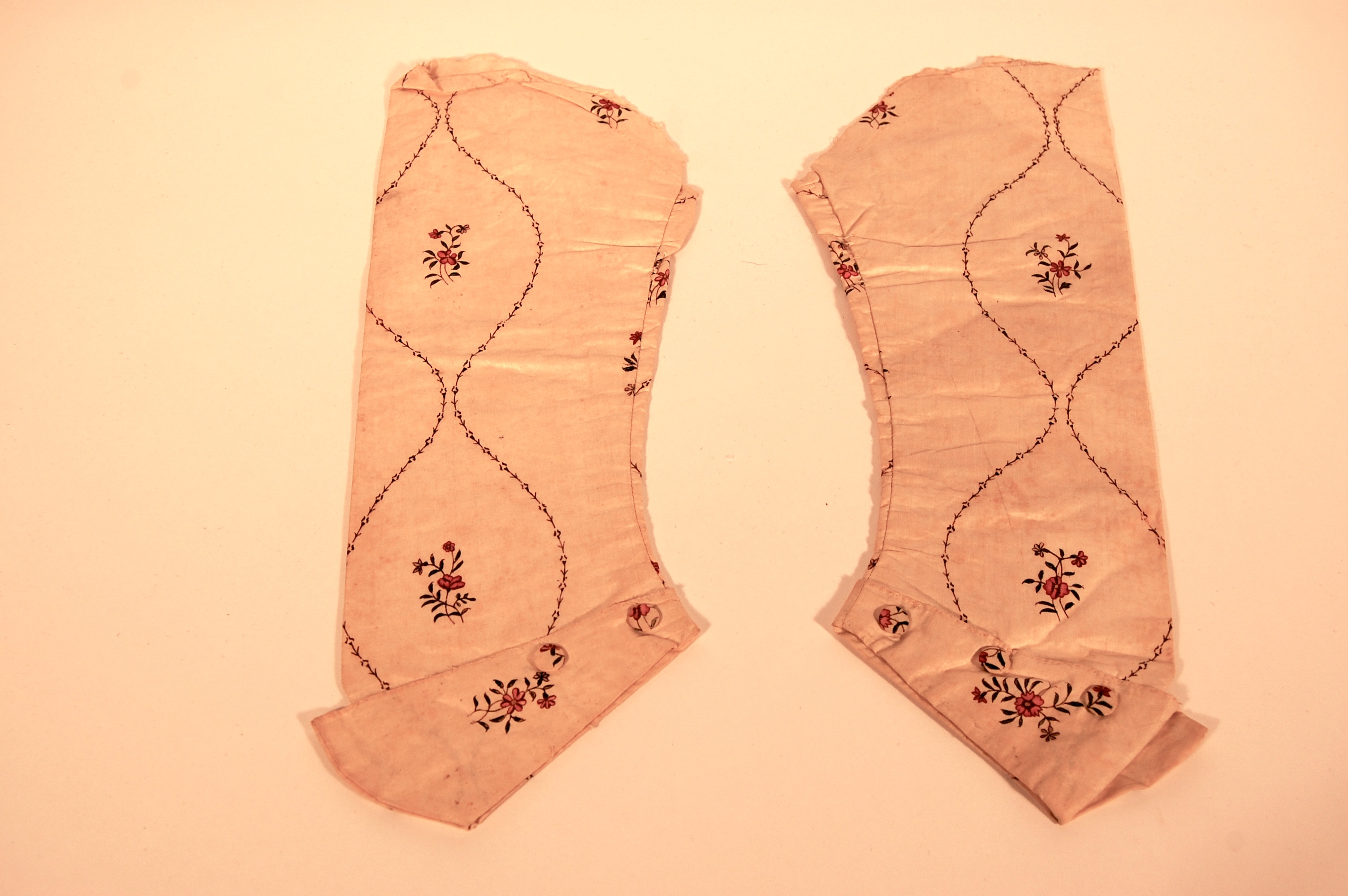
Bodice, painted Indian cotton, 1780-1795 RIHS 1990.36.27
Bodice, painted Indian cotton, 1780-1795
RIHS 1990.36.27

Once upon a time, not very long ago, when I worked in a historic house museum, I was asked to present at a conference in Worcester. I chose to talk about these fragments, and I still like to think about them. The delicate fabric was saved as a pair of sleeves, a bodice with a tiny peplum, a skirt.

Sleeves, removed from bodice 1990.36.27. RIHS 1990.36.25A-B
Sleeves, removed from bodice 1990.36.27.
RIHS 1990.36.25A-B

The pieces appear to have been part of a pieced-back closed-front gown with a matching petticoat circa 1785. I think someone decided (quite rightly) that the style was too passé for 1795, and altered the gown significantly.

Not only is there evidence of new sleeves being fitted into the gown’s armscyes, we have the sleeves-that-used-to-be. And my dear! No one is wearing sleeves like that this season!

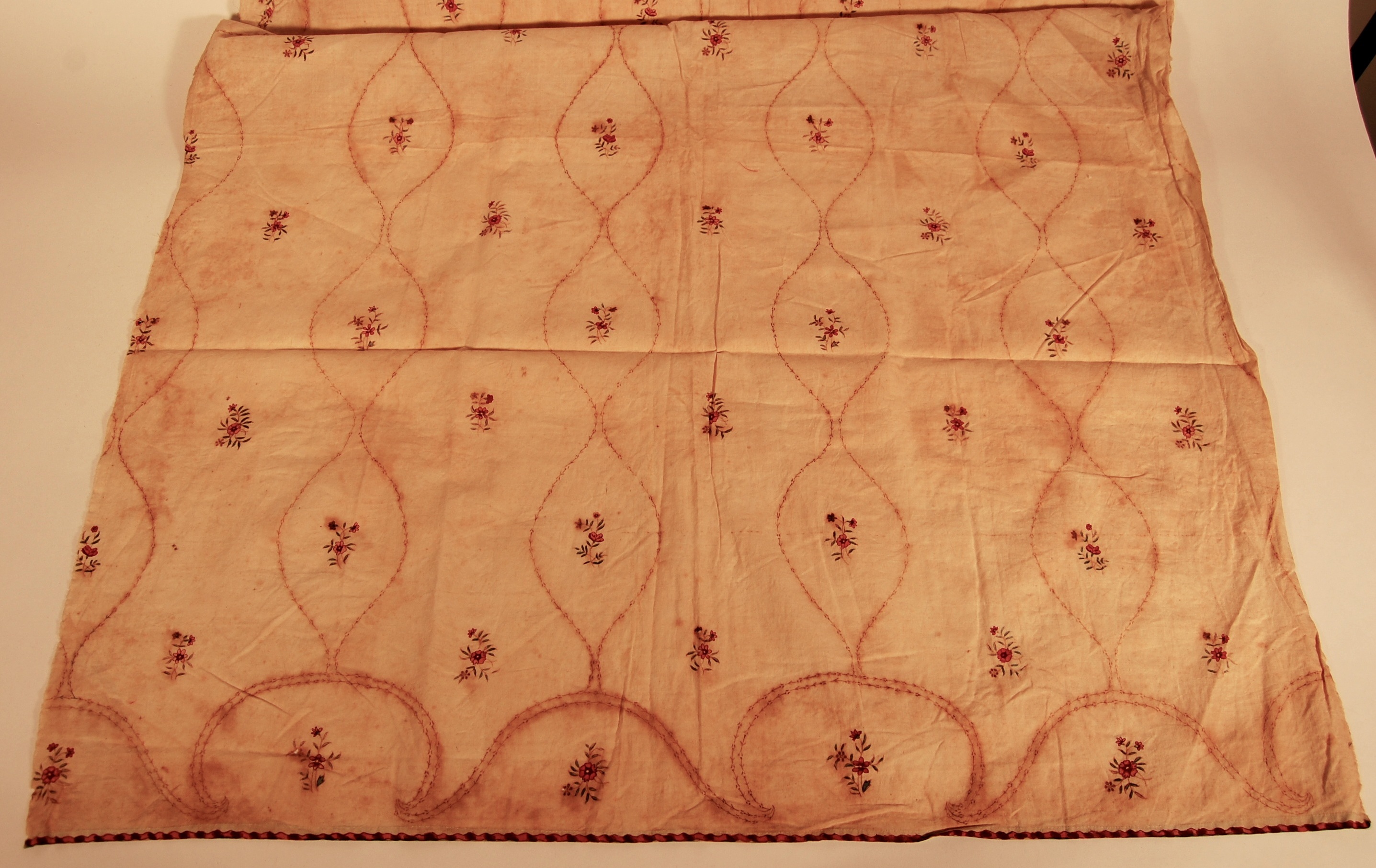
I find these garments in limbo really fascinating. Was that bodice finished and worn with a matching petticoat? (Yes, there’s a panel of that left, too; what a lovely hem!)

Skirt panel, painted Indian cotton. RIHS 1990.36.33
Skirt panel, painted Indian cotton.
RIHS 1990.36.33

Who wore the gown? Was it Sally Brown, born in 1773? And did she alter it, or did her sister’s mantua maker, Nancy Smith? We can only guess at this point, as so many documents remain in private hands. The alterations are not as finely done as the original gown, so I think there are two hands at work here– whose were those hands? There’s always more to think about and learn.

In case you’re wondering, thanks to the Met, we can see what the gown probably looked like in its first incarnation, and then what the alterations were meant to achieve. (Link to the gown on the left; link to the gown on the right.)

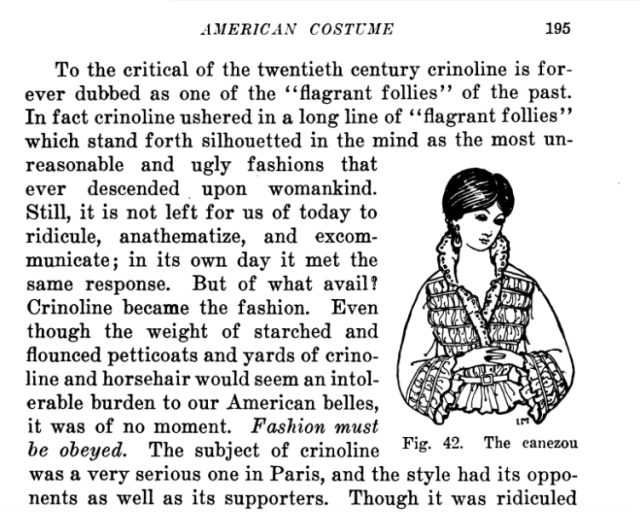
Au courant? Un canezou

Collier de Lapis. Canezou a Manche[?]

This.

Because, August (or Aôut). The Salem Maritime Festival is nearly upon us, so there’s a flurry of bonnet and accessory and other making happening chez Calash as there usually is in summer. It’s one of my favorite things to do, and this year I was asked if the millinery setup could be more of a demonstration.

That’s a kind of relief, actually, as it allows me to bring bonnets from multiple years in a variety of levels of completion, which allows me the luxury of talking about evolving styles and a variety of construction methods. Whether or not I’ll manage a drawn bonnet is still up in the air; it’s a lot of hand sewing for someone with carpal tunnel.*

Because any trip to Salem affords me the opportunity to join the mercantile class, I like to take the opportunity to make something new and non-working class when I go up there. This year, I was taken with the canezou. What’s a milliner to do, but stay as up-to-date as possible? What the heck is a canezou?

Well….roughly, from the French and English costume history books, the canezou is a short, Spencer-like garment, often in white, lightweight cotton, worn over another garment. The canezou seen here clearly has sleeves, and the plate is dated 1811, giving the lie to the wikipedia’s assertion that it’s circa 1835. (The later evolutions have become more scarf or fichu-like, but are again worn over other gowns- though apparently it enjoys a brief time as the cambric blouse worn with a riding habit. And then there’s another definition, by another fashion historian, in which the canezou is described as being like a man’s shirt.

Well, that’s all cleared up then….

With this information in hand, and the fashion plate before me, I perused the contents of the Strategic Fabric Reserve, and lit upon those popular Ikea curtains which have appeared here before as a gown and as a petticoat and now as a canezou.

I modified a Spencer pattern for the base lining of white cotton, and then draped, stroke gathered, and stitched the curtain fabric to form the floofy bodice. The lace on the cap sleeves is reclaimed from a late 19th century negligee lurking in Drunk Tailor’s collection of usable old fabrics, while the lace at the bottom was reclaimed from an antique petticoat before I picked it up in Sturbridge, MA a few years ago.

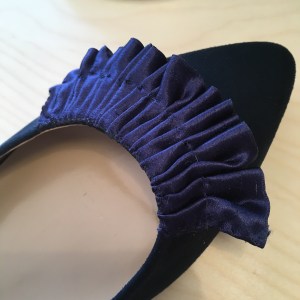
To complete this, a bodiced petticoat with an embroidered hem (machine embroidered, of fabric I may have picked up from a remnant table in Pawtucket, RI), a pair of trimmed shoes, a necklace (here of sapphire blue stones, unless I can teach myself hand-knotting by Friday), and a bonnet of blue and white check silk that arrived just in time from India. Five new items in two or three weeks: the price of fashion is slightly mad.

*Hand-sewing everything has, at last, caught up with me. I find soaking my hands in cold water helpful, as well as sleeping in those super attractive hand braces. Imma need some surgery, but for now, braces, Aspercreme, and ice water must do.

Circles and Lines

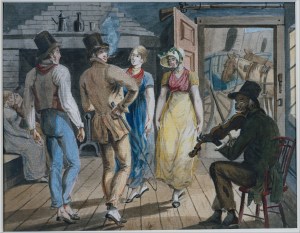
Merrymaking at a Wayside Inn, watercolor on paper by John Lewis Krimmel. 1811-1813. Metropolitan Museum of Art, 42.95.12

By some miracle, I did not have the Polecats in my head all weekend, despite spending most of Saturday only dancing. It has been some time since I danced (February’s adventure notwithstanding) and after two hip replacements, my Giant son is correct: I’m still re-training my muscles. My feet remember more than my hips do, but at least some of my muscles remember!

The Commonwealth Vintage Dancers Regency Weekend was this past weekend, and while I could only manage Saturday (Sundays are for chores when you’re expecting houseguests for Easter), I had a wonderful time and sincerely hope I can retain what I was taught. The company was very friendly and quite genteel, though I can report that I did experience a variety of partners, and, in one unfortunate case, became so confused I had to step out of the dance entirely. (Mixed rhythms and mixed-up steps became far too jumbled in my poor brain.)

The Five Positions, from An Analysis of Country Dancing, T. Wilson, 1811.

The entire day reminded me strongly of being in a novel, or, as Drunk Tailor said on hearing the description, a movie. Let us merely note that some gentleman are more enthusiastic appreciators of music than others, and that a partner can be left feeling a bit flung about in some of the figures that involve the mouliner. My rusty memories of French came in handy: mouliner and mill connect easily enough for me (seen here, in Prince Kutusoff) and the Boulanger made much more sense when I connected it to mixing bread dough. Hey– whatever gets you through the set without stepping on your own, or anyone else’s feet!

I’d like to think I will remember something of this business the next time I get to dance, whenever that may be. The patterns can be found on line in manuals (as in this description of Sir Roger de Coverly) with some occasional, bearable, videos— and, as always, resources close to home.

Next time: the dress. Until then, I’m posting more on Instagram.