Kits, Boxes, Sticks, and All

Jens Juel, Self portrait at an easel. Oil on canvas, 1766. Royal Academy of Fine Arts, Denmark.

Once again, I’m looking into artists’ materials and techniques, though instead of trying to kit myself out for the early Federal era, I’m digging into the last half (quarter) of the 18th century. It seems to be a time of rapid transitions in art materials as new pigments and media are developed. While Mr. Juel is beginning a work in oils, we still see some of the same tools that a watercolorist would use. Brushes, though his are shaped for working in oil; a shell, perhaps to combine pigment with medium, and bags of paint.

Before collapsible tubes were invented in 1841, artists scooped or scraped pigments mulled with medium into skin bags, secured them with twine or string, and then poked a hole in the bag to extrude pigment. Some more clever sorts would plug the hole with a cork– untying the bag would make more of a mess than a distribution system– but otherwise, you risked having your paint dry before you could use it up. Clearly there were some inefficiencies built into the system. (I think it also helps explain why “thick” paintings, that is, paintings using exuberant and textured layers of paint, do not appear until after collapsible tubes are invented and in wide use.)
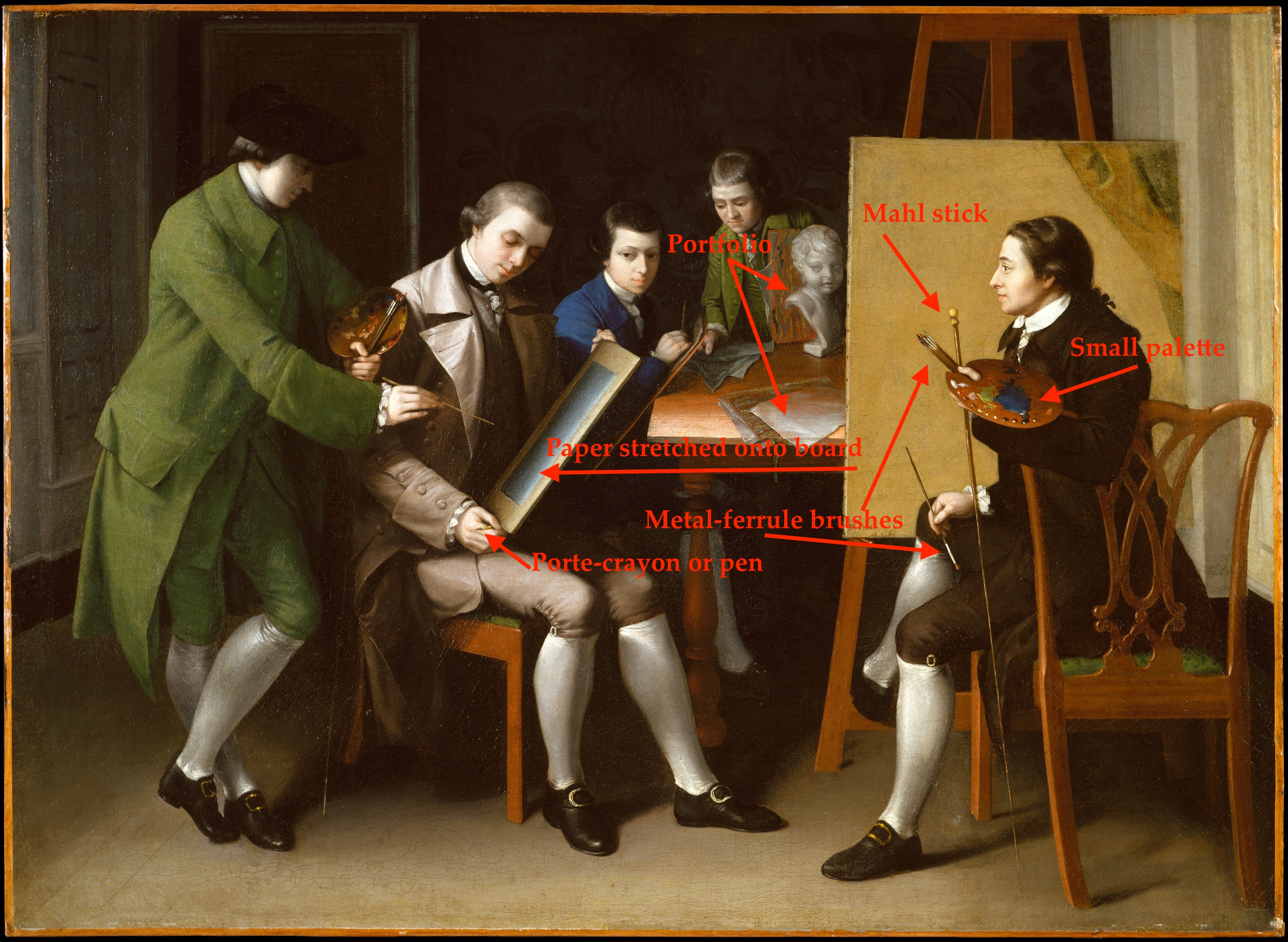
Matthew Pratt, The American School. oil on canvas, 1765. Metropolitan Museum of Art, Gift of Samuel P. Avery, 1897, 97.29.3

In Pratt’s American School, we can see how small the palettes are, and how small the dots of paint are compared to the pools where colors have been mixed. The easel, presented from another angle, offers clues to the adjustable pegs and triangular/tripod shape of the main support. But what of watercolors?

Winsor & Newton Old Paints: note the tiny bags of paint.

To date, I’ve found conservation reports more helpful than anything else, especially those analyzing paint content for sugars and gums. (One of the keys to watercolors was the re-wettable aspect of the colors; gum arabic, gum tragacanth and honey or sugar were ingredients used in varying proportions to achieve what we now take for granted.) The first watercolor cakes or blocks are introduced in 1780 by William Reeves; often, these were very hard, and had to be agitated in water (ground on a surface) to be used, much like sumi-e ink. Once paint was ground with water, it could be dried in a dish or container for re-wetting and later use. The question of course is, what do dry it in? How do you mix and use the paint?

Caroline Schetky Richardson’s Paint Box
about 1820–30. MFA Boston. 1995.156.1

Mixing is simpler to solve: a palette, of course. The small, dirty-looking oval in the image above is the ivory palette used by Caroline Schetky Richardson; while her box is 1820-1830, it’s still very similar to box in Charles Willson Peale’s portrait of his brother James (below). The box is 21 inches wide, 10 inches high, and 13 inches deep. That makes the palette something like 3 inches wide, if we take a drawer as five inches wide.

James Peale painting a miniature. Oil on canvas by Charles Willson Peale, 1795. Meade Art Museum, Amherst, MA

In the CWP portrait of JP, the slightly open drawer of the painting stand may be giving us a peek at his palette; the simple tumbler of water helps confirm that he is working in watercolor on ivory, and give us a sense of what kind of water container artists used– which, happily, can be more easily sourced than Mr Peale’s box.

Wrap it up, I’ll take it

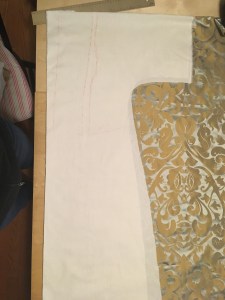
To be honest, I would love to wrap my self up and take this silk, but it is for a museum to display, so instead the box is wrapped and ready to ship.

I was lucky to be included in a message group started by a friend asking if any of us had a banyan or wrapping gown to loan. Well, no… but I can make one!

So I did.

My version is based on this 1750-1760 example at the Victoria and Albert Museum, of silk designed by Anna Maria Garthwaite ca. 1740-1750. To be honest, this is one of my favorite gowns, despite the fact that it bears no practical relationship to any part of my daily or living history life. A girl can dream, though…

Just a little bit scary, despite being able to get more silk if I really messed up.

In particular, I like the way the style combines the t-shape of a basic banyan with the pleats used to shape European women’s gowns. Tricky, right?

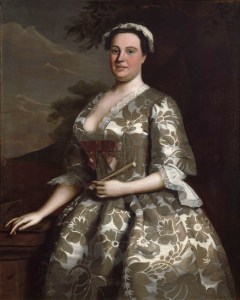
Ann Shippen Willing, oil on canvas by Robert Feke, 1746. Winterthur Museum Museum purchase with funds provided by Alfred E. Bissell in memory of Henry Francis du Pont. 1969.0134 A

I made a pattern in muslin (it took two) primarily by draping, reading the V&A description, and looking at the original images as large as I could get them. By the time I had a pattern, I was mostly convinced, but still intimidated by the silk. I’ve had my eye on this ever since I saw at the local store, for it reminded me strongly of the Anna Maria Garthwaite silk worn by Ann Shippen Willing (Mrs. Charles Willing) of Philadelphia in this portrait by Robert Feke.

In the interest of economy, I machine sewed the long seams and the interior (lining) pleats, though I would not if I wear to make this for myself. Once the main seams were done, I pleated and pinned again.

Then it was time for my one of my favorite activities, hand-stitching pleats. It’s impressive how the look of a garment changes (and improves) as you continue to work on it. The fullness of the gown with the inserted pleats is pretty impressive and very satisfying to wear. It sounds fabulous as it moves with your body.

Once the gown is fully dressed on a mannequin (that is, over a shift and petticoat), I know it will assume the more correct shape of the green gown at the V&A– it looks better even on me, although it is too small, being made for a mannequin representing an 18th century woman.

Portrait of a Woman Artist, c. 1735
Oil on canvas
40 x 32 5/16 in. (101.7 x 82 cm)
Restricted gift of Mrs. Harold T. Martin in honor of Patrice Marandel, 1981.66
Art Institute of Chicago

Along the way, I found another green silk wrapping gown or banyan, this time worn by a French artist.I can guarantee you I would never wear silk to paint in, but your mileage may vary, and if I had a maidservant and unlimited cash in 1760, perhaps I would emulate the Mademoiselle at left.

Reading the Night

Francois-Robert Ingouf after Sigmund Freudenberger (French, 1747 – 1812 ), La soiree d’hyver, 1774, etching and engraving, Rosenwald Collection 1943.3.4377

Details. It’s all in the details, right? I see this print multiple times every day, and contemplate the little stories in the details of the room.

Francois-Robert Ingouf after Sigmund Freudenberger (French, 1747 – 1812 ), La soiree d’hyver, 1774, etching and engraving, Rosenwald Collection 1943.3.4377

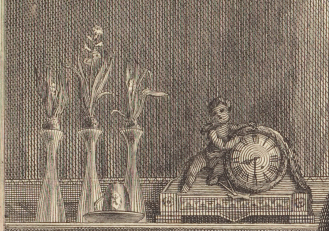
Perhaps the first thing I noticed that jarred my eye (and my thinking) was the row of glass vases for forcing bulbs. They look so modern, don’t they? But the shape is classic– form following function– and findable today. How pleasing that my mother’s winter ritual of filling windowsills and mantles with forcing bulbs can be visually documented to one of my favorite eras–and was, indeed, common in the past. This is one of those “everybody did it” ideas I can endorse.

What else is on the mantle? A clock, undoubtedly ormolu– though it could be much worse. And yes, the cupid on the clock has meaning in this print.

And then there’s this: the hot water urn– or is it?

Tucked into the fire place, I was initially pretty sure that’s a hot water/tea/coffee urn, meant to go with the tea or coffee cup on the mantle (see above; it’s in front of the bulb vases). Hot tea or coffee would be welcome on a cold winter’s evening, and the water would stay warmer tucked close to the fire.

18th Century Cast and Wrought Iron Fireplace Fire Grate

But it could also be a decorative fender, ornamented with urns at the ends. The fireplace grate shown here is English, made ca. 1780 according to the seller) but should you have space cash burning a hole in your pocket, there’s a similar 19th century reproduction of the one in the print for sale on the interwebs, should you care to recreate this image (I know some of you have the clothes). In fact, there are quite few fenders-with-urns, once you start looking, some in bronze and some in steel.

And what of this? Is that an 18th century dog house or covered dog bed? Yes, it is.

The bouillotte candlestand on the table is another nice household detail, illuminating a book lying open on the table set against the wall.

It has taken me some time of looking at period images to accept these candle stands as correct, since my experience with them was grounded in electrified reproductions in suburban Colonial Revival dens and family rooms– a location I will admit I was prejudiced against to begin with, having grown up in a city surrounded by architects devoted to (and buildings by) Mies van der Rohe.

But therein lies the point of looking: what initially seems absurd (Versailles-quality dog beds) or simply anachronistic (candlestands with shades) slides into place when seen and understood, within its proper context.

Reading Double

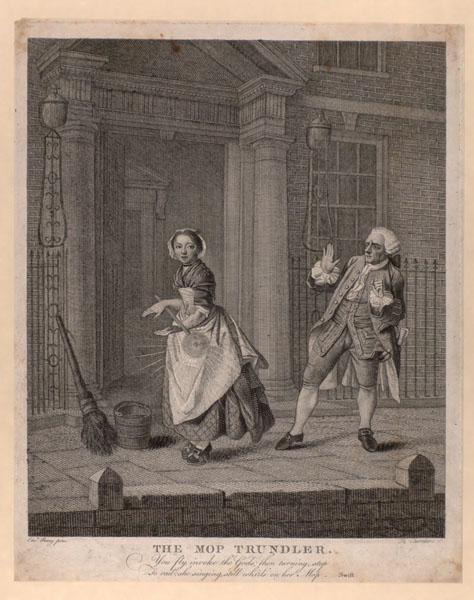
The mop trundler. Chambars after Penny. Bodleian Library, University of Oxford: John Johnson Collection
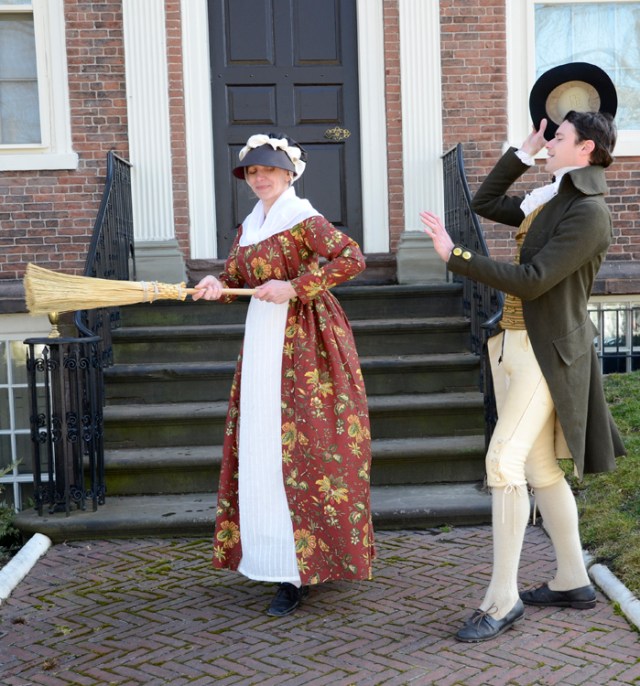
Photo by J. D. Kay, 2013

I love this image, and the original on which it is based. I love it so much that we’ve recreated it (in a later time period) whilst fooling about during a photoshoot.

But what does it really show? The image in the print depicts a passage in Jonathan Swift’s poem, A Description of a City Shower,

Such is that sprinkling which some careless quean
Flirts on you from her mop, but not so clean:
You fly, invoke the gods; then turning, stop
To rail; she singing, still whirls on her mop.

Straightforward, right?

Well, not so fast. Thanks to the wonders of ILL, I’ve been reading The Satirical Gaze: Prints of Women in Late Eighteenth-Century England, by Cindy McCreery, and looking at prints anew. Her chapters on prostitutes and old maids are particularly interesting, and confirm some of what I had been thinking about when we use prints as documentation.

Here, in the Macaroni Provider, we have what is “Probably a portrait of some (alleged) notorious procurer; perhaps Thomas Bradshaw whose portrait he somewhat resembles.” We have a pimp, folks.

The Macaroni Provider / Macaronies, Characters, Caricatures & designed by the greatest personages, artists &c graved & published by MDarly, 39 Strand. 1772 (Vol.3). British Museum

So, with this information in hand, let’s look again at The City Shower. We have a maid– one of the few classes of women found in city streets unaccompanied, and a class of women often associated with prostitution (along with street vendors and market sellers). The fashionably dressed man recoils from the spray from her mop– is he rejected the literal filth, or the implied filth of a “maid of all work,” who may have a venereal disease? Is it reasonable to wonder if Swift is using double entendres in the lines Such is that sprinkling which some careless quean
Flirts on you from her mop, but not so clean, 
so that the mop is the woman’s pubic hair, and not so clean suggests she is diseased?

I don’t know, and absent intensive research or a time machine, I may never know. But once again I wonder how we use and understand these images, and think that they pose more questions than answers. McCreery’s book (based on her dissertation) helps get at some of these issues, and is well worth a read. (I found the Amazon review hilarious, myself, once I had the book in hand. No, it’s not a compendium of prints; it’s an analysis.)