Pink on My Brain

I no longer remember where in the wilds of the interwebs I found this charming servant, but find her I did, three years ago. I probably came across her researching servants, and found her striking (since she is), so saved the image while moving on to Pyne or Krimmel for more geographically appropriate sources. Still, I’d picked up a remnant of brown and pink printed cotton at Genesee, and had a start to this ensemble.

A scrap of that print was in my pocket when my dear friend (formerly m’colleague) and I went took the train down to New York for a fabric spree. We went in late June (Genesee was early that year), trying to use up vacation time so we didn’t lose it before the end of the fiscal year– any year I didn’t have a hip replacement, I tended to lose a week of vacation so we were motivated to take time off.
I remember that my favorite dress demonstrated a peculiar friendliness, and required a safety pin for modesty’s sake. I remember m’colleague being overwhelmed in the crosswalks at Herald Square, and taking her hand to get her through the sea of bodies and cars. (She grew up in a very small town in northern Rhode Island, where apple orchards were within walking distance; I grew up on the north side of Chicago, taking the bus to the Loop.) But at Mood, I found the fabric that I knew would make the petticoat.

Pink tropical weight wool, don’t ask me how much a yard. I don’t remember, but it was certainly more than I’d paid for any fabric before, with the exception of silk dupioni I bought for a wedding dress. Madness, I thought– but beautiful madness. I started on the short gown (see above) with an extant European garment as inspiration (probably found through Sabine’s work); then I started on the petticoat.

And promptly dropped the project while I changed my life completely. The short gown I finished, and wore as a housekeeper for some Wednesday afternoon programs, but I never managed to get that petticoat finished– until this past week. The pink and black bonnet needed an ensemble, and half of it was present, in the form of the Spencer.

But what I wanted to do was to recreate that plate, short gown, cap, and all. I’m still short the black silk apron, and my cap will always be Anglo-American, but I got close enough to be satisfied that I reached the goal I set three years ago. What I did discover in trying to replicate this image was slightly unexpected, and entirely useful. Just as fashion images are exaggerated today, so too were they exaggerated in the past. M’lady in the image at top is elongated– I’m nearly six feet tall, and I cannot achieve her length. Granted, the waist on my short gown is lower than hers, but still: she’s drawn as if she has the proverbial “legs up to here.” What’s useful about this, and about trying to recreate images from the past, is that these exercises reveal some of the foibles and preferences of the past, which help us see past the filter of the present and get closer to understanding the past.
The Widow will See You Now

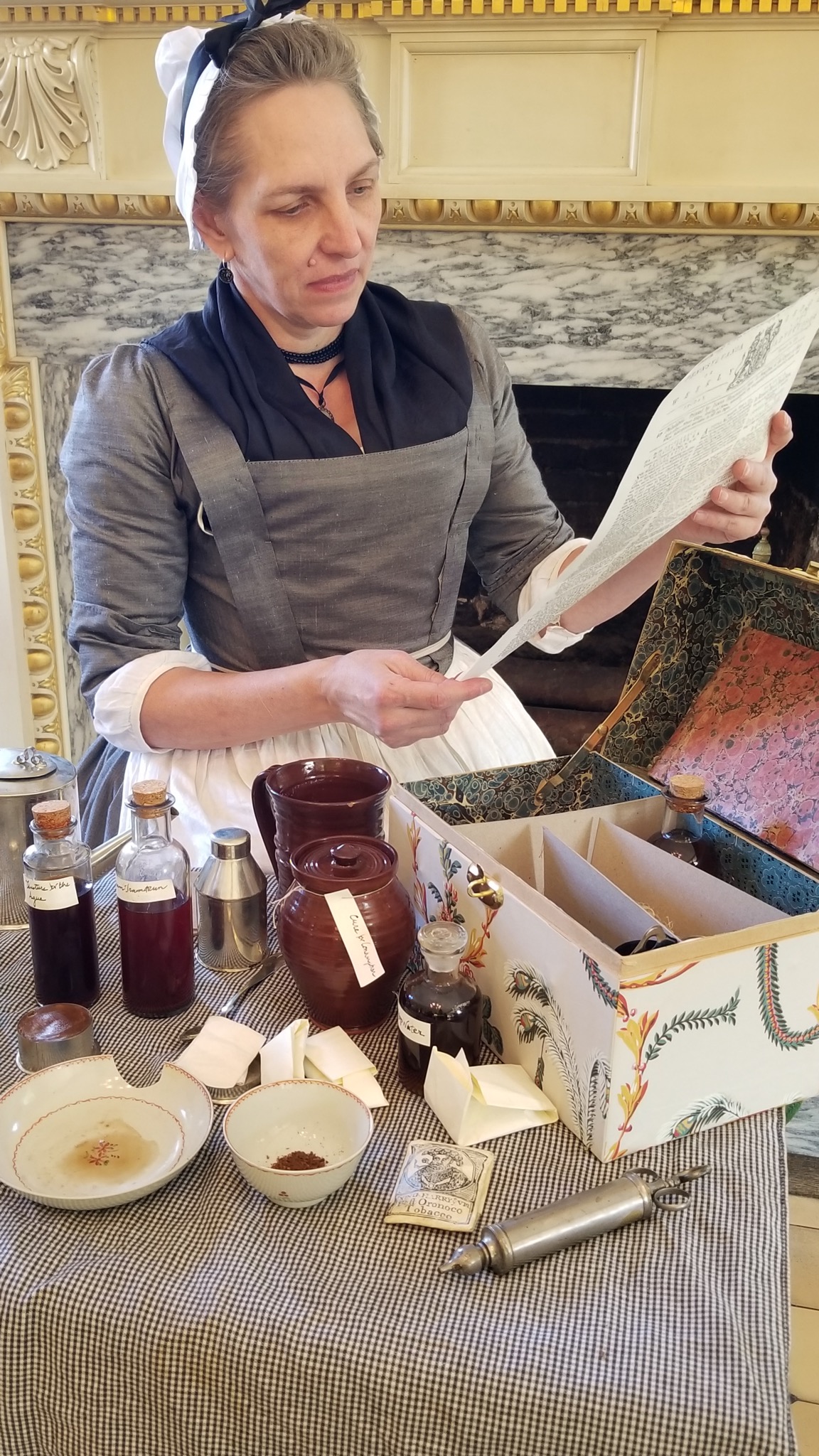
No idea how I lost that pin. Photo by Mike Cirilo. 

Part five: portraying Widow Weed

I almost prefer first person interpretation, largely because it catches visitors a little off-guard, excites their curiosity, and allows me to use more humor in conversation than third person. This time, though, I found that despite the research and thinking I’d put into this portrayal, I couldn’t synthesize the material fast enough to fully immerse myself in first person, having over-scheduled the days leading up to Occupied Philadelphia. 

Over the course of talking to 1200 to 1500 people, I was able to synthesize the material, and refine my spiel. Talking about how the remedies could be (relatively) easily made in the kitchen, using ingredients drawn from kitchen gardens, South America, the Caribbean, India and Southeast Asia allowed me to talk about trade networks and the British Empire– a reasonable segue to complaining about a port closed thanks to Mr. Nevell, and a way to explain the effect that has on the city.

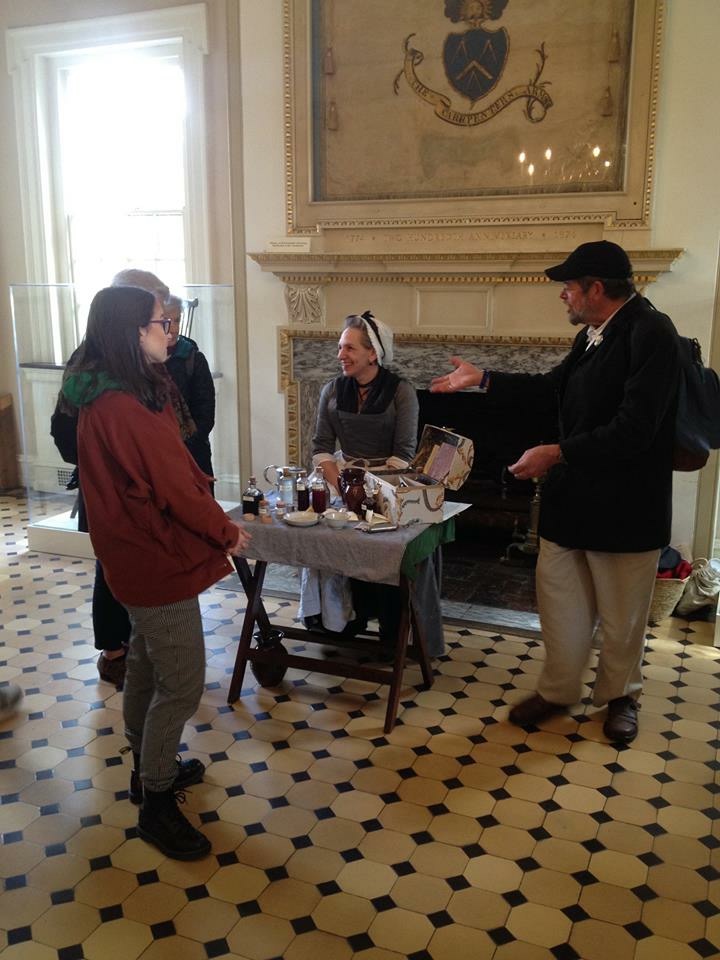
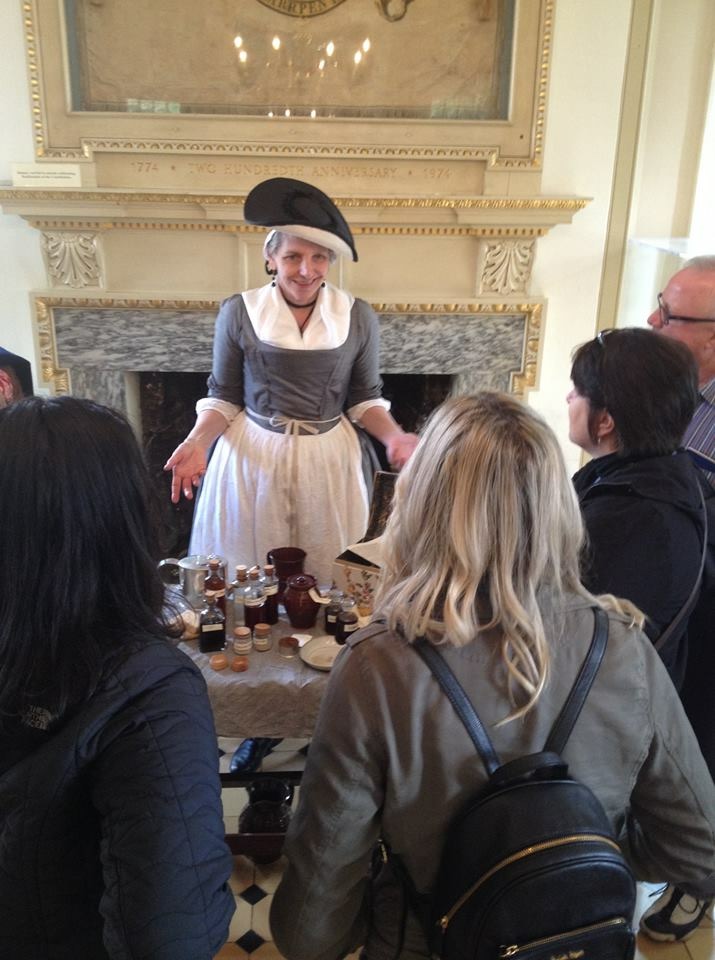
One of the most interesting aspects of this portrayal is how well women engaged with it– and enjoyed hearing about a woman with her own business. True, Drunk Tailor was steering women my way, but they also seemed to gravitate on their own. As much as I prefer in situ interpretation over the science fair table style, a table (or counter) offers enough of a barrier to make people feel comfortable approaching. On-street interactions are different, but somehow, indoors, people sometimes react as if one was perfume-spraying staff on a department store cosmetics floor. 

Photo by Mike Cirilo, saucer chip by me.

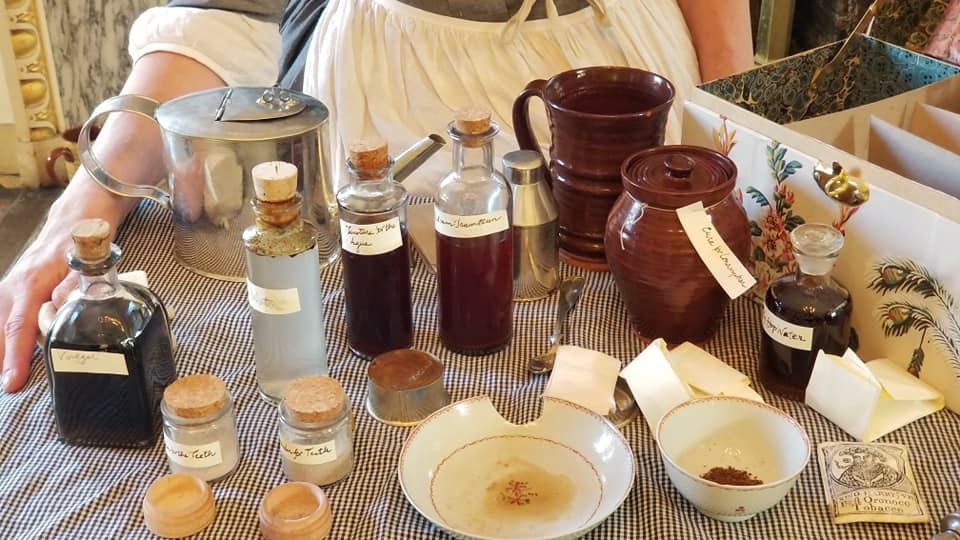
Not that scent wasn’t an excellent way to engage people! I couldn’t let visitors taste the remedies, but they could smell them, offering the opportunity to play “What’s that smell?” (non-feline edition) and talk about how people use the flavors they’re accustomed to in their medications and treatments. My cats never cared for bubble-gum flavored amoxicillin, but it’s bigger hit with toddlers than the straight-up medicine flavor would be. So, too, with tooth powders past: cinnamon, mace, and nutmeg are the blue raspberry of the yesteryear– though the tooth powders smell much better than they taste. I cannot recommend a weekend of use unless you wish to feel sad each time you clean your teeth.

Mr Nevell finds himself on the list of members of the Company of Carpenters

Drunk Tailor used the relationship between Thomas Nevell and Elizabeth Weed (their third marriage each) to move people around the main room of Carpenters Hall, and to some comic, as well as interpretive, effect. It’s far easier for him to say, “Six months in, six months left, of her mourning” as a means of explaining the grey and black palette of my clothes, allowing me to avoid the “You look like you’re ready for Thanksgiving!” lead in from the public. Confiding in the public that he’s had his eye on me for while lets them in on a secret, and visitors enjoyed trotting over to warn me about his interest, and that’s he’s sold his tools! I am always happy to tell them he’s just the kind of man my mother warned me about, adapting a banter we have used in multiple scenarios. While it’s broad, and nothing like how we really are together, it’s playful enough to engage the public, relax them, and get them comfortable asking questions.

The man on the left talked to me longer than anyone else

There are, as always, things I’d like to change about this presentation. Although I’d like to work on it enough to be more comfortable in first person, I’d miss the third-person ability to refer to 1849 cholera maps and general epidemiology. I definitely need to add a couple inches to the hem of the gown, up my cap game, and trim the mantelet. I’d like to find a wooden box, and add a proper mortar and pestle to the kit– my stainless steel one is perfect for home, but won’t work in public. But on the whole, I’m pleased to have an impression of a woman roughly my age, who can interact well with a character roughly Drunk Tailor’s age. Onward to refinements. 

The Material World of Widow Weed: an interpretation

Pomade, powder, a pad, and a liberal dose of hairspray got me closer to Big Hair than I’ve ever been.

Part four of a series

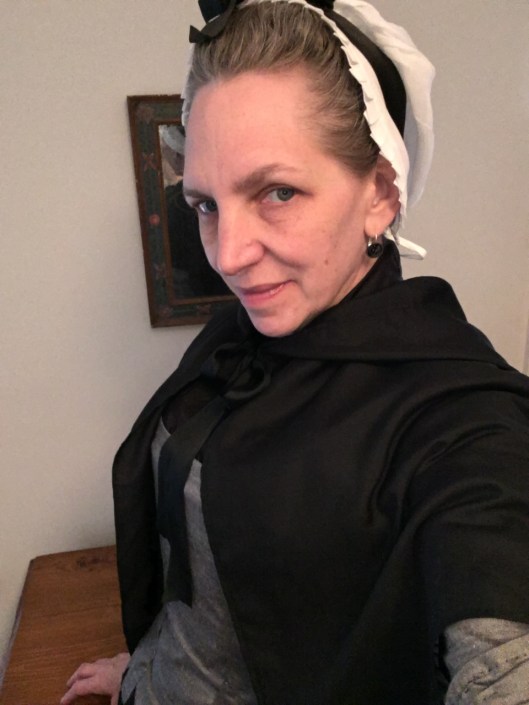
Widow Elizabeth Weed: what would she wear? What would she own? My first inclination had been to wear the grey tabby wool gown I already had, until I realized how much of George Weed’s estate Elizabeth had received. As detailed in the first post, the strategic fabric reserve (SFR) provided a “just enough” remnant of shiny silk to make a gown. Second mourning seemed right, for six months past the death of her second husband; with Mrs. Mifflin’s 1773 gown style in mind, I decided to make an English gown with robings and stomacher. (To be honest, I’m pretty pleased with how close my cuff came to Mrs. Mifflin’s, considering how badly I can mess up a cuff, and that this was my first finished silk gown in an 18th century style.)

A gown is one thing, but what about the rest of the ensemble? The Widow Costard print provided some guidance, despite being some years later than 1777. The black hood and cloak or mantelet over a white cap appears in other widows’ portraits, although the black silk cloak is not an uncommon accessory. I had been toying with making one already, and had patterned one from the original in Costume Close Up; extant examples aren’t thick on the ground, but there are enough to demonstrate some consistencies.

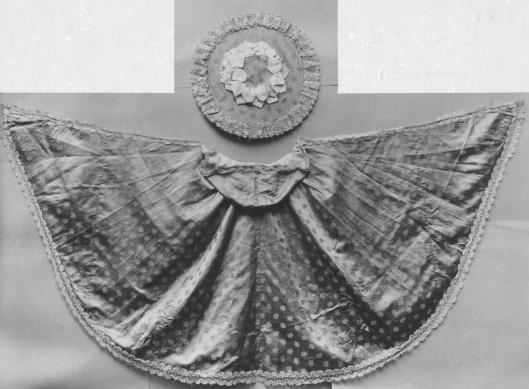
Cloak, figured cerise silk satin with a lace trim, 1760-1770. Victoria and Albert Museum, T.61-1934

1760s example at the Victoria and Albert has a shape similar to that in the Williamsburg Collection, while another at the Met (dated, without a reason cited, to 1820-1829; perhaps the reason is in the selvage or the lace), provides some clues to construction and materials. So, with another remnant from the SFR in hand, I worked from my muslin to a paper pattern, using the neck cutout from my red wool short cloak as an additional guide. It went together in fairly short order, since it is mostly hemming, with just two seams and some pleating. While I wore it untrimmed due to time constraints, self trim or lace or would be ideal additions.

Portrait of a Woman called Lady Fawkener ca. 1760. Jean-Etienne Liotard.

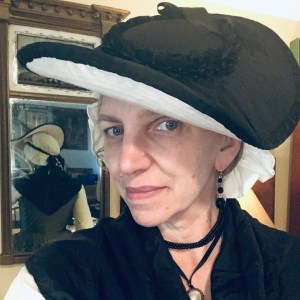
Additional clues to Elizabeth Weed’s status as a six-months widow are found in the black silk ribbon of her cap; black and white hats are common enough that the hat alone does not signal “widow.” I chose to make mine from a black figured silk taffeta lined with white, based on an ad in a Philadelphia paper. On October 15, 1776, John Brown advertised in the Pennsylvania Evening Post for a runaway Irish servant girl, Judith Kennedy, wearing, among other items, a “black spotted silk bonnet lined with white.” Obviously, this might well mean “bonnet” in the form we are most familiar with, and I have taken liberties by extrapolating the spotted silk to my hat cover. Nonetheless, black and white hats are a thing, and I was looking to upgrade from my tatty and faded black chip hat.

Gathering white linen evenly is a challenge: literal thread counting.

Gown, hat, cloak, updated caps: so far, so good. I had a black wool petticoat already, suitable for mid-Atlantic autumn (there was no way a black silk quilted petticoat was happening in the time allotted), and black worsted (woven) mitts. What else would Mrs. Weed need? Upgraded shoes are tempting but beyond my budget, so the last article of clothing was an apron.

The majority of my aprons are check linen, with one clean unbleached linen apron and one stained white linen apron (coffee is my weakness). Fortunately, I found 30 yards of vintage white linen on a trip to New England, and thus had apron fabric handy. After making five aprons, this one went together in less than a day.

The final piece was jewelry. A few years ago I found a “Georgian” cut steel and glass locket suitable for hair that I wore as a widowed housekeeper; on a fresh black silk ribbon, that would be a cornerstone. I added a three-strand necklace of black glass beads to contrast with the locket (thanks to the local hobby store and a stash of findings). Earrings also came from the stash, made up quickly from modified buttons and black faceted drops.

Accessories. I finally have them.

I added a white silk neck-handkerchief for warmth, and bought a black one just in case. Based on images, I thought white most appropriate, but somehow, with the grey gown, the image of “Pilgrim” was hard for some visitors to overcome, so on Sunday, I switched to black. Sometimes you have to choose accessories to lower the hurdles for your audience. Explaining that I was not a Pilgrim, but in mourning–while providing an opportunity for interpretation–was not my primary objective, so the easy color switch seemed well worth making.

The remedies (as promised) were another, slightly strickier matter. While making them according to the receipts I found was relatively simple– this is long before big pharma– carrying them was another challenge. I opted to make a box, and fill some bottles, as will become plain in the next installment.

Entr’acte

I: Mr B. Finds Pamela Writing. Joseph Highmore, oil on canvas (Part of four scenes of Richardson’s Pamela). Tate Britain, N03573

Entr’acte: an intermission.

Note: In this series, I describe the process I used to arrive at my conclusions and assemble the materials for my impression of pharmacist Elizabeth Weed. I strive to explicate a process of research, questioning, and reasoning that may be applied to any impression. Here’s a guide to what I’ve written thus far, and what I plan to write.

Part One: Been employed these several years past provides an introduction to the project

Part Two: may depend on being supplied explores some of the primary and secondary sources I used and questions I asked of those sources

Part Three: shop medicines, ointments, and salves examines some of the sources for 18th century remedies, and the material culture of pharmacies and healing practioners

Part Four: The Material World of Widow Weed looks at the pieces I assembled: the clothing and the choices I made for gown, hat, mantelet, apron and accessories, as well choices I made for the remedies and their presentation.

Part Five: The Widow will See You Now looks at the implementation, that is, how I chose to interact with the public, what I learned as I talked to 1200-1500 people over the course of two days, and how Drunk Tailor and I used the Anarchist’s Guide principles to inform our interactions.

Part Six will look at how these same principles and processes can be used to inform any impression you take up, with the hope that it will inspire the reader to look for new ways to add depth to living history. The fun isn’t only in the making or the performance, it’s also in the rehearsal of the research, and in assembling these scraps from the past into a living, breathing whole.