Memento Mori/Memento Vivere

Late August is the time when kids go back to school, and nostalgia  grows for summers past and the months just gone, and for what you didn’t get done that you wanted to. It’s a time for transitions and remembering, when we’re on the verge of a fresh start. Even at my age, decades out of school, fall represents a fresh start, a time to begin something new. Now it’s more painful to drop my son at the airport than it was to take him to his first day of kindergarten: I won’t see him again until Thanksgiving or Christmas, depending on his class schedule. So to distract myself, I turned to a new-old project: the circular reticule with a pasteboard center.

I’ve been working on a version of the abolitionist reticules made in the 1820s, but recently came across some delightful earlier reticules offered by Skinner, one of a lady and a lamb, and one a Memento Mori.

My disused painting skills just stretch to the naive style of early nineteenth century schoolgirl painting, though it is hard to capture the full style when one has a modern eye. (Once you’ve seen Picasso and Warhol, can you ever go back?)

If/when I make another of these, I’ll definitely make some changes in techniques and materials, starting with the inscription. (Where is my historically correct ink? Where are the pen nibs?) For now, though,I’m happy enough and even ok with the off-centeredness of the painting on the circle. Lesson learned: do not rush through a project without planning all the steps.

I figure I’ll even it out a bit when I attach the bag.

I still have to paint the opposite side, and then decide what silk to use for the bag (I have some embroidered silk that I’m saving for a 1790s ball gown, but should have enough for a bag) and whether or not to line it. The catalog descriptions don’t mention linings, and the images appear to show only a layer of silk, with no lining.

It’s hard for me to wrap my head around an unlined anything, and for embroidered silk, a lining will help keep whatever I’m carrying from tangling in the threads on the wrong side of the fabric.

This isn’t a quick project, and I have to put it aside to work on commissions, but it does give me something to look forward to working on– a small memento vivere, if you will.
Hoods and Caps and Bonnets, oh my!

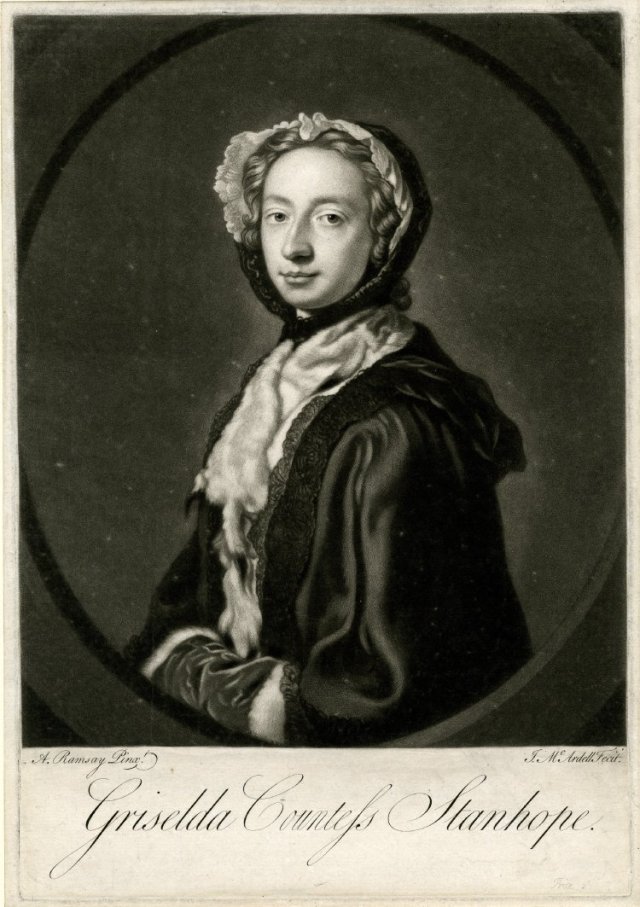
Griselda Countess Stanhope. Mezzotint engraving by James McArdell after Allen Ramsay. British Museum, ca 1760

Let’s take a closer look at Griselda, Countess Stanhope. She wears a hood over a fine white cap, as well as a hooded cloak. Around her neck, she wears a fur tippet, and her hands are snuggled into a muff. While most of the “common” women in the colonies wouldn’t rise to the Countess’s ermine tippet, they did have hoods.

Thomas Howe Ridgate’s inventory taken 19 June 1790 in Charles County Maryland includes “3 velvet and silk hoods,” while Mrs. Elizabeth Lawson’s inventory, taken 3 May 1766 in Prince Georges County Maryland includes one velvet hood and one “Allamod” hood. (She also has “1 old Striped Bonnet,” as well as 2 Womens New Capes, and 1 Womans Life everlasting Petticoat, which bears further investigation.)

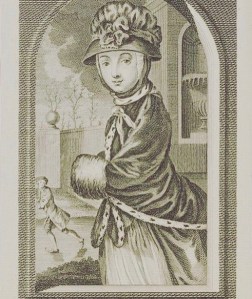
Hoods appear fairly regularly in prints, worn over caps (as in Countess Stanhope), under hats, and even under bonnets, as in this print from the Victoria & Albert Museum.

January, engraving, ca. 1780. E.3520-1953. Victoria & Albert Museum
The mantelet hood worn over the bonnet, hood, and cap layers.

In the images above, I’m wearing a white cap, black silk hood, and black “stuff” bonnet, with a black silk mantlet over a silk neck-handkerchief. The hood needs some tweaking, size-wise, but the layers definitely recreate what we see in the print of “January.” The bonnet has an adjustable caul, so will easily fit over hair, cap, and hood; the hood has a drawstring closure at the neck that helps keep out the wind. Taken altogether, these layers are definitely insulating! Looking like an 18th century engraving is almost a bonus– but when you wear what they wore, you look like they did.

“Comfortably Covered”


The last event of 2018 (for me) was the “March In” evening event at Valley Forge. My reasons for choosing events may be quirky: anything I can get to at Fort Ti, because I love that fort and landscape; MoAR events because they’re imaginative, not too far, and, bonus, I get to see my mom; anything immersive at which I’ll have tasks and a role; anything that gets me behind the scenes or gives me a new perspective on a site, museum, or event; anything that allows me to flex my interpretive muscles. March In gave me a new perspective, a new site, and a chance to expand my interpretive range. I loved it. My son, not so much. While I’d thought he’d enjoy it– he got us into this living history business, after all–since we’d visited Valley Forge every summer when we went to see my mom, and our parts would be small, progressive-focused scenarios.

Reader, he quit. Ten minutes before the park reopened to the public, as we stood in the dark on the Joseph Plumb Martin Trail, he told me he wanted to quit reenacting.*

No wonder I found the evening chilly.

I wasn’t too concerned about keeping warm after surviving and thriving in Princeton. The weather on December 19th seemed, if not balmy, seasonably pleasant, so I left off a layer or two from the Princeton list, skipping the third neck handkerchief. My bonnet this time was an old woolen “stuff” bonnet made back when my bonnet obsession first began. In the April 8 1776 Pennsylvania Packet, an ad for runaway Margaret Collands records that she was wearing “a redish coloured worsted bonnet.” My choice seemed pretty apt for winter in Pennsylvania, and, lined with linen, I can confirm my head stayed warm. My neck was not!

Griselda Countess Stanhope. Mezzotint engraving by James McArdell after Allen Ramsay. British Museum, ca 1760

At Princeton, I solved the neck draft problem by tying my third neck handkerchief around the neck of my cloak hood (see above). When I came home from Valley Forge, I went shopping in the historical record to see what I could find: hoods. Close-fitting hoods, worn over caps. Some velvet, some, possibly, quilted. I also found bonnets with “quilted crowns,” which I think may describe quilted hoods.

_____________________
The title is taken from Tench Tilghman to John Cadwalder in Boyle, Writings from the Valley Forge Encampment, 1:26 “Our Men have all got comfortably covered in their Huts and Better quarters are not in the World…” Tench Tilghman to John Cadwalader, Valley Forge, 18 January 1778.

*More on this another time, but yes: he’s still alive and well and seems happy enough for an enormous 20-year-old home with a classic college break cold.

You Are My Sunshine

Miniature painting, probably 1815-1820. Private collection.

The best things turn up when I’m looking for something else entirely. First came the miniature, now in a private collection, with the lovely carnelian or coral jewelry and the bright yellow dress. I’ve got some yellow cotton with a red and black print pattern in the cupboard, so this dress seemed within reach.

And then, while looking for something else, I found the right fabric! Not that I can buy it, mind you. It’s already owned and in use, in a gown at the Philadelphia Museum of Art. And not that I haven’t spent some quality time searching the interwebs for similar fabric, which can be found if you look hard enough. Fortunately, better sense prevailed and no cupboard will burst with an additional five yards of block printed silk.

Woman’s Day Dress, English, ca. 1820. Yellow silk brocade exported from India. Philadelphia Museum of Art. 1996-164-1a,b

Still, the fun bit is finding two such similar thoughts, one in paint and one in cloth, without even looking. that means there are more bright yellow Federal or Regency gowns out there. All it will take is the looking.