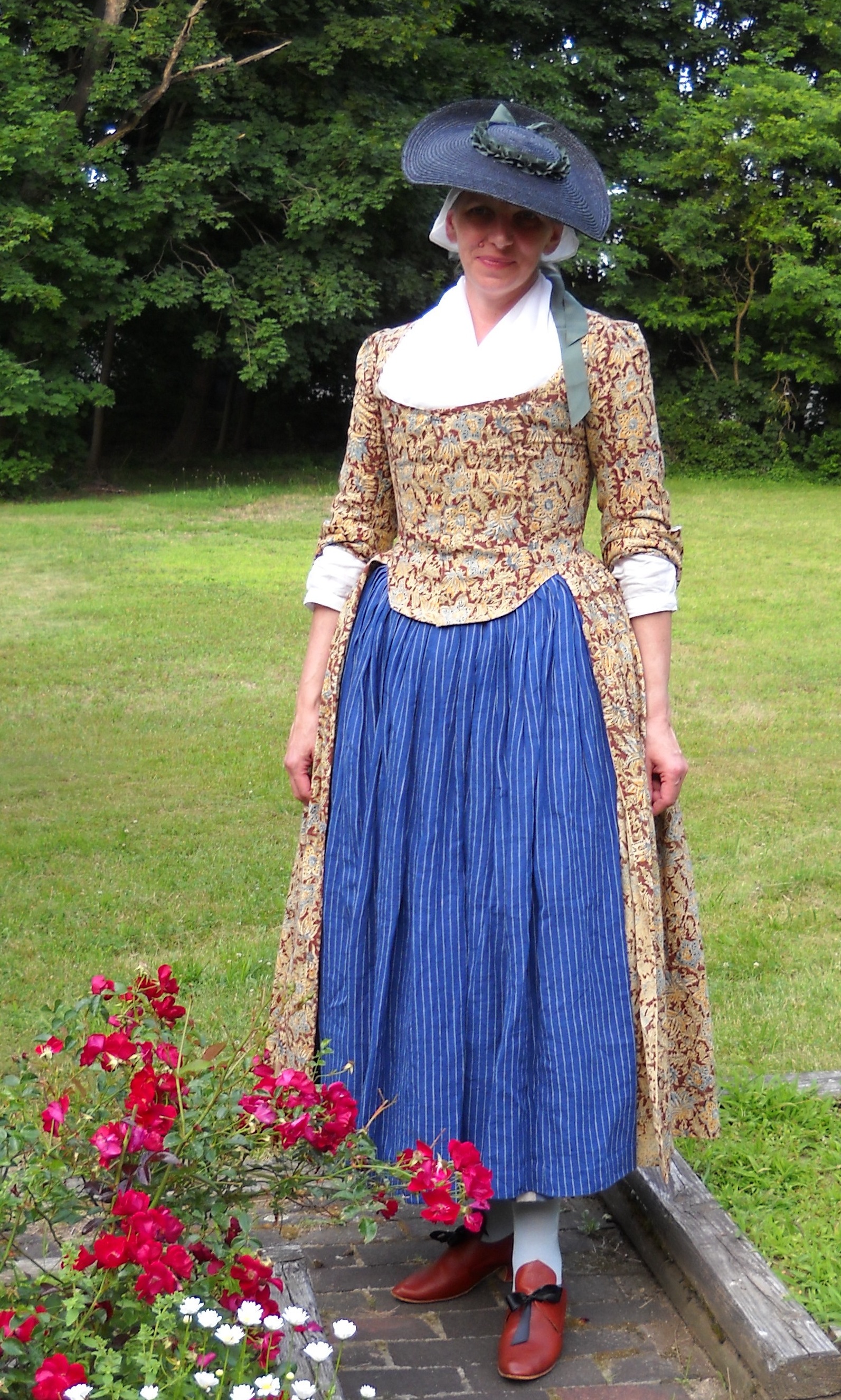
As Eloise or her Nanny might say, It is rawther warmer than I care for. Lucky for me, I have a new hat. It’s a black straw hat of a kind you might see called a bergère, along with 4 yards of silk ribbon, purchased at Burnley & Trowbridge’s tent at Monmouth. Jim and Angela and their assistants were very helpful, and this was rawther a splurge for me, as I mostly buy my ribbon from Wm Booth’s remnants, when they are available. (We are tenant farmers. Mostly.)
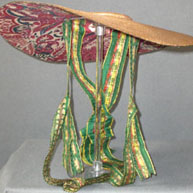
Coromandel Coast lined hat, from an auction.
But in this instance, I wanted a lady’s hat, so I pleated up about two yards of green silk ribbon, and added a bow. To get the multi-vector bending effect, I stitched millinery wire from Abraham’s Lady around the brim. The inside of the brim is lined with pieced scraps of the purple “Fleurs d’Inde” I used for a jacket (also made from a Wm Booth remnant). It ties on with yet another yard or more of ribbon. This is really a frivolous hat, for me. There are extant examples of straw hats lined with chintz, as you can see.
As luck would have it, I got to wear it right off, the very day I made it. How often do you get the chance to do without panic and pain? We attended the Saturday version of the Rochambeau Tea on Joy Homestead, an event which has its dedicated fans.
First hat outing
I wore this same gown last year, and to Nathan Hale; to my delight, I am enjoying it more each time I wear it. I think this petticoat is the right one; madder was too close and black too contrasty. Since the Rochambeau Tea “year” is 1780, this dress passes (ahem) muster; for many of the events I attend, it is too fashion forward.
London Cries: the Fishmonger. Paul Sandby ca. 1759. YCBA B1975.3.210
This hat will, I think, also work for the 1763 event, as the woman in yellow here is wearing a similarly dual-plane twist hat. I’ll never have a yellow gown though: I look pretty horrid in yellow.
Fashions, 1841. Fashion Plate Collection, Ella Strong Denison Library, Claremont College
Perhaps the Young Mr is correct: I may be crazy.
I have agreed to, at the very least, explore a project and grant funding to recreate an April 17 1841 Suffrage Parade for my workplace. We still have to decide to what lengths we’ll go, but the idea is so appealing that I want to give it a shot. (Orator positions opening soon?)
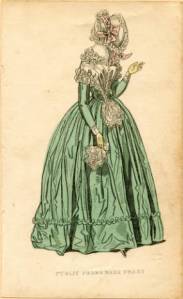
Public promenade dress, 1842. Fashion Plate Collection, Ella Strong Denison Library, Claremont College
Why is this crazy? Another year-specific event, with the event part to organize, plus wardrobe for at least some people? Pure madness, utter delight. Blame it on the Godey’s Lady’s Magazine paper dolls I bought at the Chicago Historical Society all those years ago. It could even mean another corset, and we all know how much I love making corsets. But I was thinking about how at my age in 1841 I’d be accustomed to an earlier style…but the key, as always, is looking. And looking tells me I need more of a waist than I can perhaps achieve with the stays I have in hand.
To my Pinterest board (thanks for so many wonderful leads, Cassidy) mix of extant garments and accessories, I’ve been pinning from fashion plate collections, including the well-cataloged collection at Claremont College Library.
Fashion plates are one of the sources you have to be careful with. Like Vogue, in fact exactly like Vogue, these are high-style images that are as mannered in their rendering as fashion images are today. Waists will be slimmer and skirts rounder, but the silhouette and shapes will be recognizable in extant garments, painted portraits, and thankfully, photography.
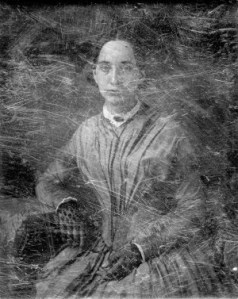
Mrs. Thomas Easterly. Daguerreotype by Thomas M. Easterly. Missouri Historical Society, PHO:17434
The year of the Suffrage March, 1841, is early for photography but not impossible (thank you, M. Daguerre). It’s not the right state, but there is a fantastic collection of images in Missouri. These portraits give a good sense of what people were actually wearing, and what shape their bodies took inside their staysand corsets. (Hot tip: don’t clear daguerreotypes with Scotch-brite pads.)
This is, really, a mad scheme that goes far beyond dress. But a banner painted with an ox and the slogan “I die for Liberty” carried by butchers? A wagonload of disenfranchised Revolutionary War veterans? Enlisting students (not in costume) to follow along behind costumed interpreters marching the known route of the 1841 parade? It’s too tempting not to try.
The American School, by Matthew Pratt, 1765. MMA 97.29.3
Mr S. has a green linen suit in the making; that is, he has breeches which mostly fit, and a frock coat in need of serious alteration. Since I will need to alter this coat eventually (that is, take it apart, re-cut and re-assemble it) I have started looking for images of green suits.
Portrait of a Boy, probably of the Crossfield family. William Williams, 1770-75, MMA 65.34
The green linen the suit was made from is no longer available, so there will be no matching waistcoat. If I can get the thing tweaked to an approximation of ca. 1763, we should be set for the August event (if that happens) and for Battle Road next year, though I know he might want wool. The taunts of “bet you wish you had the rest of that coat” from this year linger in my mind, at least.
The jacket is, admittedly, too short. I begin to wonder if I need to cut it down even more, like a workman’s short coat; the Massachusetts line “Bounty Coats” are cut shorter, and similar to a coat at the Connecticut Historical Society (1981.110.0, search by number here, the links are not stable).
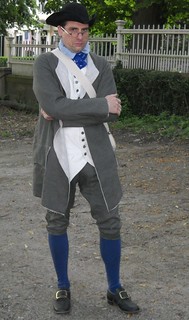
Mr S last June, in the unfinished 36-hour-frock coat
The problem with that plan, at least for 1763, is that the cuffs are clearly larger and coats longer, in 1763, than they are in 1775, at least for gentleman. I realize that this means I am better off starting over completely for the 1763 coat from a muslin up (which against all instinct and principles, I did not do for the 36-hour-frock coat). So I’m waffling here, as Mr S doesn’t always want to portray the day laborer/tenant farmer, but would like some pretensions to artisan and property owner. That means more fabric, and that means starting over completely is in order–breeches, waistcoat, frock coat and all. But wait, there’s more!
The events in the queue before the August 10th event for 1763 include Monmouth on June 15-16 (for which overalls and hunting frock are in production), Washington’s Arrival in Cambridge on July 14, which requires militia clothing, and Old Sturbridge Village the first weekend in August, for which a regimental coat is requested. Somewhere along the line, I’d like to make myself something…but it looks more and more like a summer of menswear. Perhaps cutting down that green coat and altering the breeches for July 14 is the most sensible plan…though where that will leave 1763, or the regimental coat, I do not know.
Capt. John Clayton Cowell, 1st Battalion, 1st (or the Royal) Reg’t of Foot, ca. 1796. NAM. 1963-11-133-1
That’s Captain Cowell’s right, if you were wondering. You can learn more about his biography here, from the National Army Museum London website (where my very dear friend is lucky I have not begged, implored and entreated her to go, since she is vacationing in London, basically at the very instant you are reading this.)
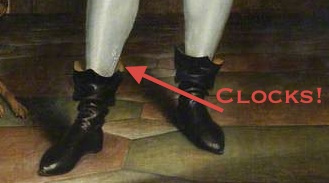
Clocks!
What I am interested in is what the painting shows us. Like The Drowsy Dame, there’s fun the details quite aside from the those slouchy boots. Inside those boots are silk stockings with clocks, a lovely detail that that shows you what class level should be wearing clocked silk stockings in perfect repair in the British Army. Anyone else not of the class that could afford a commission might want to think about having second-hand silk stockings…and, since we’re at the floor level, nice dog. I think he wants walkies, Captain.
The 18th-century fit is clear, too. Those arms may look sheathed in lycra, but they’re in wool; since the Captain served on St. Thomas, it is probably not just very fine but also lightweight. Portraits are idealized, so the Captain may not have been so very superman looking, but the fit of his breeches and coat probably served to accentuate, if not create, his graceful and refined form. And then there’s the soldier.
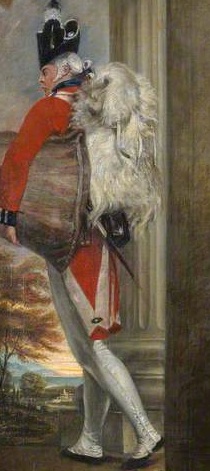
Detail of soldier, NAM. 1963-11-133-1
What caught my eye first on the soldier were his overalls, since I’m so frequently stuck with them in my sewing basket. These fit him closely, too, and are probably shaped much like these at the Met. There are six buttons on the placket at the ankle, and the strap under the instep is forward of the placket. The soldier’s feet look small (not unlike some regiments I know…) but the tongue of the overalls fits perfectly over his foot. It’s easier to do in paint than in linen, but I’ve seen them fitted this well, and the gentle cyma curve of the outseam is what you want.
On his back, the soldier has a knapsack that’s clearly made of a goat. I don’t know why they’re goatskin (this is not my army) but it’s startlingly goat-like. Other regiments carried them (see here for Troiani on the 33rd Reg’t of Foot), but I suppose the goatskin made a natural pouch shape and was water resistant (after you’d eaten the goat?). What you see on reenactors are mostly the square skin knapsacks, but when we go to Monmouth I will have to keep my eye out for the goat-shaped packs.
The large sack he’s carrying is also intriguing. The material looks to be striped, or woven with a purposeful variegation, which raises questions beyond linen-or-wool. Why trouble to die the material? Are the colors significant? On a practical level, the bag or sack probably contains any extra clothing and his blanket; it looks too light to contain much else. We can’t see his haversack,but we can see his cartridge box (the shiny black square under the goatskin) and his bayonet. But where’s his musket?
The more I look at and think about this painting, the more I wonder not just about the quotidian details we can pick up, but about the symbolism and the meaning. It has the look of “job well done, headed home” as the soldier carries his kit away, and the Captain sheaths his sword. Maybe that’s what we’re shown: tour of duty over, the Captain Cowell and troops head home, and the dog will finally get his walkies.







 Kirsten Hammerstrom
You must be logged in to post a comment.