Tentage

Scene of the Camp on Hampton Green, 1781

Like many other reenactors/living historians/suckers for wool in summer, I’ve been following the First Oval Office project with interest and envy. Imagine my delight upon finding this blog by Tyler Rudd Putman, who is working on that and many other projects of interest.
The common tent project l is one that I really do hope to take on someday, though I doubt I can ever achieve a tent of this level of quality. (Reader, I cannot weave.) But I can aspire, at the least, and I see that a hand-sewn tent is something even I can achieve. It won’t get done by me in just one day, but over the course of several weeks I could get one done as long as I cleared the downstairs of all our furniture, and put up with a cat sewn into a seam. (My assistant has been lying down on the job, melting in the heat.)

The Howling Assistant Lies Down on the Job

I’ve been thinking about tents since the after-dark hilarity at Monmouth setting up an unknown tent in the dark with a brittle pole that had to be repaired with string from a pasty wrapper, and the later perhaps over-zealous cleaning by Mr S of the tent abused by a cat and identified on the NJ turnpike’s extended play of “What the Hell’s that Smell?”

I’m not sure why we’re allowed to remain in our regiments, really, I am not. But I suspect that an ability to produce Chesire Pork pie is a factor in our favor.

We’ll be setting up tents at OSV in just about a week, broken pole and all, and looking ahead to that, I give you the following links for further reading on tents.

John U. Rees on tents in both armies of the Revolution.

How to fold a tent.

Period (British) images.

Even more documentaton: scrolling down, Rhode Islan had a return of 147 tents in May, 1781– that’s about 882 soldiers, at 6 men per tent, a max of 1029 at 7 men per tent. (At least one is always on duty, so there would not be more than 5 or 6 sleeping at any one time).

Amazing and image-rich essay, The Tent Article

Lochee, Essay on Castremetation, which I read and forget by the time it is dark and some man is trying to reason with me about how a camp should be arranged, when all I want to do is sleep. With that in mind, a brush arbor is starting to look good…
…For the Approaching Summer

Summer is, of course, fully upon us and those of us on the eastern seaboard feel its oppressive and sticky heat. Ordinarily, my town isn’t terribly hot and cools off at night, but like everywhere else, this is not the case. Last weekend, I wore wool; technically a wool and cotton blend, but more problematically, burgundy in color. This is the price of gowns inspired by London watercolors.

Summer

This leads to constant questions: Aren’t you hot in those clothes? Aren’t you dying of the heat?

There is an underlying tone that suggests that perhaps the people of the 18th century didn’t know enough not to wear wool, or perhaps they only had winter clothes. I’ve heard “well, they didn’t know any better,” as if they never took their clothes off, and if only they had, 18th century men and women would have promptly abandoned their stays, gowns, waistcoats and breeches for tank tops, shorts, and wife beaters. Of course, history is not a Fiat commercial.

Well, what did “they” do?

Barbara Johnson's book, 1764.
Barbara Johnson’s book, 1764.

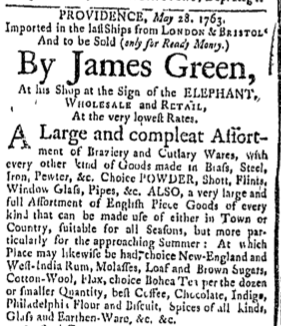
They took their trade to James Green and merchants like him who offered “Piece Goods of every kind … suitable for all Seasons, but more particularly for the approaching Summer.” (Boston Post Boy, August 8, 1763.)

And what would be suitable? Cottons, fine linens, light silks, in light colors.

Barbara Johnson chose floral prints on white backgrounds in July and August of 1764, both could be “suitable for summer.”

And as you probably know, the answer to “Aren’t you hot?” depends on who you are, but is often, “Not really. Once my shift/shirt is soaked with sweat, I’m pretty comfortable.” This is true as long as your shift/shirt is made of linen; cotton and cotton/linen blends don’t wick as well as linen.

In the Pink

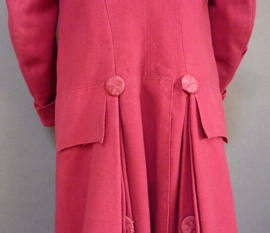
Detail, back pleats
Detail, back pleats

I swear I try to be positive about the mistakes I make. But not only did I discover this morning that I had lost my struggle with spacial processing, now I have found clear imagery to show how I should have handled the pleats on the Zombie Coat. Live, learn, unstitch and restitch: that’s all I can do. Now I have only to decide whether to do the unstitching this weekend, or next week. It will have to be done: now I know the way I’ve done it is wrong, and the master’s eye will be on that mistake and then he will know, and I will know that he knows, and it will just go on from there to tired shame.

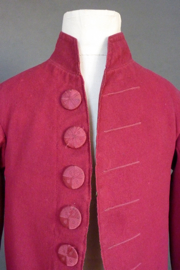
Man's wool  coat, 1770s. Meg Andrews.
Man’s wool coat, 1770s. Meg Andrews.

My favorite part of the description is this:

Either the coat was altered for another man or the wearer got fatter! … There is a half moon insertion under the arms… There’s no detail photo of that half-moon insertion, but I do so wish there was. The description notes additional changes: “If you look at one cuff you can see a lighter part of a button shape next to the seam. The cuffs have been removed and then added to the edge of the cuff to lengthen the sleeve.” At least we know garments in the past, even ones as lovely as this, were altered and changed.

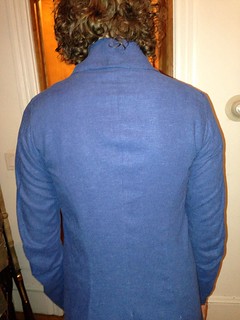
Puckering on the Zombie Coat. It’s still a nice blue, and you know what? It fits me, so maybe he’ll lose it to his refugee mother.

I will probably be inserting shapes of various kinds into the Zombie Coat, since I do now have a diagnosis for this puckering at the shoulder blades. “Viewed from the back and sides, it appears that the sleeve is binding on the front of his shoulder, causing pulling across the back shoulders – the puckers are caused by the stretching of the fabric across the rounding of the back and shoulders. If you make the top of the upper sleeve wider, or raise the shoulder cap it will create more fullness over the top of the sleeve and reduce the binding that is translating down the sleeve and across the back.”

By the time I make the changes I need to, the Zombie Coat will have acquired its own pre-history.

Apprehending Chicken

Living History Chickens. Don’t mess with them.

I have written in the past about the Living History Chicken, ripped and delicious, and the joys of making such a creature fit into a cast-iron pot. While “chicken ripper” might be the appellation you desire, it’s not what I want to be known for.

Last time, I dissed the modern ham as an item ill-suited to camp cooking (tasty, but it doesn’t look right). I have also seen hams on a spit cooked slowly (too high above) a fire, and heard a rumour about a very authentic ham-dining experience with a very authentic digestive result. That’s taking things farther than I care to take any regiment, so what to do?

Continental Army rations included, among other things, a pound of flour and a pound of beef a day per man. In Rhode Island at least, that beef might also have been fish, and I have seen chicken listed, too, as it is, technically, meat. Not wanting to inflict our fishy Ocean State customs on all comers, I think I’ll spare the regiments a pound of fish a day. But chicken? What to do? Hope to cook it?

Or maybe we should eat more fruit.The Afternoon Meal by Luis Meléndez, ca. 1772. MMA, 1982.60.39

One option is to rip the carcass apart (see above) and boil it. That would get the job done, for a bone-in chicken stew. However, I am thinking of string roasting chicken (or cornish game hens, since modern grocery store chickens are awfully large).

To be quite technically correct, I could only cook chicken for the Second Helping Regiment. They had a documented poultry thief among their number, one John Smith, who apprehended poultry if it failed to give the correct countersign when challenged. However a chicken is prepared, it will be a messy business, as we have no forks. It’s fingers, knives and spoons for us, as we have no forks. That does increase the appeal of boiling, since the meat would come off the bone more easily.