HSF# 17 Robes & Robings

I started on the HSF#15 Color Challlenge: White, but haven’t finished the white petticoat yet. It’s a bit short, and pieced in the back, but having seen Sew18thCentury’s  curtain along petticoat online, I wanted a bordered petticoat. (There are extant examples in museum collections, and one in Fitting and Proper, if you’re keeping score.) Now that I’ve seen the petticoat in person, I will definitely stick it out for a border….all in good time.
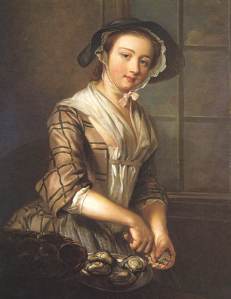
Native Meltons: she's out there in plain and colored lithographs
Native Meltons: she’s out there in plain and colored lithographs

I did originally think that I might get this gown completed for HSF # 15, but I did not. I came close, became disheartened, and stopped work on it for a time. Not only did I think I could not adequately document the fabric, I worried about style, fit, and fabrication. At some point, though, I rallied, and finished the gown. Yes, it looks a lot like Emily’s, because it is based on the same print.

I know, you’re here for The Facts.

The Challenge:  HSF #17: Robes & Robings

Finished! Another garment in the “Am I Blue” Ocean State Line

Fabric:
Indigo Cross Bar Light-Weight Check Irish Linen from Burnley & Trowbridge.
I collected images of checks and “plaids” on a Pinterest board. Remember that plaid doesn’t mean the same thing in the 18th century, but I used the term to help people know what the board included.

Pattern:
My own, based on a fitted lining and draped to the dummy, tried on and tweaked. You can see some construction progress here. Yes, that’s a center-finding ruler. Yes, it has extra pleats. Call it bling for the linen-wearing.

Matching crossbars is crazy, but fun.

Year:
Let’s call it 1760. It’s an open robe with robings and cuffs suitable for 1765, but I’m old enough to keep wearing that style. Actually, the double-lapped robings (which I really like the look of) are earlier– see this Pinterest board–but I like the way the fold creates a decorative element in linen and wool. The probable 1750s date for the double lapped robing caused another round of heartache in the documentation land. Oh, well. Carrying on wearing the older style…

Notions:
Does thread count? That’s all this takes.
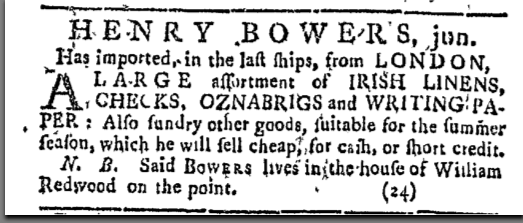
Bowers_check
Newport Mercury, 7/11/1774
Geyer_checks
Boston Post Boy, 3/11/1771

How historically accurate is it?
Well…In the right circles, one could argue that for some time. Is that not the circle one wishes to be in? Consider this, then: The gown is hand-sewn using period techniques as much as I can muster. It is based on pictorial examples from the 1750s through the 1760s. I have found newspaper advertisements for “CHECKS” in Newport (Newport Mercury, July 11, 1774) and “checks of all wedths” in Boston (Boston post Boy, March 11, 1771). Wedths means of fabric in all likelihood, not widths of the checks, so while one can find evidence of people wearing what we’d call plaid, mostly silk but the oyster seller is likely linen or cotton…we don’t know exactly what  every “checks of all wedths” fabric looked like.  I’ll go with 75% accurate and 25% conjecture and choose my wearing venue with care. Yes, I can over-think and rationalize anything.

Hours to complete:

I did this many, many times. It’s like being a carpenter with fabric and pins.

Actual sewing? 16 to 18 hours, I think; it’s a lot of hemming. The body of the gown, the draping and the lining were constructed in about a day while the guys were out doing musket-related things. The agonizing and over-thinking consumed more time. Documentation took, on the whole, perhaps 2 or 3 hours of museum collections and newspaper searching.

First worn: 
Not yet! I’m not sure when I will, now that the weather has turned. I meant to have this done for Sturbridge but despaired of the design and fabric. It’ll be wool for Saratoga, so who knows? I’d like a photo, though.

Total cost: 
Mental agony? Priceless.
Fabric? $60.

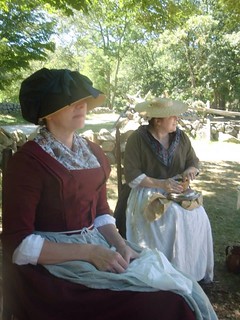
‘Countryside at War’ Saturday

The Countryside at War, Hartwell Tavern, MMNHP, August 24, 2013

We came, we saw, we sewed, we ate cake. No, it was more than that, though there was any quantity of excellent cake on a lovely Saturday.

I had a chance to spend the whole day with people I really enjoy talking to, like Sharon Burnston and Sew18thCentury. (I love that silk gown. I really do.) We are all preparing for an event we will be part of in Providence in October, and I think and hope it will be great fun! But I’m getting several weeks and 25 years ahead of myself.

On Saturday, Sharon was a widow who had traveled from New Hampshire to visit her daughter, who was but one month from her confinement. She had a portmanteau of clothes for the soon to be born child, and food, as the blockade and closing of the city had made obtaining anything very difficult.

Before the jacket was applied

Visitors came and asked interesting questions, but there wasn’t much I could answer. Reader, I had not studied. I had sewn instead, vain woman that I am, laboring to produce new trousers and a new waistcoat for the Young Mr. He spent the day reading his school book, recovered in craft paper and blue check linen. Saving grace, that cover, and I plan to make many more. The Young Mr (after hauling carts and goods for people) found  some handy stones and settled in to get his work done.

His father plans to make him a full-size wooden musket from some mahogany that was left over from construction at work: there are no rules to prevent him learning to drill will a dummy musket. At events when he’s not trying to do his school work, he does enjoy being put to work. He likes to feel useful, and I am grateful to people who recognize that, and help me keep him in the hobby. This was all his idea in the first place…

Sew18thCentury and I had a long walk on the bike path, which was mildly dangerous. Bonnets block a great deal of your vision, and change your hearing, so bicycles are particularly troubling. And when wearing a bonnet, one has to peer out from under it to see anything above you, or your lap, as you can see here.

Our clothing was documented, as you know from posts on this blog. I assembled sheets for each of us, and they can be found here: The Young Mr, Mr S and Kitty. I finished it all late on Friday night, so by the time I reached my own, well…there’s always next year to tidy that up. I still like the gown, and I really like the lightweight wool olive/brownish petticoat with the gown. Hooray! Clothing I like, in wool, that can be worn in summer. What’s not to like? (Well, pins, for one thing. They bend and pop out.)

Drilling in the shade, Shirley-style

The men were drilled for the September 28 event, which rolls forward, sort of. I expect or hope for a schedule this week, which will be helpful. Fingers crossed…though no matter what, I will have to hope a train back to Providence by 3 to make rehearsal for the event at work. That should be interesting…

Now it’s down to finishing and fixing projects in process, and deciding on fabric for a housekeeper’s gown from 1800. I think I’ve settled on a year and style, but the fabric eludes me still. I have to find it pretty soon, because on Saturday, I’ll start making coats for Saratoga. I’m a sucker for beauty, and the Adjutant got me with sea foam green and dark brown wool. The facings are false, so really, a button-hole-free, single-year, described in a letter, regimental coat? The artist in me won, and I am so making that.

Many, many thanks to Sharon Burnston and Friends of Minute Man National Park for the photos! I took none, except of the Young Mr in our yard.

‘Visual Arts Crush’

I’ve been following the Times’ Arts Crush” series, and one of the best, and best-written, in the series has been Holland Cotter’s piece on poetry and the MFA. Cotter’s writing is always elegant and accessible, with an amazing ability to render high concepts simply. (I wish he’d taught my graduate seminars in art theory…) The series inspired me to think about my first visual arts crush, and how it still resonates today.

I grew up on the North Side of Chicago, in the actual city, not Ferris-Bueller-land. By the time I was in high school, I had a pretty free-range existence thanks to the Chicago Transit Authority, and rode the bus anywhere and everywhere, even up to the southern edge of Bueller-land, also known as Evanston.

Mrs. James Ward Thorne American, 1882-1966 A17: Pennsylvania Kitchen, 1752, c. 1940. Art Institute of Chicago
Mrs. James Ward Thorne
American, 1882-1966
A17: Pennsylvania Kitchen, 1752, c. 1940. Art Institute of Chicago

Thanks to the CTA, and to the car my family drove only on weekends, and plenty of field trips in school, we visited most of the museums in the city: the Museum of Science and Industry, the Shedd Aquarium, the Chicago Historical Society, the Field Museum and the Art Institute of Chicago. That’s where I found my very first crush.

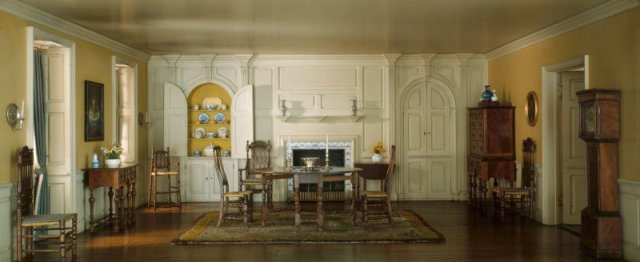
Mrs. James Ward Thorne American, 1882-1966 A3: Massachusetts Dining Room, 1720, c. 1940. Art Institute of Chicago.
Mrs. James Ward Thorne
American, 1882-1966
A3: Massachusetts Dining Room, 1720, c. 1940. Art Institute of Chicago.

There’s a lot to love in the AIC, from classic Impressionists to post-war Abstract Expressionists, but when I was in grade school, what really made an impression on me were the Thorne Rooms. The Thorne miniature rooms are meant to be the most accurate 1/12 scale representations of historical interiors. It will not surprise you that I pressed my 10-year-old nose against the glass of the early Pennsylvania rooms, or the high-style Rhode Island rooms, wishing desperately that I could shrink and slip through that solid membrane and inhabit the world the rooms depicted.

Mrs. James Ward Thorne American, 1882-1966 A11: Rhode Island Parlor, c. 1820, c. 1940. Art Institute of Chicago
Mrs. James Ward Thorne
American, 1882-1966
A11: Rhode Island Parlor, c. 1820, c. 1940. Art Institute of Chicago

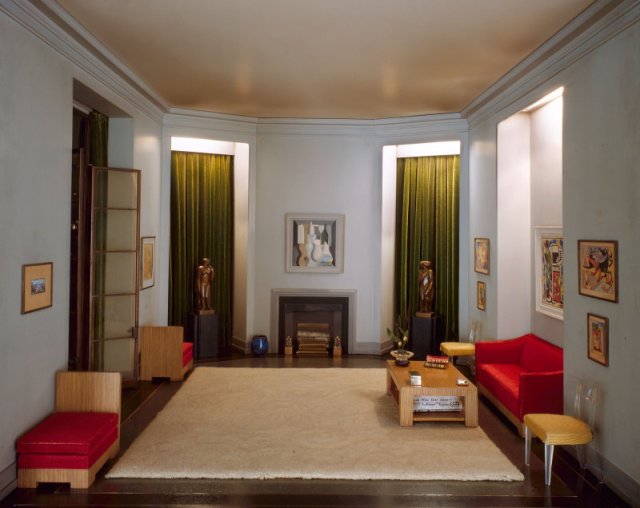
My mother and I would play a game: Which is your favorite room? Which one would you like to live in? And even if the rooms filled with tiny ball-and-claw feet were my favorite, or the chestnut-panelled keeping rooms, the one I wanted to live in (because somewhere there would be a telephone and a radio, and behind the tiny door, a well-appointed bathroom) was the Art Deco apartment. We were fairly certain this was a room you never saw in “Bringing Up Baby,” maybe the room on the other side of the bathroom where the leopard was kept.

Mrs. James Ward Thorne American, 1882-1966 A37: California Hallway, c. 1940, c. 1940. Art Institute of Chicago.
Mrs. James Ward Thorne
American, 1882-1966
A37: California Hallway, c. 1940, c. 1940. Art Institute of Chicago.

Accuracy and anarchy: those contradictory impulses have guided most of my life, from the work I made as an artist, to the work I do now. Getting details right, from citations to what’s on a table for a 1799 tea, matters; but once that’s set in motion, life takes over, the metaphorical leopard is loose, and we’re off to see what life was really like in all its emotive glory in 1799.

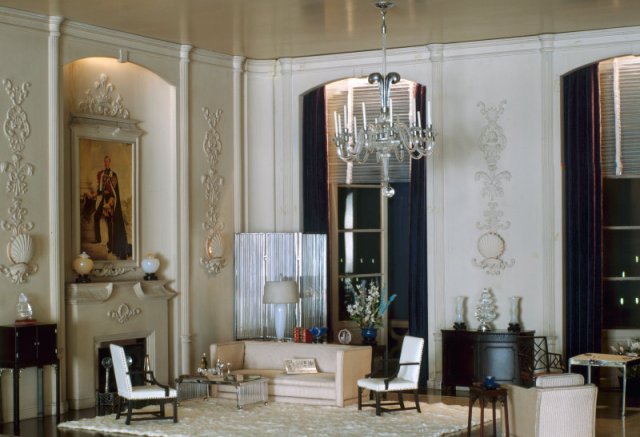
Mrs. James Ward Thorne American, 1882-1966 E-15: English Drawing Room of the Modern Period, 1930s, c. 1937. Art Institute of Chicago.
Mrs. James Ward Thorne
American, 1882-1966
E-15: English Drawing Room of the Modern Period, 1930s, c. 1937. Art Institute of Chicago.

And it all started in the basement of the Art Institute of Chicago, imagining what it would be like to live in each of the tiny worlds that ring the walls of the Thorne Rooms gallery.

Authenticity: Sources II, or, Stripes!

In any decade, I love stripes.

Stripes. I love them, really, I do. Gowns, petticoats, cats. Why do I want to use them so much?

For the guys, because I can document what they’re wearing, at least based on their current state of residence and their current nominal “home” unit with the BAR.

Here’s why:

1777 Oct 22
An inventory of Searjeant George Babcock’s
Wearing Apparil who was Killed at fort Mercer
Octor 22d 1777 Belonging to Capt Thos Arnold’s Comp’y in Colo Green’s Regemt

Two Check Linen Shirts
one Pair of Striped Linen overalls
one Striped Cotton & linen Jacket without Sleeves
one flannel Jacket without Sleeves
one home spun Woolen Jacket without sleeves
one Linen & Worsted cotee
one Kersey outside Jacket Lined with flannel
one beaver Hat & one Pair of shoes
one Pair of blue worsted stockings
one pair of thread ditto
one pair of blue yarn Stockings
one Linnen Handkerchief
one knapsack

(Clothing inventory, Capt Thos. Arnold, Col. Christopher Greene, Rhode Island Regiment
RIHS MSS 673 SG 2, S1, SSA Box 1 Folder 13)

From RIHS MSS 72, Preserved Pearce papers,  Tailor's and Tavern account books, 1778-1781.
From RIHS MSS 72, Preserved Pearce papers, Tailor’s and Tavern account books, 1778-1781.

This inventory has formed the basis for many of the clothing choices I’ve made for Mr S and the Young Mr from their check linen shirts to their blue stockings. I was criticized for the size of the checks of their linen shirts (too small! I heard), but feel vindicated time and again by the extant garments I’ve found (aprons, mostly) in this period. The checks are small.

The best piece of evidence I found was serendipitous: whilst going through tailor’s books Thursday, looking for stays, I found a scrap of blue and white checked linen used as a binding. The biggest lesson from that scrap is that I need a deeper, more indigo-rich blue and white to begin with.

The “Striped Linen overalls” in the inventory are definitely on the list of things I’d love to make, along with the “Striped Cotton & linen Jacket without Sleeves.”

One of my favorite garments of all time. Boy's frock, ca. 1760-1770. RIHS 1959.6.1
One of my favorite garments of all time. Boy’s frock, ca. 1760-1770. RIHS 1959.6.1

There are extant Rhode Island garments from made of blue striped linen, documented to the period we interpret, and another one, recently acquired (coming soon to a database near you!) from which a pattern has been taken.

After a while, though, blue stockings and checked linen shirts seem…ordinary. Common. You might start to wonder if they’re just another re-enactorism, they’re so ubiquitous.

It’s worth checking again to see that these are, in fact, common garments, probably as prevalent then as they are now.