How many men and a tub?

The Laundry
Louis-Adolphe Humbert de Molard (French, Paris 1800–1874)
1840s, Salted paper print Credit Line: Gilman Collection, Purchase, Ann Tenenbaum and Thomas H. Lee Gift, 2005
2005.100.1241

How many men does it take to know what kind of wood a laundry tub should be made of?
For now, one woman. Yes, I’ve got a new obsession.

It started innocently enough with an exchange about future laundry tubs and an existing tub described as large, made of pine, and badly shrunken. Somehow I found myself burning to know, What is the appropriate wood for a laundry tub made in southeastern New England between 1775 and 1785?

Luckily I work in the kind of place where you might find an answer to that kind of question. In the Miscellaneous Manuscripts Collection, I found George Dods Cooper Accounts (MSS 9001-D Box 4). Mr Dod worked as a cooper in Providence between about 1790 and 1820, so he’s later than I need for this specific application, but I’m not sure the form changes radically before 1850, so Mr Dods seemed like a good place to begin.

While I did not find the hoped-for a receipt for purchases of specific kinds of wood, I did find that Dods was coopering with both iron and wooden hoops, and that he was making barrels, tubs and buckets of unspecified kinds of wood as well as cedar tubs.

1813 Mr Holroid
Nov 19
Sating 4 iron hoops on a Poudering Tub 0=6 0
Sating 6 Wooden Do- on another – Do- 0=3 0

1810
Oct 3 Satting 3 hoops on a large cedar tub 1 firking hoop 0=1-6

1813
July 6 Sating 2 hoops on a Cedar tub 0=1-0

–George Dods Papers, MSS 9001-D Box 4, Folder 2, RIHS Library.

Poudering or powdering tubs were used for salting meat; satting is how Mr Dods spelled setting, and the firking is a firkin. His spelling was idiosyncratic but consistent.

Enslaved Girl 1830 Origin: America, Virginia, Arlington County Primary Support: 6 x 4 1/8in. (15.2 x 10.5cm) Watercolor, pencil, and ink on wove paper Museum Purchase Acc. No. 2007-34,1
Enslaved Girl, 1830
America, Virginia, Arlington County
Watercolor, pencil, and ink on wove paper
Museum Purchase Acc. No. 2007-34,1

So, 1813: a cedar tub. But was it for laundry? I found well buckets and house buckets, ‘poudering’ tubs and pounding barrels, barrels for meat and rum and ‘flower,’ cedar tubs and a ‘tub for Cora,’ but no tub specifically described as a laundry, washing or dish tub.

Searching local library and special collections databases using the appropriate Library of Congress subject terms proved fruitless as well, though eventually I ended up at Williamsburg, where I found an 1830 watercolor drawing of an enslaved girl with a tub on her head. (They call it a tub; you and I might call it a piggin.) This at least confirmed the persistence of the tub style seen in the 1785 British Encampment drawing. I suppose that’s something.

Domestic Engineering and the Journal of Mechanical Contracting, Vol. LX No. 6, page 160. 1912

But still, questions persisted: first, what wood would be right, and secondly, what size should the tub be? There was the thought that pine might not be right, since reputable coopers are making tubs from oak and cedar. Finally did what most of us do when frustrated now: I did a very simple Google search and ended up at Google Books with Domestic Engineering and the Journal of Mechanical Contracting, Volume 60. 

This journal helpfully informed me that Wooden tubs are made out of 1- 1/4 inch white pine grained or dovetailed together at the ends and held together by means of iron rods and went on to explain that Great latitude was generally allowed in the making of wooden tubs as they were usually made on the premises by the carpenter who had no standards to follow. No standards! Doesn’t that explain a lot.
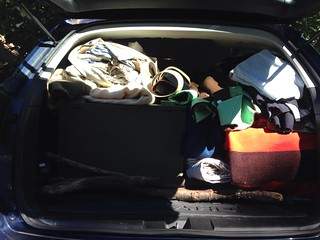
Fully loaded for Saratoga

Do I have any clearer direction? Well, clear as mud, maybe. It appears that one could have a tub of unspecified wood, hooped with wood or metal, in which one could do laundry. Or one could follow Domestic Engineering, and consider the current pine tub acceptable, if perhaps in need of mending. (I have not seen it, so I do not know.) I suppose the question is really whether or not all of this business will fit into the supply wagon known as our Subaru.

Bust darts from Hell

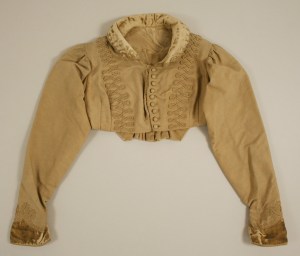
Spencer ca. 1800. MMS 1991.239.2

It all started out so well, in the muslin, but in the wool, not so much. I cut up a remnant, proving that a yard and a quarter of 60” fabric is enough for a Spencer, even for my arm length (but not less, thanks to that arm length and a respect for the grain).

The pattern I’m using has bust darts, which I haven’t sewn in years. They took some tweaking with the steam iron.

In 18th century clothing, one doesn’t see bust darts; there are some above the bust, shaping gowns at the robings, but for the most part they aren’t needed. Think cones, thanks to the stays. And later in the 18th century, a lot of work is done by gathers and drawstrings, as in the white and black  ca. 1800 French spencer at the Met.

Spencer ca. 1818-1819. MMA 1982.132.3

But if you’ve got an endowment of the non-fiscal kind, and you want your military-inspired garment to fit smoothly over your endowment, what do you do?

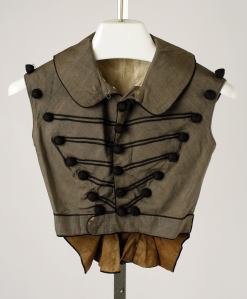
In this example, you hide the bust dart under braid and buttons. Check out that diagonal seam—and that the fabric appears to have been cut on the bias.
Brilliant, right? Gain ease by using the stretchy quality of the bias and hide the shaping under decorative elements.

Here’s an extreme detail.

Spencer, 1813. MMA C.I.39.13.48

In the garment below, of wool, three bust darts of the same length help shape the front. And again, decorative braid hides the shaping. 

It’s only cataloged as “wool,” with no weave given. There is a detail image of the darts and braid as well; I think that might be serge, and not superfine broadcloth. Still, three bust darts help achieve a smooth fit.

The Swedish Spencer at the museum in Lund has but one grainy photo: it’s hard to imagine that it doesn’t have bust darts, but the photo leaves much to the imagination.

Behind the Scenes, Below Stairs

Jonkheer Gijsbert Carel Rutger Reinier van Brienen van Ramerus (1771-1821), met zijn vrouw en vier van hun kinderen, Adriaan de Lelie, 1804

Perhaps because I just finished Longbourn and have just started Year of Wonders, servants are on my mind.

In the family portrait at left, the servants are visible (just) to the right of the tree.

The man and woman almost literally mirror the main subjects, Carel Rutger Reinier van B can Ramerus and his wife, positioned as they are in opposite relationship to each other. The servants, too, are surrounded with life, carrying a child and dogs and game.

servants

The woman is holding the infant of the van Ramerus couple, and even without Google Translate (that’s “four of their children”) we can figure this out. How? Because the child is held away from her body, and faces forward. It is a slightly odd arrangement, with the infant so peripheral to the main image, but we’re fortunate, because this composition allows us to see the servants.

Class distinctions are clear in the dress: the female servant wears a cap, kerchief and short gown, the male servant-gamekeeper, perhaps–wears breeches and a jacket from the pervious century, as well as a cocked, and not a tall, hat.

It does remind me strongly of the imperative to continue a family line, and the lot of women to breed and produce male heirs. For all that I love the past, I know I could not live there easily.

Always the Lady’s Maid, Never the Lady…

Testing the bodice and sleeve

but that’s fine, actually. I like to get dirty. The red Virginia cloth dress is now clay-splashed, and while it was made especially for the “People of 1763” event, it may no longer work. Fine for cherry-sellers, fine for hand-bill hawkers, it will not do for a lady’s maid, and I don’t especially want to clean it. Hope I can get my stays wrangled back into shape and that my cross-barred gown fits…but if not, I’ll be a recently promoted lady’s maid.

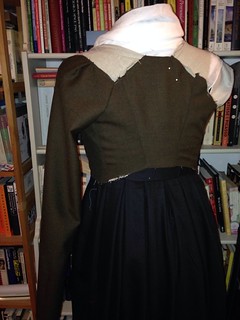
From the back.

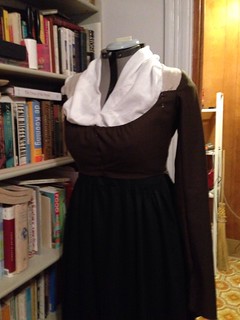
My other upcoming role as a maid will be at the John Brown House Museum, on October 5. This has required quite a bit of thinking and stewing about appropriate clothing and realistic background. I finally settled on a black-and-brown combination of petticoat and open robe, with the style of the open robe based on Paul Sandby drawings and extant garments, but determined by the scant three and a quarter yards of brown worsted that I was able to find.

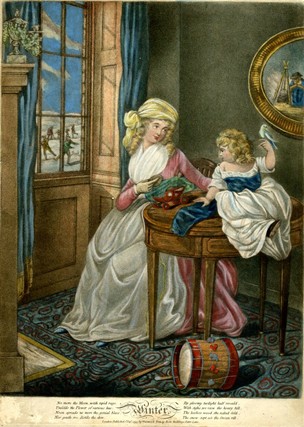
Winter, 1795. The British Museum, 2010,7081.509

The bodice back is based on the 1795-97 cross-front gown from Museum of Costume in Bath shown in The Cut of Women’s Clothes. The front is meant to be transitional: a little bit of gathering at the neck, but not a great deal, with the edges still pinning closed. The sleeves are long and slim, and will button at the wrist once I’ve gotten the length worked out.

The skirt will pleat, with fullness centered on the back triangle and decreasing to the front. For the black petticoat, I used the double inverted box pleat of the 1790s open robe in Costume in Detail. As you might imagine or just plain hope, they work! I’ve also made a small pad to help lift the skirt in the back and create the right profile; I’m thinking of adding buttons and loops so that it can migrate from gown to gown.