Another lot from the Sotheby’s American Folk Art sale is this pair of paintings by Jacob Maentel. (There’s an entire series of paintings by Maentel, all worth checking out.)
Particularly fun in this family portrait? The two little girls wearing dresses made of the same fabric. One of my former colleagues and co-conspirators always wanted to dress interpreters in clothes made of the same fabric, dresses, waistcoats and other items, as if we’d bought a sole bolt of fabric one year. Well, there it is, above: one length, two little gowns.
Lot 576, Sale N09106, “Nesmerian”
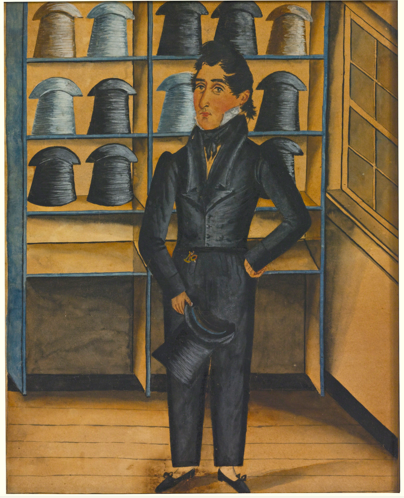
For my friend who makes hats, here is the portrait of Hatter John Mays of Schaeffertown, also painted by Jacob Maentel.
Top hats aplenty, bows on his shoes, and gold watch fobs. I’d say Mr Mays is doing quite well.
It’s auction season in antiques land, and the catalogs arrived at work smelling of money and expensive ink. Sotheby’s Folk Art and Americana sales offer some lovely pieces at the end of this month.
From the Folk Art sale, Mr and Mrs (maybe) Fitzhugh Greene of (maybe) Newport, RI.
Lot 606 from Sotheby’s sale N09106 “Esmerian”
Pretty sweet stuff, right? With an estimate of $400,000-600,000, chances are good that these aren’t headed for public display, so enjoy them now.
Mrs (maybe) Fitzhugh Greene
Mrs (maybe) Greene is a pretty fantastic painting, even if John Durand lacked the grace and skill of Copley or Feke. There is an airless quality to these paintings, though the details are fine and the contrast between the husband and wife in presentation is delightful. My favorite line of the catalogue entry is the final one: “When juxtaposed to the drab coloring of her husband’s portrait, Mrs. Greene can clearly be perceived as his adornment, a fertile beauty in the flush of womanhood.”
Egads, right? I suppose she could be, but I also suppose she could be a fine way to flaunt his wealth and success while he projects fiscal and mercantile stability and restraint. Without a solid link to actual people (and there isn’t) it could be that more is happening in these paintings than the woman serving as the man’s adornment. If you read the footnotes, you’ll see that the attribution to Newport is slim (it’s a story without a real source). If a Mr and Mrs Fitzhugh Greene lived in Newport in the 1760s and 1770s, they’re not buried in RI. They could be Loyalists who fled– auction catalogs are a fiction writers dream of inspiration– but so far, no solid evidence links these portraits to Rhode Island.
In terms of documenting a man and a woman of substance in 18th century America, or the material aspirations of those men and women, these portraits are interesting whether the clothes and jewelry Mrs (maybe) Greene is wearing are real or not. Because they could be fabrications.
Mr (maybe) Greene
Mr (maybe) Greene is firmly real. The frock coat, waistcoat and breeches are all presumably made of the same fine brown wool broadcloth, worn with a fine white linen shirt and stock adorned with lace. The buttons are interesting, and neither the zoom nor my nose pressed to the catalog page clearly reveal the pattern. They look like pretty standard issue death’s head buttons, except when one looks like it might be more like a dorset pattern, or the one that looks floral. These will be on display in New York if one has the chance, which I will not.
There are pendant portraits like these in museum collections that show a man and his sister. It is possible that what Sotheby’s is offering for sale is a pair like that: a man and his highly eligible sister, not a man and his wife.
Ever on the track of laundresses and working women, I came upon The Project Gutenberg EBook of The History of Modern Painting, Volume 1 (of 4), by Richard Muther. I was rewarded with a laundress and a cook holding a spider. Daniel Chodowiecki, a German artist, seems to have been as drawn to the common people as Paul Sandby. The caveat of course is that is he German, so details may not always be correct for American interpretations (pinner aprons, for example).
Still, we have the classic washtub-on-a-table set up, and the laundress is barefoot, which makes very good sense, though my feet hurt just from thinking about standing barefoot on the stubble of the field at Saratoga.
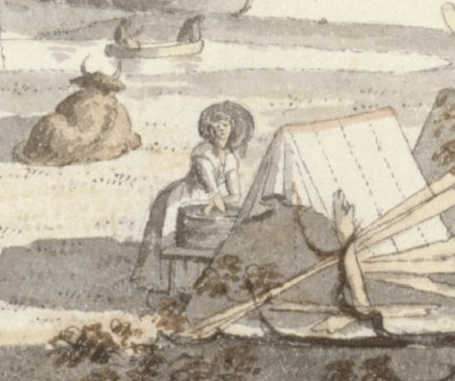
Encampment of the Loyalists at Johnstown, a New Settlement, on the Banks of the River St. Lawrence in Canada, taken June 6th 1784, James Peachey.
Laundresses come with style, too, though I am asking myself, “Is that a fabulous hat, or is your head just in front of some balled-up, sleeping livestock?” Was is discernible is that her hair is down, and she is leaning on the washtub. The tent seams are also clearly visible, and she does have the iconic washtub on a table set up.
Encampment of the Loyalists at Johnstown, a New Settlement, on the Banks of the River St. Lawrence in Canada, taken June 6th 1784. James Peachey
In another detail of the same image, we have a woman who is clearly wearing a black bonnet, tending a kettle on a fire. Here’s yet another piece of evidence for the three sticks-two kettles-no matches set up, and for the tinned kettles being left to get black on the outside.
What is she wearing on her body? There’s a white (or a least white-grounded) kerchief, and what looks like a grey or drab petticoat. But is that a short gown, jacket or bed gown? I’d say jacket, mostly because of the fit, but it’s hard to say at this distance. Whatever word you care to use, she’s wearing a reddish-brown garment fitted to her torso that appears to have a side-back seam.
Once again, tent seams are visible. This tent, just like the one in the other detail, also has some large off-white item thrown over the end. Could it be a blanket, out to air in the sun?
I do also appreciate the short blue jacket/white trousers of the man or boy to the left of the woman, since I know a guy who possesses those clothes and prefers trousers to breeches. He appears to be drinking from a cup as he carries a kettle, presumably of fresh water.
Encampment of the Loyalists at Johnstown, a New Settlement, on the Banks of the River St. Lawrence in Canada, taken June 6th 1784, James Peachey.
[An amazonian dress]. London : Pubd. May 26, 1797, by G.M. Woodward, Berners Street. Lewis Walpole Library Image Number lwlpr08972, Call Number 797.05.26.02
I was wondering about contrast revers on women’s clothes, and if I could really get away with such a detail on a Spencer, when I happened upon this image on Pinterest. Well found indeed from 1797, and very nice hat as well. Bonus: Giant Muff.
The dog has a coat, too, and now that it’s cold in New England, the local whippets are turning out in their winter coats. Mr S and I had a slightly crazy notion to dress a dog we know in a canine-scaled replica of a certain very special coat, but would need access to the hound (for measurements) and a particular scrap pile. With those circumstances not in the offing, let’s just be delighted that dogs in 1797 wore coats, and had bows in their topknots, which means that the end of civilization has been coming for a lot longer than previously thought.
Of course it may be that the dog has to dress as a human to keep from being eaten by the ENORMOUS and possibly carnivorous MUFF of DOOM. I think you could make one from the sheepskins at Ikea, if you could settle for white.






![[An amazonian dress]. London : Pubd. May 26, 1797, by G.M. Woodward, Berners Street. Lewis Walpole Library Image Number lwlpr08972, Call Number 797.05.26.02](https://kirstenhammerstrom.com/wp-content/uploads/2023/03/0a76a-reverse_lapel.jpg?w=370&h=485)
 Kirsten Hammerstrom
You must be logged in to post a comment.