A Milliner’s Wardrobe

Among the things I ponder about Anne Pearson Sparks is what she wore, and how much clothing she had. She would have seen the latest fashions and fabrics when she traveled to England to buy millinery goods. How did she translate those styles for her Philadelphia customers, like Mrs. Cadwalader, and how did she interpret them for herself? It’s largely unknowable since there are no known images of Anne. Probate inventories provide insights into the quantity and type of clothing women had in the 1770s. They skew higher income since people without wealth had so much less to leave, but given that Anne Pearson owned her own house, and had a £2700 marriage settlement, she certainly had means.

(Above right, Portrait of a woman by Charles Willson Peale, ca 1775. Metropolitan Museum of Art Accession Number: 26.129.2)

The February 1778 inventory of Mary Cooley’s estate, digitized by Colonial Williamsburg, provides an extensive list of clothing and other items owned by a York County (VA) midwife, including 10 gowns, 6 petticoats, 9 shifts, 5 pairs of shoes (4 leather and one black satin), 15 caps, 9 “chex” (checked) aprons, and 4 other aprons, presumably white. The type of gown is not specified, that is, they are not itemized as “nightgowns,” “sacks,” or “negligees,” though there is an additional wrapper. No bedgowns appear on the list, and there is only one pair of stays. Since only items with value (i.e. sale value) were listed, Mary Cooley’s total inventory probably included bedgowns. The clothing worn by the enslaved woman Bett and her child Peter was also probably not on the list. Bett and Peter appear at the end of the list after items typically found in a kitchen, where they probably worked, lived, and slept; it is likely their clothes were few and had no value.

What does Mary Cooley’s list suggest for Anne Pearson?

The gowns include:

  • 1 Brown damask Gown 60
  • 1 black Callimanco Gown 60
  • 1 Striped Holland Gown 70
  • 1 dark ground Callico Do. 70
  • 1 Callico Do. £5 
  • 1 flower’d Do. £7 
  • 1 India brown Persian Do. £3..10/
  • 1 Purple Do. £5 
  • 1 flower’d Crimson Sattin Do. £12
  • 1 Striped Holland Gown 70/

That gives us:

  • 2 Holland (fine linen) gowns suited to the hot, humid Tidewater.
  • 1 Calamanco (glazed woolen) gown, best for winter 
  • 1 Damask (probably silk, could be silk and wool) gown, worth 60 shillings ( £3), so less than the silks
  • 3 Calico (cotton, probably all printed, one with a dark ground), also suited to Tidewater 
  • 3 Silk gowns, in “India brown,” flowered crimson satin, and purple Persian. 
Woman’s Round Gown (Robe à l’anglaise) c. 1775-1780s. Striped cotton plain weave. Accession Number:
1959-113-1 Philadelphia Museum of Art

Linen, wool, silk. Living in Philadelphia, Anne Pearson probably had more wool than Mary Cooley; how many more? Would we swap one linen and cotton for two woolen (stuff or worsted or calamanco) gowns? Would we swap a cotton gown for a riding habit? Anne traveled back and forth between Philadelphia and London for years, and a riding habit or (and?) a Brunswick would make sense for travel. With appearance a key part of advertising her trade and reputation, Anne probably had more than 10 gowns, but call it 10 and add at least a riding habit.

Then we add petticoats. Petticoats expand a wardrobe by matching or contrasting with open robe gowns. Six petticoats! That’s a good number of options, but remember, they need to balance the seasons.

Mary Cooley has:

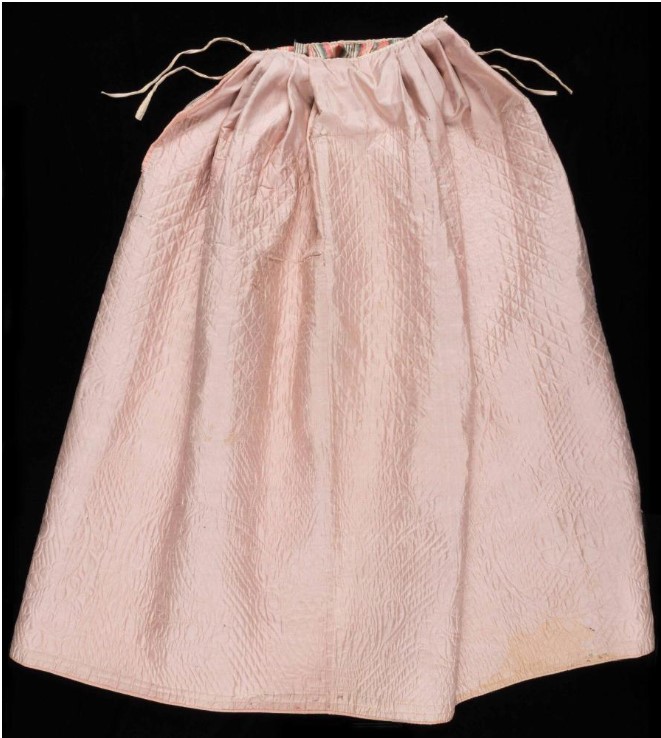
  • 1 Pink Persian Quilt
  • 1 Black Shalloon Petticoat
  • 1 Blue Callimanco Petticoat
  • 1 India Cotton Petticoat
  • 1 old striped Stuff Quilt
  • 1 blue Quilted Petticoat
Quilted Petticoat, 1770-1775. Colonial Williamsburg OBJECT NUMBER 1995-191

The pink Persian (silk) quilted petticoat certainly came from a milliner’s shop, and was likely made in England; it could easily be worn with those silk gowns. Having the color here helps us begin to imagine the combinations. Pink Persian and brown damask? Black shalloon and black calamanco? Black calamanco and blue calamanco? The India cotton petticoat was probably worn with one of the calico gowns, and we can contemplate striped stuff with a striped Holland gown. In any case, Mary Cooley’s two, possibly three, quilted petticoats helped her keep warm in silk, calico, or linen. The blue calamanco petticoat might also have been quilted; there are many calamanco whole-cloth quilts, and I like to imagine one as vibrant and shining as this quilt or perhaps this one. Quilted or not, under candlelight both gown and petticoat would glisten. 
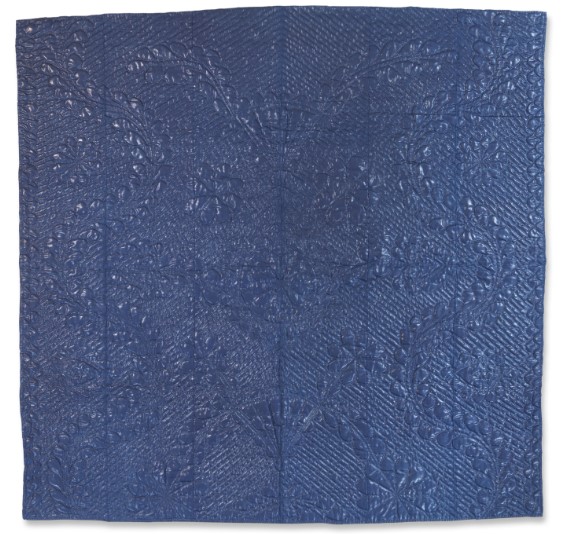
Deep Indigo Glazed Calamanco Quilt, Probably New England, Late 18th Century

Suffrage Wardrobe

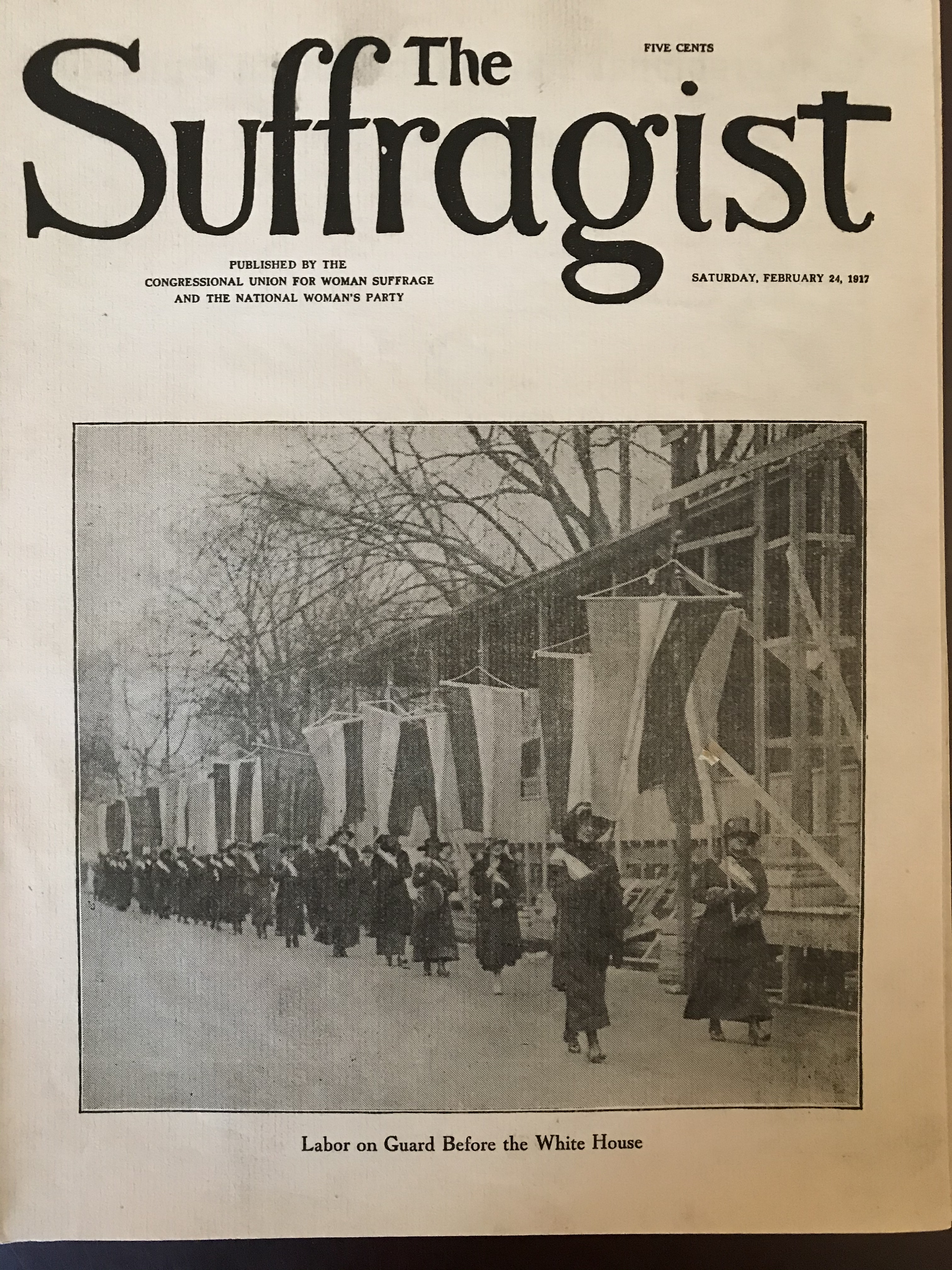
The weekly newspaper of the Congressional Union and National Woman’s Party

2020 is the Centennial of the 19th Amendment granting women in the United States the right to vote. Oddly enough, I am currently on a contract with the National Woman’s Party, founded by Alice Paul and Lucy Burns as an offshoot of the National American Woman Suffrage Association (NAWSA), and originally called the Congressional Union. The split was largely over tactics and splits continued over the years, again, mostly about tactics and mission. (In the post-suffrage years, splits continued, largely over how to pass the Equal Rights Amendment.)

I’m waiting to find out if the site has been awarded a grant I applied for in December so that I can produce a collections open house and living history event in late April designed to explore the material culture of the NWP’s protests. On the off chance that I’ll get the grant, and on the basis of a life-long obsession with the 1910s formed when I watched Testament of Youth on Masterpiece Theatre and promptly demanded the book, I have begun to consider the component parts of a suffragist’s wardrobe. (You gotta have something to think about on the Metro.)

Capes in violet and yellow were part of the costumes worn in suffrage parades and pageants

Here’s the preliminary list:

Chemise
Drawers
Corset
Stockings
Petticoat
Corset cover
Skirt
Blouse
Jacket or sweater (we’ll be indoors)
Boots or shoes
Votes for Women button

I am incredibly lucky to have found (separately) a silk blouse and a wool skirt that both fit me! I also have a wool skirt that is too small, but could be patterned, and a cotton blouse, that could also be patterned. But given what I have to accomplish by the end of April, I think it’s most likely I’ll need to wear the antiques.

Stylish suffragists in the capitol for a meeting

What do I have to make, if I get this grant and decide to be one of the costumed interpreters?

At a minimum:

Chemise
Drawers
Corset

Now, I could opt for a union suit of the kind Our Girl History made, but I’m not super convinced by my abilities to sew knits. Before she posted the union suit, I was planning to use the Dreamstress’s guide to 1910s underwear.

The Suffragist was funded in part by ads.

I have the Scroop pattern, and if I finish my projects and I get the grant, I’ll dive into this decade sometime in March. It’s hard to say whether I’d like to get it or not: there is always the “Oh crap, now we have to pull off this project!” factor with any grant award. It’s daunting, but at the same time, once those projects are finished, thinking about the who, how, and where of the making of suffrage banners and capes is pretty appealing for a material culture person.

In the meantime, while I’m at work, inventory projects provide lots of exposure to inspiration.

Bonnet UnBoxing

I’m really looking forward to recreating this (and to making a custom stand for it). It reminds me of the lovely brown bonnet sold by Augusta Auctions ten years ago. Poking around in fashion plates, I’d be comfortable putting a date range of 1825-1835 on this, with a likely date of ca. 1828. The two-part construction, the exuberance of the caned brim, and the color suggest to me that this is pre-1837 (when the effects of the economic crash can be seen almost immediately in smaller sleeves and tighter bonnets). Still, combing through fashion plates is never dull and I look forward to learning more in the year ahead.

“Now Selling at Prime Cost”

Although I’ve portrayed a milliner before, the earliest iteration has been as a shopkeeper in August, 1804, so I thought it best to refresh my knowledge of what 18th century milliners advertised. (Deep dives into bonnets help me focus on bonnets, but necessarily what else was being sold.)

Pennsylvania [Philadelphia] Packet, January 15, 1772.

One of my favorite ads is from the January 15, 1772 Pennsylvania Packet. Mary Symonds of Philadelphia published an extensive list of goods, many of which will lead you down a rabbit hole. Three of the listings had particular appeal.

“Womens’ and childrens’ black and coloured silk, Dunstable and chip hats, and bonnets”

“Black and coloured silk” almost surely encompasses the range of colored silk bonnets seen in Boston advertisements, but what’s the difference between Dunstable and chip hats? Price, of course. What most of us think of, or call, “chip” hats should be called Dunstable or simply straw.

Chip hats like the one above in the Snowshill Wade Costume Collection, were made of plaited (woven) thin strips of wood, more like flat baskets or chair seats.

Straw hats, like the one above (also in the Snowshill Wade Costume Collection) are clearly finer than chip and do not need to be covered. The earliest description of the distinctions between hat types that I’ve found thus far is from 1815, in “An Encyclopæaedia of Domestic Economy, Comprising Such Subjects as are Most Immediately Connected with Housekeeping etc etc” which goes into some detail.


The most entertaining discussion I found was in  The Sessional Papers Printed By Order Of The House Of Lords, Or Presented By Royal Command, In The Session 4 And 5 Victoriae And The Session 5 Victoriae 1841. The recorded exchange resonates with current discussions of tariffs on imports, but the really revelatory bit is this:

Class distinctions expressed in materials and apparel are eternal.

“Tobines” were new to me (or at least forgotten) and have nothing at all to do with the bishop of Providence. Thankfully, Textiles in America has the answer: “A wide variety of dress materials from fine silks to silk and worsted, and linen and cotton combinations that have warp-float patterns of small flowers or intermittent stripes and dots.” (p 367). Once you’ve seen it, you realize you’ve seen it before.

Berch papers, Nordiska Museet.

“Childbed baskets” were also a new concept to me, but The Female Reader, Or, Miscellaneous Pieces in Prose and Verse; Selected from the Best Writers, … for the Improvement of Young Women illuminated the term; the current equivalent is a layette set that includes bedding, and goes beyond the crocheted sweater, cap and booties some of us came to fear receiving. (Mint green acrylic? really?)

It’s a wide range of goods for women to buy (including small accessories for the men and boys in their families), and somewhat beyond the bonnets-hats-jewelry-trimmings we typically associate with milliners. While I don’t have any plans to start manufacturing chip bonnets or making up childbed baskets, I am definitely intrigued by the possibility of expanding my “offerings.”