As far as I know, that’s not an internet meme yet, but it might as well be. It’s meme in my head, and that’s what counts.
While I should be thinking about the probability of Spencer-wearing in 1800 Rhode Island, I got distracted during a hunt for head wraps and found this lovely little water color.
Boy in a Beaver Hat. Watercolor by Anna Maria von Phul, 1818. MHS 1957.158.27
How lovely is that coat? The Young Mr already has a semblance of that hat and trouser (admittedly too short) so the coat and a matelasse waistcoat would be just the ticket to recreate this image. He’ll bring his own sulky look to the party.
I’m trying to figure out what the coat would be made of, and what I’m willing to pay for a coat that will be grown out of rapidly. In the meantime, though, what a lovely image.
Detail, the John Miner Coat, Stonington Historical Society, 2009.120.001
If I examine and exactly replicate a coat for personal use, what do I owe the museum that owns that coat– anything? I think I owe the museum any information I can share that will improve their records and help build a research file for the future.* I also think I owe them copies of the images I may take, and with digital images, that’s now incredibly easy.
But if I replicate this coat (shoulder intact) for Mr S or the Young Mr, should I give the coat to the Stonington Historical Society when we are done with it? SHS thinks I probably should, but as someone who manages collections, how many replicas do I want, and what standards do I use to judge them?
I think the best course of action is for museums to make patterns of popular or often-requested garments available for purchase, so that anyone who wants to make a replica has all the data they need. Short of that– and funds are often short for that– catalog records with as many measurements and as complete a description as possible will allow dedicated tailors and stitchers to get as close as possible to original garments.
True replicas involve recreating fabrics and using period techniques, and matching a garment measurement to measurement– and in the case of the Miner coat, there is no way to replicate its history. And the amount of work and expertise that would go into a true replica of any historic garment seems enormous– it would constitute a large donation to the museum, even if the garment had been worn.
*For those of you reading the caption on the Miner coat, yes, it needs work, and yes, SHS knows there are problems with that description. I promised to help them with their catalog record.
The Frail Sisters, 12 May 1794. British Museum, 2010,7081.1077
Here’s the British Museum’s description of this print: “Two young women dressed in fine clothes in a room with decorated wallpaper, one sitting in front of the window looking onto the street, with a pet squirrel on her lap, turning to smile towards the viewer and pointing at herself, while the other stands behind her chair on the right. 12 May 1794.” It’s good to get the pet squirrel question out of the way.
This is another print that’s hard for us to read completely: you might wonder why they’re called the Frail sisters. Is Frail a proper noun, an adjective, or something else? It’s probably code: frail here may well refer to the strength of their morals rather than their biceps.
There’s another Frail Sisters drawing, also 18th century, probably late 1780s-early 1790s. This is appears to be a ‘straight’ drawing, but I don’t know: it could be an artist’s portrait of three prostitutes at play. Or it could be actresses (they weren’t so very far from prostitutes and courtesans).
Mrs Frail appears in William Congreve’s Love for Love; do these images also reference characters first seen in Restoration comedies? This is stuff I haven’t thought about in a long time, so I can’t yet unpack how the title and meaning of the print relate to what the women are wearing. And I might be over-thinking things a bit, so let’s step back and just look.
What is the standing sister wearing?
A half-robe, indoors. Time of day, indeterminate, but perhaps morning.
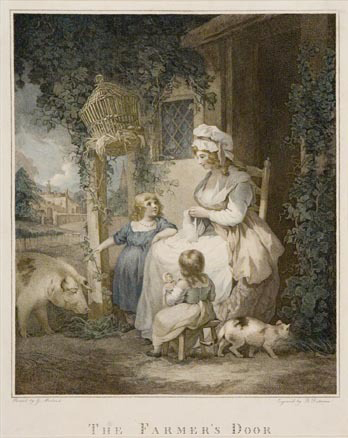
The Farmer’s Door. George Morland, London: Published by J. R. Smith, King Street, Covent Garden, Aug. 4, 1790
A somewhat easier image to read is the print after George Morland’s The Farmer’s Door, from 1790. This genre painting presents the romanticized vision of humble life, with the farmer’s wife and her children (note the blue stays on the seated child).
Is the farmer’s wife wearing a half-robe over a quilted petticoat and apron? The quality of the images I can find is poor, and the coloring questionable.
In another version here, the kerchief is clearer and seems to go over a long-sleeved garment with a short skirt.
Selling Carrots by George Morland Date painted: 1795 Oil on canvas, 76 x 63.5 cm Collection: Brighton and Hove Museums and Art Galleries
In Selling Carrots, there is another short-skirted garment with long sleeves worn over a petticoat and with a kerchief.
Without getting overly distracted by titles and meaning, I think there are clues to how these half-robes or jackets are worn by women of different classes, aspirations, and locations. For rural women who are not gentry, these appear to be comfortable working clothes worn all day. For urban women, they seem to be worn early in the day, and sometimes out of doors, perhaps even to the lending library.
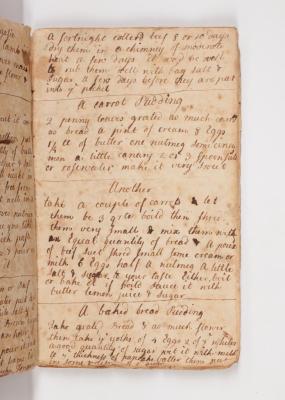
Thanks to the American Antiquarian Society and a grant from the Pine Tree Foundation, you can now access digitized versions of the AAS’s manuscript recipe/receipt/cookery books. Pretty cool, right? Because I know you want to experiment with every variation possible of carrot pudding. (Mr S got a stomachache just now and doesn’t know why…)
I first read about this in a twitter link to the MassLive article, and I’d like to point out up front that you go to the AAS GIGI portal and search in the box for Pine Tree Foundation. That’s the quickest way to access the books. I also searched for cookery or recipe and ended up in some interesting places with carrot pudding recipes.
One of the AAS staff members has been trying out the various recipes, and blogging about them here. There appear to be manuscript books as early as the late 17th or early 18th century, which is very cool (and still about puddings!).




 Kirsten Hammerstrom
You must be logged in to post a comment.