What Table Manners?

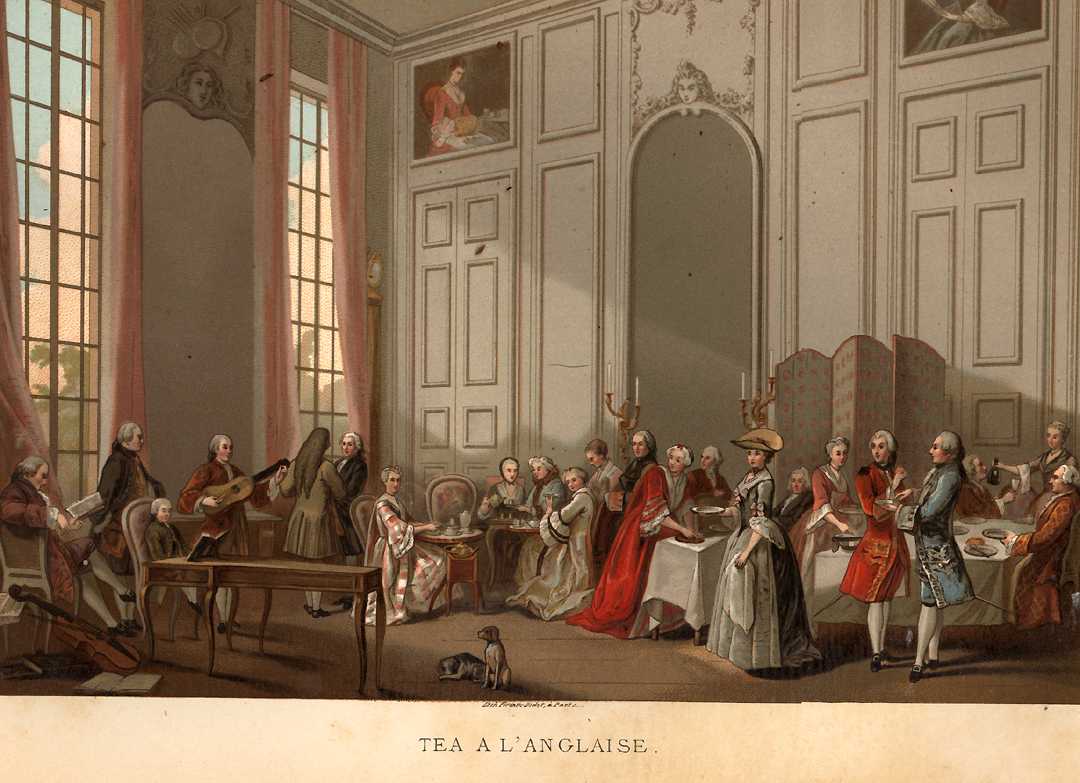
When you think of 18th century dining, which image comes to mind, tea on the left, or the sea captains to the right?
While I did not carouse with sea captains this weekend, at dinner today, I found myself deeply envious of someone’s skill in eating from a knife. I shoveled food onto my spoon yesterday with abandon. I coveted the last three pieces of quince tart today despite knowing that one of those pieces was for my husband. And I am not ashamed. Ok, not too ashamed.

The best part of living history is always what you learn, and I feel a separate blog post should deal with “the public, god love ’em.” What I learned this weekend was less about quilting and more about living old school. Ok, and maybe more about the public’s…breadth….than depth…

The most instructive thing was about being hungry and thirsty. Thirsty as in my lips are dry and I know I need to drink, which means being past thirsty and at dehydrated. Yesterday I went all day without peeing and that’s not right. Both yesterday and today I left the farm hungry, not because there was not food but because I ate mindful of leaving enough for those eating after me. The goose pie was delicious and seriously worth eating standing up in the kitchen. I’d fight for that pie.

Eating boiled dinner (ham, parsnips, carrots and turnips) along with a pudding, with 18th century utensils was challenging. Two-tine forks have great sticking ability but not much carrying ability.  Spoons are your friend. Knives may be better as trowels than cutting implements. No one really cares about your manners, they are too hungry to notice. Boiled pudding is this season’s smash hit.

Coggeshall Farm uses Amelia Simmon’s American Cookery, which I started reading last week. It is full of useful receipts based on American ingredients and I recommend it. Here is the receipt for the fantastic, sliceable pudding we had today:

A boiled Flour Pudding_.
One quart milk, 9 eggs, 7 spoons flour, a little salt, put into a
strong cloth and boiled three quarters of an hour.

There were hot words about those “7 spoons” from the kitchen staff and to be honest, I did not quiz them fully on the size of the spoons they used. But whatever magic they worked, it was truly delicious with and without the molasses cream sauce. Sliced and eaten with spoon or fingers (I snitched some later in the kitchen), it a consistency of solidity like the best parts of a Swedish rice pudding, though smooth.

It is hard to countenance how hungry people must have been much of the time in the past. More than the extreme hunger of the soldiers (like Greenman and Plumb Martin), I think common people experienced days of lacking, and accepted them, with the seasons. Food was not constant, but in flux, and even at harvest, I think, or hope, that one was mindful of the needs of others.

For more on seasonality and 18th century ways of thinking or seeing, read Circles and Lines: The Shape of Life in Early America. That’s what I’m going to pretend to do while I fall asleep.

Framing a Plan

cross-posted from A Lively Experiment, all images copyright RIHS.

This coming weekend, I’ll be joining in at the Coggeshall Farm Harvest Fair, along with my co-worker who helped clean the museum 18th-century style. She will be helping with cleaning and laundry and ironing (must remember to pack the lavender and vinegar solution), while I will tackle a quilted petticoat.

At first glance you might think I’ll have the easier weekend, and in some ways, I will, sitting in a parlor with a quilting frame. On the other hand, I booked myself a weekend with worries that have pestered me since we were invited in mid-August. Is the fabric I’ve chosen going to work? Do I know enough about the quilted petticoats in the RIHS collections? What kind of quilting frame is correct? And where did I stash the batting?

Research is always the place to start. I compiled a Pinterest board of quilted petticoats  in other collections to build my visual literacy, and tracked down articles by Lynne Zacek Bassett in PieceWork[i] and in the  Textiles in New England  II: Dublin Seminar for New England Folklife Proceedings[ii].  From the Textiles in New England proceedings, I learned that September is the second-most common month for quilting mentions in diaries for the late 18th and early 19th century in New England (May is the most often mentioned, Octobe is third). This was a relief as I wondered if quilting in September was even appropriate. With that resolved, I was able to move on to aesthetics.

New England and Rhode Island quilted petticoats share some general characteristics: the overall skirt is quilted in a diamond or diaper grid of about 1” square. Below this is a decorative band or border, usually about 12” deep. The top of this is set off from the grid by a cyma curve or wave pattern. Some examples use an undulating feather border, and others have a stylized arc and clam shell border.  The background of the border is stitched in diagonal lines. Sometimes the direction is set from center front, and lines radiate to the left and right, and in other cases the lines radiate to left and right from the center line of each arced segment.

Within the border, floral and animal motifs are quilted. Animals seem prevalent in New England quilts—there is even a mermaid in Connecticut—but none of our quilts have a mermaid. We have sunflowers, pomegranates, and carnations similar in form to the stylized flowers that appear in samplers and embroideries of this time period. Animals include deer, lions, squirrels and a creature that looks like an oryx but may be an elk. Birds are represented as well, peacocks and stylized songbirds as well as an owl, and even what seem to be roosters.

I drew these conclusions not only from reading, but from examining two quilted petticoats in the RIHS Collection, the lighter one made ca. 1745 by Alice Tripp [Casey], accession number 1985.7.1, and the darker one made in 1770 by Anna Waterman [Clapp], accession number 1982.76.3. In the catalog record, the images for 1985.7.1 are incorrect–they are for 1982.76.2, and the confusion testament to cataloging and linking records in a building several blocks from where the petticoats are stored. Now, at least, we can work on correctly them.

The quilted petticoat that I plan to make will use the typical Rhode Island elements. The top portion will be quilted with an overall diamond pattern, while a feather border will set off the bottom band. Within that, I will quilt squirrels, chickens, and probably an owl and a cat, because they are favorite creatures in my household. I’ll also quilt in my initials, just as Anna Waterman did in her quilt.

You can join us at Coggeshall Farm Museum this weekend, September 15 & 16, starting at 10 each day, and see RIHS staff members in action! We think it will be a good warm up for What Cheer! Day, coming to the RIHS on Saturday, October 13.


[i] “Sarah Halsey’s Mermaid Petticoat.” PieceWork. January/February 2003

[ii] ‘..a dull business alone’: Cooperative Quilting in New England, 1750-1850.” Textiles in New England II: Four Centuries of Material Life, The Dublin Seminar for New England Folklife Annual Proceedings 1999. Boston University Press, 2001.

Into the Breech(es)

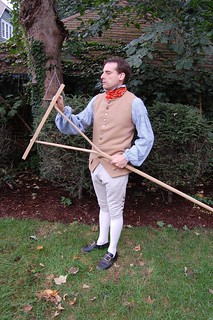
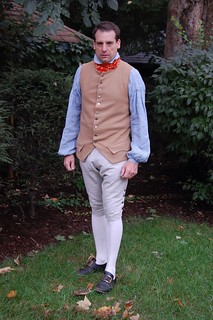
Not me, but Mr. S. I finished the last of 20 or so button holes on waistcoat and breeches, and got him to agree to get dressed and be photographed. He chose the rake, as he likes 18th century work. He hopes to  join in as a volunteer laborer at Coggeshall Farm this coming weekend, and these are his clothes.

The shirt, which he has had for a year, is from the Kannik’s Korner pattern, made in a blue and white check linen purchased from Wm Booth Draper. There was a check shirt in the clothing inventory of a 2nd RI soldier who died at the Battle of Monmouth, and this small blue and white check is found throughout New England at this time in shirts and aprons. The neck handkerchief is from Time Travel Textiles. He has another one in blue that he likes to wear with his uniform on hot days.

The waistcoat is adapted from a BAR pattern I got from the captain. The wool is a Wm Booth Draper remnant that was not enough to make a jacket for me. It just made the waistcoat for him, and is lined in a striped linen from Jo Ann fabrics that was lurking in the stash. The breeches are made from the Mill Farm pattern, which doesn’t have diagrams but has well-written instructions. I finally got pockets to work using that pattern the first time out! The fabric is a linen-cotton blend from a remnant table at the local mill store. The waistband is lined with a utility linen from Wm Booth Draper, as there was not enough for the waistband…because these started out as overalls. They became a hot mess because Mr. S has large, single-speed-bike up Providence Hills calves. Henry Cooke got a look at the man in shorts a few weeks ago, but still thinks he can fit them. I say, it will take Mr. Cooke’s skill. At least Burnley & Trowbridge stockings fit over them.

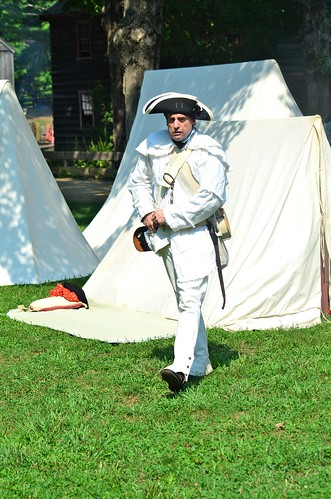
The last photo shows him at Redcoats & Rebels this year, striding across the common to join the 10th Massachusetts. Here as above, the shoes are Robert Land’s Williamsburg shoes, and the buckles are from G Gedney Godwin. I went with plainer buckles with rounded corners because that was called for by the uniform specifications in the Continental Army, so that the buckles would not wear through the tongues of the uniform overalls. Shoes & buckles were Mr S’s Christmas gifts. The tan waistcoat was supposed to be as well, but the buttonholes got the better of me. Once I get past the first two, they’re OK, but at the start of the buttonholes for a man’s waistcoat or breeches, I have a kind of Kubler-Ross reaction: denial, anger, bargaining, depression, and acceptance.

I’m so glad he likes reenacting. Buttonholes aside, it’s been a great learning experience sewing for him. Onward to a regimental, and to this: No farmer’s smock for him, thank you. Next year, his laborer intends to be well-dressed. At least with those big buttons, there won’t be that many button holes…though I bet the total area of button hole sewing is the same!

Bonnet, found

Readers may recall that I have a bonnet problem. It’s a problem I think can only be solved by more bonnets!

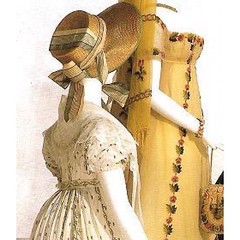
I’ve long admired and coveted the bonnet shown left in the Kyoto Costume Institute.

Well, see this bonnet? It’s called an 1812 Sun Bonnet over at HistoryHats.com. It is based on the KCI bonnet.

It is also similar to this ca. 1810 bonnet sold by Meg Andrews.

I’ll be spending time out in the sun in September, dressed for 1799. Black silk bonnet, yes, but, it could be hot and not so shady. Big plate of a straw hat? I guess so, but it’s a little too big for 1799. Straw bonnet? I wish….

But wait! Trapped on Amtrak, scrolling through Dames a la Mode,  what do I find? This! Check out that bonnet on the woman seated at right.

(Click through for larger version.) Similar cut out at the back of the neck to both the 1812 sunbonnet and the KCI bonnet. Interestingly, the woman in the straw ‘sun bonnet’ is wearing a dress with sleeves like those found on a chemise a la reine. She can’t be less fashionable than her companions, can she? How can that be in a fashion plate? I think this speaks to the persistence of fashion details longer than we might otherwise credit them. It only makes documentation trickier– or more fun, depending on who you are.

It’s 1794. By 1799, that bonnet might very well have made its way to Providence. We know girls and women were dismayed by the Jeffersonian embargoes, and driven to make their own straw hats in Providence. That means they had them, they’d seen them, and they’d seen fashion plates before the 1807 embargo.

Yes, I need a broadside or a newspaper ad to clinch the deal, but there’s an extant hat, a fashion plate in English, and I know by the early 1800s women are weaving straw for hats in Providence.

I think I might be able to have that hat after all…but I still have to finish that shirt I started for Mr. S. It simply will not sew itself!