What’s behind that green suit?

The American School, by Matthew Pratt, 1765. MMA 97.29.3

Mr S. has a green linen suit in the making; that is, he has breeches which mostly fit, and a frock coat in need of serious alteration. Since I will need to alter this coat eventually (that is, take it apart, re-cut and re-assemble it) I have started looking for images of green suits.

Portrait of a Boy, probably of the Crossfield family. William Williams, MMA 65.34
Portrait of a Boy, probably of the Crossfield family. William Williams, 1770-75, MMA 65.34

The green linen the suit was made from is no longer available, so there will be no matching waistcoat. If I can get the thing tweaked to an approximation of ca. 1763, we should be set for the August event (if that happens) and for Battle Road next year, though I know he might want wool. The taunts of “bet you wish you had the rest of that coat” from this year linger in my mind, at least.

The jacket is, admittedly, too short. I begin to wonder if I need to cut it down even more, like a workman’s short coat; the Massachusetts line “Bounty Coats” are cut shorter, and similar to a coat at the Connecticut Historical Society (1981.110.0, search by number here, the links are not stable).
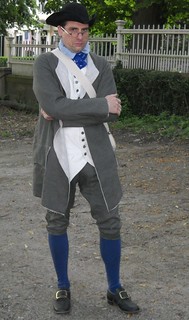
Mr S last June, in the unfinished 36-hour-frock coat

The problem with that plan, at least for 1763, is that the cuffs are clearly larger and coats longer, in 1763, than they are in 1775, at least for gentleman. I realize that this means I am better off starting over completely for the 1763 coat from a muslin up (which against all instinct and principles, I did not do for the 36-hour-frock coat). So I’m waffling here, as Mr S doesn’t always want to portray the day laborer/tenant farmer, but would like some pretensions to artisan and property owner. That means more fabric, and that means starting over completely is in order–breeches, waistcoat, frock coat and all. But wait, there’s more!

The events in the queue before the August 10th event for 1763 include Monmouth on June 15-16 (for which overalls and hunting frock are in production), Washington’s Arrival in Cambridge on July 14, which requires militia clothing, and Old Sturbridge Village the first weekend in August, for which a regimental coat is requested. Somewhere along the line, I’d like to make myself something…but it looks more and more like a summer of menswear. Perhaps cutting down that green coat and altering the breeches for July 14 is the most sensible plan…though where that will leave 1763, or the regimental coat, I do not know.
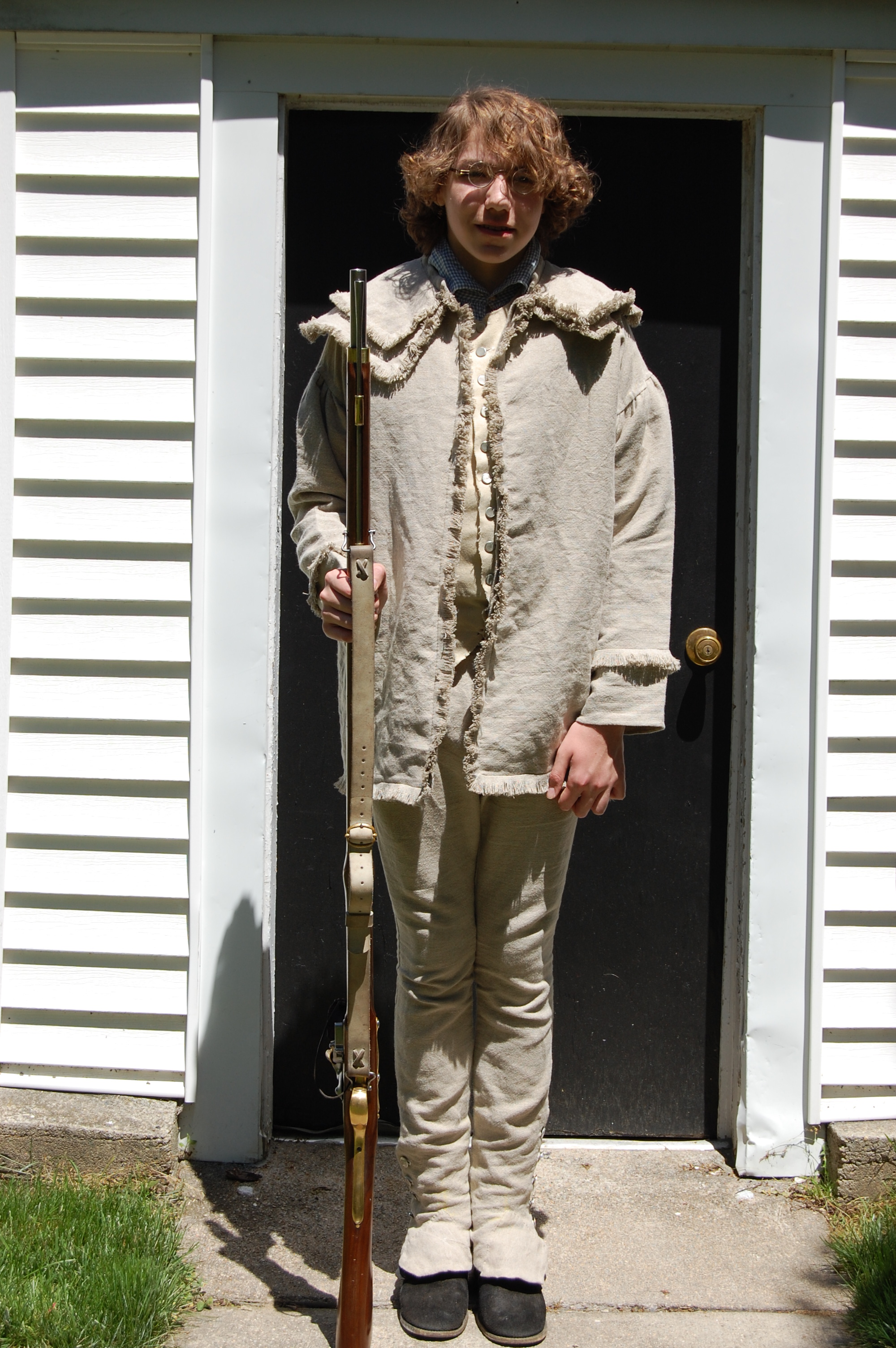
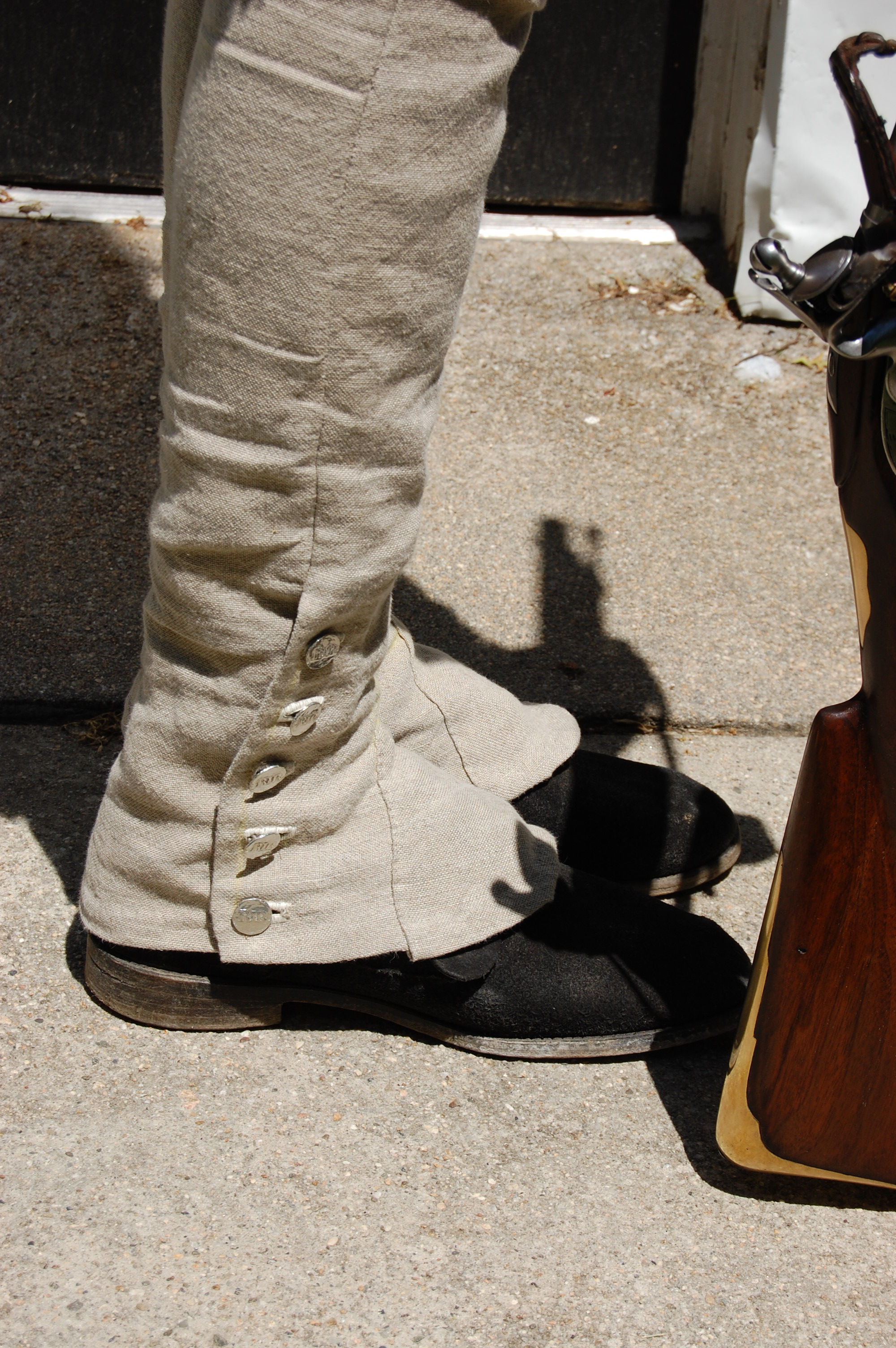
Lunatic Fringe

Hunting frock and overalls complete!

Oh, my goodness, it’s done! It’s done, and the photos have passed the master. Phew! Just one more to go, oh, my goodness, no.

The Young Mr was allowed to carry a musket in the Warren Memorial Day Parade. I do not love a parade, so I didn’t go. But he had no overalls of suitable fit and they were so nearly done, that I resolved to finish them, and finish them I did, in time for bed on Saturday, no less. It’s all thanks to BBC’s brutal but entrancing programming. My sewing better to blood curdling screams (also courtesy ITV), which seems awful but there it is…though the darkness of Mad Men has proven good for back stitching, decent button holes require murder.

Buttonholes. I hate those guys less now.

Fifteen button holes, multiple fittings, and some curse words have resulted in a pair of decent-fitting overalls that did not split at the knee or stretch too extremely when worn. And atop it all, in the yard if not in the parade, the new model hunting front adopted by the 10th Massachusetts. The Young Mr is uniform-forward as Neal Hurst’s research has led the adjutant to conclude that the men were wearing frocks, and not shirts. (In the Rhode Island records, I found that rifle frocks were listed until 1780/1781, when the Records of the State of Rhode Island began to indicate rifle or hunting “frocks or shirts.” That’s a wrinkle for Mr Hurst, but I saw only frock in 1777-1780.)

Lunatic fringe. Cut, fold, clip, strip, stitch.

The fringing is a task completed by Mr S, who has fringed the strips for his own Rhode Island hunting frock, and now knows what fun awaits him as another frock will made for him. My goal? Another complete 10th Massachusetts kit by June 15. I’ve sewn buttonholes in a moving car before, and I expect to be felling seams or sewing buttonholes as we travel down to New Jersey. They’ll be fine; after all, the traffic is murder.

The 1763 Project

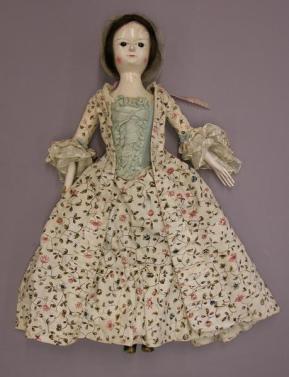
Doll, 1763. V&A, T19.36, T19P.36

Sweet, right? Who wouldn’t want to look (or at least dress–those pupils suggest something untoward, chemically) like this doll? And she’s 1763. Of course, my friend DC didn’t get the grant he applied for, so he has to try again.

Still, it seems the event will go ahead and I am stumbling on under the impression that I will have a chance to make myself something lovely for August. Of course, that comes only after I make the regimental menswear, so why am I typing and not backstitching? Because after a while, it’s just plain dull. Plus, doll! Printed cotton! Lightweight and lovely! And look: a hairstyle I can manage: birds’ nest.

Nice Petticoat.
Nice Petticoat.

What I like about this doll are her details. (The better written description is on the V&A website, but the better photos are at VADS.) She’s wearing a sacque (known also as a sack-back robe or a robe a la Francaise) and matching petticoat, a green silk quilted petticoat, a white linen petticoat, and a pocket that matches her gown.

The blue silk of her stomacher is used as trim on her sleeves, which are ornamented with flounces. Hallie Larkin goes into this well on her blog post about Changes in Cuffs. And that’s what stops me: the fine linen and the lace.

An actual reproduction, no less.

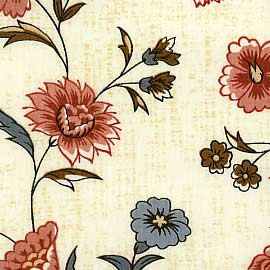
The gown itself, even a sacque, seems like something I can manage. (And yes, this is but one more piece of cotton sacque evidence.) A very similar fabric is available and if this sells out, there are variations on the theme. The blue silk stomacher can be managed: I have taffeta sources, and from making bonnets have learned the basics of the serpentine designs. I could make that. But those flounces–what about those?

Here she is from the V&A, ca. 1760, T.19-1936

Here’s the V&A description: “lace and cotton elbow ruffles.” Hmm. Cotton, perhaps that I can find in a fine, sheer weave. But the lace?

The more I think about this lovely gown, about the materials, and who would wear it, the more I think I’m better off sticking with lightweight wool and Sandby’s cherry seller...

I love a good challenge, but the lads need regimentals and their own 1763 apparel. Sandby’s woman wears a gown I’ve made before, so construction screw-ups will be fewer time will be shorter. And at least we can all wear whatever I make for various other celebrations and riots. New England had them in abundance in the 1760s and 1770s.

Shoulders and Sleeves

Dante's Own Infernal Sleeve of Poof
Dante’s Own Infernal Sleeve of Poof

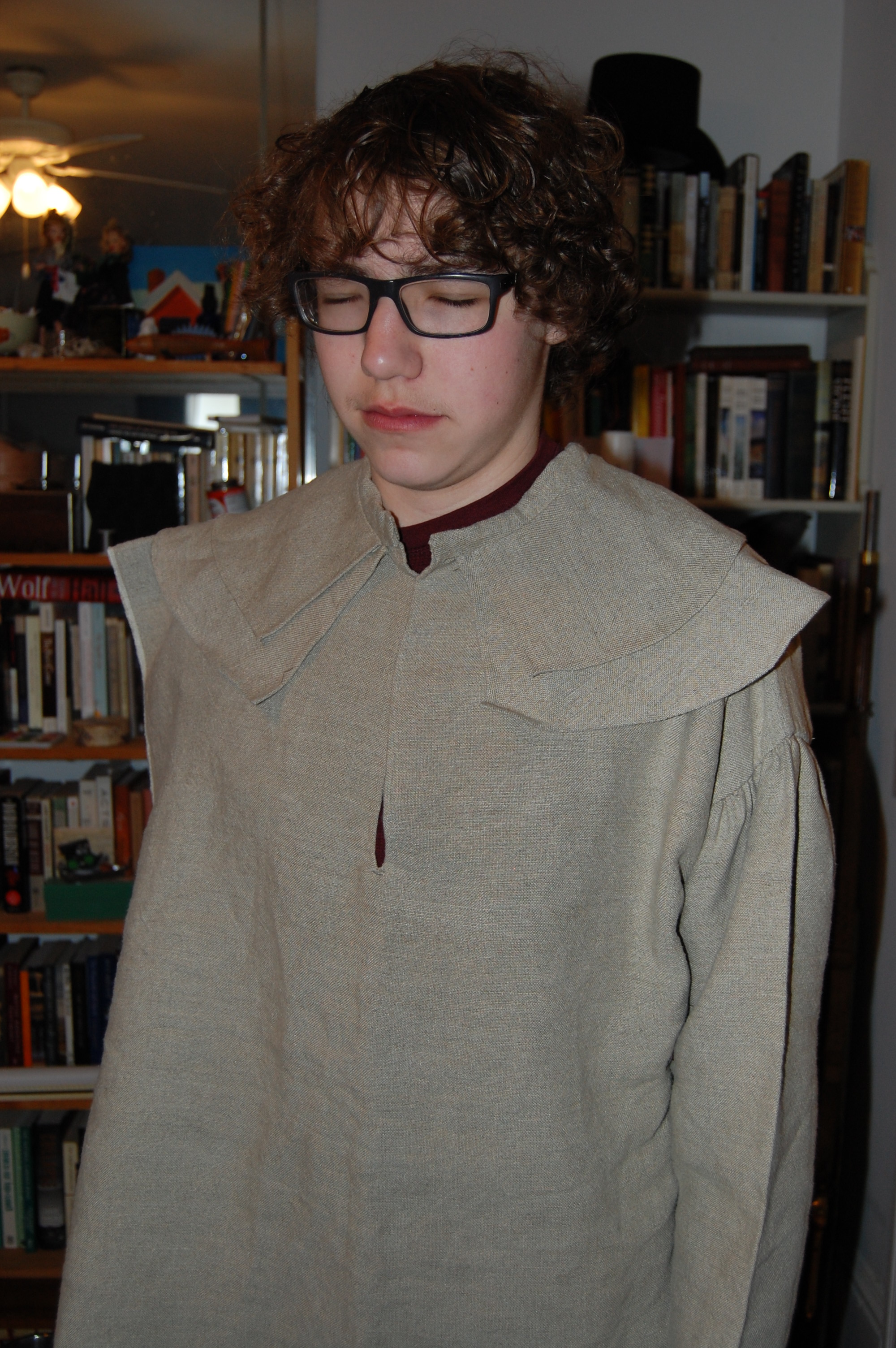
Twenty-four hours on, this is where we are: Poofy, shoulder-popping sleeve of doom. How can that be a uniform sleeve?

Well, Pilgrim, this is how:

Oh. They're all Infernal Sleeves of Doom.
Oh. They’re all Infernal Sleeves of Doom.

So glad I have that near-feral hunting shirt, because without it I would have ripped this out completely. Could the Poof of Doom be there to allow movement?

Subject was detained for photography.

Before school, even.

Arm out, doubts remain. Arm down, less terrifying.

I do feel sorry for him, but at the same time, I have to fit it to him.

It’s possible that the poof at the apogee of the shoulder is due to the intense pressing I gave this to retain the center line, and the fact that, despite washing, the linen is still pretty stiff. When I compare the two– the completed shirt and the in-progress shirt, I can see that while both display a tendency to drift up, the gathers on the adjutant’s shirt are more evenly distributed. You know what that means…and that’s why the sleeve is only basted in. Might as well change it now as on Sunday, because it must be done. So in the end, I am ripping it out completely, but with the knowledge that 1) the upward angle seems to be correct as shown in the finished garment, and 2) evening out gathers may reduce the Poof of Doom.