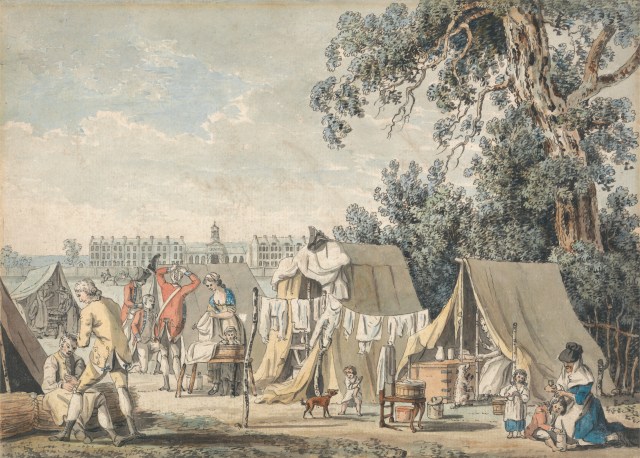
James Malton, 1761-1803, A Military Encampment in Hyde Park, 1785, Watercolor with pen in black ink, with traces of graphite on moderately thick, moderately textured, beige, laid paper, Yale Center for British Art, Paul Mellon Collection
This Saturday is the BAR event at Putnam Park in Redding, CT. This is an event with an early set-up time, one of those “early enough to be worth packing the car Friday night” events, as Mr S will need to depart at the time he usually gets up. I’m pouting not because of the early departure time, but because I won’t be going.
The Young Mr has his first swim meet Sunday, so Saturday he’ll have to get his homework done. That means someone has to stay home, or he’ll sleep till noon and spend the rest of the day eating meat and playing video games, all normal for a 15-year-old, but not helpful when most of Sunday will be spent marinating in chlorine.
I did a strange and awful thing to my back in an altercation with the face plate of an UPS unit for a server, and find that two weeks on, I still have a mis-aligned rib and occasional searing pain when reaching for Amelia Simmons’ cookbook to find something for Mr S to take with him to Putnam Park. At first, it seemed that it would be like Fort Lee, where one does not cook.
However, it seems that a camp kitchen is planned and there could be cooking, if only someone could tend the fire during the tactical, but no. I will not be there to stir meat of any kind, in any way, and the gentlemen, if one can call them that, will have to scrounge in the corners of their haversacks, take pot luck from the Boy Scouts, or find other means of nourishing themselves. I’ve also been told that it might be as well for me not to lace up my stays and push my ribs around, though on the whole, I think I might be better off wearing them more often. No matter what, home I shall I be, and the gentlemen will have to shift for themselves. Having seen them in action, I have no doubt that they will do well for themselves, and I might still bake them a pie.
1. The Cross-Barred Gown is Too Big. I will have to take it apart and make it smaller as it is too wide across the back in general and the shoulders. This is fairly simple.
2. The stays are Too Big. I can lift them up and do the shimmy inside them. Seriously. Eighteen months ago, when they were made, I had a two inch gap at the back and the front did not lace closed. Now I can lace them shut front and back.
Whether I have some body image issues or am just a crack-addled monkey can be debated among impolite company some other time, but to solve these problems, here’s the half-baked scheme plan I have in mind:
I re-cut and re-fit my bodice block for an open robe and made it smaller. (For the sacque, I need only trim the sides of the back because I haven’t gotten any farther than that, thank goodness! Now I have a better sense of the shoulder width I need to fill with pleats, also good.) For the Cross-Barred Gown, dis-assembly and re-construction can happen in the spring. Simple enough, and adjustable, too but…
Stay pattern mock-up, measured.
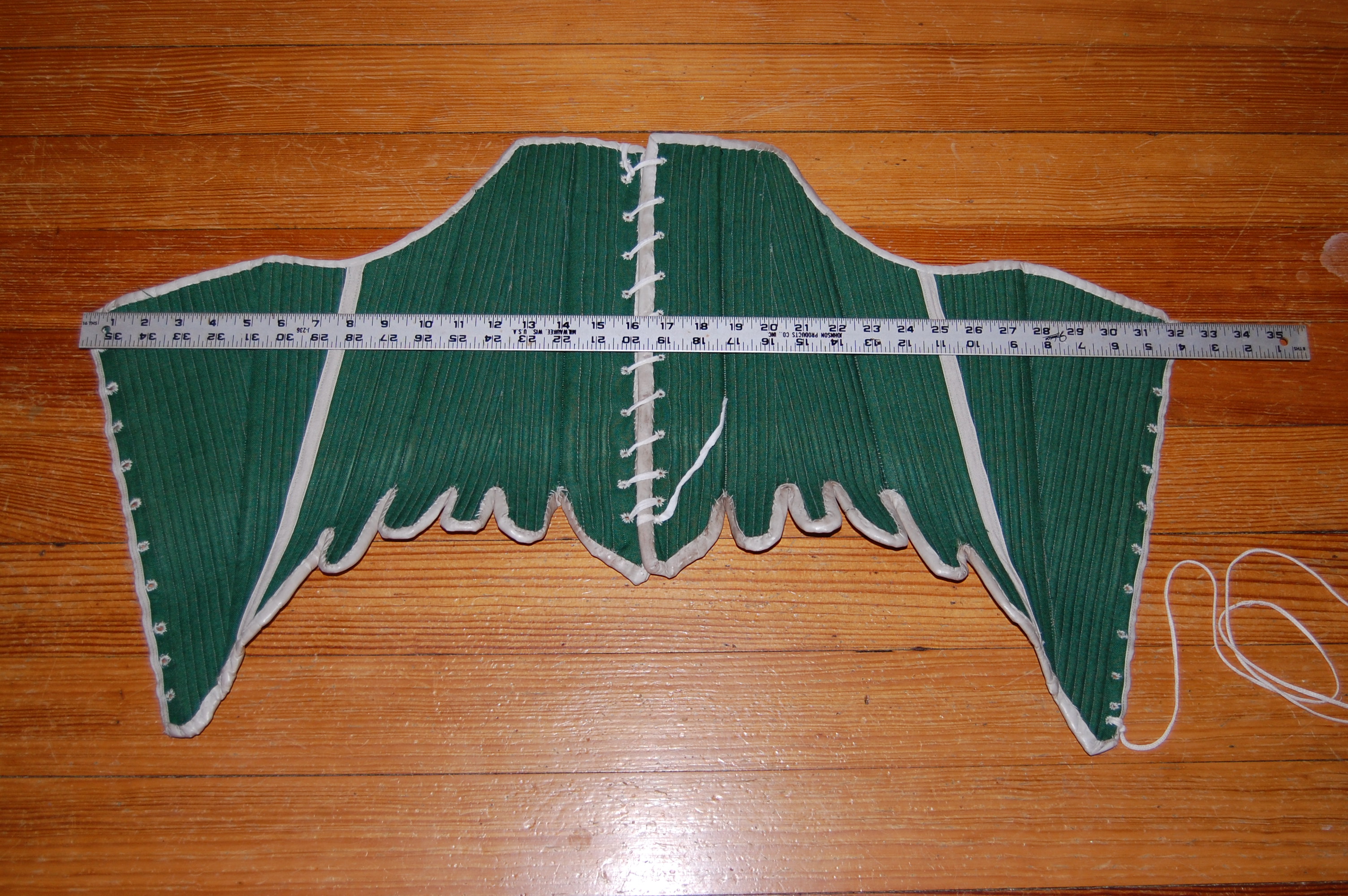
The stays are a little different, and much more serious. I’m not yet sure what to do. I could unstitch the binding and the panels and remove some bones, re-stitch the seams and re-apply the binding…or I could start all over, but make the stays a size smaller. The cardboard mockup measures 33 inches across. With a tape measure snugged up, I measure 37 inches around. Seems like all should be well, no? Two inches, front and back?
32 inches, but they don’t fit.
It is not. Here you can see the green stays and the yard stick: 32 inches. I should have five inches altogether, right? No. These lace shut front and back (see the back lacing, kindly trust me on the fronts).
How did I not notice this drop before? (The pale line is the tide line of petticoat waistbands & ties)
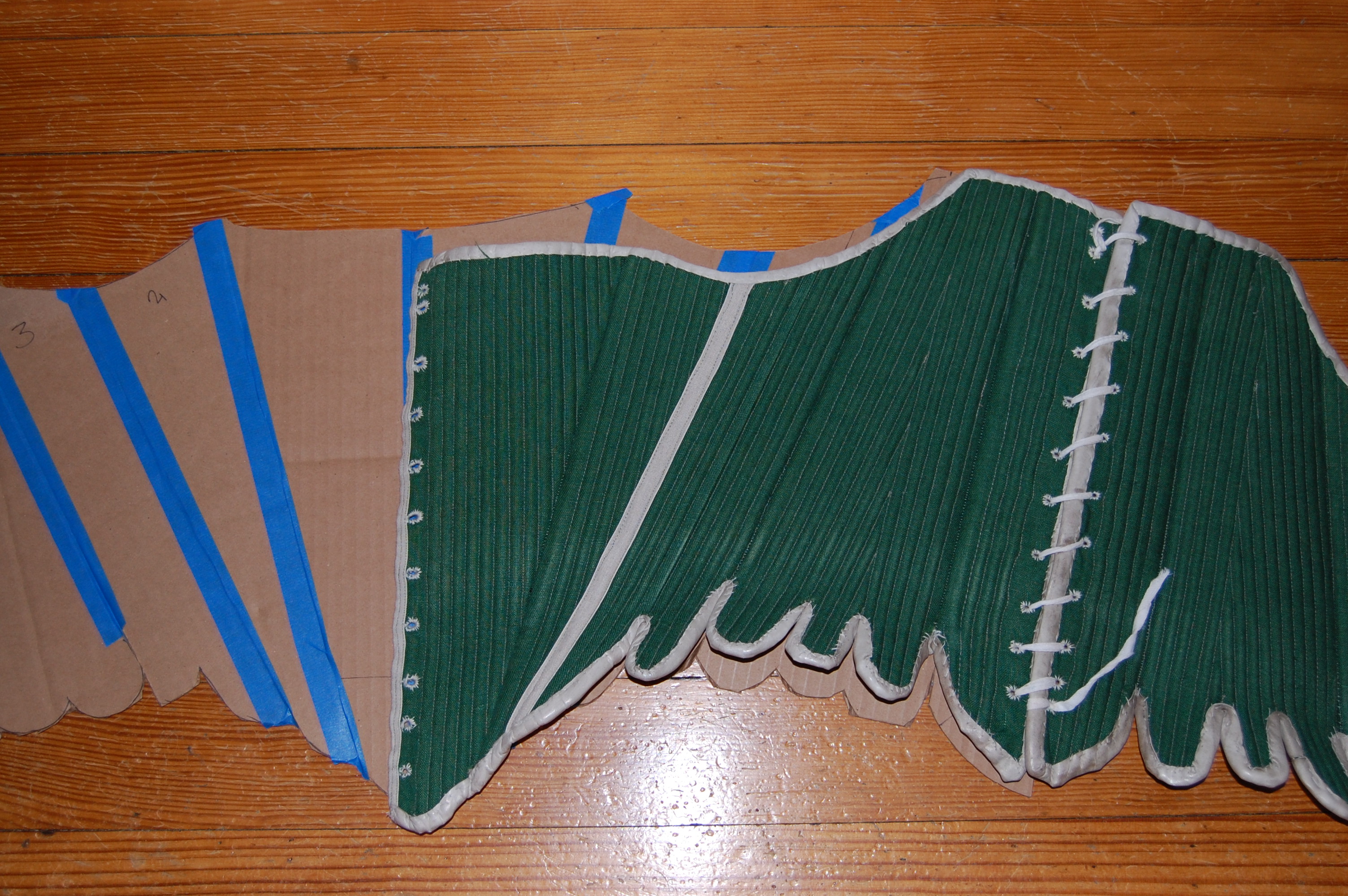
Then I compared the mock up and the stays. Curiouser and worser!
Somehow when I assembled this hot mess, I mis-aligned the pieces,and the fronts are lower than they should be. This explains much about the increasingly poor quality of fit as these slide down my ribcage…as you can imagine, the stays can’t do their job when they’re not in the right place to do their job.
If I am to reclaim these and my decorum, the first step will have to be dis-assembly simply to get the various panels into the their proper places. I think it would be fairly simple to do to the fronts, and then I could end some of the madness by sewing the front panels shut and converting these to back-lacing stays. It might be only a temporary fix, but that alone would be worth the effort. Fortunately, I won’t require these until November 23, and in the meantime, I know which gowns are too big, and need to be smaller. With open fronts, at least they’re pretty adjustable.
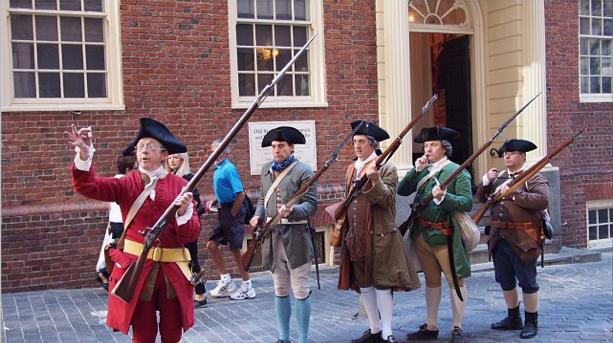
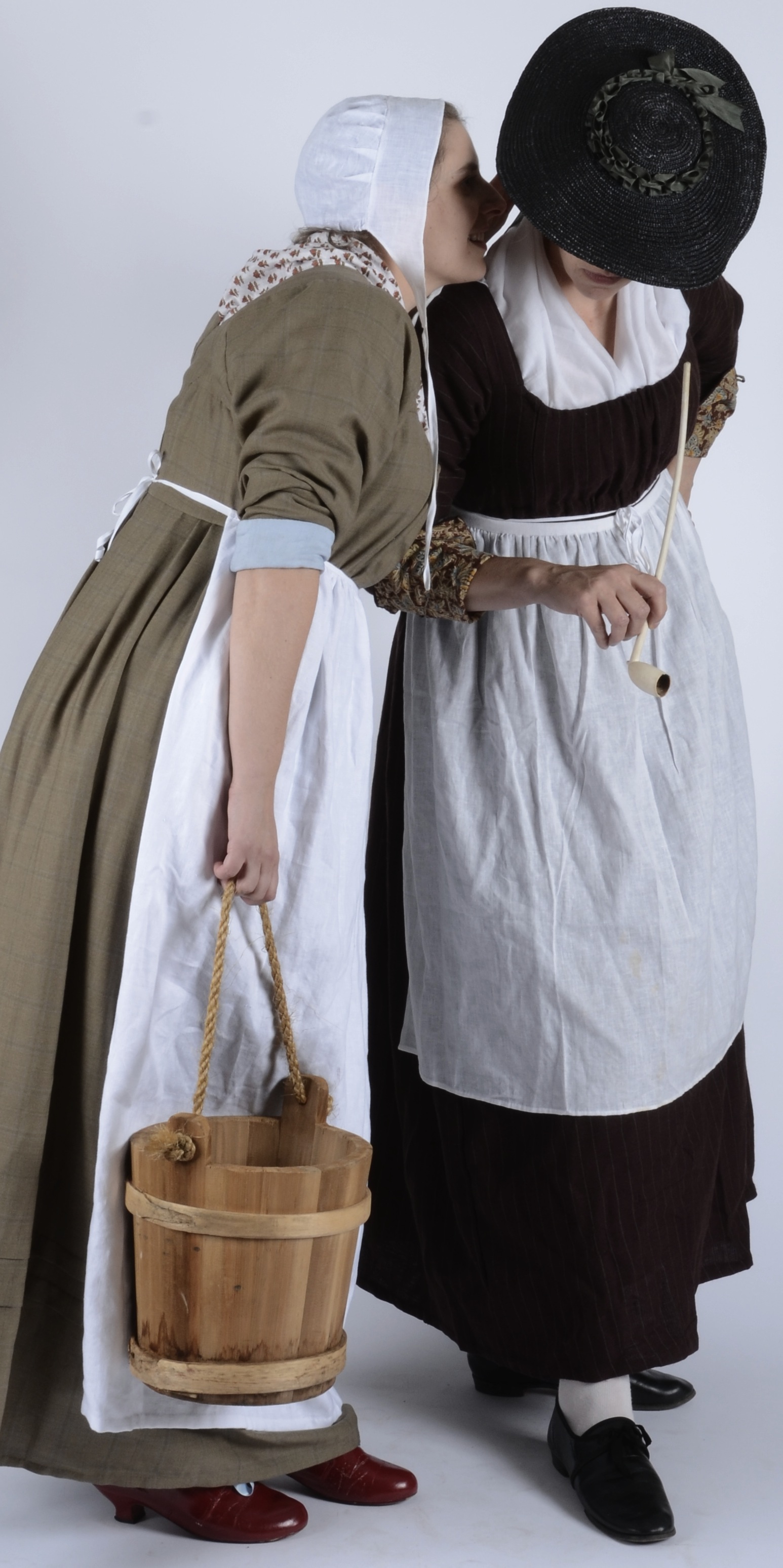
That’s last Saturday, outside the Old State House, for the “People of 1763” event. Sew 18th Century and I provided a material culture/ladies’ clothing presentation in the Hands on History room. The guys drilled outside, had their photos taken, and represented the militia. The Bostonian Society had over 1200 people in the museum last Saturday, which is a pretty respectable number for a small place. It can also leave you feeling somewhat overrun. (All my photos turned out fuzzy: all I had was a shaky hand and my phone. Chalk it up to needing more sleep.)
Gossip!
This coming Saturday is What Cheer Day at the John Brown House Museum, and my sewing and research and house prep continues, if not apace, at a steady pace. Mannequins have been put away, furniture moved, and the accents practiced. By the time we were trying to say, “These are not the droids you’re looking for” with 18th century Maine vowels, we knew it was time to go home. Why this and not “I’ll put the kettle on to boil,” I do not know.
It’s still hard for me to get a handle on my character, and not so much her background as her attitude. I’m not very good at being servile or lady-like, which is why, if I’m still working for the Browns, I must be a relative of some kind.
My husband’s dead; he died in 1788, not long after the Browns moved into their new house; wounded in the Revolution, he never quite recovered and despite the best ministrations of Dr Bowen, Mr S succumbed at last. My son, now 18, was born not long after Mr S returned from the war (Mr S enlisted ‘for 3 years or the war’). Curiously, the chaplain of his regiment is also the pastor at the Congregational church in Providence.
I am a nearly non-observant Anglican, but I recognize Reverend Hitchcock, and know the work he has done in support of free public education. Mr Brown and his brother disagree on many things, but they have at least agreed upon the importance of free public education. My son and I can read, but if Tom had been better educated, perhaps he would not have gone away to sea.
Next I have to think about my cousin from Newport, and the Brown women, and what I think about them.
And there’s still the small matter of sewing two hems, three buttons and three button loops and hoping the whole business will fit properly. At least my friend finished my cap for me. I get just so far, and then I hate caps.
Wow. Yet another learning experience up on the Hudson River this past weekend. It was as up-and-down a weekend as the rutted field in which we were camped, where walking felt more like swimming over the ground, and social calls were well nigh impossible. Also, we had considerable wind. By Sunday, Mrs P said we should feel grateful we never camp with a dining fly, because we knew it was wrong to feel smug that we hadn’t had to chase a fly down. Yes, every possible pun of “fly” got an outing.
The Coats, Grouped Around their Colors, Prepare for Action.
The coats turned out quite well, and there would have been one for the Young Mr if only I had not spent the past two weeks on a petticoat and patterning a gown for What Cheer Day at work. I have some regrets about that, just because they looked so very well in those unusual coats. They weren’t just a fashion statement, either: I know Mr Cooke answered a lot of questions about them, and I did, too (women ask women about the guys…). They’re a really good interpretive hook to talk about supplying the troops, and the differences in uniforms over time, and the kinds of documents historians and costume historians use in their work. Also, those coats are just plain handsome.
Down in the corner, in a lovely white gown, holding her hat on head, is Cassidy. The wind was hard on headwear.
The Battle, well, there was chaos on the public side of the battlefield, and it was difficult to see. The wrenching ground made visiting difficult (and we don’t have much of a parlor in our camp) so I did get to meet Cassidy in person but not much more.
Mr S, the Young Mr and I were grateful for Mr H’s excellent assistance with the fire.
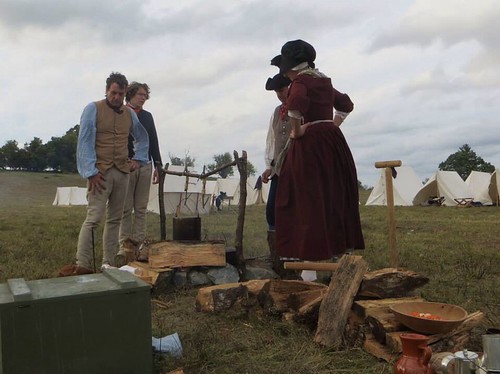
My friend Mrs H and her husband, Mr H, and I walked back from the battlefield to work on dinner. I’m not sure what we’re contemplating here, but the kettle is on and we’re thinking about something (probably what to add next).
As you can see in the photo, we had no iron “s” hooks. I don’t know what box they’re in, but they weren’t in the kitchen box. Mr FC made us hooks from branches he discovered on the way back from his car. They held up well, and were even better and more authentic than the “s” hooks would have been. With this, we were all delighted and not at all smug.
After dinner and washing up, we participated in the hospital vignette for the public tours. (By ‘participate,’ I do sort of mean ‘first person bombed’ the scenario.) In working this out, the Adjutant wondered which of the men was the smallest and lightest. His first thought was the Young Mr, but Mr S and I soon disabused him of that notion, and after I said, “It’s you, Mr C,” and we determined that even skinny Mr S was 5 pounds heavier than Mr C, we had our victim: Mr C. He became the wounded captain carried up by Mr S, the Young Mr, Mr FC and Mr McC on a litter made from a tent and poles. I carried the lantern.
At the hospital tent, we demanded attention for our wounded captain, who had taken shot in the groin, ‘near the back.’ (We covered the wound with a coat.) The men and I were insistent upon the Captain receiving attention, despite the enlisted men requiring attention to their head wounds and amputations. Although he was given laudanum, and the ball removed (ba-thump, yes, we’re here all weekend, tip your waitress), the captain developed a fever. We demanded rum and water, but he vomited upon the very noisy private with a head wound, while down the line another private cried out, “Why, captain? Why did you do this to us?”
After he vomited, the captain’s delirium increased, and the doctor bled him. He called for his wife, and reached for me, though I am but the lowly woman with the army. I held his hand and stroked his head to ease his passing while he talked of his wife and his son, “with the angels now.” After he died, the men were summoned again to remove him from the hospital and they carried him away.
Ready to leave with the entire kitchen on my back and in my hands.
The captain’s story may have been too quiet and subtle for the public to see in the dark, but around us nurses and doctors were busy and patients were yelling, and the scene presented was one of chaos and misery (and some humor). I’ll have to analyze it more later, because there’s a strand for the reenactors and another for the public and it’s hard, sometimes, to know if they combine satisfactorily for all. I know we were pleased with our dying captain, and the boundaries it pushed for those of us newer to the first person world.
On Sunday–well, less said the better, perhaps–some of us failed to eat or drink enough and felt quite ill until mid-morning and a second cup of coffee. It’s a lesson in having protein bars stashed in pockets and haversacks, and in how wretched the soldiers and women must have felt, and how limited their decision-making capacities. That’s the argument for officers getting better food and accommodations: they make the decisions, so they need fuel and rest for their brains. The rest of us just go where we’re told.





 Kirsten Hammerstrom
You must be logged in to post a comment.