Female court martial : held upon the conduct of an admirable lady. [London? : s.n., 1757] Lewis Walpole Digital Library 757.03.00.04+
Everything I think I know about courts-martial I learned from the movies (The Caine Mutiny and Breaker Morant, or Paths of Glory) but thankfully I can realize that knowledge is probably not so applicable to Bridget and her context.
Thanks to Yale, it’s easy enough to find the Rules and Orders for the Continental Army, as set down by the Continental Congress in 1775. I don’t have to know this, the guys know it, but it’s helpful for me to understand what’s happening. I also figure Bridget would have known how the system worked (or should have) since she was part of it, and would have observed life around her. In the same way that I understand the organizational politics and policies of my workplace, she and the soldiers would have understood the rules and regulations under which they lived and worked.
“Art. XV. Whatsoever non-commissioned officer or soldier, shall be convicted, at a regimental court-martial, of having sold, or designedly, or through neglect, wasted the ammunition, arms, or provisions, or other military stores, delivered out to him, to be employed in the service of this Continent, shall, if an officer, be reduced to a private centinel; and if a private soldier, shall suffer such punishment as shall be ordered by a regimental court-martial.”
There you have it: they sold provisions or “other military stores” delivered to them to be employed in the service of the Continent, and suffered such punishments as were ordered.
And Bridget? Well, for one thing, she should have known she was subject to the articles, rules, and regulations. She was one of those “all persons whatsoever.”
“Art. XXXII. All suttlers and retailers to a camp, and all persons whatsoever, serving with the continental army in the field, though not inlisted soldiers, are to be subject to the articles, rules, and regulations of the continental army.”
Technically, I cannot find anything stating outright that one could not buy issued goods from the soldiers to whom it had been issued, but since selling it was wrong, receiving was wrong, too.
We know from the final punishment that Bridget probably breaks yet another article:
“Art. XL. No person whatsoever shall use menacing words, signs, or gestures in the presence of a court-martial then sitting, or shall cause any disorder or riot, so as to disturb their proceeding, on the penalty of being punished at the discretion of the said court-martial.”
I think the “the Insolence to the officers of [the 10th Massachusetts] Regiment” may have taken place at the court-martial, given the swiftness of her punishment.
On Saturday last, we were delighted to attend a long-anticipated and much delayed birthday celebration for George Washington, combined with a quarterly unit meeting and workshop. We are multi-taskers, because it is pretty easy to talk and sew, and talk and eat, though sewing and eating is more challenging and potentially more dangerous.
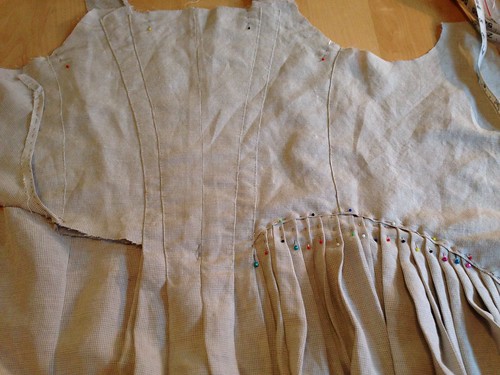
I got some progress made on Bridget’s gown, Mr S started a knapsack, the Young Mr played video games with the other boys and they all took the adjutant’s dog for many walks. Our hosts have a very neat house with fireplaces that work, and a bee hive oven that works (those of us who live with Don Draper’s Ossining kitchen may be jealous) so are able to cook in an accurate and delicious manner.
Bridget’s dress, in process.
Honestly, I don’t know where all the food came from: I would not have thought the kitchen could hold so much, as I do not think ours could! Roast chicken, fish cakes, carrot pudding (of which I am quite fond), brown bread and beans, turnip sauce, more bread of a different recipe, a chocolate torte, onions and apples, and surely more things I have forgotten.
We had a lovely time, talked about a lot of things, and came home well-fed. On Wednesday, I made ‘buttered onions another way,’ since the Young Mr deigned to eat it, and thought it would be delicious another time. Apples and onions go well with pork, and someday, when I have time, I’ll try Indian pudding. Just because I have a 1960s kitchen with all-electric appliances doesn’t mean I can’t try.
Interpretation: I’ve been thinking about it a lot lately, reducing it to basics. Beverly Serrel challenges exhibit designers to articulate the one Big Idea about their work; one sentence that describes what your exhibition is about. I’ve been thinking about the Big Ideas for some upcoming exhibitions and programs at work, and in my personal work.
Some seem easy: Slavery in Rhode Island: Everyone was involved, everyone is connected. Slavery is part of our shared past. We are all part of the web of complicity. (Pick one, they’re all related.)
For the house museum, and the living history day at the house museum, it’s a little more complicated. We tried an involved story line last year and it didn’t seem to matter to visitors who were mostly intrigued by watching pretty costumes in a pretty house.
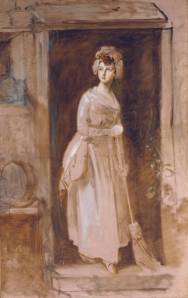
Thomas Gainsborough, The Housemaid. 1782-86. Tate Museum, Presented by Rosalind, Countess of Carlisle 1913, N02928
What I’ve settled on for now is a crude variation of “it takes a village,” in that a complex web of food and support networks was necessary to sustain an elegant 18th century mansion. (Our theme this year is Rhode Island Seascape and Landscapes, AKA Surf & Turf.) I begin to imagine diagrams that support that theory: small holding farmers and dairymen and fishermen who sold supplies to the wealthy, the merchants importing goods, the sailors and captains and shipbuilders needed to bring the barrels of china, boxes of sweets and tea and nankeens back to Rhode Island to support the scenes of elegant perched at the very top of the social pyramid.
Then I come to my personal interpretation and Bridget Connor. What is that story about? A Bridget with a troubled past and nothing left to lose? Poor women struggled to survive in an unstable war economy? Or simply that not everyone in the Revolution was a hero?



![Female court martial : held upon the conduct of an admirable lady. [London? : s.n., 1757] Lewis Walpole Digital Library 757.03.00.04+](https://kirstenhammerstrom.com/wp-content/uploads/2023/03/9cfa8-femalecourtmartial1.jpg?w=640)

 Kirsten Hammerstrom
You must be logged in to post a comment.