Coat Tales

Coat pattern version 3

As the Salem Maritime Festival approaches, my anxiety increases.

Whatever will those ‘gentlemen’ wear? Coats and waistcoats, and thank goodness I finished the Young Mr’s shirt and his farm trousers still fit. He has promised to be a very annoying runaway apprentice, and I have promised to chase him from the miilliners’ shop with a broom, but before any of that can happen, ‘gentlemen’ will need new waistcoats and coats.

I got out Fitting and Proper, and took a look at that coatee pattern. It’s a little earlier than I want, so I also looked at The Cut of Men’s Clothes. In truth, I did not draft up a pattern from scratch. I had a commercially available pattern that I’d purchased when it first came out, one that purported to be historically correct, researched, and came from a reputable company.

Toile number 3. One more fitting to go...
Toile number 3. One more fitting to go…

Well…so I guess the issue with the pattern is that the gentlemen in my household are not of the typically boxy build one may see streaming past tourist sites in Boston, or even lumbering across a field in historical uniforms. My gentlemen are built for the Light Infantry, so when I finished the first muslin (or toile) of the coat and fitted it to Mr S, I removed inches–yes, inches–of material along the side and center back.

I suspected this would be necessary when I first traced the pattern pieces, but went ahead because you really have to mark up a toile on the body in question to get the fit correct. Maybe it’s just this many toiles because I’m inexperienced.

Center back pattern, version 3

In any case, the armscye and upper shoulder seam were re-drafted, the drape and sweep of the tails, the width of both side and center tails, the side seam of the body, and both seams on the center back piece, which originally had a flat center back seam (I ask you!), a shorter shoulder seam, and a different side seam.

I’ve left the tail length short and after toile number 4, will mark the final tail length for both gentlemen (luckily we are at a sweet spot where this fits Mr S well and the Young Mr passably, so that with minor adjustments for the lad, a second coat could be made at some time).

I still don’t believe the tail pleats entirely, but lack the time this week to draw them from an original. They still seem too wide, though I have taken an inch or more off every tail edge.

The last thing to really wrangle, after bringing the under arm seam back up, is the sleeve; the upper arm is too long, reflecting the fact that the basis for this sleeve is my Spencer sleeve, which traces its origin to Mr Cooke’s linen suit coat pattern. Both Mr S and the Young Mr have shorter humeri and femora, which put the elbow crook on their forearms which looked rather silly and uncomfortable.

In the end, the pattern I had proved useful only in saving me from the math of enlarging a pattern from a book– it got me full-scale immediately, so that I could proceed to fitting–but this project will, when it finished, reflect multiple fittings and four pattern drafts.

If there is a moral to this story, it is this: Almost nothing will fit straight out of the book or the envelope, so leave plenty of time for catching your subject and fitting muslins.

Another moral may be, “Buy muslin in bulk,” which I did thanks to a clearance sale. I’ve already used 2 yards off the bolt I bought Saturday afternoon.

Frivolous Friday: Footwear

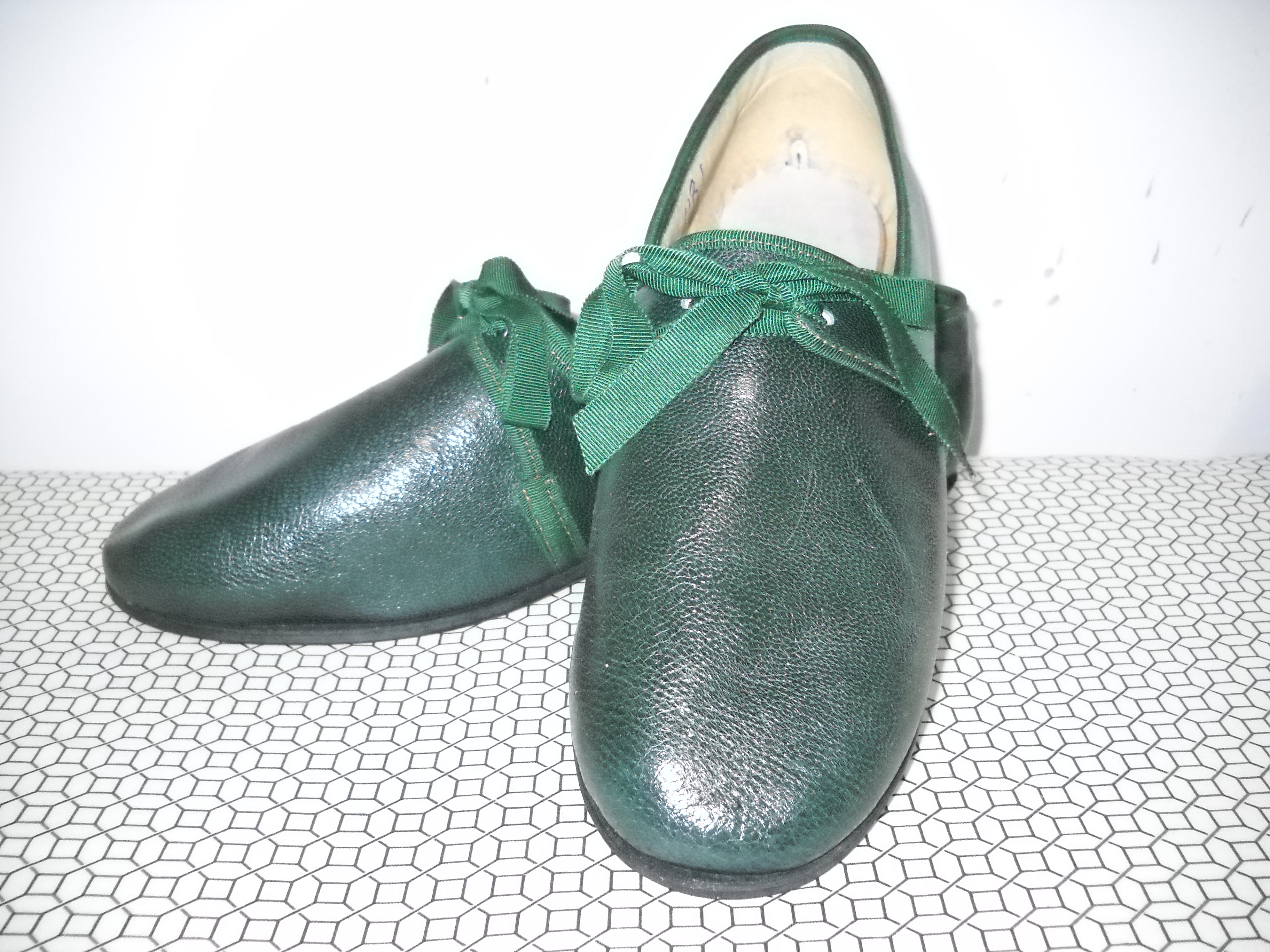
Shoes, 1810-1820. Gift of Miss M. Lee. T.385&A-1960, Victoria & Albert Museum.

Like my grandmother, I love shoes. Also like my grandmother, I have “problem feet.” Finding a pleasing ladies’ shoe in a size 11 narrow is no mean trick, and with arthritis and activity, fit becomes ever more important. Standing all day in ill-fitting shoes will not improve your ability to interact with the public in a pleasant way, nor will it improve your stamina, which you will need if you are cooking for a motley assortment of ‘gentlemen.’

Many reproduction historic shoes (and most contemporary shoes) just don’t fit me, so I can’t order from common suppliers and I can’t alter affordable fashion shoes. Like Cinderella’s stepsisters, the shoes don’t fit.

Robert Land's Regency Lady's Shoe
Robert Land’s Regency Lady’s Shoe

That means that sometimes my shoes are not quite-quite correct. For 1799-1800 events, I wear Robert Land’s 1812 shoe, which is modeled on a shoe in the V&A collection. I find Land’s lasts are long and narrow, he makes my size, and lo and behold! Last time I ordered, the shoes arrived in four weeks. My mileage has varied in that regard, and yours may, too. They aren’t cheap, but they are well-made, straight-lasted, and most importantly, they fit. (I’ve been wearing them to work this week, because their flatness is more comfortable than my modern shoes.)

Shoes, 1810-1829. Probably British. MMA 2009.300.1471a–d

Do I wish they came in silk? Yes. Do I wish he’d make ladies’ 18th century shoes? Yes. But I have a workaround for the 18th century that I debuted on Flag Day: Mules. They won’t work for every event– I don’t think these are the shoes for climbing Stony Point in July–but they have their benefits. For one thing, you can take them off. Barefoot is best (maybe not in Boston), and not having to wear stockings when it’s 80+ degrees is nice, though only permissible if you’re named Bridget and have a shirt problem.

Burnley & Trowbridge men's mules
Burnley & Trowbridge men’s mules

Burnley & Trowbridge shoes also run narrow, and their men’s mules work for me, because I like a very low, flat heel. In winter, wool stockings make up any size differential, and in summer, these flats are pretty comfortable and even walkable. They may not be perfectly correct (though documented here), but comfort plus documentation goes a long way in my book.

What I’d really like, at least for late War interpretations, are a pair of these red velvet shoes at the MFA. Latchets for buckles, low heels, and they’re red? While I wonder about the date, the features I like might outweigh any misgivings– except that I cannot afford Sarah Juniper‘s work, and I can’t make my own shoes (yet).

Pair of women’s shoes, 1780s. MFA Boston, 44.493a-b

Musical Monday: Chester

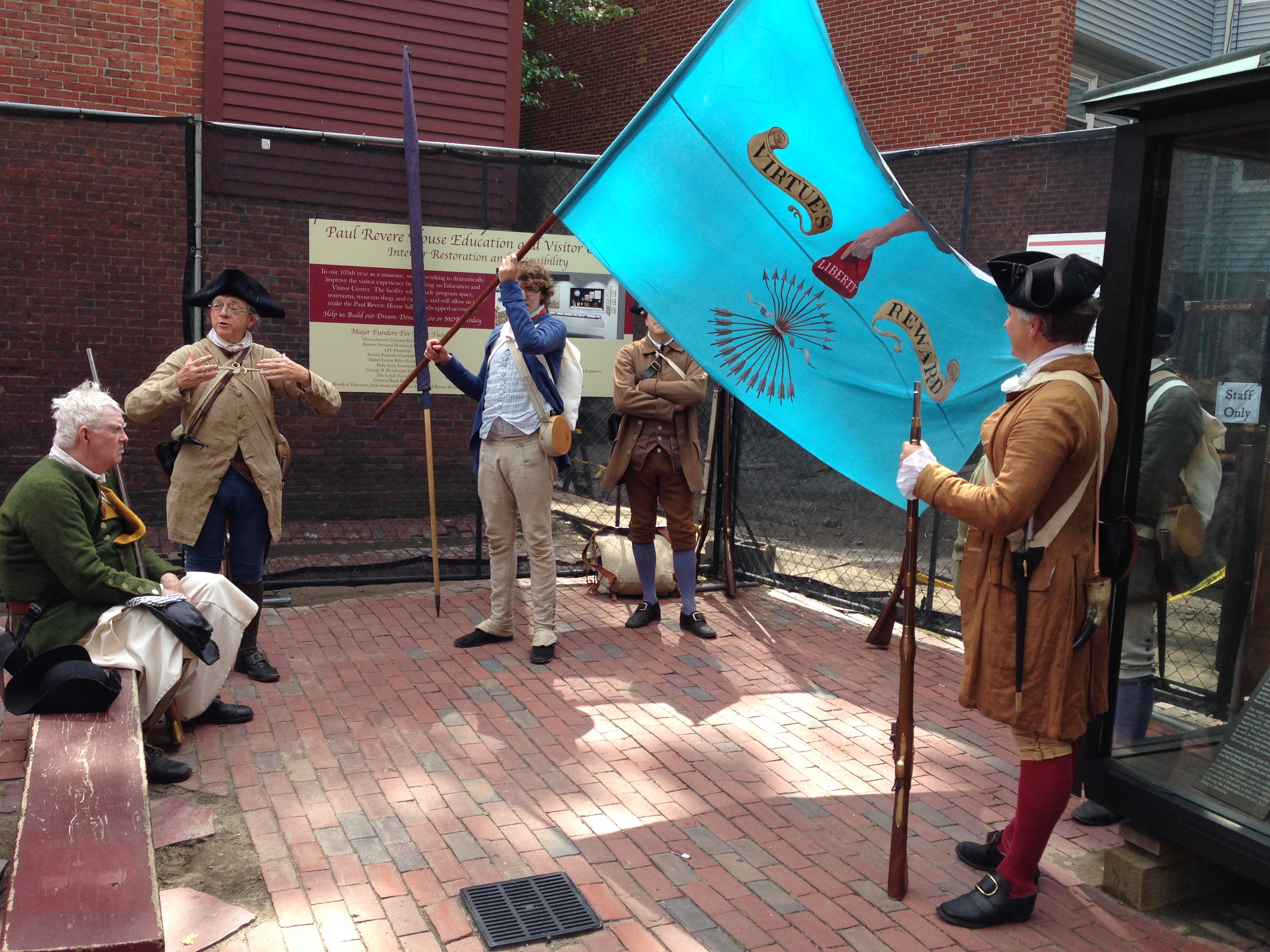
Virtue Rewarded
Virtue Rewarded

Saturday was Flag Day, but you knew that, right? There are a lot of holidays we no longer pay much attention to, from Armed Forces Day (when Mr S and I once hosted a very amazing and lengthy party in an 1870s brick row house in St. Louis) to Arbor Day to Flag Day.

To celebrate the Bicentennial of the Star Spangled Banner, the Paul Revere House asked us (which means Mr HC) to lead the visitors in the national anthem. “Never miss an educational opportunity” could be one of the 10th Massachusetts’ mottoes, so with the regimental colors unfurled, the time was right to lead the assembled company in a rendition of Chester, written in 1770 and perfected in 1778 by William Billings, and the song to which the men are accustomed to march. (It is also the song mostly likely to play accidentally on my phone while it’s in my pocket.)

So here they are, the 10th Massachusetts and Members of the Publick, led in Chester by Mr Cooke.


As mentioned elsewhere, it is nearly impossible to read and sing simultaneously. It is also clear that we do not generally sing in our daily lives, or not nearly as often as people did in the past. Most of us think we have awful voices and refuse to sing, though we endure singing in school, or did. It’s an art that we should enjoy more and more often. You don’t have to be Idina Menzel to please the right audience (in my case, some cats).

History is Not a Competition

IMG_1583
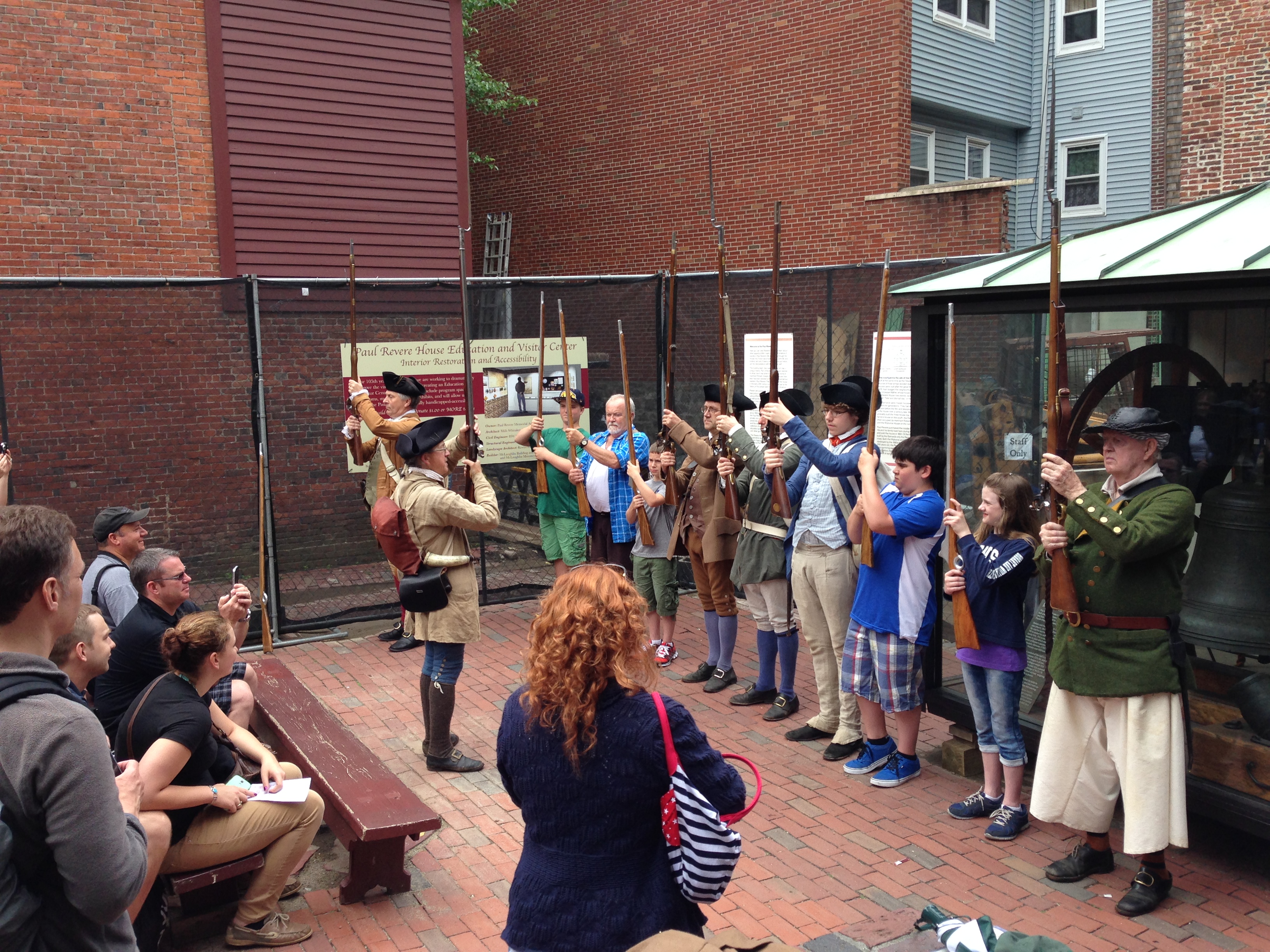
Drilling by the Sergeant

Saturday was my first post-operative foray into costumed interpretation, up to Paul Revere House on Flag Day. This went much better than my first attempt at Paul Revere House, which ended in ignominy as I missed the train. In April, I managed to convince Mr S to drive in Boston, which he usually refuses to do (in fact, he nearly abandoned me once at the Old State House one Saturday after a miserable drive that had us stuck in the Downtown Crossing vortex).

I’m so glad we managed this, Despite anticipatory near-tears and epic pouting by the Young Mr, we managed to have a rather nice time.

Poise, with extra elevation by the Young Mr

We were in the courtyard, and Mr HC and Mr FC told the story of Amasa Soper’s company and its members several times to the streams of tourists. They solicited recruits and ran them through the 1764 drill using the nicest wooden muskets I’ve ever seen, though with mixed results. Some new volunteers held their muskets backwards, and the Young Mr’s ramrod got stuck in the barrel, though that is a known issue with that particular musket.

I sat on my ladder-back chair near the house and made the tiniest hems I could on Mr S’s next shirt, which will be for best. People asked about the sewing and my clothes, and I had a chance to talk about what women wore, typical fabrics and fibres, supplying the army, and who made what.

The day was warm, but fortunately not overwhelming, and as a museum person, I found the crowd quite interesting. This is a facet of Boston I don’t usually see: the tourist experience.

In one memorable moment, a pair of young women stood just outside the door to the house.
Young Woman Number One: “Is this really his house?”
Young Woman Number Two: “Yes, this is where Paul Revere lived.”
YWNO: “Oh, my God! I’m so excited! This is so neat!”
Kitty Calash: <eats heart out with jealousy> “Why can’t my museum do that?”

The celebrity factor of Paul Revere is undeniable. There were tourists with guide sheets in Chinese, and tourists who made me wish I still remembered my college German. Some seemed to be hitting every Boston landmark they could in one day, carrying white cardboard pastry boxes; some seemed to be going more slowly, looking, and trying to figure out what they were seeing, and what it meant.

Virtue Rewarded
Virtue Rewarded

What living history means is something I’ve been thinking about lately, or trying to. It’s tangled up with questions of authenticity and appropriateness, but what I learned on Saturday, or re-learned, was how very happy this business makes me. I like history, and historic costume. It doesn’t matter to me if we are talking Revolutionary War or New Republic or Lewis and Clark.

My favorite visitors were a mother and daughter from Steamboat Springs, Colorado, visiting Boston for the first time with a young man from New Hampshire. The mother said, “There’s so much more history here than where we’re from. Our town’s only 100 years old.”

That’s a challenge I’m always ready for, so I asked where they were from. Colorado to me means Native American settlements reaching back a thousand years, Spanish explorers and conquistadors, French, and then American, fur traders. It means hundreds of years of history, and a chance to remind people this isn’t a competition for “oldest” or “mostest.”

Knowing where our country came from is important: so yes, please visit Boston, and Paul Revere House, and Providence and Newport, too! But knowing where you are is just as important. There’s history all around you, and your local historical site, society and museum would love to tell you about it.