Replication and Responsibility

Detail, the John Miner Coat, Stonington Historical Society, 2009.120.001

If I examine and exactly replicate a coat for personal use, what do I owe the museum that owns that coat– anything? I think I owe the museum any information I can share that will improve their records and help build a research file for the future.* I also think I owe them copies of the images I may take, and with digital images, that’s now incredibly easy.

But if I replicate this coat (shoulder intact) for Mr S or the Young Mr, should I give the coat to the Stonington Historical Society when we are done with it? SHS thinks I probably should, but as someone who manages collections, how many replicas do I want, and what standards do I use to judge them?

I think the best course of action is for museums to make patterns of popular or often-requested garments available for purchase, so that anyone who wants to make a replica has all the data they need. Short of that– and funds are often short for that– catalog records with as many measurements and as complete a description as possible will allow dedicated tailors and stitchers to get as close as possible to original garments.

True replicas involve recreating fabrics and using period techniques, and matching a garment measurement to measurement– and in the case of the Miner coat, there is no way to replicate its history. And the amount of work and expertise that would go into a true replica of any historic garment seems enormous– it would constitute a large donation to the museum, even if the garment had been worn.

*For those of you reading the caption on the Miner coat, yes, it needs work, and yes, SHS knows there are problems with that description. I promised to help them with their catalog record.

A Trip to Stonington

The view from Stonington Point

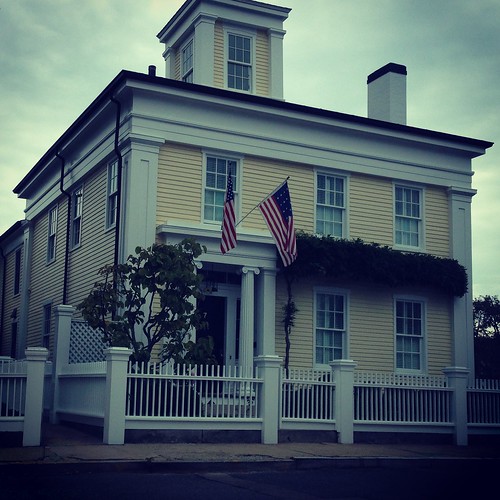
On Tuesday, I drove down to Stonington, CT to visit the Stonington Historical Society’s Lighthouse Museum and look at a coat. Stonington was beautiful as ever, smelling of the ocean and money, and the little Lighthouse Museum was nicely done.

The coat did not disappoint.

It is a truly amazing artifact, having survived despite pretty incredible events. The donor wrote a letter about the coat when he gave it to the SHS in 1914:
“I have heard my father say due to the haste and excitement of the volunteers they failed to properly cool their gun before pouring into its muzzle the powder, which due to the excessive heat of the gun caused the powder to explode prematurely, as you may see by reference to the coat—burned and torn upon the neck and shoulder.” (Coat and letter, Stonington Historical Society, 2009.120.001).

Stonington, CT

As beautiful as the town of Stonington may be, and as much money as there may be on the Connecticut coast, the SHS has a small budget and must use its funds wisely. We had an interesting conversation about the reenactors and museum collections, and what responsibility historical costumers have to the collections that hold clothes they replicate.

Half Robe or Jacket: How Do You Wear One?

Half robe, 1790-1800. National Trust Inventory Number 1348749,
Half robe, 1790-1800.
National Trust Inventory Number 1348749,

What Cheer Day is coming, and I hate to miss an opportunity to make a new gown (despite having just made one, and despite needing to make some waistcoats and trousers for the event). While I lay awake last night, I pondered my options, and whether a half gown would be suitable.

Although I have concluded it probably is not, I was curious about how these should be worn. Where can you wear such a garment? Is it only suitable for at-home use?

This is the robe from Nancy Bradfield’s Costume in Detail, replicated by Koshka the Cat here, and approximately by me, here.

Since I will be a housekeeper again, I think a gown is more correct for me, but that doesn’t stop me thinking about half robes, and whilst scrolling images by year at the Yale Center for British Art, I found this by Cruikshank:

ladies in a lending library
Isaac Cruikshank, 1756–1810, British, The Lending Library, between 1800 and 1811, Watercolor, black ink and brown ink on medium, lightly textured, beige wove paper, Yale Center for British Art, Paul Mellon Collection

There’s a lot to love in this image, even with its fuzzy “between 1800 and 1811” date. Not only do we get an array of reading material (Novels, Romance, Sermons, Tales, Voyages & Travels, Plays), we get costume tips and– special bonus– a dog gnawing its leg.

(If you are curious about some of the books in the Library at the John Brown House, check out this tumblr bibliography. I’ve been using it of late, and the representative genres are quite similar to what we see in the Cruikshank.)

We also get a chemisette on the lady at the counter, along with a very dashing hat, a fancy tiered necklace on the lady in pink, who also carries a green…umbrella? Parasol? With just a veil, that seems likelier than the longest reticule ever.

I like our Lady in a Half-Robe and her deep-brimmed bonnet showing curls at her brow. She and her companions show the range of white and not-white clothing seen in early 19th century fashion plates, and the range of head wear, too.

Undress for August, 1799. Museum of London

The last question I’m asking myself, though, is whether the yellow garment is a half-robe or a short pelisse or a jacket. And can you wear a half robe out of doors? And what did the ladies of the period call that garment?

In this fashion plate (featured by Bradfield on page 84, found by me at the Museum of London), the lady on the right is certainly wearing a short upper body garment, and I’d wager that she’s out of doors or headed that way, since she’s carrying a (green) parasol. Bradfield calls her garment a “jacket,” and until I can find the text of the Ladies’ Monthly Museum for August 1799, perhaps that is the term we should use instead.

While two images aren’t a lot of evidence, it does appear possible to wear a half-robe or jacket out of doors for informal visits in clement weather, and finding two is as good a reason as any to look for more.

Malaise or Ennui?

image Hard to say which, but I am ill at ease and dissatisfied with my costuming. You might even call it bratty. But I don’t wanna be like Bridget Connor!

It started the week of the Stamp Act protest, when I felt quite tired of being the shabby, unrefined woman of the regiment and street vendor, and wanted a nice cozy shop like the milliner had. I was also looking forward to being a housekeeper again, and several weeks of moving boxes and volumes with red rot at work had me feeling generally filthy and unappreciated. Bratty.

When in doubt, sew. A new dress can’t help but cheer you up, right?

Well… sort of…

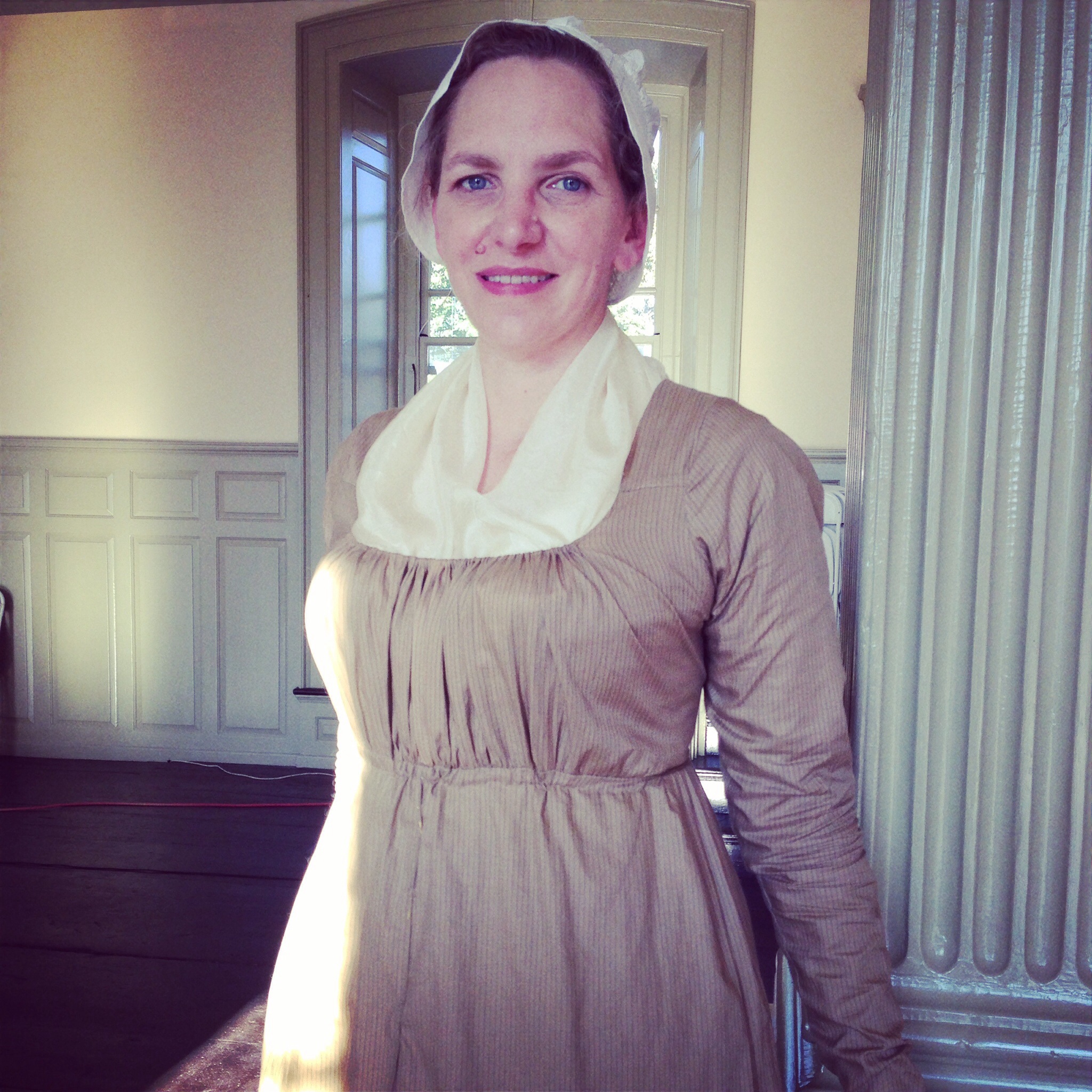
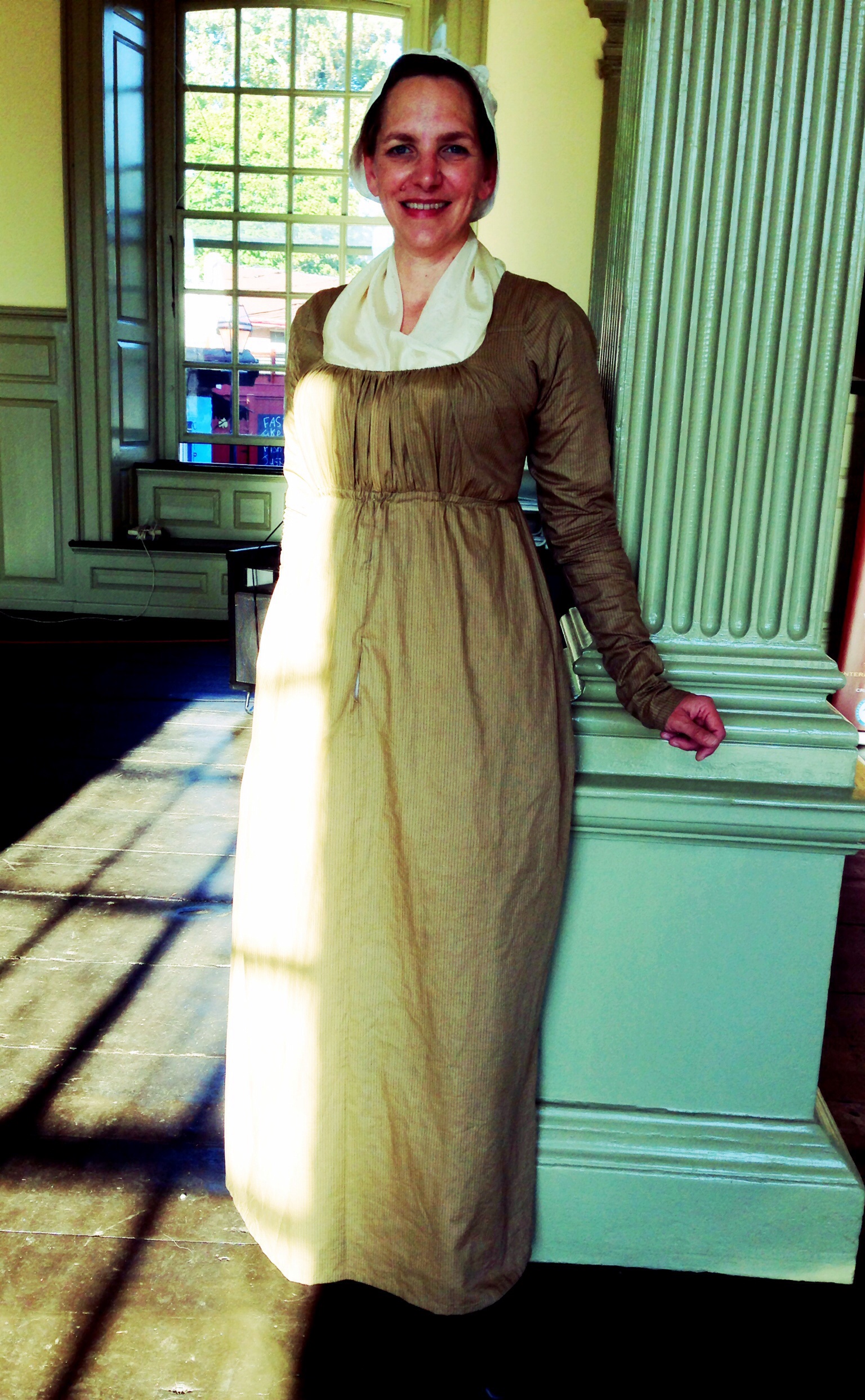
Last Thursday, we did a reprise of the Williams family letters program at the Newport Historical Society. The Williams family were Quakers, and the letters were from the early part of the 19th century, so for the program in March, I made a green silk cross-front gown based on the Quaker gown in the back of Costume in Detail. (Check out the schematic on the 19thus.come page; I didn’t see this until I was mostly done with the dress, but thank goodness I got it right!)

But it’s September, and Thursday was expected to be quite warm, so I salved my bureaucratic wounds in the $1.99 loft at the local mill store, and made a new Quaker gown, also suitable for a maid.

I ask you! Even though it’s my very own pattern based on sketches of original drawings, even though it fits, even though it cost $10, even though every seam is overcast and the whole thing is made with period correct stitches, it still fails to make me happy and cheerful and delighted.

image

This brattiness has resulted in a reappraisal of my approach– and a trip to Sewfisticated in Framingham. What did I buy there? Yards and yards of pink taffeta? Gold taffeta? Blue taffeta?

No.

Because they didn’t have the right colors in the right weave– too slubby– or in enough yardage. Brace yourselves: I bought brown.

Many thanks to Sew 18th Century for taking the photos!

It appears I do not learn from my mistakes. When I think, “Gee, I’d like a pretty dress,” I end up buying fabric based on the texture as much as the color, and I have to tell you, that brown taffeta has the most wonderful l hand and sheen, and I will look much more like a Copley portrait than I ever have before, so that’s something.

It seems I have created a set of mental rules for myself, a mission, if you will, for the historic clothing I sew and the roles I take on, and I only play within those rules.