An Afternoon in N’port

IMG_3041
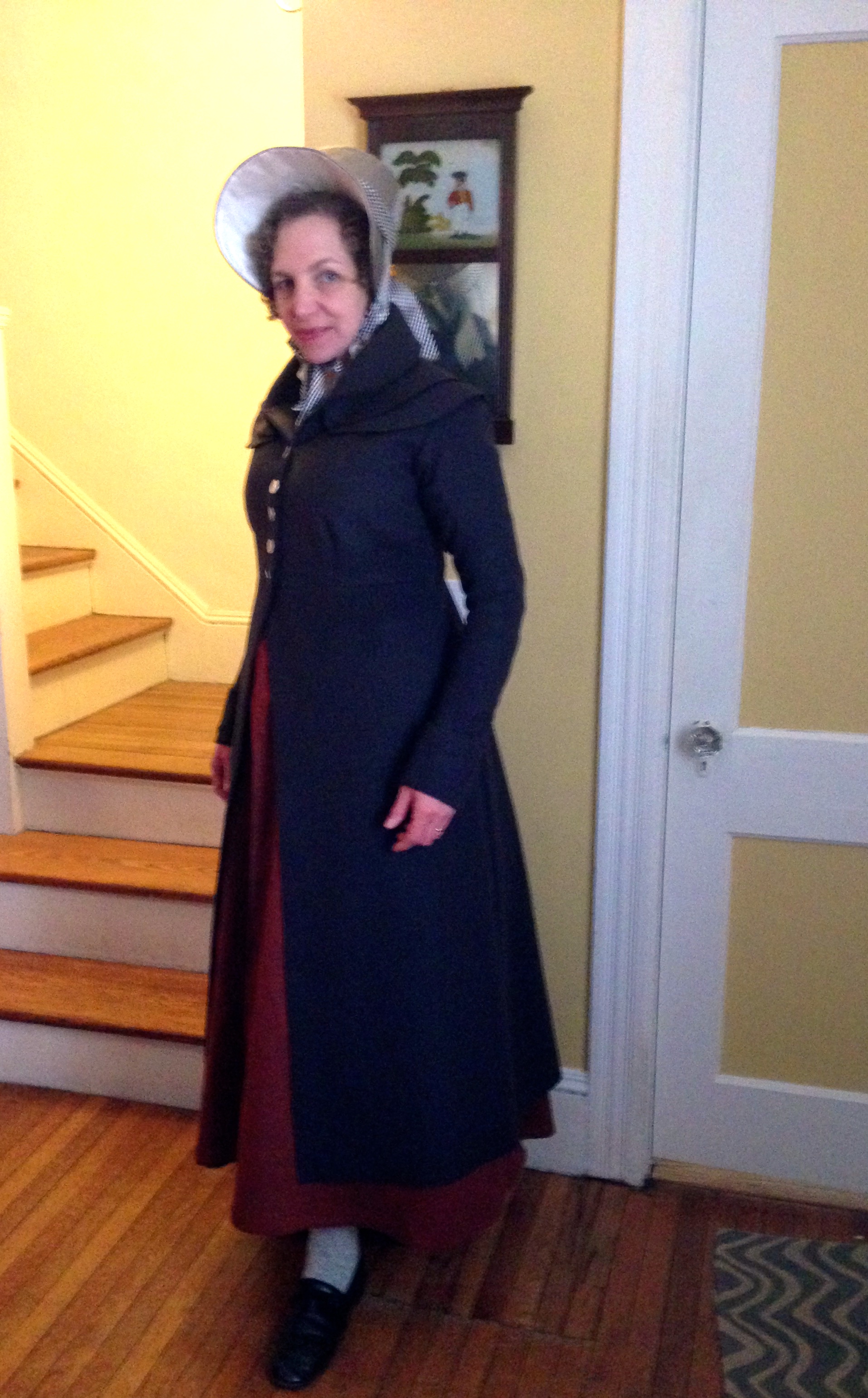
New coat!

I set off for Newport yesterday to spend the day at Whitehorne House with Sew 18th Century. I was pleased to have my coat, and pleased as well to see the ads for “lead colored pelisse cloths” at Nathaniel Sweet’s shop at 112 Cheapside in N’port. Everything fits better when you have some documentation.

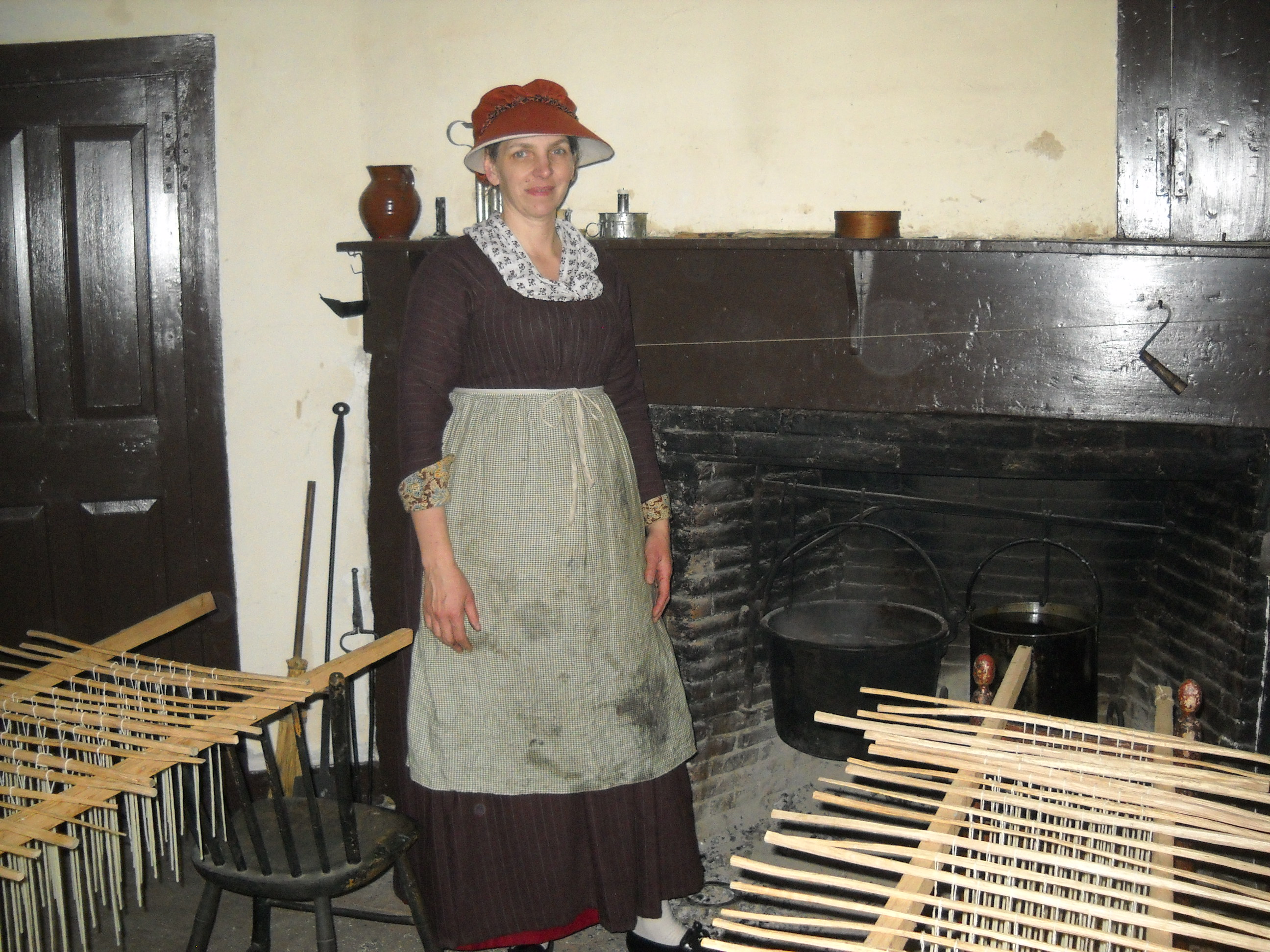
We occupied the kitchen at Whitehorne House, interpreting the lives of mythical maids and cousins Eliza and Kitty Smith.
DSC_0607
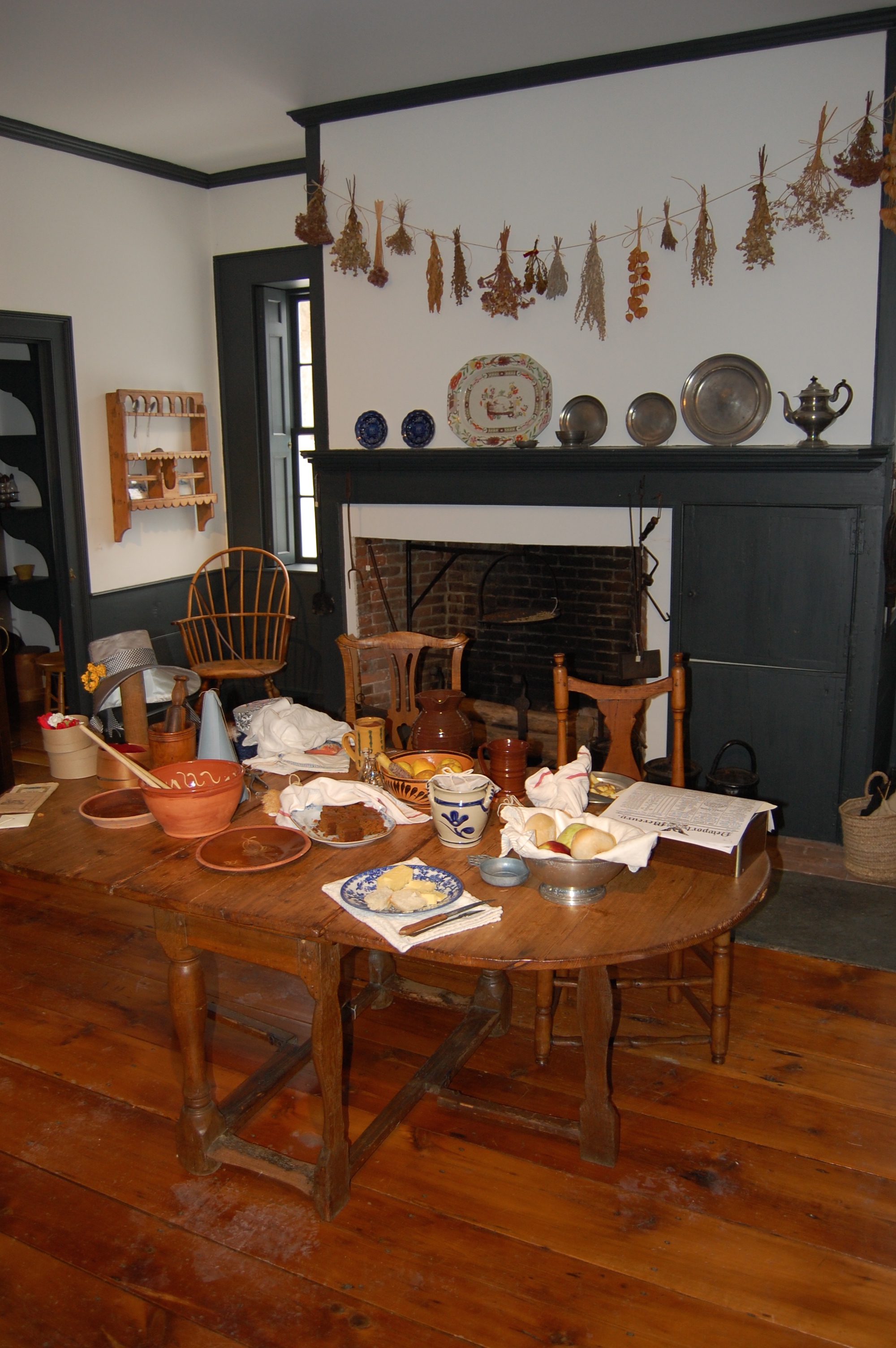
The Whitehorne Kitchen

We hope to save enough to reopen our millinery shop, which flourished once in Salem just a few years ago. Times are hard in Newport, but there are some promising lotteries–a $10,000 prize in the Kennebec Bridge lottery and an incredible $25,000 prize in the New York Literature Lottery! We will have to save our wages to buy even one ticket– difficult to do with so many tempting’ wares in the shop–but the rewards would well worth our efforts.

A shop on Thames Street is to let not far from the Great Friends Meeting House. We think ’tis a fine location, for while Friends may be plain, they are well dress’d. One of our visitors offered to spread the rumor that the shop is haunted, so no one else will rent it, but I worry that such a tale might drive off custom.

DSC_0611
Gingerbread, bread-and-cheese and apples form’d our repast

Visitors called from as far away as New Jersey, New York and Connecticut, but found Mr Whitehorne at the Coffee House and Mrs Whitehorne out makin’ calls. As prominent citizens, they are busy about the town. Mrs Whitehorne is well-known for her receipts, and we were pleased to offer callers a sample of her fruited gingerbread. Indeed, ’tis delicious, though not as sticky as the late Mr S preferred.

Some visitors thought our plan to invest in woolen mills was a fine idea, and in addition to the mills on the island (there is one in Portsmouth), we hear there are several in Hartford. Providence has not the monopoly on industry she imagines.
DSC_0615
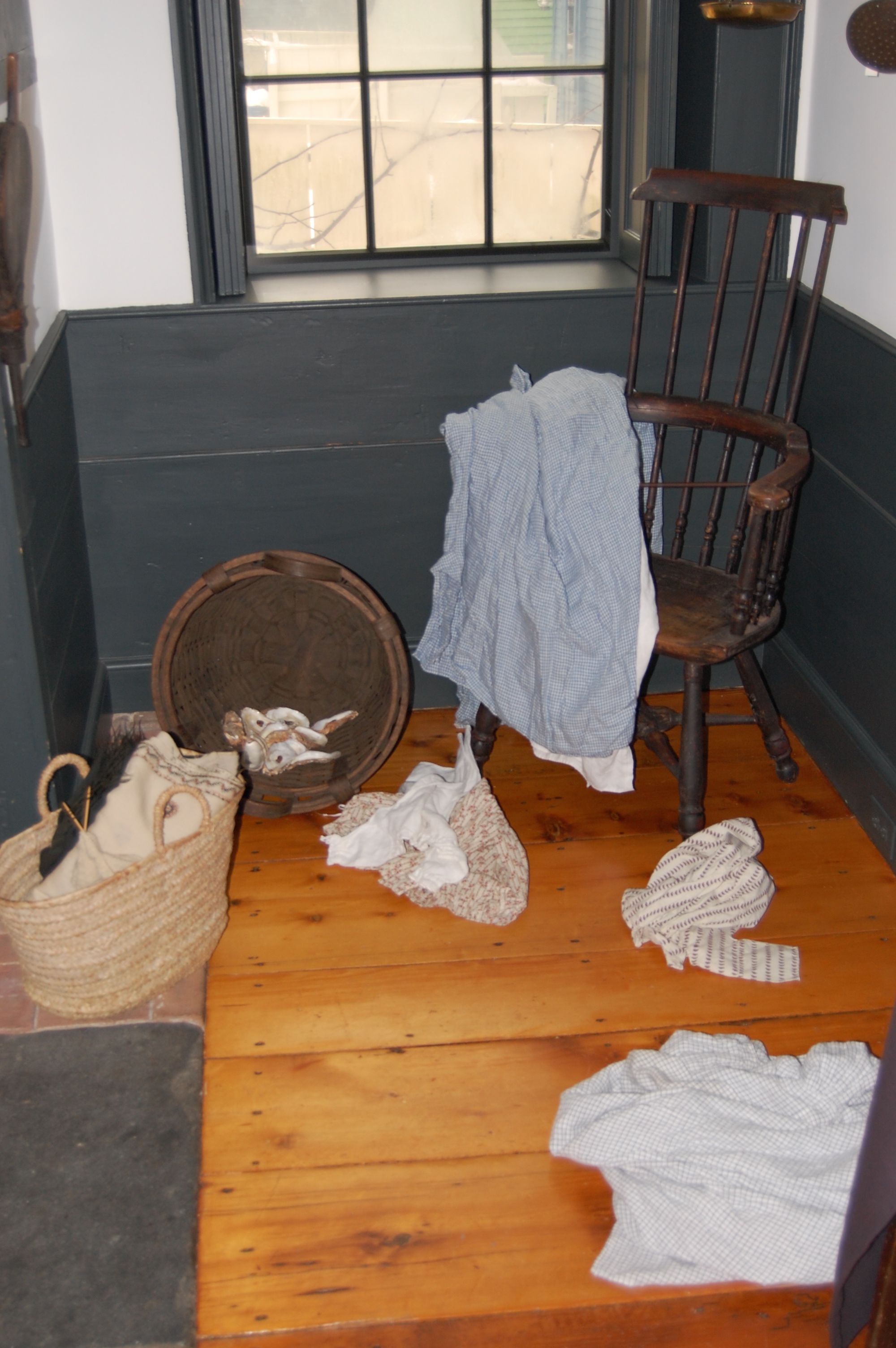
There is much washin’ and mendin’

The laundry does pile up in a household of seven children, and since we have run out of wood, I suspect the laundress has as well. The island is short of lumber now, and wood must come from Swansea. Still, there is always mending’ to be done.

Perhaps if we had known how many visitors would call, I might have taken more care in tidyin’ up the kitchen. ‘Twas a surprise to see so many, from so far away, but we do think N’port is due for a revival. ‘Tis a busier day of visitin’ than I was accustomed to in winter at the farm on Poppasquash Neck, but with Mr Smith now dead, and our lad on a brig in the coastal trade, we could not keep the lease. I am grateful to my cousin for helpin’ me find work in such a lovely house.

IMG_3043

Frocks Coats in Providence

Saturday last saw the launch of History Space, the collaborative project of the Rhode Island Historical Society and the Newport Historical Society designed to help living history practitioners and reenactors acquire the clothing and skills needed to bring the past to life.

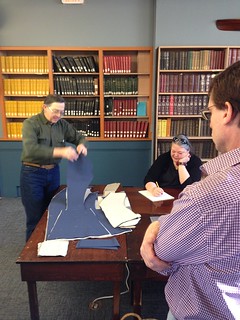
Many parts to a frock coat.

Scheduling being what it is, we plunged right in to hands-on work with Easy Grace and Comfort, a two-day man’s frock coat workshop with Henry Cooke. We saved enormous amounts of time in the workshop by having Mr Cooke cut coat kits for participants, and I know it was well worth every penny.

There is much less on-body fitting when Mr Cooke cuts a coat for the kid than when I do. (I think the Young Mr grows while I am trying to figure it out, but Henry cuts fast enough to head him off.)

Buckram and button stands

The most painful part of the whole thing (if fitting is largely done) is stitching on the buckram interfacing and the button stand. The zig-zag stitch as demonstrated by Henry was fairly easy to get the hang of when you caught the rhythm, but the tightness of the Red Edge stand tested my needle and even my fingertips.

There were some complaints at one table, largely voiced by the Fifer Formerly Known as Lambchop, who awaits his 10th Mass name.

Sleevils!

We made it all the way to sleeves, which is impressive, considering that some of the gentleman had not made more than a haversack or knapsack before. But if you can backstitch, and have some help with your fitting, you can make a coat.

I happen to like sleeves, myself, stitching them up and setting them in the garment. I think it’s the three-dimensionality of them that appeals to me– and I like a good challenge.

And here we are: sleevil one.

It’s critical to pay attention, though, so you make one left and one right sleeve, and to keep track of them as you set them to the garment body. I sometimes mark mine with chalk, and have even pinned notes to the pieces when feeling especially daft.

I’ve made it to an assembled coat body and sleeves, with one sleeve basted on. Before Saturday, I plan to baste on the second sleeve and test fit sleeve set on the boy. I’ll also try to get pocket flaps made. Since I have a talk to write and a bedgown to finish as well, I’m probably dreamin’ big.

When this suit is done, the Young Mr will have a very nice blue ensemble that includes breeches (join in the fun here) and a waistcoat. I think he’ll look rather nice, and better than he has previously. I still want to make lower-class* clothes for him, but first he does need a nice suit.

*I said urchin, but Mr Cooke said urchins can’t be over 6 feet tall. Basking sharks are big, but in this blue-grey suit, perhaps the Young Mr will finally be a grey reef shark.

Same Place, Different Day

We were doing some preliminary planning for an event this fall, and we were considering recreating the 1803 funeral of Important White Guy. Our event is in October; the funeral was in September. Somebody asked me, “What does it matter when we do it?” and I didn’t respond nearly as gracefully or eloquently as I could have.

Why does it matter? Does it matter to anyone but me and my cohort?

It does, and here’s one reason why: When interpreting the funeral in late October, perhaps a member of the public will ask, “When did he die?” Can an interpreter really say “September 20” and not expect a slew of questions about how long the body was kept and why the funeral was delayed and wasn’t that a health hazard? Can the event orientation start out with “We’re doing it in October because that’s when we want to do it,” without fundamentally changing the event?

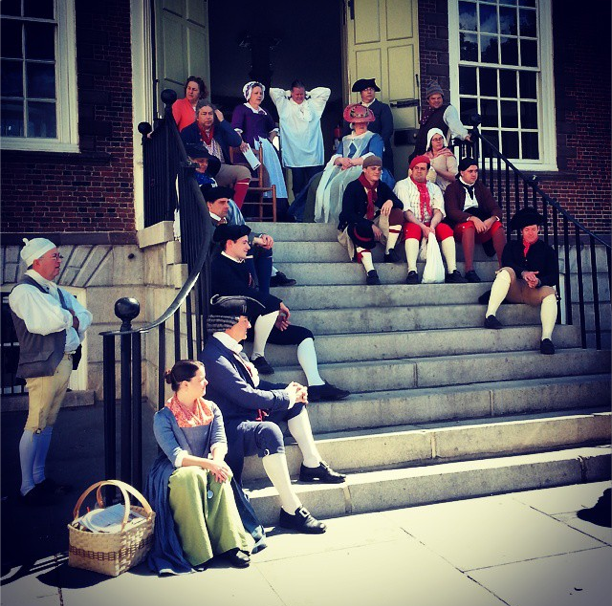
On the Colony House steps
August is hot. Can we riot in September? No!

Moving the recreation of a specific event by more than it takes to get to a weekend* seems dishonest to me: do you really want to celebrate your birthday 5 weeks after the actual date for someone else’s convenience? July 4th: Gosh, it’s not working for me this year. Let’s do that in August.

For a historical organization to suspend caring about accuracy for living history events but not for published articles, catalog records, or finding aids just contributes to the greater problem in and of living history.

When asked about the goal of a living history event, I have been told, “Well, we want families, right? So we should have some hands-on activities, you know, immersive, like candle dipping.”+

It took a bit, but at last I grasped the core of the angry-making: Kids like living history, therefore it is less sophisticated than other forms of history.

The right place for immersive string activities.

Living history is not as sophisticated, nor need it be as accurate, as traditional (written, orated, curated) historical presentations: I think that is the background assumption a lot of people make, both in the adminstration of traditional historical organizations and in the presentation on the field. It is a complete fallacy.

Living history done well and done right is as well-researched as a paper, exhibition, or article. It draws from primary sources both written and visual, it requires the absorption of countless secondary sources to help analyze the primary sources. It is as collaborative and negotiated a process as any museum exhibition, and like exhibitions, it uses material culture interpretation to deliver its messages, i.e. meet its educational and interpretive goals.

15316751814_946818c254_z

A good living history event is beautiful, but like a ballet, that beauty does not come easily. There are no shortcuts, and beauty does not equal superficial or stupid. It indicates sophistication. Part of that appeal is accuracy: the better, the more accurate and immersive the historical setting and action you create, the more visitors can learn without asking.

Lawn games
Lawn games

When I organize an event in our house at work (or even on a guided tour) one of my interpretive points is always “people saw the world differently– literally– and this event/house tour helps you see the world of 1800 the way people living then saw it.” Aesthetics were different, and were underpinned by ideas and opinions. But understanding those aesthetics and the opinions people held about race, gender, beauty, work and class takes actual research and analysis. It’s not all putting on a pretty dress and cavorting on the lawn. Facts matter. Accuracy matters.

Museums are some of the most trusted organizations. If we started juicing facts like every History channel show, we’d lose that trust, and rightly so. Our trustworthiness is grounded in our honesty and integrity.

Living history events are mobile museums, and every reenactor curates his or her own impression. To retain the trust and interest of the public, we have to be accurate.

*Events are moved to weekends because that’s when interpreters and audiences can come.

+This at a house that not only lacks a working kitchen earlier than 1960 in the staff area and was owned by a partner in a candle factory. I’m thinking “bought ’em in bulk,” here, not dipping.

[Not Quite] Good Enough Coat

When not working on the Unified Theory of Living History,* I’ve been sewing for the February program in Newport. You know about the skritchy brown gown, and then there was the Great Coat Obsession. Well, here it is, in unpressed previews.

The photographer and I had barely achieved emotional détente by the time these were taken after a foray out of doors in the late afternoon, but we survived on willpower and the promise of strong beer and here you are. Two and three quarters yards were not quite enough at this length, though perhaps the coat does not have the close in the skirt. For $13, I think I’m still okay with where this is headed, though buttons will be the very devil.

My finger tips are so calloused that working touch screens is getting hard, and silk thread practically shreds when I try to make deaths head buttons. It’s still too early to give in and buy buttons, but there will be swearing ahead.

Back to the coat: there is enough wool for a cape or two, if one is pieced or false. It’s hard to tell how warm this will be, until the buttons are on and the body lined. Wearing it outdoors on Sunday did make me think about the wool flannel shift in a collection near me, and how nicely cozy that would be for winter.


*Stewing about recreating the past