What’re you lookin’ at?

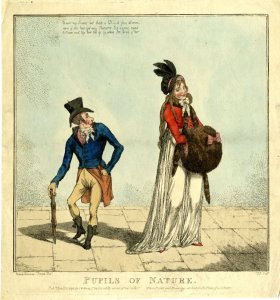
Pupils of Nature.hand-colored etching published by S W Fores after Maria Caroline Temple, 1798. British Museum, 1867,0713.409

No, really: Do you know what you are looking at?

When we set out to make historic clothing and costumes, it’s important to understand our sources. Newspaper advertisements and account books are one source of information that can be difficult to decode: from Swankskin to Tammies to Shalloons, Nankeens, and Calimancos, we encounter words we do not understand. Dictionaries can help, but it is as well to remember that we need that help decoding the words.

We don’t get the same handy, universal guidebook in quite the same way when we look at extant garments. What we do often get is provenance. Knowing a garment’s history is essential to truly understanding it. It helps date the item, for one thing, and understanding the history of the wearer gives us even more information about the clothing. How old was the person when this was worn? What was their social status? Income level? And if there are mends and alterations: even better!

I came to understand the family who lived in the house where I work more clearly through their clothes. Muslin waistcoat fronts that, on examination, are not truly out of the tippy-top drawer helped me see the Big Fish/Small Pond nature of the family and their wealth. You may be a Playa in backwater Providence, but you Just Another Guy in Philly. It was a little window into the insecurities of the father, and how those played out in his reaction to his daughters’ marriages.
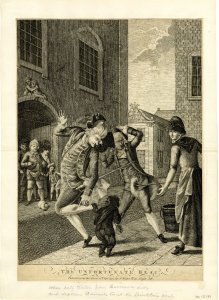
The Unfortunate Beau, etching, Publish'd as the Act directs 12th Sept 1772, by S.Hooper, No.25 Ludgate Hill. British Museum 1991,1214.20
The Unfortunate Beau, etching, Publish’d as the Act directs 12th Sept 1772, by S.Hooper, No.25 Ludgate Hill. British Museum 1991,1214.20

But (in the grand scheme of things) there are only so many newspaper ads and account books and few enough garments, let alone the zebras of garments with solid provenance. The groups are smaller still when you consider relevance to what you need or want to know or replicate. Small state? You’ll have a small pool.

So we turn, often, to images. Here again, provenance is helpful when we look at a portrait. Even knowing the maker is helpful: Ralph Earl or James Earl? Portraits by brother James aren’t the same level as those by Ralph, so you get a different kind of information. But that’s all quite aside from what’s contained within the image– and that’s even before you begin to consider what you are doing when you replicate the image.

Understanding the symbols and meanings of images and objects is slightly esoteric but questioning your sources (Interrogating the Object, if you will) allows you to better understand what the heckers you are doing and how it may be perceived. In the pursuit of historical clothing, living history and reenacting, that is more important than we credit. Do we really know what the sources mean? I’ve argued before that we don’t-– and that doesn’t mean DON’T it means USE WITH CAUTION. We’re long removed from the details of, say, satirical engravings that lack a literary source, so those need especial caution as sources. We lack the context.
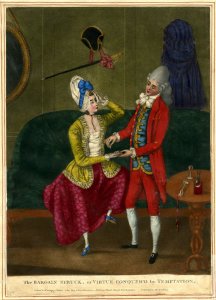
The Bargain Struck, or Virtue conquer'd by Temptation. Mezzotint, 1773. British Museum 1935,0522.1.130
The Bargain Struck, or Virtue conquer’d by Temptation. Mezzotint, 1773. British Museum 1935,0522.1.130

Now, if your goal is straightforward: replicating costume for fun, say, you will care less about the notion of meaning within images than someone who is trying to understand the past by inhabiting the clothing with the hope of gaining insight into the worldview of the past. That second category is possibly a more tortured group of souls than the first, laboring as we do at an impossible task.

We are talking about semiotics here, and if you want a quick intro, The Signs of Our Time by Jack Solomon, PhD clocks in at 244 pages including bibliography. It’s old– 1988– and perhaps oversimplified, but we’re not in graduate seminar here, so it will do for our purposes. Solomon’s book contains a handy list he calls the Six Principles of Semiotics:

  1. Always question the “common sense” view of thing, because “common sense” is really “communal sense”: the habitual opinions and perspectives of the tribe.
  2. The “common sense” viewpoint is usually motivated by a cultural interest that manipulates our consciousness for ideological reasons.
  3. Cultures tend to conceal their ideologies behind the veil of “nature,” defining what they do as “natural” and condemning contrary cultural practices as “unnatural.”
  4. In evaluating any system of cultural practices, one must take into account the interests behind it.
  5. We do not perceive our world directly but view it through the filter of a semiotic code or mythic frame.
  6. A sign is a sort of cultural barometer, marking the dynamic movement of social history.

Now that you’ve read the list, perhaps what I obsess about will be clearer: we don’t fully understand the culture of the past. We don’t have the same semiotic or mythic filter than the people of the 18th century had, but when we recognize first that they had a filter, and second that the filter varied from culture to culture, we can better understand our sources.

If you can accept that the cultural filters of England and France and the United States were all different, perhaps it will be easier to accept that you cannot mimic a French fashion plate in portraying a middle-class New England woman without encountering some questions. But if you replicate that fashion plate for the pleasure of experiencing that fashion moment, that’s another game altogether.

Intention matters. Your goal will dictate your sources, and how you use them. As committed as I am to the everyday (because no one is documenting us or saving us, no matter how desperately we try to signal our being with Facebook and Instagram posts), I’m not suggesting that we all attempt to recreate the same past. I’m arguing that we strive to understand what we are doing (dressing up, portraying a specific character, portraying an archetype) and that when we know what we are doing, we understand better how to use the sources we have.
Documented Fantasies

It was three years ago on a warm August afternoon in the museum room we’d turned into a photo studio when I quipped, “All my fantasies are documented.” It’s been hard to live down ever since.

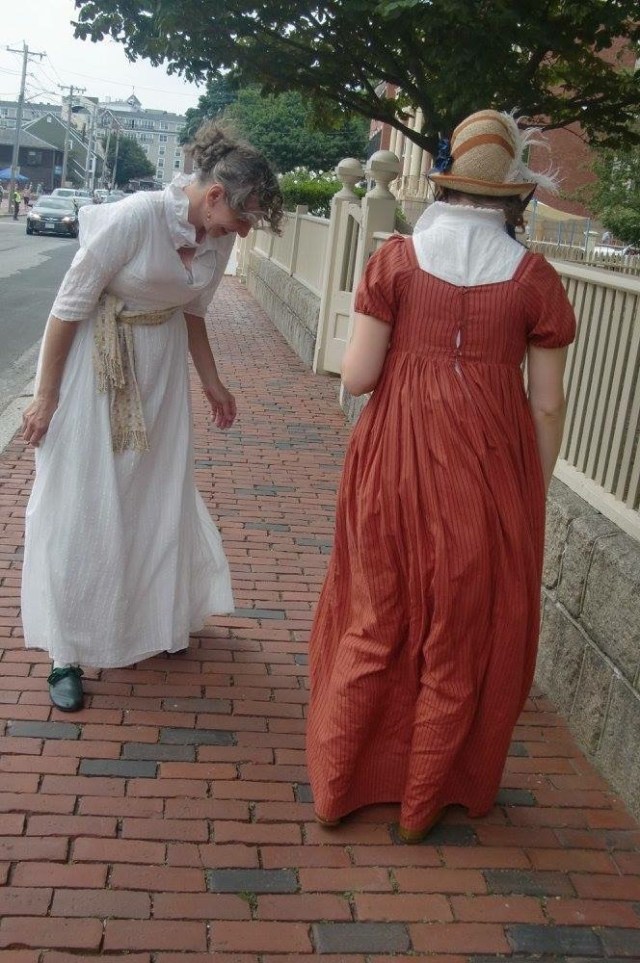
With Mrs B watching Miss B self-perambulate upon the sidewalk.

Documentation, research: we all do it, everyone who reads this blog does it. What matters is how you use it– or, maybe even more importantly, how well you understand how you are using your research. This past weekend was the Salem Maritime Festival, and round number three for me in the West India Goods Store (WIGS, which sounds far more political than it is). The year was 1804, and as you may recall, that required a new dress.

Reader, I wore it. And it survived!

Yes, it is made from an IKEA curtain. The pattern is my own, derived from examples in Janet Arnold, at Genesee, and the KCI. Once again, I discovered the power of upper body strength and leverage. It’s not that my stays are too big necessarily. The busk is too long, that I will grant you. But I think the shoulder straps are as well, and the shift– that slattern! She was rolling a la Renaissance Faire, which is completely unacceptable, of course, as she slid down my right shoulder by the end of the day when the shop had been unpacked into the conveyance.

So let us focus on the non-slattern part of the day, when a mercantile enterprise briefly overtook the WIGS.

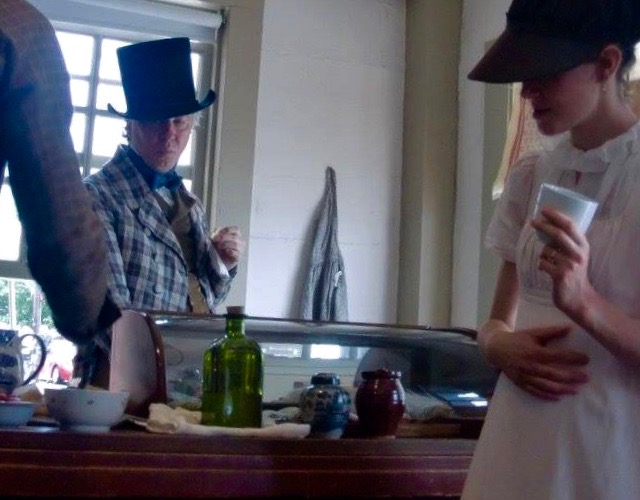
There was some custom, though numerous debts were recorded in the ledger.  (Somehow, there are no images of Mr K sweating over the figures in the book, though I recall them clearly.)

IMG_7634 (1)

The shop was hot, but we attempted to stay fed and hydrated, as we discussed the various kinds of goods imported to places like Salem and Providence in 1804. Politics were rather difficult to discuss, as Mr K has a marked antipathy for Mr Jefferson that caused a mild agitation; expanding the country does seem a bold and perhaps unconstitutional move, given the deal Mr Jefferson has struck with Bonaparte, but perhaps this is for the best. The Indians will surely benefit from Christianity and education.*

It’s engaging in the moment, and we’ve done our research. But it’s a fantasy nonetheless, a kind of happening grounded in primary sources and material culture. I’m OK with that– I understand what I am doing– but I wonder sometimes if the people I’m watching on social media understand what they are doing with the fantasies they portray.


* To be SUPER clear, I’m staying in character here. I worked in Missouri and I have enough understanding of “manifest destiny” to disagree with this point of view.

Indocent Exposure

IMG_7288 Or, Confusion into Confusion.

Docents and volunteers: the backbone of any non-profit organization, right?

Well…sort of. I’ve worked with docents for more than a decade, and along the way I’ve learned what does and doesn’t work. What does work is intensive engagement and participation, though the occasional shock to the system can be necessary and useful. For special events, though, and in cases of turf, diplomatic relations must be opened with the enemy early and often.

That is not to fault the organizers of the “Order Out of Confusion” event this past weekend, for I was one of the people organizing the civilian, non-marching end of things, and due to turbulence in my own life, I failed to plan adequately in the arena of Docent Relations.

IMG_7296

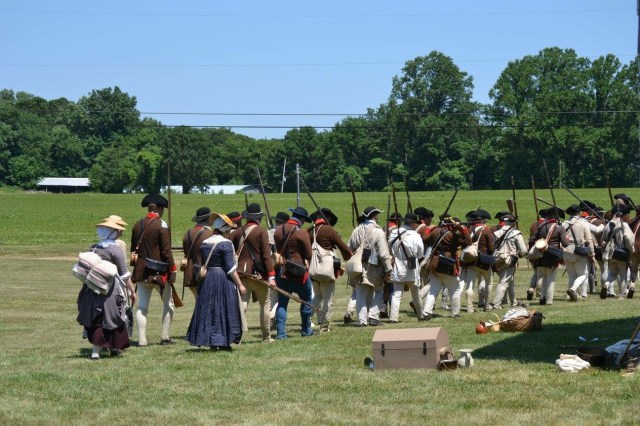
We had a Retaliator, a Pine Robber, a Quaker, and a Slave-Owning Patriot. We managed a debate or two over slavery. We begged people to take the Quaker home with them. But we did not occupy the house, for the house was occupied by red-shirted volunteers who gave at least some of us the five cent Condescension Tour punctuated with, “But I suppose you’re not interested in that.”

IMG_7298

Actually, that look was one of sheer disbelief, sir, at the farm implements in a bedroom, the tidy piles of perfectly formed ashen coals under the cookware in the fireplace, and the roomful of flax accented with a snake charmer’s basket. In my line of work, I enjoy house tours, but find they generally go better when tour guides don’t point out all the flaws to me. Complaining about the state (which owns the site) and onerous regulations that make repairs expensive will also increase my look of horror and disbelief. But really, if you want full-on horror, kindly inform the Quaker that Japanese POW camps “really weren’t that bad” because we are thriving on confusion today.

IMG_7297

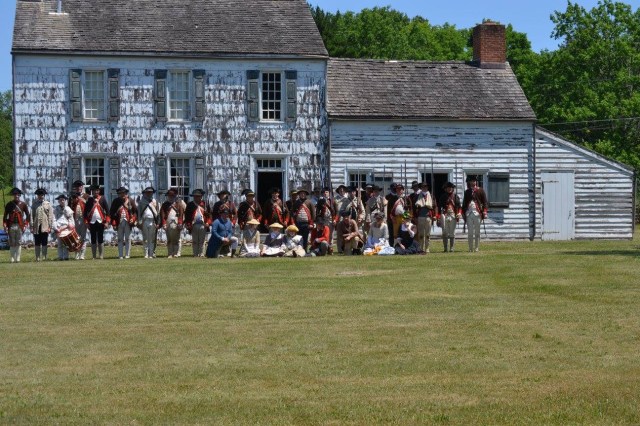
The volunteers were thrilled by the marchers, and were clearly very positive about the event. They love Craig House, and the battlefield, but that sense of pride and ownership made it impossible for them to share the house with us, or to see us as anything but invaders– an Army of Occupation in our own right.

It’s my fault that I’m not an agile enough negotiator to convince recalcitrant octogenarians that my friends and I are safe to play with and will respect the house, and it’s my fault that I didn’t put in place all the lessons I’ve learned in the past decade. Then again, I don’t know that I would have had time to travel for meetings with the volunteers to generate buy in and support, given the maelstrom that was my life this past spring.

IMG_7289

But it’s a lesson well-learned: interpreters will read voraciously, acquire tons of material, and turn that research into appropriately-dressed characters making interpretive points, but unless you work with the site and its volunteers or staff to create agreement about presentation, you’ll get about half the value of the work you put into the planning.

Many heartfelt thanks to everyone who participated, and to the organizers for letting me try out my interpretive model. Next time, I know I have to work with the site staff and volunteers to make sure that execution matches vision.

Free-for-All Friday

Well, at least I can dress myself.

Most sadly, my obnoxious yellow gown will not be finished for this coming weekend, so I will not be flaunting my goods in such flashy clothing. Instead, I will be dressed like a giant version of the darling Miss B, whom I fear does wear the Space Invaders print better than I.

The real point, of course, is the action expected for Saturday, June 25, at the Craig House. The press release is fairly general about how we’ll be representin’ New Jersey’s 18th century civil war, and no one has leaped up to portray Little Anthony the [Quaker] Insurrectionist, but here’s the scene:

Craig House is empty the day of the battle. John Craig is with the Continental Army, leaving Ann Craig to flee with chattel, child, and two slaves in two wagons. This leaves the house and remaining property vulnerable to occupation and depredation.

An armed member of the Association for Retaliation is snooping around the Craig house and catches Loyalist and Quaker refugees who are squatting/hiding, as well as a “London” trader. He can’t let them go, and he is afraid to move them for fear of the British by day and the Tories by night. The Retaliator is joined by a local farmer who has stopped by to check on Mrs Craig’s safety in the surrounding commotion of the troops moving towards the coming battle. 

“Disaffected” smugglers use the chaos of the war in New Jersey to continue trading with the British and Loyalists. The “London trade” feeds the taste for tea, fabrics, rum, lemons, and sugar that even the Revolutionaries cannot shake.

Quakers are viewed with suspicion and animosity for their pacifist, anti-slavery views, which gives the impression that they are Loyalists. Harassed in Philadelphia by various committees requisitioning blankets and other goods; by 1778, the Quakers’ abolitionist views make them vastly unpopular in Monmouth County.

These characters in search of a plot will encounter each other at Craig House and, with some history improv, portray the tension and conflict between New Jersey residents in the Revolutionary period. Want to come out? Craig House is here, and a visitors’ guide is here.