A Tisket, A Tasket: What Basket?

Nancy had a great question: What did middle class ladies use to carry their shopping?

But here’s the thing: they didn’t carry the shopping, because they didn’t do the shopping– not the big shopping, anyway.

La Pourvoyeuse, oil on canvas by Jean-Simeon Chardin, 1739. Louvre Museum.

La Pourvoyeuse by Chardin shows a woman returning from market in 1739. No basket. A bundle or bag with a fowl in it, head down. Unwrapped loaves of bread. But clearly a servant.

From waste books, it’s pretty clear that people are sending their “boys” and “girls” (servants or slaves) to fetch liquor. That will come home in bottles, like the ones at the feet of La Pourvoyeuse. And I think it comes home just in their hands, but perhaps- and more likely not– in a basket. A floppy basket, usually for floppy birds.

Balthazar Nebot, active 1730–1762, Spanish, active in Britain (from 1729), Fishmonger's stall, 1737, Oil on copper, Yale Center for British Art, Paul Mellon Collection
Balthazar Nebot, active 1730–1762, Spanish, active in Britain (from 1729), Fishmonger’s stall, 1737, Oil on copper, Yale Center for British Art, Paul Mellon Collection

Baskets have come up before. So this is part of a larger argument. Mostly, we see servants marketing. Middle class ladies certainly shop– what is the class level of this woman (above)?— but so many things can be delivered, or are peddled door-to-door, and servants are so common, that I think we don’t yet fully understand shopping in the 18th century.

After the meteoric rise of consumerism, after department stores, yes: shopping is more like what we do. But in the pre-ice box and pre-packaged era, meat cannot be bought and frozen, and milk will not last all that long. Things were brought home one at a time, or a few at a time, many times a week. And middle class ladies bought small things– ribbons, almanacks, shoes– and bring them home in their pockets, just in their hands, or, I would guess, wrapped in a bundle of paper (a pair of shoes) or in a band box (a bonnet) if the things are not delivered.

A long winded way to say, I don’t know: but I’m pretty sure middle class ladies sent their servants out frequently so the ladies didn’t carry baskets and the servants used bags, aprons, and their hands.

Mop It Up

"Useful occupations: Women's work, sewing, spinning, washing, ironing etc," illustration from Basedow's 'Elementary Work', 1770. Etching by Daniel Chodowiecki — at LACMA
“Useful occupations: Women’s work, sewing, spinning, washing, ironing etc,” illustration from Basedow’s ‘Elementary Work’, 1770. Etching by Daniel Chodowiecki — at LACMA

Mrs. Boice is at it again, folks: you can register now for a workshop in just a few weeks where you can learn more than you thought you’d ever want to know about getting ready for winter, laundry, caps, games, and dancing. Thought honestly, I think you can never know too much about these things, which is why I keep trying!

Yes, it’s what I think about: how did women prepare houses for winter? How did they get things clean? It was a lot of hard work, and is often underrepresented in historic sites both domestic and military.

You can learn more about the weekend online or download the detailed flier.

Filthy Friday: Rolling with a Purpose

“It looks like you rolled in dirt,” I said to the Young Giant when he dumped a gritty mess on my lap.
“I did,” he said, “but it was rolling with a purpose. We dug a fire pit, and then I had to keep the fire going. So I was on my belly in the dirt.”

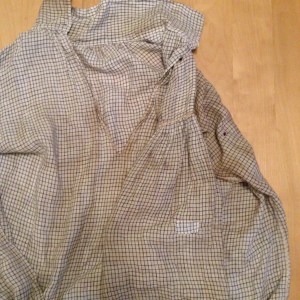
file_000

This was followed by, “Mom, you need to mend my shirt.” But first, I needed to wash that shirt.

file_004

I’d like to wash that shirt right out of my hair, but there it is: it’s got to be attended to.

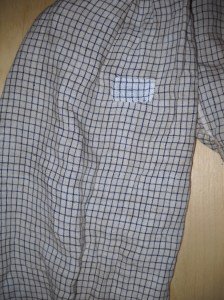
I did what mending I could before I washed it, since some areas seemed more likely to disintegrate further in the wash.

That’s clean linen verus dirty linen, the 18th century wrestling match. Patch secured, I very nearly packed this into a priority mailing container for delivery to the esteeméd Red Shoes Laundry, but I took a deep breath, and put the lobster pot back in the cupboard. (Yes, I considered boiling this on my stove top on a 95° day. Wouldn’t you?)

Instead, I trekked down to the cool of the basement and ran the water as hot as it gets and added Oxiclean (used by some of the finest weavers I know when they encounter dyes less fast than anticipated.)

The first tub achieved a kind of colloidal slurry of mud and sweat and soap. Delicious. Five rinses and an overnight soak later, dirty shirt became just a shirt again.

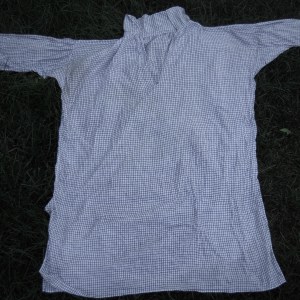
file_008

I took advantage of the clear weather to dry this outside on the grass, hoping the later sunlight would aid in whitening.

Wondering about that patch? Wonder no more, compare:

It’s another one of those “is it done? it’s perfect” situations. I’d love to wash my clothes with historically correct methods, but for now, the shirt’s clean enough for final mends and wearing in October. The winter should give me time to figure out stove top washing.

Tavern on the Green

[Not] Mrs Guernsey and Mrs Holstein
[Not] Mrs Guernsey and Mrs Holstein
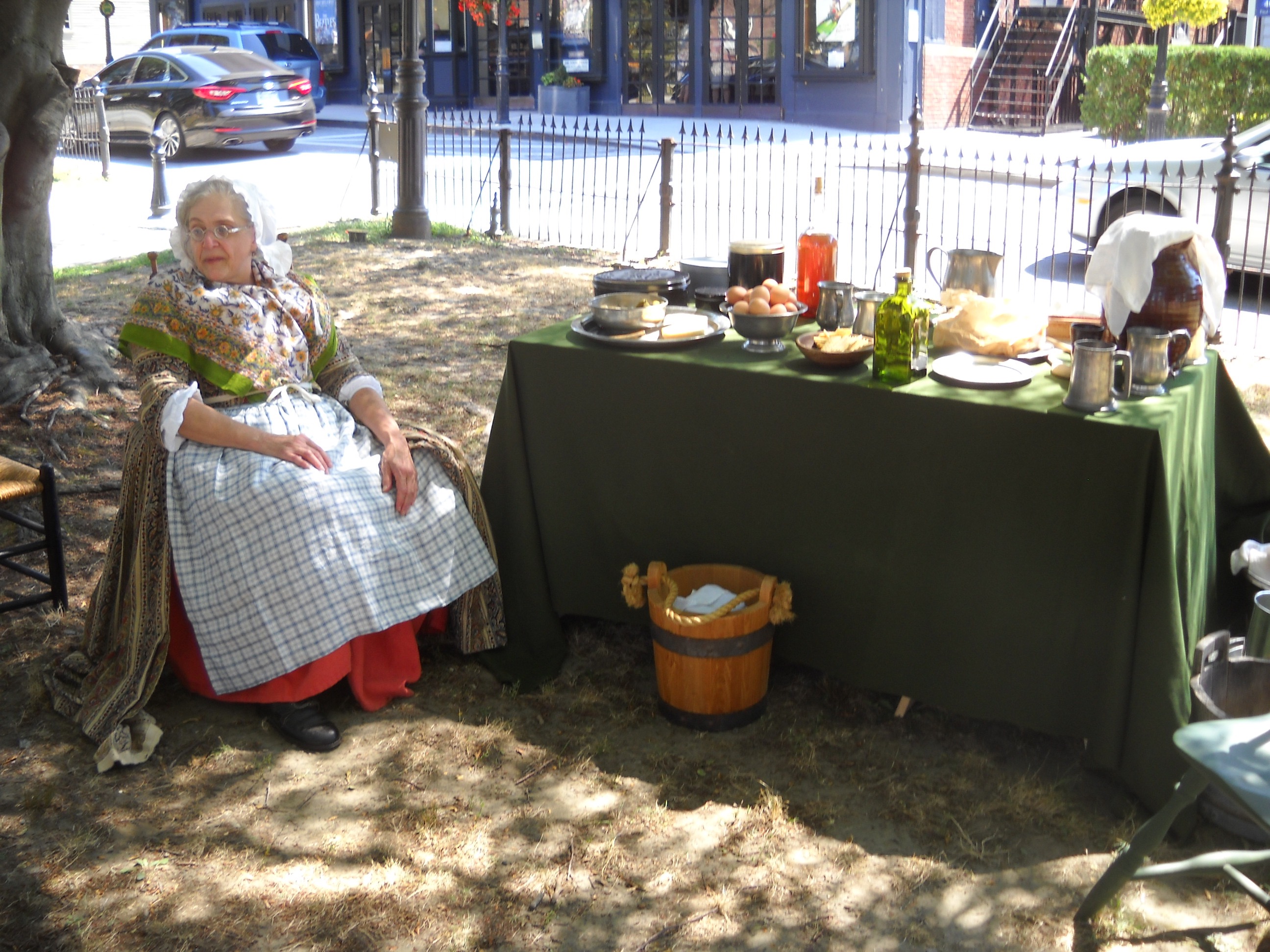
The wags will quip and Mr M certainly did, to my delight, though I might more properly have been Mrs Fjäll, but that’s neither here nor there.

We offered games, beverages, and tavern food as best we could in the makeshift setting of Washington Square in Newport and served as the site of an impressment riot based on incidents involving sailors from the Maidstone in June, 1765. Custom had been brisk before the Royal Navy so rudely imposed upon our establishment, and dragged off some of our best patrons– leaving their debts unpaid, of course.

Barmaid. Bouncer. Bobby.

We resorted to more gaming, though even that was risky: a young, possibly motherless thief whose trousers barely contain his calves made off with our winnings, and had to be chased down. Fortunately, despite her propensity to smoke, the barmaid was able to apprehend him and, money restored and apology made to Mistress B, we allowed him at our table– I believe we are a better influence than the company he had been keeping, as our trade is honest even if modest.

Much was on offer in town on Saturday, and while Miss C had advertised Hogarth and Sandby throughout the morning, by late in the day, she still had no offers, and the pair were advertising themselves effectively. ‘Tis a pity, for with fish unsold, another day passes and Miss C’s gown remains in pawn, and her shiftless husband’s shoes as well– even the Navy did not want him, for he professes never to work and affects half-wittedness that conceals his natural wit.

Despite hiccups along the way, setting up a tavern on the green, even in this kind of makeshift way, allowed us to do something I’m always excited about: interpret the history of working women. Serendipitously, one of my favorite books delves into the history of women and business both large and mostly small, and examines Newport. The Ties that Buy, by Eleanor Hartigan-O’Connor is one of the best books on 18th century women’s history that I’ve read, making clear that women, despite their restricted legal status, conducted business, had lines of credit, sued for non-payment of debts, and participated in expanding consumer networks. This book, in addition to research into punch, alcohol, Rhode Island taverns (and I’ve got ready access to tavern ledgers) grounded the interpretation of the Sign of the Two Old Cows. The best part of the intersection of living history and research is bringing actual people from the past to life, and reshaping the way the public understands and appreciates history. For Two Old Cows and a book, I think we did pretty well.