
Once Upon A Time…

Betsy Ross and friends: A Child Guidance Educational Activity

This is the third set of these paper dolls (Educational Activity) I have owned. The very first set was given to me by my mother, Lo, at the Dawn of Time, in the Dark Ages known as the 1970s.

I wore them out.

A new set was purchased, probably once again at Marshall Field’s, possibly in the book department. They now reside in an attic outside Philadelphia (how appropriate).

From this Educational Activity flowed many more home-designed outfits and home-made paper dolls of historical and literary origins, which have led to this moment, when I make myself and my family into historical characters, make us outfits, and set us in motion with friends and colleagues in scenes of historical play-acting, by which I mean Educational Activity.
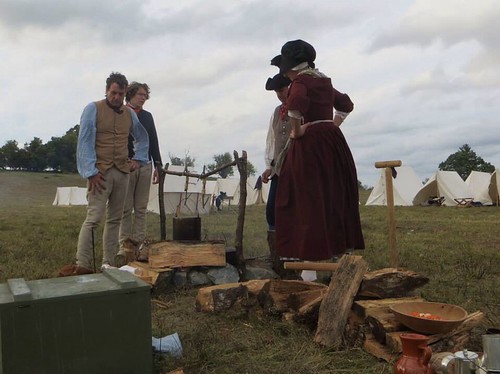
Cooking at Saratoga: very Educational. Photo courtesy D Molly Ross.

I like to think that the clothing we wear is more correct than the “Authentic Costumes” advertised on Betsy Ross’s box, but there is always more to learn. I am in no way denigrating Betsy Ross, or paper dolls, or suggesting that I see my family, friends and colleagues as paper dolls. But I do know that as long as I have been playing, I’ve been playing history and reading history, and drawing history, and using books and paintings and yes, even paper dolls, to figure out the world present and past.

If January Jones played Betsy Ross...
If January Jones played Betsy Ross…

Even though I always thought I wanted Betsy’s birthday cake gown, the one I really liked was the work gown. The “construction” of her garments confused me even as child: how the heck does that kerchief work? And the bodice front? Never mind, have a slice of dress, I mean cake. (Field’s had a cafeteria that served slices of pink-iced layer cake that I somehow conflated with the paper dolls, thanks to the shopping trips my mother and I made.)

Memory and fact, impression and citation: when we reenact the past as an Educational Activity, we should remember that some will walk away enlightened, and others will walk away thinking about birthday cake. Our job, beyond getting the facts right, is to engage our visitors, to interest them, and to excite their imaginations. What they do from there is up to them, but we will know that we have done our best to present them with a scene that can take them one step closer to being there.

Light Housekeeping

Heavy Housekeeping: Piano Relocation

As new readers stumble along here, I thought it might be helpful to explain a few things, to explicate the process, if you will.

The Images

The images I post are, wherever possible, linked back to the holding institution or owner. When a full caption appears, chances are good there is a catalog record for the image. If the holding institution doesn’t have a database, or doesn’t have a good way to link to the image, there will be clues to the source in the text or caption. That way, if you want to share an image, you can click it and get the source to share elsewhere. Check Pinterest as well, usually there are even more images than I can fit here.

The Writing

While I conduct research for what I write and for the events I am part of, this is obviously not an academic blog. It’s a personal blog, and a conversation. I think by writing, so my posts tend to be process-oriented and more about questions than answers. The longer I live the less I know, and the more I am comfortable with uncertainty and the search for knowledge and understanding. You may not see the snow leopard. It’s OK. (I do recommend Matthiessen’s book if you haven’t read it.)

Jumping Snow Leopard by Emmanuel Keller

I try to give my sources (sometimes as footnotes, sometimes in the text; this is a blog, I don’t always follow the Chi Man of Style) so that you can verify what I find and reach your own conclusions. Most sources I use can be found on Google Books, or the Internet Archive so that everyone can enjoy the digital surrogates; I also try to link to holding library catalog records where digital sources do not exist. Please forgive me: I am not the greatest proofreader at 5:00 AM when many of these posts are written.

I pad stitch like crap, but it’s getting better.

The Sewing

Talk about your work in progress! I’m still figuring all of this out, and I expect I always will be. Grab your popcorn, I will be doing something stupid any minute now on a garment I need in very short order. Again, what I think is true is that 18th and early 19th century tailors and sempstresses had a vocabulary of stitches, materials, and techniques that they commonly used in a variety of ways. There will be typical constructions and idiosyncratic assemblages. Some garments will be a mix of both. Welcome to idiosyncratic central. This is about the process of figuring things out, gaining knowledge and increasing ability and understanding. I try to understand how I would have sewn in the 18th century, which  means not even as well as an 8-year-old would have constructed clothing in 1770.

The Topics

I have my obsessions, you have yours. Historic laundry processes, living history, poor women, cats, museums, art, books, construction, the spectacle of the art and antiques market…you’ll find I jump around. Think of it as a restaurant with a varied tasting menu built around a few key ingredients.

The Attitude

Snotty and snarky? Yes. But because I know some folks read this at work, you are spared my customary in-person profanity despite the mighty effort it takes some days to resist writing like Rebecca Schuman. Especially when I write about the art and antiques market.

The Philosophy or Mission

Be excellent to each other. Practice kindness. Share your knowledge.

Thank you for reading and commenting. I really do appreciate it. Now, where’s that snow leopard?