2020 Vision

Rebecca Young at the Museum of the American Revolution. Always a good experience.

We made it: another turn around the sun, another year, a time of resolutions and reflection. 2019 was the year I had three jobs, invented a job, and qualified for Medicaid. It was a year I spent wondering who I was, and what my experience meant, if anything. I developed a new chronic condition (can you have too many?) and continued struggling to manage the old ones. I applied to, was waitlisted by, and ultimately rejected by a prestigious graduate program. I applied and interviewed for five jobs and got two. The one I have now, though a short-term contract, uses all the skills I honed over three decades working in museums. I expanded the repertoire of 18th-century women I represent, learned about flag making, and increased the number and accuracy of remedies in my medical box. I even journeyed further back in time to represent a Lost Colonist of Roanoke.
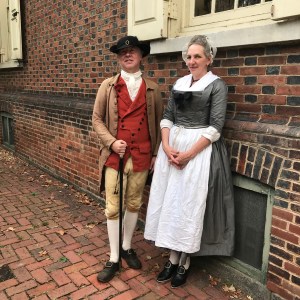
Together in multiple centuries, despite the bumps. Photo by Aaron Walker

Still, six months of working all weekend every weekend at job number two put me so far from my friends and habits that despite the pleasure of representing Rebecca Young and Elizabeth Weed, I still feel uncomfortable with living history and costuming. Those months certainly strained my relationship with Drunk Tailor, and with my own identity. Twenty nineteen is year I would revisit only in select details.

Mrs. Wainwright, Miss White and Miss Baker going into the Supreme Court to hear the decision on the Ohio ratification of the suffrage amendment, 1920.

For this coming year, I know only a few things. My contract expires at the end of March. I still love things and order, but I don’t know if I want to work full-time in a museum again. In a bit of perfection, I’m working as the de facto collections and project manager to transfer the library, archival, and object collections of the National Woman’s Party (NWP)  to the Library of Congress and the National Park Service, effectively closing the NWP as a cultural organization (the house is now preserved as a national monument).

I took this contract before my Kickstarter succeeded and admit I am ambivalent about it. Kitty Calash as a business is a little too small to sustain me with a kid in college, but museum work, aside from the work of establishing ownership and provenance, remains difficult for me. I wonder about the accumulations of objects, their meaning, and relevance for the future. I was a curator for a long time, but now I wonder what my role will be, in the evidence locker of history.

Like “curator,” “reenactor” no longer feels like it fits, even though I love history and clothes and dressing up. Perhaps this is too many weeks where dressing up was not an option, too many events missed, the habit lost. Perhaps it’s fear of succeeding, of striking out on my own and doing well, and instead of jumping, hesitating at precisely the wrong moment. Suddenly, it all seems so silly in the face of elections, climate change, and the instability of the gig economy.

Purveying ideas and goods as a milliner is a lot like being a curator.

I wrestled with this in 2017 and 2013,  winters when things seemed hopeless for reasons large and small. Three years ago, I found my refuge in art. Even a year ago, art and aesthetics felt like solace. This year, the New York Times’ Culture Therapist addressed a reader’s question, or problem, that echoed with my own sense of perturbation.

The core of the issue was this: “What happens when we no longer fit our own context?” The answers were varied, and to me, seemed like long shots (too many uncontrollable factors) but this struck me: It will require risking compassion to create an expanded and possibly destabilizing relationship to visual culture.

In 2019, I learned the key to most successful endeavors is vulnerability. I spent a lifetime building walls to protect myself that now box me in. Razing those walls is what I think of when I read “risking compassion,” though it’s hard to say exactly what a destabilizing relationship to visual culture (or history, or costume, or fashion) might be. It may be understanding how little one knows about the past, accepting new aesthetics, or trying something completely new. Even as I contemplate a possible grant-funded costumed interpretation program, clothes from 1919 don’t feel “new” enough to me; they are not different enough. I don’t know what will be, but I do know that unless I’m emotionally uncomfortable, I’m not learning.

For all the angst and tears and anger of 2019, all the feelings I do not want to feel again, this year taught me to trust myself, to try, to fail, and to succeed. We learn as much from our failures as our successes, and while some of us more easily recall painful memories, it is worth remembering they can lead to our happiest moments. For this coming year, I will try to hold onto hope, that thing with feathers, and plan to learn new skills, improve the ones I have, and continue to find joy in the everyday.

The City in Winter

December: when the year ends and begins again, a time when historically, for many Scandinavians at least, there was no spinning or winding, lest the world stop turning. No one wants to be stuck in mid-winter forever. This is the time when most of us look back, wondering what we accomplished this year, what it means, and begin to think about what we want for next year.

For me, this year has brought changes: three jobs, and my own business. I’m fortunate that I never stopped working. But I also never stopped working, and that keeps catching up with me. The days are grey and wet, and now that I work (part-time, for a few months more) in the district, I see winter creeping into the city as well as the suburbs, with all the signs of the changing seasons.

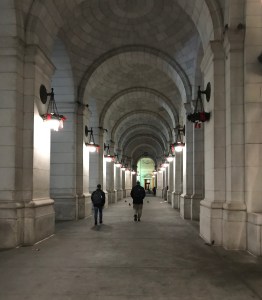
It’s not just sunsets, increasingly bare tree limbs, wool coats, or holiday lights as I walk to the train station, it’s what I smell. Some nights on Capitol Hill, it’s steak. Some nights at Huntington, it’s pizza. But even on the mornings when I collect the office mail from the post office, the terrazzo floored lobby with its glazed bronze doors smells like the office building lobbies of downtown Chicago in the 1970s and ‘80s. What was that smell: floor cleaner and metal polish, paper, and the seeping damp of melting frost? As difficult to describe as it is easy to remember, where I work now smells like where I grew up.

5200-5244 S. Greenwood Ave., Chicago

The landscape is similar, too, rowhouses on one walk to work, and office buildings on another, and, as I walk past the station proper, pigeons and homeless people. That, in particular, reminds me of Chicago, and a boy I knew from Eastern Europe.

He drove a cab with his father, but with me, he walked the scabby downtown streets eating croissants bitter with chocolate that turned sweet in our mouths as we kissed down the stairs from the cheapest seats at the Auditorium, sweets we carried in our pockets to share at intermission when we crept down to better seats not sold for that matinee performance.

I met him at a punk club, but he alone of all my friends loved ballet with me, he alone knew the ballerinas, the ballets, the composers.

He was tall and unforgiving.

“Your parks!” he said, “Dead pigeons and dog shot! People sleep in that!” and I had no answer, for he was right. He could say nearly the same about my walk to work today.

I think about this as the decorations go up, rituals are re-enacted, and we look forward and back at once. We’re our own private historical societies, editing our collections, interpreting our lives in ornaments, family photos, dinner menus, and table settings. Everything is different for me this year, even when I set the table with the same plates I’ve used for 25 years. And I have no idea what it will mean.

Next time, a look back at this year with an eye to next year’s aspirations.

Women in Business


One of things I’ve struggled with in living history is reconciling my own life as a 21st century working woman and feminist with interpreting the lives of 18th century women.

Mrs. James Smith (Elizabeth Murray)
John Singleton Copley (American, 1738–1815) 1769

It takes a while– and a bunch of reading– to get past the notion that these women lack agency in their own lives. Sure, there are notable exceptions: Abigail Adams, Mercy Otis Warren, and Elizabeth Murray, but those wealthy Boston women aren’t the kinds of women I’m interested in portraying. What about more everyday women? What about the women more like me? They’ve proven harder to find, but not unfindable–though even they, by dint of being findable, are more exceptional than the vast majority of 18th century colonial American women.

Elizabeth Weed carried on her husband’s business as a pharmacist, noting that she “had been employed these several years past in preparing [his receipts] herself,” and was therefore well-equipped and trustworthy to carry on in his business. Rebecca Young advertised as a flag maker, and as a contractor, made flags, drum cases, cartridges and shirts for the Continental Army, thanks to her brother Benjamin Flower’s position as a Lieutenant Colonel.

In researching Elizabeth Weed, I read about other women running businesses in Philadelphia, and practicing as “doctoresses” in nearby New Jersey, demonstrating that Mrs. Weed operated in a context of other successful women, including some practicing medicine, or at least “medicinal arts.” What I would really like is to track down the records of a mantua maker or milliner in 18th century America, and not only because I make and sell gowns and bonnets, but because in doing so, I’m carrying on with the kind of work that my grandmother and great aunts did.

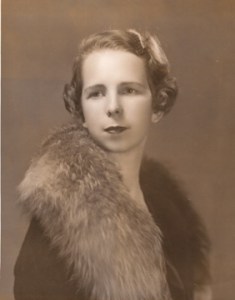
Elsa, Studio Portait ca 1935

For fifty years, my grandmother ran a dress shop in western New York state, dressing the women of Jamestown and the surrounding counties in fashionable and flattering clothes. My aunts made hats and accessories in their own shops, completing the look. I come from a family of makers (including a great-grandmother who made her own shoes), who care deeply about fit and helping people look and feel their best. My grandmother ran a successful shop for fifty years, until she sold it in the mid-1970s. I have many fond memories of sorting costume jewelry upstairs, and gift-wrapping boxes in the basement, with a rack of ribbons in all colors handy on the wall.

She was exceptional in her own way, though you will be hard-pressed to find much (if anything) about her on the interwebs, but maintaining a business through the Depression and World War II was challenging. She gave back, as a member of the YWCA and Women’s Hospital boards, recognizing the importance of sustaining the community you’re part of. When I portray Elizabeth Weed or Rebecca Young, or the Hawthorns of Salem, I think about my grandmother. Maybe it’s a step too far to say the living history work I do or the business I’ve started honors her and the other working women of my family, but I like to think that it helps make visible women who, though now forgotten, were as important to their own communities as she was.

The Past Never Grows Old

It’s obvious that the people I know and associate with understand the genius of They Shall Not Grow Old, and the importance– necessity– of seeing it. This is a brilliant public history project in the most public sense of all– and not only because it’s a movie made by Peter Jackson, which one hopes will attract a wide audience– but because the mini-documentary after the feature lays bare the bones of the making. Jackson’s explication feels at times as if he is speaking to you through his laptop camera on the best Skype connection you’ve ever had. Despite the occasional weirdness of that, it’s worth staying for, because it makes clear what makes the film powerful: research and meticulous attention to detail (plus phenomenal computing power and the genius of WingNut productions).

Royal Irish Rifles, Battle of the Somme

This film rests on research: 100 hours of footage from the Imperial War Museum, 600 hours of oral history audio. Jackson and his team immersed themselves in the media, and it shows. Their intention was to create a generic experience of the common soldier (I may well have teared up at that), so the description of the assault is generic– is it the Somme? Vimy Ridge? Ypres? It is all of them and none of them.

Now the magic of that choice is not that we hear anything about how a Lee-Enfield works, but rather about the minutiae of getting ready to go over the top. We are in the soldiers’ world, and that world is made up of mud, bread and jam, and tea. Yes, there’s talk of the packs and what they carry, but the descriptions of what the waiting was like, how the officers behaved and gave their orders, are what make the moments so immersive. The words match the abject terror on one private’s face, caught in a grimace more rictus than smile. At the same time, we do get descriptions of the logic of the shelling, what the shells contain, and how the mines work. Matched to footage showing what the veterans describe, we come to understand how terrifying those moments were– and then we hear how, once you go over the top, fear disappears as you walk towards the German lines. (The walking always astonishes me: but that’s how they did it, lines of soldiers walked towards the machine gun nests.)

But it’s the details of the getting ready and the tension of the waiting that make the assault so much more intense, as contrast always will. The assault itself, for which there is no footage because it was too dangerous to send cameramen over the top, is depicted with halftones from The War Illustrated, selected for their realism and lack of heroics. (Published in Britain, it was as much a propaganda tool as a documentary publication, though accuracy improved over time.)

We don’t get the “glory” of a battle. We don’t get heroics. We get descriptions of the most terrifying and dehumanizing “job of work” people (mostly men) are ever asked to do. And we get the aftermath, rendered small. In detail. The descriptions of wounds and deaths are moving, and the tireless work of the doctors, but then there is the desire for a cup of tea. Tea threads through the film, seeping into every aspect of the war. It is, after all, men living daily lives in the most outrageous conditions, where every banal desire– dry feet, strawberry jam, a safe place to defecate–is thwarted by the conditions that make those desires so achingly large and yet dismissable. You have to enjoy what you have and can achieve and laugh at what you cannot, or you won’t survive. No one can ache endlessly.

What makes this film really work is the hyper-attentive focus on detail, on getting everything as right as possible, from the color of the uniforms to the accents giving the soldiers voice. The point of the research is not detail for details’ sake, but immersion. Only when there is nothing to notice– nothing that seems amiss, an entirely seamless world–can we fully enter the other, another time, place, culture. That is what we are seeing: another culture, with its own language, mores, habits and taboos.

This is what we are trying to recreate when we reenact the past: we are reviving a lost culture. To do that correctly and well, we need to apply the same level of care and understanding and empathy visible in Jackson’s film. We need to make sure that the details are correct not because the public will call us out on errors, but because the oversights are disrupting. The difference between a well-researched, highly detailed impression that does not focus on “Want to know how a musket works?” and one that’s musket-centric and approximates the past with “If they’d had it, they would’ve used it” is not actually of quality or necessarily or care. The difference is that one allows both the enactor and the audience to more fully enter the past. It’s like a bubble of time we can step into, one where we get as close as we can to how the people of the past saw, thought, felt, smelled. The other, often excused with “The public can’t tell the difference,” remains performative and distant, only half-reaching the past.

The public can tell the difference. They can tell when what they are seeing comes closer to the past, engages with the material in detail and in attitude, and creates attitude, worldview, empathy rather than a recitation of facts. To reenact the past, we must inhabit it, from the color of the wool to accent of the speech, to the taste of the food. The moments we recreate are specific in time, and, when they embody everything you can know about that moment, help us reach across time to understand both the past and the moment in which we stand.

Vera Brittain and her brother, Edward, in 1915. Testament of Youth was my gateway drug to World War I.

I am the last person to tell you I get close to this ideal of detail. I strive for it, and do the best I can to be whatever character I’ve selected. I write this not from the position of someone who has mastered the past, but as someone who has seen technique and principles applied to one medium– film– that are applicable to living history, exhibit design, public programming, and writing. Jackson’s film illustrates the power of knowing details and the power of caring about those details not for trivia’s sake but for the Tommy’s sake. Those specific details serve to create the “everymen” of the War. The research to find which regiments are shown, to get the shoulder badges right, to find how what speech an officer is reading, prove the power of the archives. The past is there, waiting for us, in acid free boxes. We can restore the dignity and humanity of the people of the past by reading their words. Specificity creates archetype.

At the end, Jackson encourages the audience to ask their family members about their history, to find out what stories there are, to find out how the Great War touched them. He reminds us that those memories die with the people who carry them, unless we ask and write them down (or record them). That is perhaps the greatest public history lesson of all: that the past touches us all through the people we know and love, and that by knowing those stories, we can understand not only our family stories, but the history we all share.