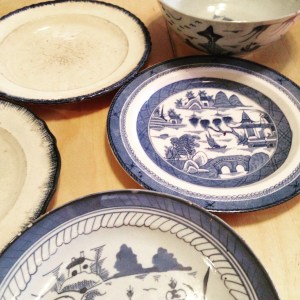
You can learn a lot about a place by visiting its antique and junk shops. Here, where the China Trade was A THING, you can practically fall over Chinese export porcelain (and its imitators) of a variety of types every day. It can become a bad habit. You can become an enabler.
Elsewhere, the objects for sale tell a different story. I’m fond of the haphazard antique malls museum of things world, and while on a tea pot delivery mission to Maryland, went to one in Mount Vernon. It was astonishing.
Mid-century modern furniture, the Arabia Anemone tableware of my childhood, and shelves of geisha dolls, Kabuto, ceramics, and the occasional sword confused me at first until I realized these were probably the jumbled contents of a prior generation of military and civil servants’ homes emptied by their children. The aesthetics were markedly different from what I typically encounter in southeastern New England, where I am accustomed to reading subtle variations between the states I frequent.
Local variations occurred in Vermont as well, though the general flavor was more familiar.
Some things are universal: chaotic piles of partially-identified snapshots can be found anywhere, stacks of pelts and dog-like foxes, not so much. Origins debatable, ethics questionable, the late mammals tempted the tourist trade in St. Johnsbury, where we stopped as we headed south for home.
We influence our landscape more than we credit: from changes in the land wrought by farming to climate change to the differences in what we cast off and what we collect, the visible human influence is undeniable. Material culture can be about place as much as it is about thing.
Woman Selling Salop. William Henry Pyne. The Costume of Great Britain. 1805.
Night watchmen. We’ve been over them before, tangentially, but never in an experienced way. Sure, sleeping overnight at museum sites, I’ve encountered the night watchman making his rounds. And as a museum visitor, I’ve met the guards who monitor how I’m wearing my messenger bag, and how close I get to various works of art.
But what I don’t think about enough, and don’t observe being thought about, is the safety of people over objects. The Museum Security Network has posts on art theft, forgery, and vandalism— all of which are important topics– but there’s a clear focus. For years, decades, that was our focus at work: stuff, buildings, not people.
That changed in our Library five years ago with one obstreperous patron who touched–didn’t hurt, but was angry, and put a hand on– one of our librarians. Now we think about books, papers, and people. But it’s hard: for as long as I’ve worked in this field, and it’s fully half my life, I’ve had the mission drummed into me: access. We preserve these materials, these objects, these sites, for the use and enjoyment of the public, and that means everyone.
The radical democracy of object care (everything we own is preserved with the best care we can provide, from 17th century basket to 21st century advertising hard hat) translated for me into the radical democracy of access: everyone gets in. (It helps that I’ve worked at places where we could provide a lot of free access, and where we continue to strive for as much free access as possible.)
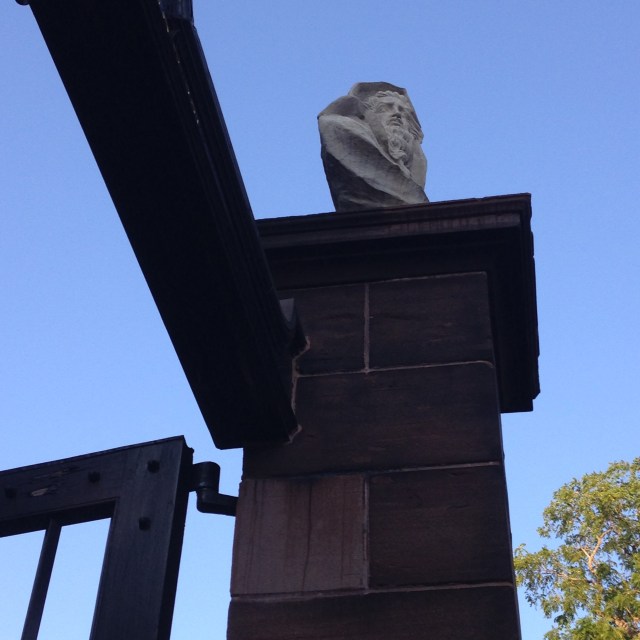
Hades atop the front gate pillar
Everyone gets in. Everyone can appreciate our shared cultural heritage. And then I met Mr Hades. That’s not his real name, but the young man who has been visiting us at the museum (after coming to the library last summer in a quieter mode) has developed an obsession with Hades. He came in Thursday, asking about the front gates, about Hades being the god of Hell, and whether the gates of hell were in our basement. I’ve heard a lot of myths about our basement, but not that one. After ten minutes, and before we could connect to 911, Mr Hades left.
But he was back yesterday, more erratic than before, sunglasses hiding his wide and striking pale green eyes, ranging through the house from front to back streaming a rap song on his phone. He paid for the tour, but left after 10 minutes in the house. He’s clearly been on a tour before.
So we met two police officers from the local substation, and we know to call them immediately if Mr Hades returns. A little research (that’s what we do) turned up a lot of interesting information about Mr Hades, and we suspect that there are officers and judges and guards who are pretty familiar with him, and that he needs help as much or more than he needs incarceration. But he disturbs our visitors, and agitates the staff, and that’s a bad visitor experience. (Thanks to my anti-anxiety meds, I don’t get anxious; I just get a stomach ache and keep talking with Mr Hades to try to keep him focused.)
But last night, talking about safety and Mr Hades with Drunk Tailor, I realized that we don’t think enough about the security of our staff. We put our visitors and our objects before the staff, and that’s not right. This incident made me put the safety of our staff above that of the objects, but we can’t help our visitors be safe unless we take care of ourselves.
If your staff members know their routines, know how to respond and have the tools they need to respond, they’ll be better able to care for and direct visitors to safety. I know we have to shift our thinking and procedures where I am; chances are your procedures are up for their annual review, too. For many of us, the new fiscal year has just begun. What better time for review and changes?
I don’t mythologize or romanticize the villages of the past: we all know how The Crucible turns out, but I thought about privacy and proximity, and I thought about scale. Let’s take privacy first.
In this century, it’s difficult to experience the past as anything more than a series of simulacra which we piece together in a crazy quilt of understanding, but past notions of privacy are far different from our own.
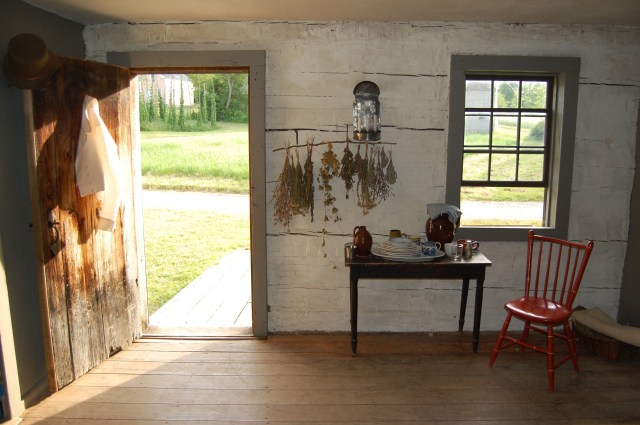
Early one morning, as I lay in a creaking rope bed, I considered how unfamiliar most of us are with the noises of other humans. The wall of our bedroom just barely fit against the exterior wall, and moonlight on whitewash showed the spaces between planking and the plaster, and we slept with the bedroom door open to take best advantage of the cool evening cross breeze.
As I lay awake, my companion happily asleep, I pondered the true extent of my laziness. How much clothing did I really need to wear to go up to the public facility? How loud would relieving myself in the chamber pot be? And what would the reaction be? (I have been on the side of someone else’s choice not to use a chamber pot, and said, “I wouldn’t care,” but one never knows.) And though I elected to put on more than my shift and walk to the public convenience, I began to wonder: what did the people in the past tolerate, ignore, or politely decline to mention?
What did living together feel like, when people shared smaller spaces? When the boundary between private and public, bedroom and parlor, was pierced with holes?
This past weekend, I had a conversation with a friend about requests to borrow “costumes” we’ve made, sometimes for school children to wear, sometimes for movies, and sometimes for parties. We generally say no: these are hand-sewn clothes, and the replacement cost would be ridiculous– plus, we like them and wear them.
I hand sew because I get better control, but also because there were no sewing machines in the 18th and early 19th centuries. To get a garment right, you have to hand sew it, and that’s expensive. I took the time once to figure out what a set of clothes for the Young Giant cost– much to my dismay, and eventually, to his, as I became even more insistent that the garments be treated with respect.
Last year, I sent the Young Mr off to Battle Road in a new suit, and the whole business of what he was wearing was quite expensive. Using $25/hour as a base for labor, here’s how the kid’s Battle Road suit breaks down:
Grand total, with labor: $2532.25 Grand total without labor: $732.25
This wasn’t cheap either.
So think about this the next time you attend an event with a lot of well-made garments: you are standing amid a lot of labor and love.
Sewing is a fairly simple enterprise (you’re pushing thread in and out of fabric, after all), but it takes practice to develop fine skills and speed. A well-made garment will never be cheap. The best investment you can make in your wardrobe is to invest in your skill set, and learn to sew.






 Kirsten Hammerstrom
You must be logged in to post a comment.