Living Like a Refugee

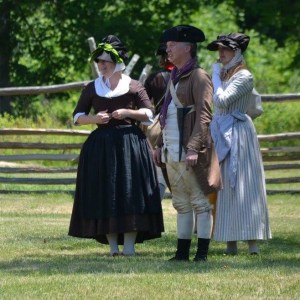
At the Speaker’s House. Photo by Drunk Tailor.

When I was in middle school, we were given an assignment that is now considered inappropriate: we were asked to trace our family history or genealogy as a way to help understand historical time, stories of immigration, and the ways in which we are all American (according to the then-prevalent “melting pot” model of being American). Exercises like that are now discouraged as educators recognize the myriad ways in which people form families, though in my middle school, what was revealed was not adoptions or absent parents but the yawning chasm of class and privilege. My people are more peasant than princess, so the women I portray in living history make sense to me. They don’t wear silk. They make things, and they sell things.

Walking back from Augustus Lutheran Church, Trappe, PA

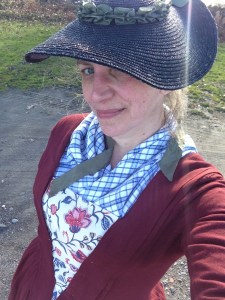
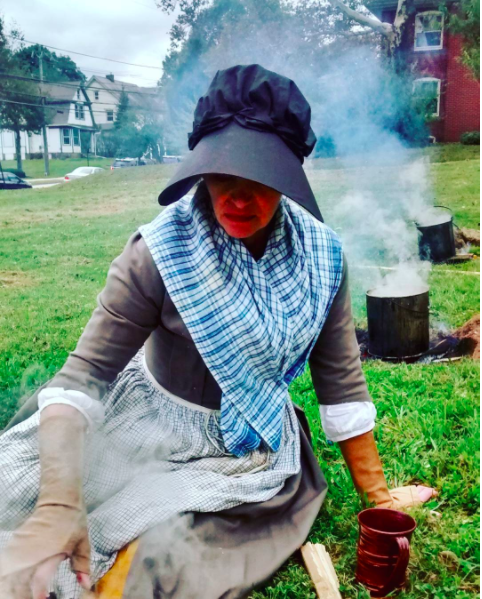
Portraying a refugee was a little trickier to wrap my head around. Whiny I can do– if I wasn’t teaching workshops in New Jersey this November, I’d be in 1587 North Carolina pining for England and wondering why I didn’t listen to my mother instead of marrying that head-in-the-sky Virginia colonist. What made being a refugee tricky for me was finding something to do. Obviously I shared in the cooking chores and the walk to Augustus Lutheran Church, but projecting “refugee” was tricky for me.

Looking back, I can see that straggling after a militia company may well have been enough– not wanting to leave their “protection,” not having a place to be, illustrates displacement. Even dressed as a middle-class or lower-middle-class woman, I am out of place sitting on grass or following armed men.

Displacement: I had not previously considered this as a means of provoking informed interpretation. Interpreting lack or absence can be as effective as interpreting presence. “No shoes” or “no musket:” these are easier, more obvious, but as a refugee, I had no home, no place, and no belonging. That seems even more important to understand and interpret today, at least for those of us concerned with making the past present, and the ways we can study the past to understand the present.
Draping and Dreaming

Why have just one dream project when you can have more than you can possibly achieve? Here, in no particular order, are things I’d like to make or achieve but probably never will:

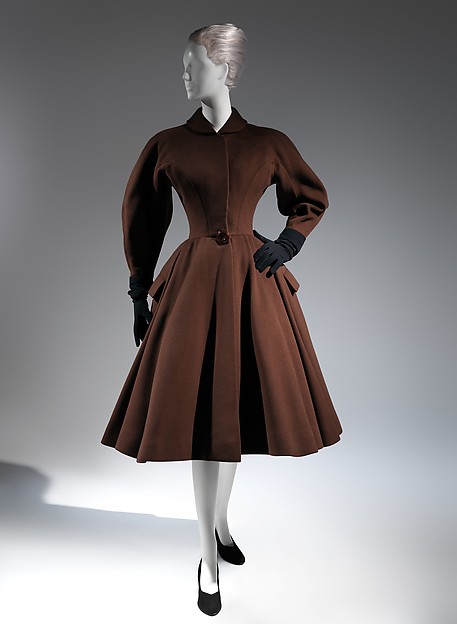
Charles James (American, born Great Britain, 1906–1978)
“Cossack”, 1952
American,
wool; Length at CB: 46 in. (116.8 cm)
The Metropolitan Museum of Art, New York, Brooklyn Museum Costume Collection at The Metropolitan Museum of Art, Gift of the Brooklyn Museum, 2009; Gift of Muriel Bultman Francis, 1966 (2009.300.402)

Charles James: American master of draping fabric. I have nowhere and no reason to make or wear this coat, but the lines and fabric appeal to me. This skill level is currently beyond me, but I recognize that I have enough historical clothing that I could get out of the 18th and 19th centuries to concentrate on learning the couture techniques of the 20th century. Many muslins went into making this, and a deep understanding of fabric. One of the best things about the Met’s Charles James collection is the large number of muslins. Costume and clothing designers’ sketches, muslins give us a good sense of how a designer thought, and what steps went into a garment.

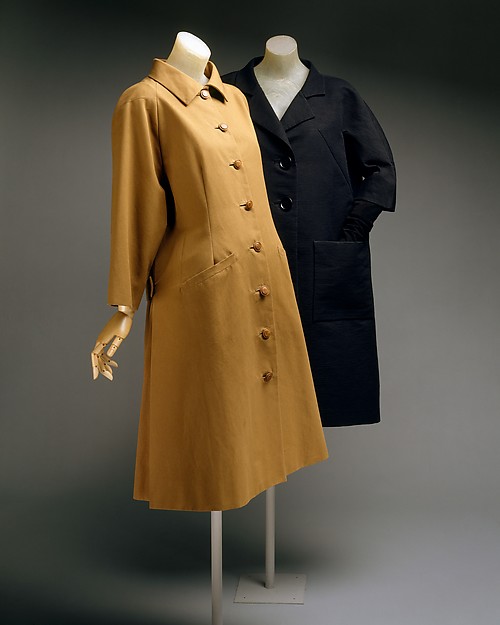
Balenciaga is another favorite. Evening gowns, suits, and coats, all deliciously draped.

House of Balenciaga (French, founded 1937)
Rain ensemble, fall/winter 1965–66
French,
cotton ; Length (a): 42 1/2 in. (108 cm) Length (b): 24 in. (61 cm)
The Metropolitan Museum of Art, New York, Gift of Rachel L. Mellon, 1987 (1987.134.23a, b)

Lest you think I only like coats, the “Tulip” dress is equally interesting.

House of Balenciaga (French, founded 1937)
Evening Dress, 1964
French,
silk ;
The Metropolitan Museum of Art, New York, Gift of Baroness Philippe de Rothschild, 1973 (1973.21.8)

Thanks to the V&A, there are digital animations of the construction of the tulip dress, which has deceptively simple pattern pieces. The video was created in support of teh V&A’s Balenciaga exhibition, which I am sorry not to be able to see.

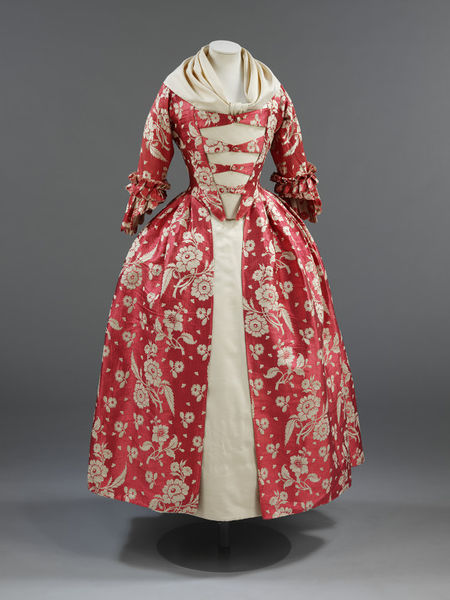
Equally out of reach is this: a remodeled silk lampas gown. The idea is to make the first gown– that is, the gown suitable for the fabric’s earliest date (which is probably not 1790, but closer to 1740-1750) and then alter that gown to the late 18th century style.

Unknown maker. Gown, 1790. French, silk, The Metropolitan Museum of Art, New York, Purchase, Irene Lewisohn Bequest, 1964, (C.I.64.32.2)

This last “dream” project is more achievable, though somewhat academic. Silk lampas fabric can be found, and there’s a simpler alteration project in lampas at the V&A

Gown, Spitalfields silk, ,
1740 – 1749 (weaving) 1740 – 1749 (sewing)
1760 – 1769 (altered) 1950 – 1959 (altered)
Given by Mrs H. H. Fraser Victoria and Albert Museum, T.433-1967

.

Frivolous Friday: Favorite Fabric

Favorite Fabric? Are you kidding? Is it fabric? It’s my favorite.

Dat neckhandkerchief, tho’

There’s the hand-woven handkerchief made by a friend that is my absolute favorite textile accessory.

There’s silk taffeta, and the occasional silk satin, for bonnets.

And linen for shifts and linings.

But my all-time favorite fabrics are Indian block print cottons. I have multiple yards in storage, and multiple yards in the accessible Strategic Fabric Reserve. I try not to look at them in the online shops, for I cannot afford to be tempted.

My favorite three gowns are made of Indian block print cotton:

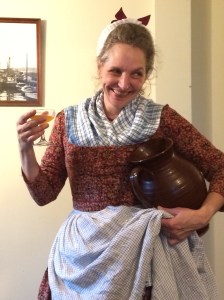
The Milliner in Red

The Bib-Front Tailoress

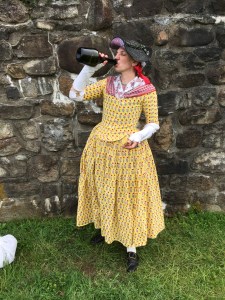
And the somewhat noticeable Nancy Dawson.

It was hot. And humid. That’s only water.

There’s an early red, white, and black calico based on a Philadelphia runaway ad, too, and though I’ve not had it on in a while, it may be due for a renaissance.

Once upon a time in Connecticut…

Oh, and while it requires some shoulder strap adjustments, there’s the brown Indian print I wear as a unsatisfactory Philadelphia servant and Boston sight-seer…and the red print I wore for a 1790 Providence housekeeper.

So, yes, pretty much my favorite, and of the prints? Nancy Dawson, hands down, though I was skeptical at first, for the yellow was so very bright. Made up and worn, though, I love it.

An Introduction, or Re-Introduction, of Sorts

No, I won’t say how many cups I’ve had.

What is this thing, and who am I?

It’s Costume Blog Writing Month (inspired by NaNoWriMo), and I’m Kitty Calash. I used to post much more frequently, but life caught up: I moved, which meant I didn’t sew at all for over a month* and thus didn’t have much to write about, since this isn’t a packing and moving blog.

But even before that, posting had slowed as I began to wonder why I wrote, and why I sewed. Costume Blog Writing Month, with its 31 flavors of posts, is a chance to reacquire the writing habit, and to think again about what I do, and why– and thus proved irresistible.

I’m a curator in search of a collection, a fugitive from architecture school, a compulsive editor, and a cat wrangler. I started sewing as a child with help from my mother and grandmother** who made clothes for me and my favorite doll, Moira. Although I graduated from two art schools, my interest in history is deep: I craved china dolls, collected antique quilts and tools, and insisted my bicentennial Samuel Adams costume have functioning knee bands– and yet, it’s taken me years to admit I’m “detail oriented.”


Some days Drunk Tailor asks me if I really enjoy sewing– my face betrays my frustration, and I do not play poker–but I get both distraction and satisfaction from it. Most of what I make I wear at living history events, so I hand-sew everything I can. I fall into the “progressive” reenactor/enactor/costumed interpreter camp, and strive for authenticity and accuracy in what I make, how I wear it, and what I do.

I’ve come to realize that I’m chasing art: my thesis work looked at what it means to be an American. What does “America” look like, what does the myth of America and our founding story mean? How do we portray it? Yes: I costume and organize events in pursuit of an experience for myself and participants that helps explain this nation, and how it came to be the way it is.

Not every post gets into this kind of theorizing— really, most don’t– but at core, my costume pursuits do chase the myth of an American Dream as I try to understand the people of the past, how they thought, what they made and wore, and how the past continues to inform the present.***

*During this time, I lost the distinctive callouses that will help a detective identify me as a seamstress when my murdered corpse is found in a Paris hotel doorway in the Georges Simenon novel I write in my head. I watch a lot of murder mysteries while I sew.

**Elsa turns up here from time to time; she was a style maven, the doyenne of design in a small Southern Tier town, who, for 50 years, ran the shop that dressed the maidens and matrons of the nearly best classes in a community of striving Swedes aching to assimilate.

*** And that, friends, is what working in history museums for two and half decades will get you: your own personal mission and an empty bank account.