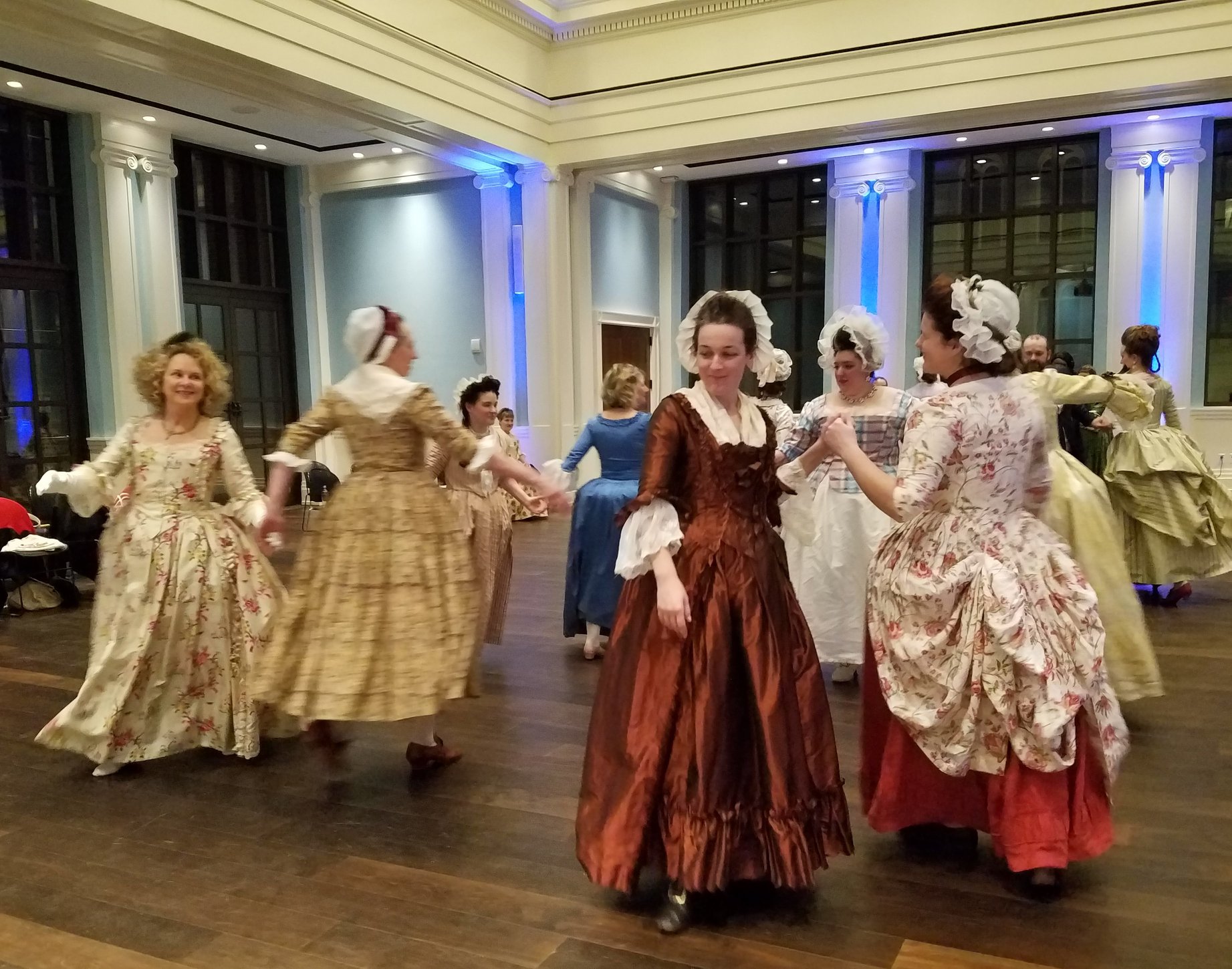
There haven’t been as many chances to dance as I’d like of late, so when I got the Museum of the American Revolution’s invitation to come dancing at their January History After Hours event, I said yes. Luckily, I had to be in Philadelphia for the next day anyway, so out came the 1780 appropriate dress and the fancier shoes, along with my resolve not to be a wallflower, and off I went. I very nearly made it on time, but I dressed as fast as I could, and managed to join the crowd with my dress pinned and my hair tamed.
As at past balls, I was rescued by a kind soul (and excellent dancer) who took me through the steps and saved me from my occasional pattern dyslexia. (Reversing can be tricky– they didn’t let me drive the forklift much in school because my brain sometimes struggles to process a mirror image.) But Miss V was a gracious partner, and reader, I confess: I greatly enjoyed myself.
One aspect of historical dancing that has always appealed to me is the relationship between classical ballet and traditional English country dances. While you won’t find tutus on Jane Austen’s dance floor, you will find balancé and glissade, and the use of positions. This connection between two things I love, and the way movement can connect us to the past, makes me enjoy these dances even more. Using steps I learned and practiced endlessly decades ago in a hobby I pursue today is a very personal reminder of the persistence of the past.
An evening of dancing, with the best dance caller and instructor I’ve yet had the pleasure to meet, was a welcome winter treat.
Many thanks to Miss G.J. for the use of the photos, and deep honours to Miss V.D. as a partner, and Mr. N.V d.M., dancing master.
Mountebanks and miscreants: how we love them. I have found myself in a situation of late that feels altogether too much like high school, and as a means of understanding it, I have a story to tell. It will, sadly, confirm what my parents thought was happening, but hoped was not.
Let’s step back to the time when I was known as the Rat, when I spoke truth to adolescents and paid the price of ostracism and harassment. I was already largely outside whatever cliques there were in high school, for I’m not certain you can call an assemblage of despised literary hopefuls in a hallway window seat a clique, so the harassment hurt more than the exclusion. Harassment these days comes not in the form of people chanting at you in person, but rather in online trolling, which can be deleted, unless people take the energy to rise to doxing or swatting, and few in the living history world seem to– and that’s not a challenge, kids.
So, operating within a loose-knit band of misfits more Donnie Darko than Ferris Bueller, I began breaking the rules, taking films back to the public library for my teachers and spending the rest of the day at the art museum or bookstore, or combing thrift shops for my nearly-all-vintage wardrobe. I could not find a place to be, so I stepped out.
Naked Raygun at the Metro (not the club in question)
Along the way, I met some very interesting people: punk musicians, artists, dancers, and students who introduced me to a very different world than the one my classmates lived in. It was a kind of mid-western Desperately Seeking Susan, or perhaps Something Wild, only I suppose I was Susan seeking myself. I saw great bands and terrible bands, and continued my forays even after I’d left the city for college, which leads me to a moment that resonates fiercely with me in light of the past few days of highly localized re-enactor drama.
portrait of a wanna-be-artist
I had a sometime-boyfriend who was ahead of me in college, at a different university, who worked as a DJ in northside night clubs. On one summer trip to the city, I found myself walking out of a nightclub where I’d been dancing, eager for some fresh air. At the door were two of my former classmates– too much acquaintances to be called frenemies– trying, and failing, to get in. I caught their eyes, agog, as I walked out.
“You come here?” one asked. “How’d you get in?“
“I know a guy,” I said. “I’ve been coming here all summer,” and walked up the street to catch the bus to the next party.
We all love things, don’t we? Things in the literal, corporeal, piled-in-a-heap sense: plates, shoes, books, chairs, necklaces, models. But what makes us love them? How deeply do we really love them?
Someone posed the questions, What would you take if you had to pack in a hurry to leave home forever? What will your kids remember you by?
Those are hard to unpack: how will other people remember us? Often, we have no idea what we mean to other people, even the ones closest to us. It’s easier for me to know what I would take or keep to remember someone else by– a single sleeve link; a wooden train engine; a stainless steel spoon; a necklace of handmade beads. None of those things reflects what is truly meaningful to me about them, that is, without my knowledge, these aren’t particularly interesting or aesthetic objects. What makes them special is the story I attach to them.
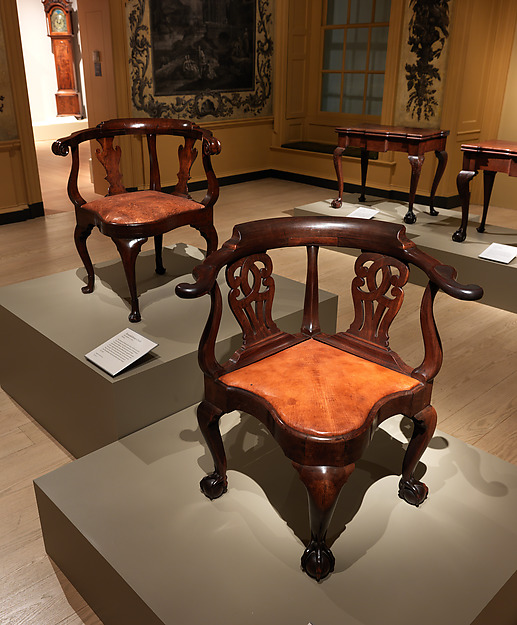
That is, of course, the key to interpreting objects in a social history context: the story is what makes the object more interesting, more important, more compelling. It’s the difference between a provenanced and an unprovenanced object, between a roundabout (or corner) chair in context, and one out of context.
Corner chair, probably John Goddard. Metropolitan Museum of Art, L2014.9.1a,b Lent by the Wunsch Collection, 2014
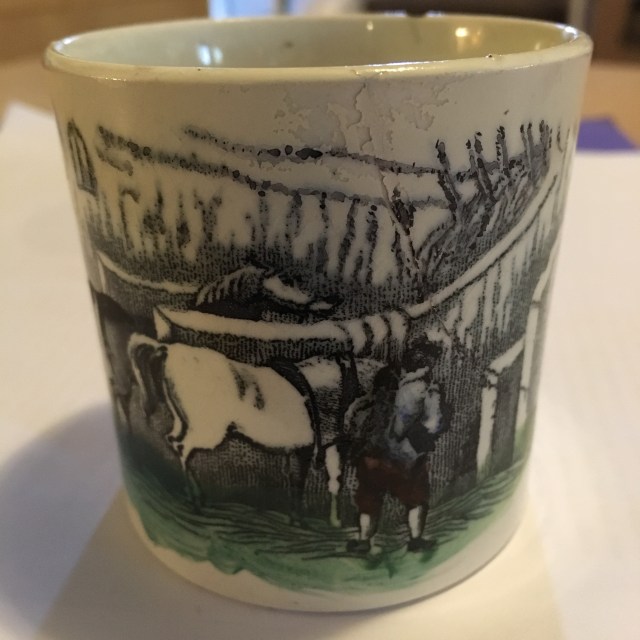
This is not to say that beautiful things are without value removed from context, but what makes that Goddard chair more compelling is knowing who made it, who it was made for, and when– knowing that it was part of a set of furniture ordered to furnish a house for Providence newlyweds, made in Newport by one of the hottest makers of the time. It’s the people who make the object more interesting, who make it worth having, seeing, holding on to– whether it’s a $6 million chair or a $25 mug, memories and stories make things compelling beyond our associations with them.
Part of a museum curator’s job is understanding those stories, placing objects in context, and connecting them back to their stories, to their makers, users, owners, and keepers. We may buy things because they’re beautiful or useful, but often we keep them because of their meaning– which is, more often than not, about people. Unprovenanced objects have less meaning; an object sold outside, or without, its context will not fetch as much. Value resides in people, not in things.
I think of this not only because a portion of my work is to recreate or reestablish the human contexts and connections for things, but because there is a human instinct to grab onto something tangible (like an object), rather than something ethereal (like a memory), even though what will sustain us in the end is not things, but other people, and our memories of them.
A Female Philosopher in Extasy at Solving a Problem. London, England; about 1770 Mezzotint and engraving with watercolor on laid paper Colonial Williamsburg Foundation
Scandal and outrage rock the reenacting world as reading comprehension lags and The Gentle Author is accused of presentism– or, at least, that’s the most reasonable translation I have for comments made about me last night on social media, including:
Yeah- she’s got great stuff. But I feel awful that she fell into a modern-think trap.
and, my favorite,
I’d say its a post modern Critical Theory think trap. Frankfort [sic] School is gushing from the pores.
Let’s take this apart, shall we? The Frankfurt School (not this place) was a social and political movement based in Frankfurt am Main in the immediate post-World War I years. After 1933, the school, formally known as the Institute for Social Research, moved to Columbia University in New York city. Being insulted by association with the likes of Walter Benjamin and Theodor Adorno is a new experience for me; I’m more usually associated with the ideas of Mary Daly and Jacques Derrida but I’ll take backhanded intellectual flattery where I can get it. (Also, thanks for thinking of me, but Kitty does not require your pity.)
More seriously, the postings last night (which happened while I was in class and have been deleted) brought to mind two powerful issues in living history and the reenacting community: Presentism and Feminism (with its unholy shadow, mansplaining).
Let’s go over these:
Presentism:uncritical adherence to present-day attitudes, especially the tendency to interpret past events in terms of modern values and concepts.
Feminism: The radical notion that women are people. the theory of the political, economic, and social equality of the sexes.
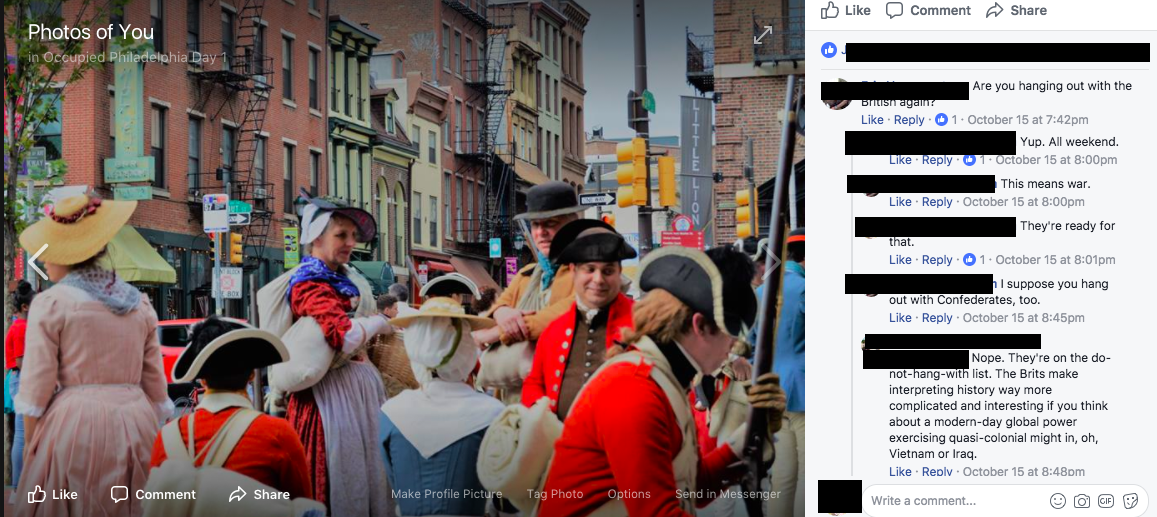
Images were posted to Facebook, and I was tagged in one that showed me in the midst of a crowd that included members of the 17th Regiment of Infantry, one of the forces that occupied Philadelphia in 1777. My cousin, ever the wag, commented:
click to enlarge in a new window
“I suppose you hang out with Confederates, too,” had some bite. What surprised me was my well-educated and thoughtful cousin’s facile conflation of Confederates and British. Is the world that easily black-and-white, good-and-bad, Manichaen? Not usually, and certainly not usually to my cousin. Explanations seemed in order. Why had I done what I did, and what did I do? What was Occupied Philadelphia about?*
To me, it offered the chance for some complicated interpretation that’s more readily accessible via living history than by exhibit panel, or at least significantly more engaging than text. How do you elucidate the complexity of the American Revolution? How do you get people to think about the past in the past’s terms? How do you get them to query and interrogate their accepted understandings of history?
Apparently that position towards living history– that it is complicated, worthy of criticism, can be used to create a complicated look at the past, and can be understood through cultural criticism– is deserving of the dog-whistle scorn of men hiding behind false names on social media. It elicits from them suggestions for interpretation that include impressions already being done, and referenced in the original post. It elicits suggestions based on 1811 paintings of Philadelphia, because of course, nothing helps illuminate 1777 Philadelphia like a genre painting made 34 years later.
If anything, I was suggesting that complicated interpretations (that is, showing how an “occupying force” might be “good” for the population) can further an understanding of the past that helps us understand the present. Isn’t that the mission of most history organizations? Understanding the past to illuminate the present and shape the future? It’s unsettling to realize so immediately how people who practice history use it to reinforce the status quo, and use misreadings of interpretation to further their own sense of superiority.
That’s where feminism comes in: suggesting “new” roles for women in living history (Laundry? How ’bout being a Quaker?) on a page dedicated to women’s history is a dizzying feat of sexist thinking. It is particularly delightful given that the Gentle Author and her associate, Our Girl History, are among the people who have suggested new roles for women, and have organized events that included suggested roles, and in fact required them. But please, tell me what to do. Belittle me by association with some of the leading critics of the 20th century. Because when you do, you reveal yourself not only to me, but to others.
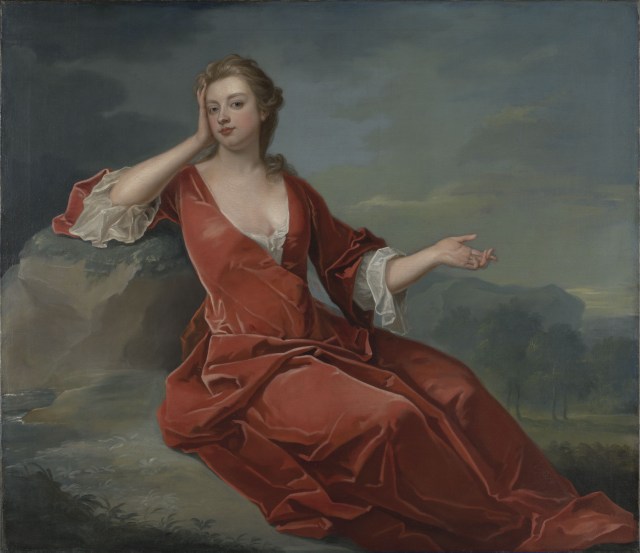
Sarah Churchill, Duchess of Marlborough. Oil on canvas by Charles Jervas.
The greatest sin a woman could commit was to participate in any sort of public life, be it theatre, politics, or social causes – this made her immediately ‘difficult’
*Brits-as-Nazis is not my origination, but the distillation of a comment made about the dedication of a monument at Guilford courthouse and subsequently reported to me. Despite a commenter’s attempt to attribute the equation to me, it is not mine, as should have been clear from “in certain circles.” Not my circles, not my monkeys.




 Those are hard to unpack: how will other people remember us? Often, we have no idea what we mean to other people, even the ones closest to us. It’s easier for me to know what I would take or keep to remember someone else by– a single sleeve link; a wooden train engine; a stainless steel spoon; a necklace of handmade beads. None of those things reflects what is truly meaningful to me about them, that is, without my knowledge, these aren’t particularly interesting or aesthetic objects. What makes them special is the story I attach to them.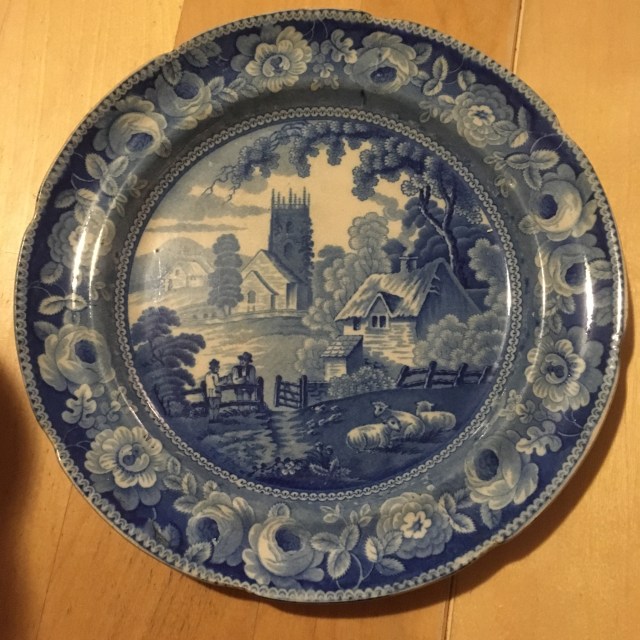

 Kirsten Hammerstrom
You must be logged in to post a comment.