On Wanting to Quit the Hobby

Sometimes I want to quit this hobby.

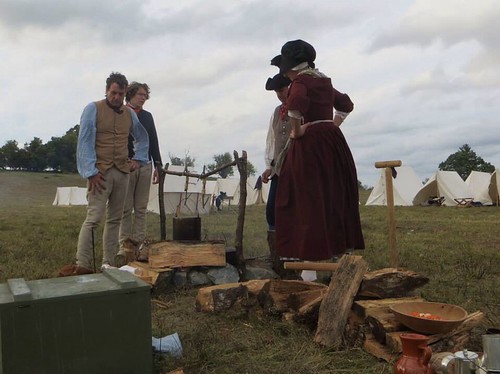
It’s usually for selfish, petty reasons: for all I swear that I didn’t see the trash compactors and cars in Newport, spinning wheels, cast iron, and candelabra in dining flies made me nuts at Bennington. Why the difference? In Newport, the modern things were all backdrop and unchangeable. At Bennington, reenactors had choices.

Why would someone else’s cast-iron kitchen make me want to pack up my sticks and go home? Maybe because I’ve been very tired this summer. But more honestly, I have a streak of self-righteous grade-grubber: “I work hard at this, why can’t you?” was surely my internal whine as I surveyed the mess area at Bennington.

My emotional immaturity aside, I think that same “I get this, why can’t you?” is felt by a lot of reenactors/interpreters when they stand in their well-researched, hand-sewn, and agonized-over clothes in a Spartan camp watching the public interact with sofa-print-gown- or baggy-breeches-wearing cooks bent over cast iron in camps littered with slat-back chairs, folding tables, and candlesticks.

We feel unappreciated. We feel like no one recognizes our hard work. We are not getting the grade we deserve.

We need to get over it.

Don’t abandon the authenticity: abandon the attitude. Abandon the eye-rolling, the snubbing, the sneers, and the turning away.

Comparison is the enemy of contentment. Even when you think you’re better.

Stop playing the “I’m more authentic than you” game. It sucks. It makes people want to quit this hobby. It makes people want to skip events.

You want to have events where only people who meet your personal authenticity standards can play? Knock yourself out. Keep it private. In privacy, be as catty as you like with people who enjoy it, but keep it in the real world and not online. Online, it comes off as passive-aggressive cowardice.

Right?
Right?

Not everyone wants to play the same game. But no matter what the game is, it’s never fun to be the butt of meanness, and it’s not really fun to be mean—plus, it’s bad for your health, bad for the hobby, bad for the people around you.

We’re visual creatures: we can over-focus on what we see. We focus on the clothing being worn instead of the person inside those clothes. But really, it is the person who is important.
So maybe we should lighten up a little.

Individual choices don’t always affect a group. When choices do affect a group—cars in camp past stated removal times, weapons and fire safety violations—then I think anyone can and should speak up. But violations of published and easily accessible standards should be pointed out to event organizers, and not handled at the individual level. When there are no published and readily accessible shared standards, there’s nothing to enforce. So consider stepping down from the fashion police and enjoying yourself instead. I’ve been to very few events without redeeming factors.

Lighten up!

All that iron at Bennington? Forgotten when I focused on what I was doing: cooking something new in camp, and forgotten even more when I shared the pudding and compote with my friends.

That’s why I don’t quit this hobby: it allows me to share amazing experiences with my friends, I learn new things all the time, and I get far outside my petty worries.

Ceci n’est pas une cruche

This is not a pitcher

Sometimes a pitcher is not a pitcher. In the same way that Matthiessen‘s Snow Leopard is not about a snow leopard, this was not about me: this was about the woman who approached me as I walked with Cat to the water bubbler with this white ceramic pitcher from Home Goods.

She stopped me to say, “You shouldn’t have a pitcher in camp. You should have a bucket.”

This is true, as far as it goes: but really, I should have a tin kettle (and I do). But the reasoning I was given had to do not so much with the fragility of the pitcher (which I pack in a basket or wrap in our towels and stuff into something in the supply wagon) as it did with the myth of Molly Pitcher. For an explication of the Molly Pitcher myth, I refer you to the Journal of the American Revolution, because, as I said to the woman who approached me, “It’s not my fight.”

So what’s the point? Maybe there are several:

One might be, Everyone has a hobby horse. Some of us are made mad by The Bodice. Some of us cannot abide makeup on “camp followers” who look like stragglers from a high school production of Sweeny Todd. Some of us are material culture and camp equipment fanatics– begone, ironware! Still others twitch at the baggy, off-the-rack cut and fit of some uniforms.

For another, This wasn’t about me– or my pitcher. The woman who approached me had a thing about Molly Pitcher and the myth of the woman on the battlefield with a pitcher, bringing water to the men. My pitcher and I were merely a trigger.

colonial woman with pitcher and kettle
Everybody’s got something to hide ‘cept for me and my…pitcher? or kettle?

And for a third, We all make choices and compromises. I chose not to bring the antique family copper coffee pot into the field, and also chose not to let the coffee and water sit overnight in the tin kettle. I chose, too, to use the white pitcher and a redware one for water that we drank all day long. When it’s hot, I slice lemons or limes into the water to make it easier to drink as much water as we need to in a day spent sweating outdoors, and it prevents scurvy to boot.

Fourth? We can all, always, make better choices. Few among us achieves true 18th century purity– I can assure you that even had I dashed my pitcher to the ground Saturday and dropped to my knees in repentance, I was not 18th century to the skin. There are monthly occurrences that I won’t go old school on, and on this point I shall not be moved.

But back at my ‘rock maple’ table, I could do better. We could/should have but one wooden bowl (mine), and the boys could/should have tin bowls, and we could/should swap out the redware canns with the handles broken off, but they make a nice refugee statement and until they break completely…

And there is a fabulous copper cistern by Goose Bay Workshops that I covet for its copper glory, but since it is not tinned inside, no lemons or limes would be allowed, and it would be hard to argue it for a Light Company. That puts me at another tin kettle, designated for water, and dipping our cups in. I can probably live with that choice.

But then, if I encounter someone who wants to talk about Molly Kettle, I’ll know I’m in real trouble.

Once Upon A Time…

Betsy Ross and friends: A Child Guidance Educational Activity

This is the third set of these paper dolls (Educational Activity) I have owned. The very first set was given to me by my mother, Lo, at the Dawn of Time, in the Dark Ages known as the 1970s.

I wore them out.

A new set was purchased, probably once again at Marshall Field’s, possibly in the book department. They now reside in an attic outside Philadelphia (how appropriate).

From this Educational Activity flowed many more home-designed outfits and home-made paper dolls of historical and literary origins, which have led to this moment, when I make myself and my family into historical characters, make us outfits, and set us in motion with friends and colleagues in scenes of historical play-acting, by which I mean Educational Activity.

Cooking at Saratoga: very Educational. Photo courtesy D Molly Ross.

I like to think that the clothing we wear is more correct than the “Authentic Costumes” advertised on Betsy Ross’s box, but there is always more to learn. I am in no way denigrating Betsy Ross, or paper dolls, or suggesting that I see my family, friends and colleagues as paper dolls. But I do know that as long as I have been playing, I’ve been playing history and reading history, and drawing history, and using books and paintings and yes, even paper dolls, to figure out the world present and past.

If January Jones played Betsy Ross...
If January Jones played Betsy Ross…

Even though I always thought I wanted Betsy’s birthday cake gown, the one I really liked was the work gown. The “construction” of her garments confused me even as child: how the heck does that kerchief work? And the bodice front? Never mind, have a slice of dress, I mean cake. (Field’s had a cafeteria that served slices of pink-iced layer cake that I somehow conflated with the paper dolls, thanks to the shopping trips my mother and I made.)

Memory and fact, impression and citation: when we reenact the past as an Educational Activity, we should remember that some will walk away enlightened, and others will walk away thinking about birthday cake. Our job, beyond getting the facts right, is to engage our visitors, to interest them, and to excite their imaginations. What they do from there is up to them, but we will know that we have done our best to present them with a scene that can take them one step closer to being there.