Why Do We Buy Things?

The Sunday, November 9th Guardian had a series of short articles on collecting, including one on why people collect things. This was similar to the New York Times’“Room for Debate” series on Why We Collect Stuff.

Chair, table, chair.

I liked the Guardian’s “Love, anxiety or desire?” question, and asked it of myself: why do I collect?

Collecting is something that I had given up for a while, given that so much of what Mr S and I had collected was stashed in boxes in our basement after an apartment move nine years ago. Nine years! If you haven’t unpacked in that time, do you really even care about those things?

No, not really. Many the things I unpacked recently as we went through the basement again are destined for Etsy: McCoy pottery vases, colorful Pyrex, FireKing glassware. I bought it at a time when I liked green pottery—it was an outgrowth of the blue and yellow creamware I’d begun collecting when I first lived in Rhode Island.

But now, I’m done with it: done with the mid-century modern, and going back to the early American things. There’s an aesthetic quality I like in both styles: simple lines, bright colors.

The most recent acquisition is a drop-leaf table in a very country Sheraton style, with a tiger maple skirt. I watched this table for months before finally committing to it, and dragging Mr S up there late Saturday afternoon. He was game, and in the past day the table has grown on him.

Why did I want it? For one thing, it reminds me of a maple drop-leaf Sheraton-style table my mother has, so perhaps there’s an element of nostalgia, or a desire for approval. I also imagined it exactly where it is, though it will require some adjustment in lighting. Did I buy a piece not only of the American past, but of my own? Is this what adulthood looks like? Or am I just responding to shape and color?

The table and chairs are low, and not comfortable in the way that modern furniture is: I wouldn’t want to sit in the chairs or work at the table every day, but these things give me pleasure, whether bought for love, anxiety, or desire.

Things Won’t Make You Happy…

DSC_0455except when they do.

I try hard not to be acquisitive, though our home is perhaps more crowded than it might be if I were better at the task or cleaned at work less and at home more. Around the time of What Cheer Day, I became rather obsessed with teapots.

At the local antique mall, I found an attractive Chinese export porcelain cylinder or barrel-form teapot with crossed strap handles, suitable in design and shape for use in 1800 Providence. I made a special mid-week trip fully intending to buy the teapot and free poor Mr S from ever hearing “teapot” again in endless conversation. When the item was out of the case, though, it turned out to have a mended crack right across the bottom, and as I told the woman, “It matters because I intend to use this.”

DSC_0450In the end, I did not have my fabulous teapot for What Cheer Day. In fact, my fabulous teapot arrived just this past Thursday, after patient stalking on eBay. It arrived with a bonus of five cups and a saucer, most with mends, but the pot itself has just a handle flaw or mend (typical, and seen, along with wear, in some museum pieces, too). The quantity of cups suggests that the previous owner had a relationship with them not unlike the one you might develop with a large litter of kittens you were fostering…adopt one, get another! Just to get them out from underfoot.

DSC_0470The cups and pot reminded me of the difficult meals and teas Elizabeth Bennett takes with Maria Lucas and Lady Catherine whilst visiting Mr Collins and his new bride Charlotte Lucas. There’s a tension in these cups, some combination of the dainty and the strong, some slightly misshapen (not all makers were equally skilled) that calls to mind the polite verbal combat of tea parties.

I washed the cups, and was reminded of the duties of maids to clean and care for these delicate items, the kind of thing they were unlikely ever to acquire, though there were grades of china then as now: what sat on John Brown’s table was not what sat on the Dexter’s table, or at least not in the same quantity.

DSC_0452The quantities of china coming into Providence and the rest of the Eastern seaboard after 1788 were enormous: in 1797, dinner sets of 172 pieces could be ordered at Canton for $22, and included 6 dozen large flat plates, 2 dozen large soup plates, 2 dozen small dessert plates, 8 pudding dishes, 2 large tureens, dishes and tops, 2 smaller ditto, 16 dishes of various sizes, 6 sauce boats and stands, and 4 salt cellars. Tea and coffee sets of 81 pieces were bought in Canton for $6 to $9! Just for dinner and tea, you could have 253 pieces of china, and we haven’t even begun to get into custard cups, cache pots, and garnitures!

DSC_0473The indifferent pieces I have acquired may have started out as kaolin, feldspar and quartz in Ching-te-Chen, 200 miles west-southwest of Shanghai. There were important porcelain manufactories there, and porcelain wares traveled by road and boat to Canton, where sets were customized to meet specific orders and then loaded onto ships bound back to America, six months or so after the order was placed in Providence, Salem, or Boston. It’s a lot of work for a fashionable sip of Hyson or oolong, and no wonder cups and pots were mended, saved, and reused.

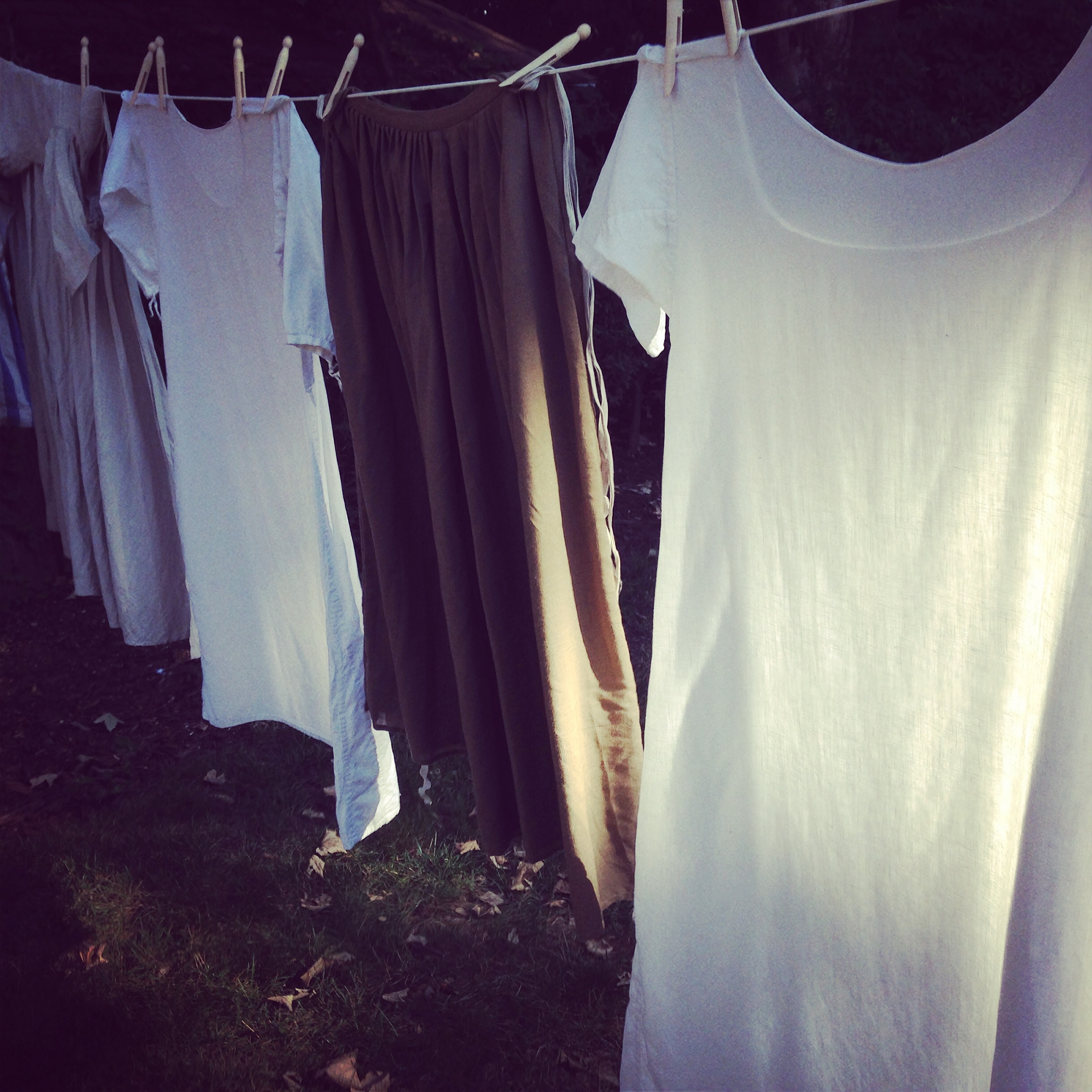
Wash on Monday

shifts and petticoats on a line
Living history laundry

We spent Labor Day laboring at home: even the Young Mr spent the day working on a five page essay (due Wednesday) for history class. I spent the day tidying the house and washing clothes from all centuries.

Of our historic clothes, I don’t often wash more than body linen (shifts, shirts, stockings) but the petticoats had not been washed in some time; in the end, I washed the tow and blue striped one, but only aired the Virginia cloth and madder linen. Since I may not wear these again this year, washing and airing seemed warranted.

It’s incredibly easy to wash in this century, with the luxuries of indoor plumbing, a hot water heater and a washing machine. At Walloomsac, though I didn’t do any laundry, we were always fetching water, and I think of how much water we use, and how easily.

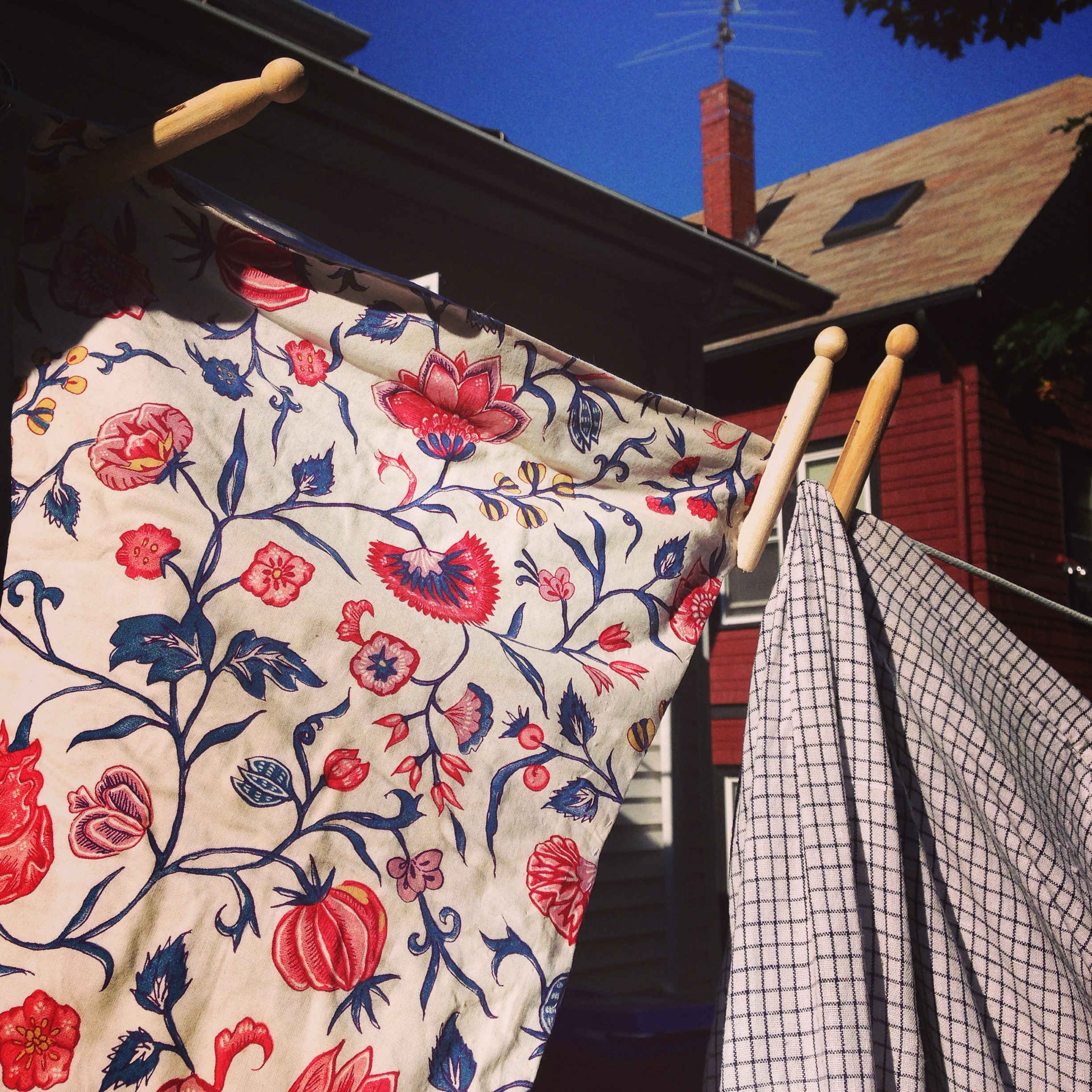
chintz and checked clothes on a  clothesline
Red, white and blue

While I stitched a dress (new, though the mending pile is growing), I listened to biography of the Buddha, and thought about mindfulness and living history.

What is there to learn from sewing a gown, or hanging my wash on the line? How much does it matter that sunlight makes my shifts brighter, or that the dress in my lap is not a exact replica of an extant garment, but rather one made using period techniques, a close analog of a period fabric, and is cut to period style?

So little remains of the vast middle and smaller lower classes that it would be stifling to limit oneself only to exact replicas. And in any case, we can never recreate the mindset or worldview of the people of the past. We can only mimic their processes, read their words, and study the things they have left behind in our best attempts to understand them.

Two Decades in…

Tureen in the wild
Tureen in the wild

On Wednesday, Mr S and I will mark our twentieth wedding anniversary, and due to some unfortunate timing, one of us has a medical procedure scheduled for that day, so we won’t actually celebrate on the day itself. (In sickness and in health, you know…)

Instead, we went antiquing in New Bedford on Sunday, after Mr S spent Saturday clearing brush at Minute Man National Historic Park. New Bedford was a nice change from the places we usually go in Rhode Island, and I always enjoy looking in Massachusetts, because objects there are typically free of Rhode Island connections, which means I can actually make encumbrance-free purchases.

I don’t know how encumbrance-free this purchase was…for now we are encumbered with a large hard paste porcelain tureen decorated with cranes and a federal eagle.

The platter it sits on may not be its original platter, but do I care? No. Look at that fantastic, crazy thing. The face the Young Mr made when this was unwrapped in front of him was priceless, but he has long questioned my sanity; now he will question my aesthetics.

Pride of place, with a friend's painting and Mr B's hats
Pride of place, with a friend’s painting and hats by Mr B

It sits in pride of place on our mantle now, and as far as I can tell, it’s typical of the shape of tureens made for the American market ca. 1790-1810. I’ve not seen the cranes before, and I still haven’t found this pattern in a museum or auction house, though Winterthur’s tureen collection is pretty amazing.

If the thing is real (and it looks and feels like the real ones at work), its voyage has been  incredible: from China to a port in Massachusetts, down through time to a shelf in an old mill building, to my mantle.  Think of the person who ordered this– and the set it was likely part of– by letter, and then waited for months for the goods to arrive. Some sets were as large as 250 pieces, custom-monogrammed at the factory, and then packed into barrels and crates lined with straw and loaded onto ships bound back to the East Coast.

I’d love to know this piece’s story, but even without a provenance, the object itself is pretty astonishing, and fits into our already eclectic china (and yes, mantle business).  Now, for a soup party!