Wrestling with Myself

Hard choices!
Hard choices!

I wrestle a lot with myself, which sounds much sexier and more athletic than it is, when it’s your patience and conscience. It’s a constant fight with my own brain and animal nature, like Snowy pondering a bone.

  • It’s hard to keep sewing for an ever-taller young man who refuses almost all attempts at fitting. (Especially when your calloused fingertips and split thumb keep catching on the silk buttonhole twist.)
  • It’s hard to have program ideas and then realize you will end up as the maid, serving a meal to a group including some people you might not like. (Don’t you think that must be a fairly authentic emotion, historically?)
  • It’s hard to put aside plans for your first pretty silk dress because someone doesn’t want to go where you want to go.
  • It’s hard to embrace the importance and meaning of interpreting the ordinary in a culture that celebrates the unique.

I come to that and stop: mission.
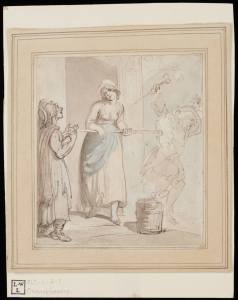
I'm a bad maid. Watercolor by Thomas Rowlandson, 1785? Lewis Walpole LibraryDrawings R79 no. 7
Watercolor by Thomas Rowlandson, 1785? Lewis Walpole LibraryDrawings R79 no. 7

You can take anything too far, of course, and an occasional silk gown and turn around a dance floor might make being the maid a little easier, but in the end I know that what’s important to me is representing the people who have been forgotten.

That same impulse may be part of what drives the splintering into ever-smaller groups with every-different coats, but walking the cat back also leads me to think that lace, tape, and shiny buttons may be part of the equation, too. Are those uniforms the gents’ equivalent to cross-barr’d silk sacques? As in any culture, it is easier to have your cake and eat it, too if you’re a guy.

For most of us women inhabiting the past, if we’re not baking cake, we’re serving it.
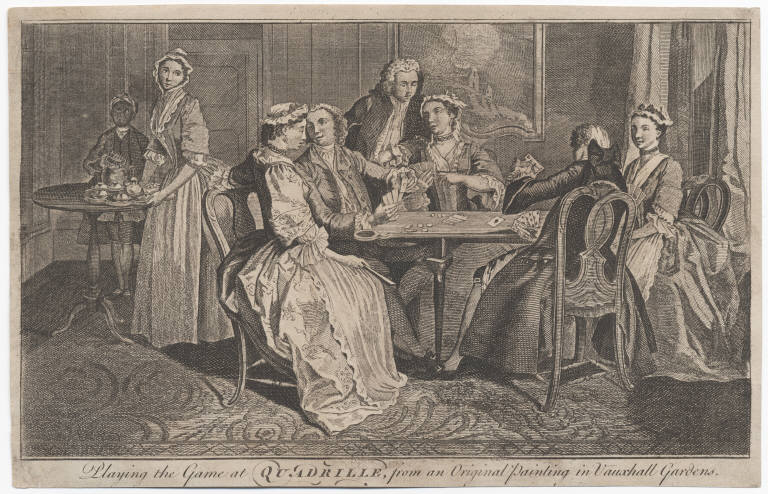
Playing the game at quadrille : from an original painting in Vauxhall Gardens. London : Robert Sayer, ca. 1750. Lewis Walpole Library, 750.00.00.14

It’s a funny thing to want a break from work you find important, but as with anything, variety and perspective are important.

She looks wistful, doesn't she? The others are whist-full.
She looks wistful, doesn’t she? The others are whist-full.

In a world of individualists, each trying to stand out, quotidian celebrities– cast a skeptical glance at your social media feed and tell me I’m wrong–our impulse may not be to inhabit the background. But most of us are the background. We’re large only in our own minds, stars of the movies of our lives that flicker past our eyelids. And that’s ok: that’s noble, even, to live a small, thoughtful life.

 Silver Pocket Watch of Meriwether Lewis, 1936.30.5
Silver Pocket Watch of Meriwether Lewis, 1936.30.5

Once upon a time, when I worked in Missouri, I was fortunate enough to spend a lot of quality time with some amazing artifacts.

Meriwether Lewis’s refracting telescope.

William Clark’s compass.

Meriwether Lewis’s pocket watch.

William Clark’s Account with John Griffin for thread, cloth and other articles including a hat for George and shoes for Mary. (July 1820, William Clark Papers, B13/F5, MHS)

Account of expenses in “horse keeping,” 1829- 1831. Request to Clark to pay to Mrs. Ingram, with request to serve as receipt. On same document: ADS Dashney to Major Graham, 26 June 1826. Order to pay William C. Wiggins. (1831 Dec 13, William Clark Papers, B14/F2, MHS).

There are letters to one of Clark’s sons, trying to get him to stay at West Point. There are bills for bolts and iron work for Clark’s house. Yes: there are amazing things in the collection as well, and historians of all kinds can do amazing work in the papers.

But they are ordinary. They are daily life played out in the first third of the nineteenth century in St. Louis, bills and accounts punctuated by letters from famous people and news of wars and explorers. But after processing the family’s collection, what struck me more than anything was how ordinary they were, how quotidian.
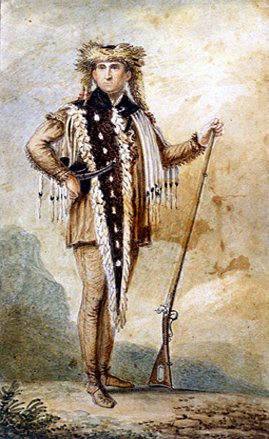
Meriwether Lewis in Indian dress. engraving after St. Memin, 1807.

Lewis was fabulous, interesting and mysterious. I don’t know what really happened on the Natchez Trace, but I know what happened in St. Louis. William Clark kept living, paying his bills and stumbling sometimes, refusing a role as territorial governor before accepting it. He got boring. And for that, I love him more than Lewis.

There’s real value in interpreting the everyday, ordinary people, in bringing work and working people to life in the past. I don’t always love repressing my ego, but I know that a nostalgic view of the past can be dangerous. I meant backwardly aspirational when I first wrote it, and I mean it now: most of us would not have been merchants wearing silks and velvets and superfine wools.

After wrestling with my ego and silk dress disappointment most of this afternoon*, I’ve found satisfaction in the thought of expanding my understanding of working class women. If really digging into interpreting the world of the marginal makes me uncomfortable, it must be worth doing, and doing well.

*Thankfully whilst performing useful tasks like running errands and thus wasting little real time on this nonsense.
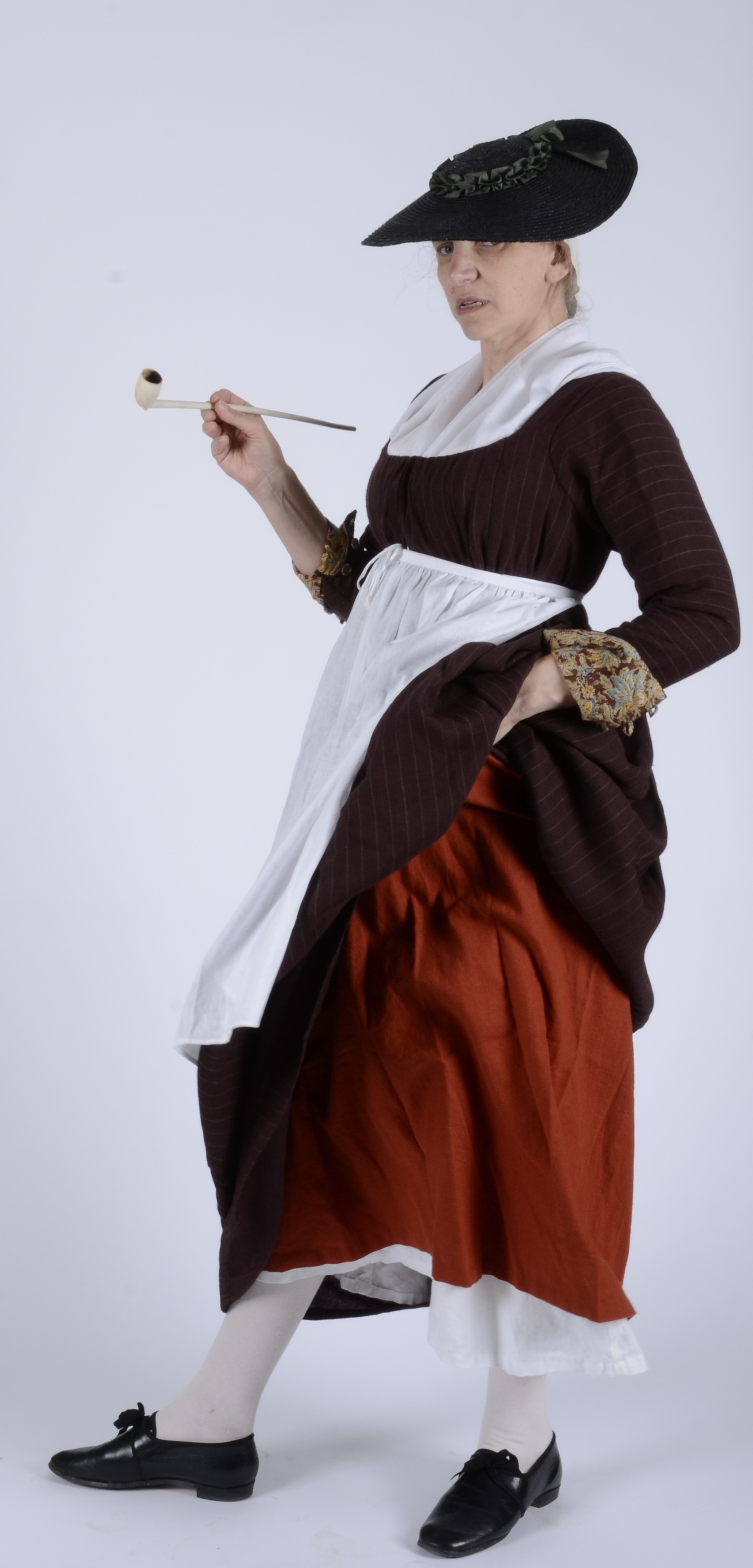
Send in the History Clowns

Once upon a time, I called reenactors and costumed interpreters History Clowns. The pilgrims at Plimoth Plantation 25 years ago scared me, and I did not like to visit living history museums.

petticoat
History Clown

Now, I’m one those costumed clowns.

What changed? For one thing, I did. But more importantly, living history and reenacting changed. It got better. It became more accurate, more inclusive, more specific. (Even Plimoth admitted at a Dublin Seminar that their costuming had evolved.)

When I see the fights that erupt online (there was a skirmish on Facebook last night—Peale’s march will not die), I think about the History Clowns. I think about the evolution that has taken place, and I think about the skirmishes I get into in trying to plan living history events at my own institution.

Most of these fights are not about accuracy—that FB fracas wasn’t—but do we know what they are about? We try to push back with our insistence that accuracy matters, but that’s not the argument our opponents are trying to have with us. They don’t give two rats about the cut of your breeches or the cord on your canteen or what you think of their rubber-soled shoes.

They want to be recognized. They want to be appreciated. They want to matter.

It reminds me a lot of when I first came to the place I work; I was one of three new, younger people hired within a short span of time to work on exhibits and an expansion project that never happened. As we looked at the organization, we saw things that didn’t seem right to us. But often, we met a lot of resistance to new ideas: “We’ve done that already.” “We tried that and it didn’t work.” “This is fine the way it is.” “We’ve always done it that way.”

I think those translate thusly: If you do it, you might make my attempt look bad.

If you succeed where I failed, I will look bad.

I don’t want to change.

I’m afraid to try something new.

What about my efforts? Won’t they be rewarded anymore?

I think that’s what people are saying to us sometimes, even when the words they say are, “These haversacks are fine, they’re really durable. It doesn’t matter if the fabric isn’t really right,” or “Market wallets? No, that was just a Henry Cooke fad.”*

43919175The fight is probably not as much about accuracy and authenticity as it is about feelings. That said, I think it behooves people on both sides of this line (and it is often generational) to be equally mindful of each other’s feelings. While we can respect the work that people before us have done, they should respect the work we are doing now, as new resources come to light, and new thinking is applied to history and interpretation.

Just as we cannot live in the past of historic house museums, we cannot live in the past in reenacting/living history. And while I respect the tenure of some unchanging regiments and the work they’ve done before, it comes down to this:

Accuracy matters. Adapt or die.


*I think my eyeballs fell out when I heard that one, from a guy who prides himself on his extremely accurate topographic battlefield models.


Gingerbread (in the) House

Illustration by Tasha Tudor

Here we are again, at the time of year known as Impending Parental Visit, which causes a variety of reactions ranging from full-on repaint the kitchen and both baths freak out (whilst nursing an 8-week-old Young Mr) to Eh, she’s got a dog acceptance.

This year, Mr S had the freak out, and has undertaken a living room painting project which he has carried out on weekends since Thanksgiving. It does look good, and I am grateful for his persistence, because this year’s late fall and early winter brought me a serious case of the blues.

That's a happy cat!
happy cat!

I’m in the midst of trying to finish a dress before my mother arrives (my sewing area is really our dining table, with the Strategic Fabric Reserve stowed in sideboards and cupboards). Yesterday, I tried it on: it fits, and looks rather nice (grey wool, and when it’s done, you’ll see it). But it fails in intention: clearly, it is no maid’s dress.

But I felt so much happier in my stays and petticoat that I dug up the wool dress made for farm adventures, put on my apron, and made ginger bread.

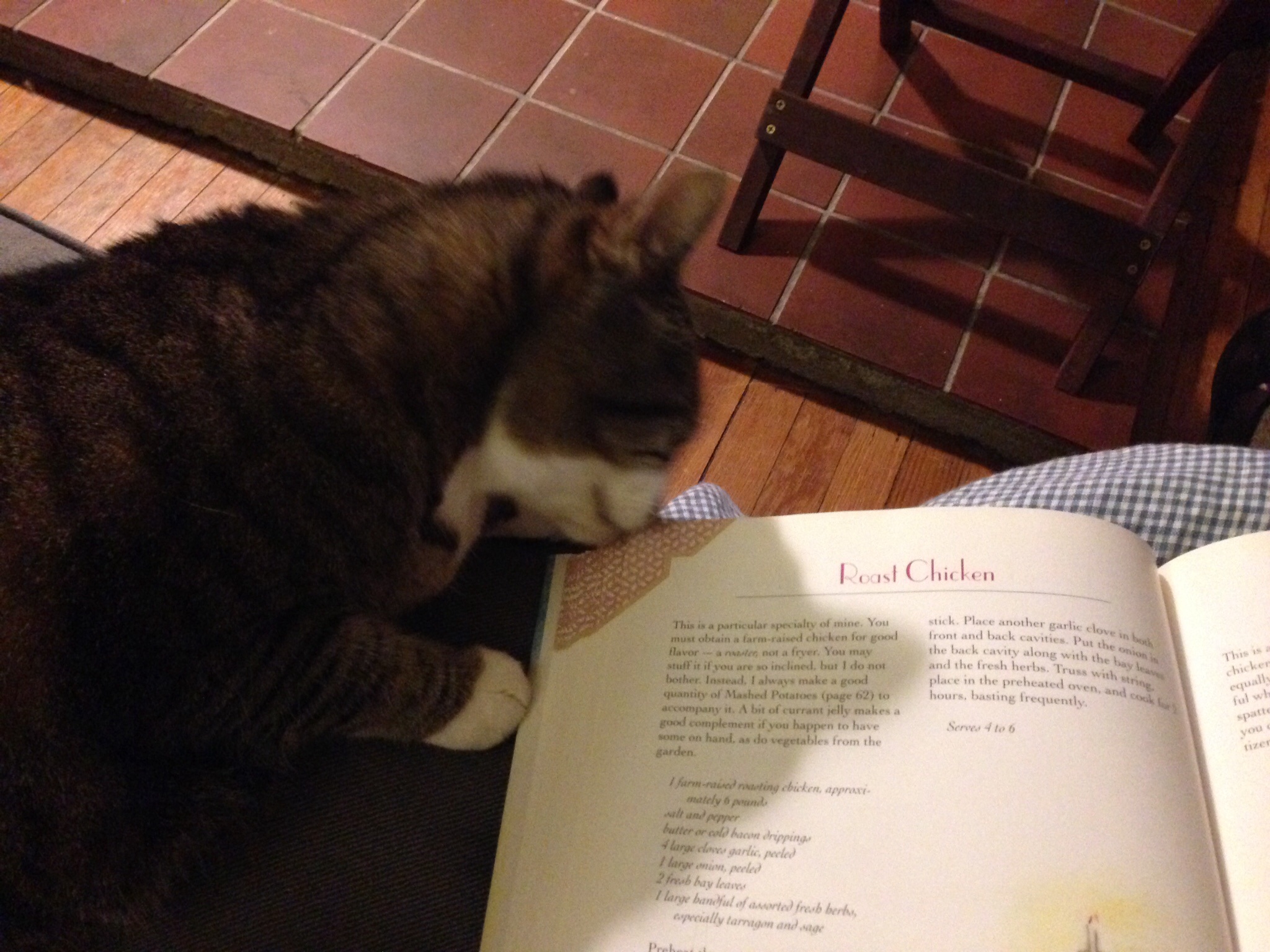
The cat approves of my reading material.

The recipe, which I shared recently with a friend, is an old Rhode Island family receipt, and very similar to the Tasha Tudor cookbook receipt. (The Howling Assistant approved of Tasha’s Roast Chicken receipt. She is a poultry fan.)

When copying over the receipt for my friend, I forgot the hot water, and failed to warn him that this gingerbread cake is best eaten with a fork. Delicious, but sticky, here it is:

1/4 cup butter, room temperature or a little softer
1 cup sugar
1 teaspoon baking soda
1 cup boiling water
Combine the last two ingredients and pour over the butter & sugar.
Add 3/4 cup molasses
Combine well.

Sift into the liquid mixture:
1.5 cups flour
1/2 teaspoon ginger (I use a heaping 1/2 tsp)
1 teaspoon cinnamon
pinch salt

Combine gently. Into the mixture drop one unbeaten egg.
Beat the whole with a hand-cranked eggbeater or whisk.

Pour into greased 9×13 pan, and bake at 350F for 35 to 40 minutes, or until a toothpick comes out clean.

Gingerbread cake
Gingerbread cake

Good with tea, coffee and clementines. I’ve made this perhaps a dozen times, once without the egg, and it’s always edible. (The egg provides some leavening, so made without it, the cake is dense and extra sticky.) Baking it makes the whole house smell good and it’s a simple, one-bowl receipt. For an easy holiday treat to share, I recommend this Rhode Island Gingerbread Cake.

Less is More

Though it may seem contrary to previous posts, there are times when I really believe less is more, and that’s when we’re out in the field.

Each year I’ve tried to improve our kit and impression by replacing or removing items, mostly to increase our accuracy but also to reduce what we carry. The less we have to carry, the less I have to pack and clean and think about and the more I can think about the history. This iteration of “What the heck can I quit?” was prompted by reports of a conversation with someone I respect, which caused me to rethink what we were hauling along and how I could change it.

The Box of Doom with the Pitcher of Inaccuracy

We have stripped away most of what we used to bring for the comfort of the kid; as he has grown up, he’s needed less to feel comfortable and “at home.” We traded ground pads for bed sacks* very quickly, and we never had any iron to begin with. I’ve tried to keep within seasonal and historical cooking guidelines, but the largest hurdle and heaviest literal burden is the wooden cooler box.

Feeding the Young Mr is a tricky thing: he likes what he likes, and he likes a lot of it. What he likes are carrots, apples, and meat. There’s some swapping that can be done with seasonal fruit, but the largest hurdle is meat: if I can scrap fresh, needs-to-be-kept-cool meat, I can leave the cooler box at home. (At this moment, several gentlemen are suddenly feeling empty inside, with a taste of ash in their mouths. Dirt stew, boys: it’s coming.)

No iron, but what goes into the kettle?

I had gotten about as far as pease porridge when, in a completely costuming context, I came across links to The Sewing Academy.

The squeamish and childless may writhe at the handouts on dealing with nursing babies, hygiene, and winter clothes for children, but these Civil War resources have utility for all of us trying to be more accurate in our portrayals of the past.

I had not thought about packing frozen meat and storing it underground, and though I like the idea very much, it will not suit in cases where digging is forbidden. But it is certainly a way around the cooler box, and one I’m willing to entertain. (Check “No Refrigeration Required.”) “The Progressive Questions” help sketch out a responses to a variety of situations.

Quoth the Mavens” contains this excellent definition: A truly progressive mind-set tries to figure out the logic of what was indeed used, rather than rationalizing modern logic into a period situation.

There’s nothing more to add to that pithy statement, but a renewed sense of dedication to accuracy and “less is more” thinking.

*As accurate as my attitude would be after resting arthritic bones on the ground, no one really needs to experience that. Call it a safety measure.